
A race condition in OS happens when two or more processes or threads access shared data at the same time, and the final result depends on which one executes first. In simple terms, if multiple tasks “race” to change the same resource without proper control, it can lead to wrong or unpredictable results.
This is important in operating systems because modern systems run multiple processes simultaneously. If race conditions are not handled properly, they can cause data inconsistency, system errors, or unexpected behavior. That’s why operating systems use synchronization techniques to manage access to shared resources.
Race conditions commonly occur in multi-threading environments and when processes share resources like variables, memory, or files without proper coordination.
In this blog, you will learn what a race condition in OS is, see a simple example, understand its causes and effects, and explore easy ways to prevent it using basic synchronization techniques.
What is Race Condition in OS?
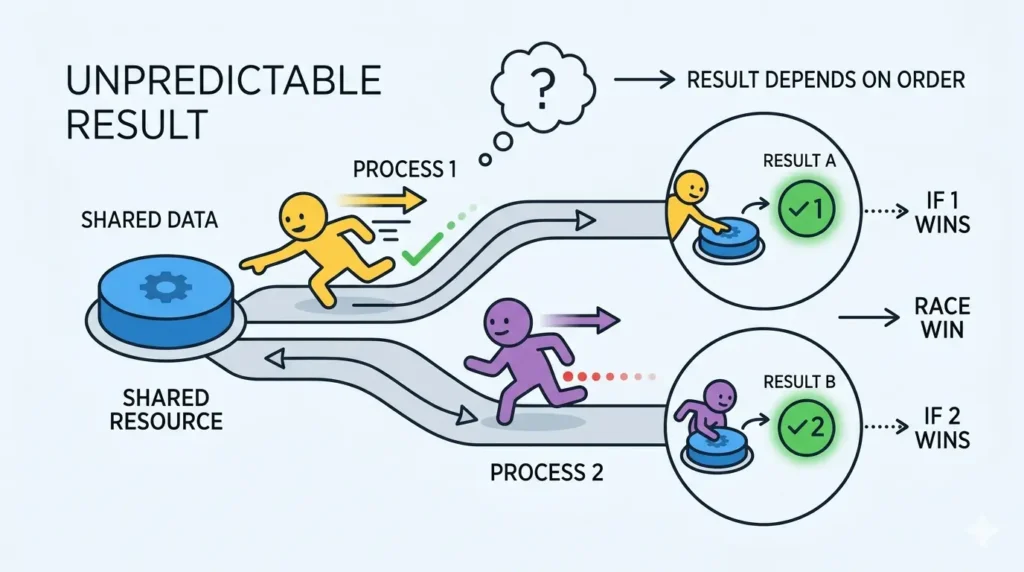
A race condition in OS is a situation where two or more processes or threads access shared data at the same time, and the final result depends on the order in which they execute.
In simple words, when multiple tasks try to use or change the same resource without proper control, they “race” against each other. Because the system cannot predict which one will run first, the output may be different each time and often incorrect.
Real-Life Analogy
Imagine two people trying to write on the same whiteboard at the same time without coordinating. Their writing may overlap or erase each other, resulting in a confusing or wrong final message.
Example of Race Condition
To understand a race condition in OS, let’s look at a simple example where two processes access shared data.
Basic Example
Assume there is a shared variable:counter = 0
Two processes (Process A and Process B) try to increment this counter at the same time.
Step-by-Step Execution
Step 1:
Process A reads the value of counter (which is 0)
Step 2:
Process B also reads the value of counter (still 0)
Step 3:
Process A increments its value → 0 + 1 = 1
Step 4:
Process B also increments its value → 0 + 1 = 1
Step 5:
Process A writes back 1 to the counter
Step 6:
Process B writes back 1 to the counter
Final Outcome
The final value of counter becomes 1, but the expected result should be 2 (since two increments happened).
Why This Happens
This incorrect result occurs because both processes accessed and modified the shared variable at the same time without synchronization. The system could not control the execution order, leading to a race condition.
Causes of Race Condition
A race condition in OS mainly occurs due to improper handling of multiple processes or threads working at the same time. Below are the key causes:
Concurrent Execution
Race conditions arise when multiple processes or threads execute simultaneously. Since operating systems support multitasking, different tasks may run in parallel, leading to overlapping operations on the same data.
Shared Resources
When processes share common resources like variables, memory, or files, conflicts can occur. If more than one process tries to read or modify the same resource at the same time, it can result in inconsistent or incorrect data.
Lack of Proper Synchronization
The most common cause is the absence of synchronization mechanisms. Without tools like locks, semaphores, or mutexes, the system cannot control the order of execution, allowing processes to interfere with each other and create race conditions.
Effects of Race Condition
Race conditions can create serious problems in an operating system because they affect how data is handled and how programs behave. Here are the main effects:
Data Inconsistency
When multiple processes modify shared data without proper control, the final value may become incorrect. As seen in earlier examples, updates can be lost or overwritten, leading to inconsistent data. This is especially critical in systems like banking or databases where accuracy is important.
Unexpected Results
Since the execution order of processes is unpredictable, the output of a program may change each time it runs. The same code might produce different results under different conditions, making it difficult to debug and unreliable for real-world use.
System Instability
Frequent race conditions can cause programs to behave abnormally, crash, or even affect the overall system performance. In severe cases, it can lead to deadlocks, corrupted memory, or system failures, reducing the reliability of the operating system.
How to Prevent Race Condition
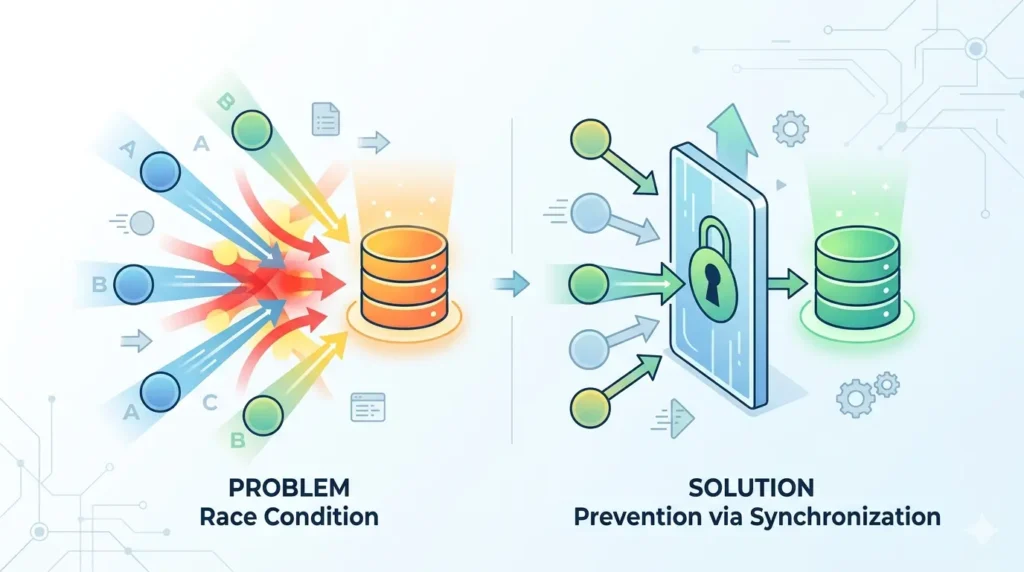
Race conditions can be prevented by controlling how multiple processes or threads access shared resources. This is done using synchronization techniques that ensure only one process accesses critical data at a time.
Mutual Exclusion
Mutual exclusion means that only one process or thread is allowed to access a shared resource at a time. The part of the program where shared data is accessed is called the critical section, and mutual exclusion ensures no two processes enter this section simultaneously.
Locks / Mutex
Locks (or mutex – mutual exclusion objects) are used to enforce mutual exclusion. Before accessing shared data, a process must acquire the lock. Once it finishes, it releases the lock so another process can use it. This prevents multiple processes from modifying the same resource at the same time.
Semaphores
Semaphores are signaling mechanisms used to control access to shared resources. They maintain a count that determines how many processes can access a resource.
- A binary semaphore works like a lock (only one process allowed)
- A counting semaphore allows limited multiple accesses
Semaphores help manage synchronization more flexibly compared to simple locks.
Critical Section Problem
Definition
The critical section problem refers to the challenge of designing a system where multiple processes or threads share resources, but only one of them can access the critical section (the part of code that uses shared data) at a time.
Relation to Race Condition
The critical section problem is directly related to race condition in OS. A race condition occurs when multiple processes enter the critical section simultaneously and modify shared data without control. Solving the critical section problem ensures proper synchronization, which prevents race conditions from happening.
Why It Matters
The critical section problem is important because it helps maintain data correctness and system reliability. If multiple processes are allowed to access shared resources without restriction, it can lead to data corruption, incorrect results, and unstable system behavior. By properly managing the critical section, operating systems ensure safe and predictable execution of concurrent processes.
Solutions to Critical Section Problem
To solve the critical section problem, operating systems use different techniques to ensure that only one process accesses shared resources at a time. These solutions help prevent race conditions and maintain correct execution.
Peterson’s Solution
Peterson’s solution is a classic software-based method used for two processes. It uses two variables—a flag and a turn variable, to control which process can enter the critical section. It ensures mutual exclusion and avoids conflicts, but it is mainly used for understanding concepts rather than in real systems.
Hardware Solutions
Modern systems use hardware-level support to handle synchronization efficiently. Special instructions like Test-and-Set or Compare-and-Swap allow processes to lock resources atomically (in a single step). This prevents multiple processes from accessing the critical section at the same time and is faster and more reliable than pure software methods.
Synchronization Tools
Operating systems provide high-level tools to manage the critical section easily:
- Mutex (Locks): Allow only one process to access a resource at a time
- Semaphores: Control access using counters (can allow one or more processes)
- Monitors: High-level structures that automatically manage mutual exclusion
These tools are widely used in real-world programming to ensure safe and synchronized access to shared data.
Conclusion
A race condition in OS is a common problem that occurs when multiple processes or threads access shared data without proper control. It mainly happens due to improper handling of shared resources and lack of synchronization between processes.
If not managed correctly, race conditions can lead to incorrect results, data inconsistency, and system instability. However, this issue can be effectively avoided by using proper synchronization techniques such as mutex, semaphores, and other locking mechanisms.
Understanding and preventing race conditions is essential for building reliable and efficient operating systems and applications.
FAQs
Q1. What is race condition in OS in simple words?
A race condition in OS happens when multiple processes or threads try to access and modify shared data at the same time, and the final result depends on which one executes first. Because the timing is unpredictable, it can lead to incorrect or inconsistent results.
Q2. What causes race condition in OS?
Race conditions are mainly caused by concurrent execution of processes and the lack of proper synchronization. When multiple tasks run simultaneously and access shared resources without control, conflicts occur.
Q3. How to prevent race condition?
Race conditions can be prevented by using synchronization techniques such as locks (mutex), semaphores, and other mechanisms that ensure only one process accesses shared data at a time.
Q4. What is critical section?
A critical section is the part of a program where shared resources (like variables, memory, or files) are accessed. It must be protected so that only one process or thread executes it at a time to avoid conflicts.
Q5. Is race condition a problem?
Yes, race conditions are a serious problem because they can cause incorrect outputs, data inconsistency, and even system crashes, making programs unreliable.