
Polymorphism in C++ is one of the core concepts of Object-Oriented Programming (OOP) that allows the same function, operator, or object to perform different actions depending on the context. The word polymorphism means “many forms,” which perfectly describes how a single interface can have multiple behaviors.
It helps developers write cleaner, reusable, and scalable code while improving flexibility and maintainability. Whether you are a beginner learning C++ or preparing for technical interviews, understanding polymorphism in C++ is essential for building a strong OOP foundation.
In this blog, we will explain the types of polymorphism in C++, including compile-time and runtime polymorphism, along with syntax, practical examples, advantages, and commonly asked interview questions.
What is Polymorphism in C++?
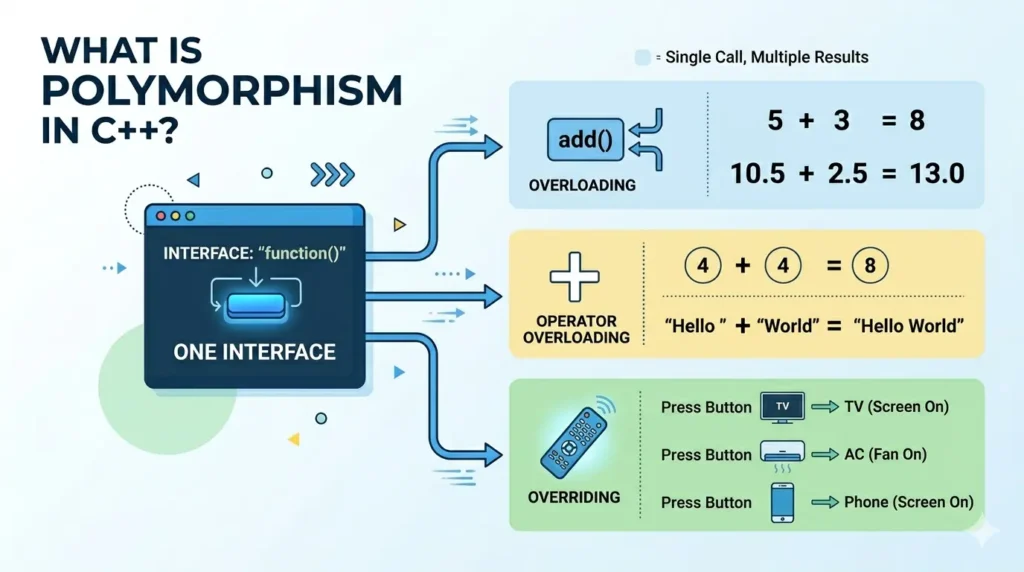
Polymorphism in C++ is an important Object-Oriented Programming (OOP) concept that allows a single function, method, operator, or object to behave in different ways depending on the situation. The word polymorphism comes from two Greek words: poly meaning “many” and morph meaning “forms.” In simple terms, it means one interface with many forms.
Polymorphism is widely used in OOP because it improves code reusability, flexibility, and maintainability. Instead of writing separate functions for similar tasks, developers can use one common interface that works differently based on input or object type. This reduces duplicate code and makes programs easier to manage.
In C++, one interface can perform multiple actions through features like function overloading, operator overloading, and function overriding. For example, the same function name can add integers, decimals, or strings depending on the arguments passed.
A real-life example of polymorphism is a remote control button. The same power button can turn on a TV, AC, or speaker, but the result changes based on the device being used. Similarly, in C++, the same function call can produce different behaviors depending on the object or data type.
Why Polymorphism is Important in C++
Polymorphism in C++ plays a major role in building efficient, scalable, and organized programs. It allows developers to use a single interface for multiple behaviors, making code more practical and easier to manage. This is one of the key reasons polymorphism is considered an essential concept in Object-Oriented Programming (OOP).
Code Reusability
With polymorphism, the same function or method can be used in different situations without rewriting separate code for each case. This saves development time and allows programmers to reuse existing logic across multiple classes or data types.
Flexibility in Programming
Polymorphism gives programs the ability to adapt based on the object or input being used. For example, the same function call may behave differently for different classes. This makes software more dynamic and easier to extend with new features.
Better Maintainability
When code is written using polymorphism, changes can often be made in one place without affecting the entire program. This makes updating, debugging, and maintaining large applications much simpler.
Cleaner Architecture
Polymorphism helps create a well-structured codebase by using common interfaces and organized class relationships. It keeps the program design neat, modular, and easier to understand for teams and future developers.
Reduces Duplicate Code
Instead of creating multiple functions with similar logic, developers can use one common interface that handles multiple behaviors. This reduces unnecessary repetition and keeps the code shorter and more efficient.
Types of Polymorphism in C++
Polymorphism in C++ is mainly divided into two types: Compile-Time Polymorphism and Runtime Polymorphism. These types describe when the decision is made about which function or behavior should be executed. Understanding both forms helps you write more flexible and efficient C++ programs.
1. Compile-Time Polymorphism (Static Binding)
Compile-time polymorphism is also known as static binding or early binding. In this type, the function call is resolved by the compiler during the compilation process. This means the compiler already knows which function or operator to execute before the program runs.
Because the decision is made early, compile-time polymorphism is usually faster and more efficient than runtime polymorphism.
The two common ways to achieve compile-time polymorphism in C++ are:
a) Function Overloading
Function overloading means creating multiple functions with the same name but with different parameters such as different data types or different number of arguments.
The compiler decides which version of the function to call based on the arguments passed.
For example:
#include <iostream>
using namespace std;

int add(int a, int b) {
    return a + b;
}

double add(double a, double b) {
    return a + b;
}

int main() {
    cout << add(5, 3) << endl;
    cout << add(2.5, 3.7) << endl;
}
Explanation:
add(5, 3)calls the integer version.add(2.5, 3.7)calls the double version.
Even though the function name is the same, it behaves differently depending on the parameters.
b) Operator Overloading
Operator overloading allows operators such as +, -, *, ==, etc., to work differently with user-defined objects. This means you can define how an operator should behave for a custom class.
For example, the + operator normally adds numbers, but it can also be used to add two objects.
#include <iostream>
using namespace std;

class Box {
public:
    int value;

    Box(int v) {
        value = v;
    }

    Box operator + (Box obj) {
        return Box(value + obj.value);
    }
};

int main() {
    Box b1(10), b2(20);
    Box b3 = b1 + b2;

    cout << b3.value;
}
Explanation:
b1 + b2uses the overloaded+operator.- Instead of normal addition, it adds the values of two Box objects.
Why Compile-Time Polymorphism is Useful
- Faster execution because decisions are made during compilation
- Makes code readable and reusable
- Allows same function names for related tasks
- Improves programmer productivity
Compile-time polymorphism is widely used in C++ because it provides flexibility while maintaining high performance.
2. Runtime Polymorphism (Dynamic Binding)
Runtime polymorphism is also known as dynamic binding or late binding. In this type of polymorphism, the decision about which function should be executed is made during program execution, not during compilation. This means the compiler determines the function call at runtime based on the actual object being used.
Runtime polymorphism is mainly achieved through inheritance, function overriding, and virtual functions in C++. It is very useful when you want the same interface to behave differently for different derived classes.
Although it may be slightly slower than compile-time polymorphism, it provides greater flexibility and extensibility in object-oriented programming.
a) Function Overriding
Function overriding happens when a derived class provides its own version of a function that already exists in the base class. Both functions must have the same name, same return type, and same parameters (same signature).
When the function is called using an object of the derived class, the derived class version is executed.
For example:
#include <iostream>
using namespace std;

class Animal {
public:
    void sound() {
        cout << "Animal makes sound";
    }
};

class Dog : public Animal {
public:
    void sound() {
        cout << "Dog barks";
    }
};

int main() {
    Dog d;
    d.sound();
}
Explanation:
- The
sound()function exists in both classes. - The
Dogclass overrides the base class function. - Calling
d.sound()executes the derived class version.
b) Virtual Functions
A virtual function is a function declared with the virtual keyword in the base class. It tells the compiler to use runtime binding, so the correct overridden function is selected based on the actual object type.
This is commonly used when a base class pointer points to a derived class object.
For example:
#include <iostream>
using namespace std;

class Animal {
public:
    virtual void sound() {
        cout << "Animal makes sound";
    }
};

class Dog : public Animal {
public:
    void sound() {
        cout << "Dog barks";
    }
};

int main() {
    Animal* ptr;
    Dog d;

    ptr = &d;
    ptr->sound();
}
Explanation:
ptris a base class pointer.- It stores the address of a
Dogobject. - Because
sound()is virtual,Dogclass function is called instead ofAnimalclass function.
Why Runtime Polymorphism is Important
- Allows one interface for multiple class behaviors
- Makes code more flexible and scalable
- Supports extension without changing existing code
- Useful in large real-world applications such as games, GUI software, and management systems
Runtime polymorphism is one of the most powerful features of C++ because it enables dynamic behavior based on object type during execution.
Example of Polymorphism in C++
Polymorphism in C++ can be understood more clearly through practical examples. As discussed earlier, it is mainly divided into compile-time polymorphism and runtime polymorphism. Both types allow the same function name or interface to behave differently depending on the situation.
Below are simple examples of both types.
Compile-Time Polymorphism Example
Compile-time polymorphism is achieved when the compiler decides which function to call during compilation. A common example of this is function overloading, where multiple functions have the same name but different parameters.
#include <iostream>
using namespace std;

class Print {
public:
   void show(int x) {
      cout << x;
   }

   void show(string y) {
      cout << y;
   }
};

int main() {
   Print obj;

   obj.show(100);
   cout << endl;

   obj.show("Hello");
}
Explanation:
In the above example:
- The class
Printcontains two functions with the same nameshow(). - One function accepts an integer parameter.
- The second function accepts a string parameter.
When the program runs:
obj.show(100);calls the integer version.obj.show("Hello");calls the string version.
The compiler selects the correct function based on the argument type during compilation. This is why it is called compile-time polymorphism.
Output:
100
Hello
Why This is Useful:
- Same function name for related tasks
- Cleaner and more readable code
- Easier maintenance
- Reduces need for separate function names
Runtime Polymorphism Example
Runtime polymorphism occurs when the function to execute is decided during program execution. This is usually done using inheritance and virtual functions.
#include <iostream>
using namespace std;

class Animal {
public:
   virtual void sound() {
      cout << "Animal sound";
   }
};

class Dog : public Animal {
public:
   void sound() {
      cout << "Dog barks";
   }
};

int main() {
   Animal* ptr;
   Dog d;

   ptr = &d;
   ptr->sound();
}
Explanation:
In this example:
Animalis the base class.Dogis the derived class.- Both classes have a
sound()function. - The base class function is declared using the
virtualkeyword.
In main():
- A base class pointer
ptris created. - It stores the address of a
Dogobject. - When
ptr->sound();is called, the program checks the actual object type at runtime.
Since the pointer refers to a Dog object, the Dog class version of sound() is executed.
Output:
Dog barks
Why This is Useful:
- One interface can represent multiple objects
- Useful in large software systems
- Makes code flexible and extensible
- Supports dynamic behavior during execution
Key Difference Between Both Examples
| Type | Decision Time | Example |
|---|---|---|
| Compile-Time Polymorphism | During compilation | Function Overloading |
| Runtime Polymorphism | During execution | Virtual Functions |
Difference Between Compile-Time and Runtime Polymorphism
Compile-time polymorphism and runtime polymorphism are the two main types of polymorphism in C++. Both allow the same interface to behave differently, but the major difference lies in when the decision is made about which function will be executed.
Compile-time polymorphism is resolved by the compiler before the program runs, while runtime polymorphism is resolved during execution based on the actual object type. Understanding their differences helps in choosing the right approach for performance and flexibility.
| Feature | Compile-Time Polymorphism | Runtime Polymorphism |
|---|---|---|
| Decision Time | During compilation | During execution |
| Speed | Faster | Slightly slower |
| Examples | Function overloading, Operator overloading | Function overriding, Virtual functions |
| Binding | Early binding | Late binding |
1. Decision Time
In compile-time polymorphism, the compiler decides which function to call before the program starts running. This happens based on function parameters or operator definitions.
In runtime polymorphism, the decision is made while the program is running. The compiler waits until execution to determine the correct function based on the object type.
2. Speed
Compile-time polymorphism is generally faster because the function address is already known during compilation.
Runtime polymorphism is slightly slower because the program checks the actual object type at runtime, often using virtual function tables.
3. Examples
Common examples of compile-time polymorphism include:
- Function overloading
- Operator overloading
Common examples of runtime polymorphism include:
- Function overriding
- Virtual functions
4. Binding
Compile-time polymorphism uses early binding, meaning the function call is linked early during compilation.
Runtime polymorphism uses late binding, meaning the function call is linked later during execution.
Which One Should You Use?
- Use compile-time polymorphism when performance is important and behavior is known in advance.
- Use runtime polymorphism when flexibility and dynamic behavior are needed.
Both types are essential in C++ and are widely used together in real-world applications.
Advantages of Polymorphism in C++
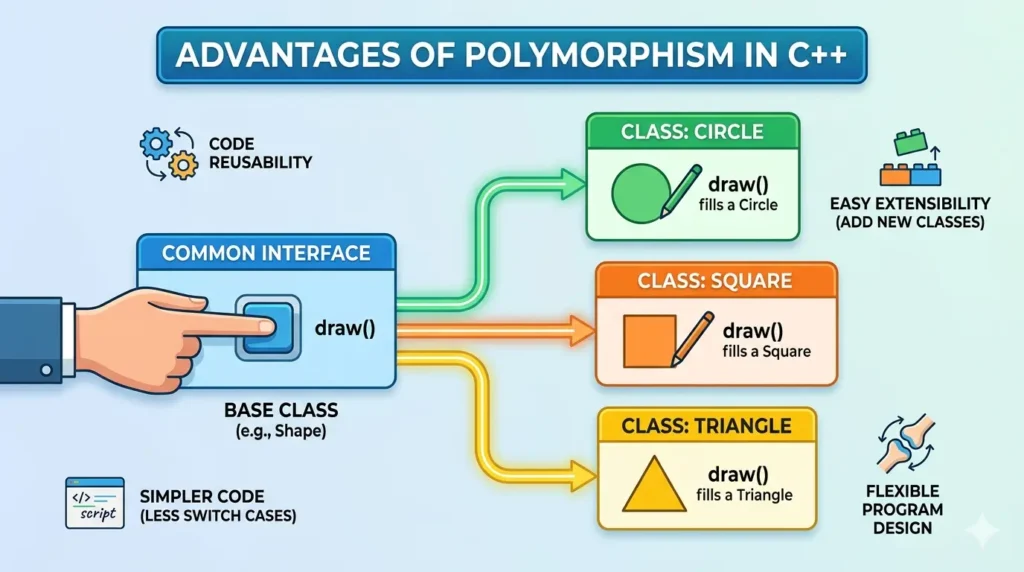
Polymorphism in C++ is one of the most powerful features of Object-Oriented Programming (OOP). It allows the same interface to perform different actions depending on the object or situation. This makes programs more flexible, organized, and easier to manage. Because of these benefits, polymorphism is widely used in modern software development.
Below are the major advantages of polymorphism in C++:
1. Makes Programs Extensible
Polymorphism makes it easier to extend programs by adding new classes or features without changing the existing code structure. Developers can create new derived classes that use the same interface while implementing their own behavior.
For example, if a program has a base class Shape, you can later add Circle, Rectangle, or Triangle classes without rewriting the main logic. This makes future development faster and more efficient.
2. Improves Readability
When similar tasks are handled through a common function or interface, the code becomes cleaner and easier to read. Instead of using many different function names, programmers can use one meaningful name for related operations.
For example, using a common display() function for multiple classes is easier to understand than creating separate names like displayStudent(), displayTeacher(), and displayEmployee().
Readable code is especially important when working in teams or maintaining projects over time.
3. Easier Debugging and Maintenance
Polymorphism helps reduce repeated code, which means fewer places where errors can occur. Since related behavior is managed through common interfaces, fixing bugs or updating functionality becomes easier.
If a change is needed, developers often update only the relevant class rather than modifying many sections of the program. This saves time and reduces the risk of introducing new errors.
4. Promotes Modular Programming
Polymorphism supports modular programming by dividing software into separate classes or components. Each class can manage its own behavior while still following a common interface.
This structure keeps code organized and allows developers to work on different modules independently. It also improves testing, reusability, and collaboration in team environments.
5. Useful in Large-Scale Applications
Large software systems often handle many objects with similar behavior but different implementations. Polymorphism is ideal in such cases because it allows one interface to manage multiple object types efficiently.
Examples include:
- Banking systems with different account types
- E-commerce platforms with multiple payment methods
- Game development with different character behaviors
- GUI applications with various controls like buttons and menus
Without polymorphism, managing such systems would require much more repetitive and complex code.
Real-Life Uses of Polymorphism in C++
Polymorphism in C++ is not just a theoretical programming concept—it is widely used in real-world software development. It helps developers create flexible systems where a single interface can manage multiple types of objects with different behaviors. This makes programs easier to scale, maintain, and extend.
Below are some common real-life uses of polymorphism in C++:
1. Game Development
Polymorphism is heavily used in game development to manage different characters, enemies, weapons, and objects.
For example, a base class Character may have a function called attack(). Different derived classes such as Warrior, Archer, and Mage can implement their own version of the attack function.
- Warrior uses a sword attack
- Archer uses arrows
- Mage uses magic spells
The game can call the same attack() function, but the behavior changes based on the character type.
2. Banking Software
Banking applications often use polymorphism to handle different account types such as:
- Savings Account
- Current Account
- Fixed Deposit Account
A common base class Account may have functions like calculateInterest() or withdraw(). Each account type can implement these functions differently based on business rules.
This allows the software to process multiple account types using one common interface.
3. GUI Systems
Graphical User Interface (GUI) applications use polymorphism for buttons, menus, text boxes, checkboxes, and other UI elements.
For example, a base class Control may define a function draw() or click(). Different UI components can override these functions.
- Button draws as a clickable button
- Checkbox draws as a selection box
- Textbox draws as an input field
This helps GUI frameworks manage many controls efficiently.
4. Shape Drawing Programs
Drawing software commonly uses polymorphism for handling different shapes.
A base class Shape may define a function draw(). Derived classes such as:
- Circle
- Rectangle
- Triangle
can provide their own drawing logic. When the program calls draw(), the correct shape is rendered automatically.
This is a classic example of runtime polymorphism in C++.
5. Vehicle Management Systems
Vehicle management systems use polymorphism to manage different vehicle types like:
- Car
- Bike
- Truck
- Bus
A base class Vehicle may include functions such as startEngine(), fuelType(), or displayInfo().
Each vehicle type can implement these functions differently. For example:
- Car starts with petrol engine
- Bike uses a smaller engine
- Electric vehicle starts battery systems
This makes transportation software easier to manage and expand. Similarly, smart charging infrastructure utilizes an OCPP gateway built on polymorphic design patterns to process operational commands across highly diverse electric vehicle supply equipment variants
Common Mistakes Beginners Make
While learning polymorphism in C++, beginners often understand the concept but make small mistakes in implementation. These errors can cause unexpected output, compilation issues, or prevent polymorphism from working correctly. Knowing these common mistakes can help you write better and cleaner C++ code.
1. Forgetting the virtual Keyword
One of the most common mistakes is forgetting to use the virtual keyword in the base class function when implementing runtime polymorphism.
Without virtual, the base class pointer will call the base class function instead of the derived class version.
Wrong Example:
class Animal {
public:
   void sound() {
      cout << "Animal sound";
   }
};
Correct Example:
class Animal {
public:
   virtual void sound() {
      cout << "Animal sound";
   }
};
The virtual keyword enables dynamic binding and allows the correct overridden function to run at execution time.
2. Wrong Function Signatures in Overriding
For overriding to work properly, the base class and derived class functions must have the same name, same parameters, and usually the same return type.
If the signature changes, the derived class creates a new function instead of overriding the original one.
Example:
class Animal {
public:
   virtual void sound();
};

class Dog : public Animal {
public:
   void sound(int x);
};
Here, sound(int x) does not override sound(). It becomes a different function.
Always ensure the function signature matches exactly.
3. Confusing Overloading with Overriding
Many beginners mix up these two concepts because both use the same function name.
Function Overloading:
- Happens in the same class
- Same function name with different parameters
- Example:
add(int, int)andadd(double, double)
Function Overriding:
- Happens in inheritance
- Same function name and same signature in derived class
- Used for runtime polymorphism
Understanding the difference is important for interviews and practical coding.
4. Using Polymorphism Without Inheritance
Runtime polymorphism in C++ requires inheritance. Some beginners try to use overriding or virtual functions without creating a base and derived class relationship.
Polymorphism through overriding only works when one class inherits from another.
Correct Structure:
class Animal { };
class Dog : public Animal { };
Without inheritance, runtime polymorphism cannot be achieved.
Interview Questions on Polymorphism in C++
Polymorphism is one of the most frequently asked Object-Oriented Programming (OOP) topics in C++ interviews. Interviewers often ask both theoretical and practical questions to check whether you understand how polymorphism works and where it is used. Preparing these questions can help beginners, freshers, and experienced candidates perform better in technical interviews.
Below are some common interview questions on polymorphism in C++:
1. What is Polymorphism in C++?
Polymorphism in C++ is an OOP concept that allows the same function, operator, or object to behave differently in different situations. The word polymorphism means “many forms.” It improves flexibility, code reuse, and maintainability.
2. What Are the Types of Polymorphism in C++?
There are two main types of polymorphism in C++:
- Compile-Time Polymorphism – Achieved through function overloading and operator overloading.
- Runtime Polymorphism – Achieved through function overriding and virtual functions.
3. What is the Difference Between Overloading and Overriding?
| Feature | Overloading | Overriding |
|---|---|---|
| Occurs In | Same class | Base and derived classes |
| Parameters | Different | Same |
| Binding | Compile-time | Runtime |
| Example | add(int,int) | sound() in Animal/Dog |
Overloading uses the same function name with different parameters, while overriding redefines a base class function in a derived class.
4. What is a Virtual Function in C++?
A virtual function is a function declared with the virtual keyword in the base class. It allows the program to call the derived class version of the function when using a base class pointer or reference.
5. Why is Runtime Polymorphism Slightly Slower?
Runtime polymorphism is slightly slower because the function call is resolved during execution instead of compilation. The program uses dynamic binding (virtual table mechanism), which adds a small overhead.
6. Can Constructors Be Virtual in C++?
No, constructors cannot be virtual in C++. Constructors are used to initialize objects, and the object must exist before virtual behavior can occur.
7. Why Use Polymorphism in Real Projects?
Polymorphism helps in:
- Writing reusable code
- Managing large applications
- Adding new features easily
- Improving flexibility and scalability
8. What is Early Binding and Late Binding?
- Early Binding – Function call resolved during compilation.
- Late Binding – Function call resolved during runtime.
9. What is Pure Virtual Function?
A pure virtual function is declared using = 0 in the base class and forces derived classes to implement it.
virtual void display() = 0;
It is used to create abstract classes.
10. Is Polymorphism Important for Freshers?
Yes, polymorphism is one of the most commonly asked OOP concepts in fresher interviews, especially for C++, Java, and software development roles.
Conclusion
Polymorphism in C++ is a powerful Object-Oriented Programming (OOP) feature that allows functions and objects to behave differently based on the context. It helps developers write cleaner, reusable, and more flexible code while improving maintainability in small as well as large applications.
By understanding both compile-time polymorphism and runtime polymorphism, you build a strong foundation in C++ programming and gain the skills needed to design efficient real-world software solutions.
FAQs
Q1. What is polymorphism in C++ in simple words?
Polymorphism in C++ means one function, method, or object behaving in many forms depending on the situation. It allows the same interface to perform different tasks.
Q2. What are the two types of polymorphism in C++?
The two main types of polymorphism in C++ are:
- Compile-time polymorphism
- Runtime polymorphism
Compile-time polymorphism includes overloading, while runtime polymorphism includes overriding and virtual functions.
Q3. Is function overloading polymorphism?
Yes, function overloading is a type of compile-time polymorphism in C++. It allows multiple functions with the same name but different parameters.
Q4. Why is the virtual keyword used?
The virtual keyword is used to enable runtime polymorphism. It allows a base class pointer or reference to call the derived class version of a function.
Q5. Is polymorphism important in interviews?
Yes, polymorphism is one of the most important OOP concepts frequently asked in C++ interviews, especially for freshers and software development roles.