
Hybrid inheritance in C++ is an important Object-Oriented Programming concept that combines two or more types of inheritance in a single class structure. It is used to create complex relationships between classes while improving code reusability, flexibility, and organization. This type of inheritance is helpful when modeling real-world systems where one class may need features from multiple sources.
In this guide, you will learn what hybrid inheritance in C++ is, its syntax, examples, advantages, disadvantages, and common issues like the diamond problem.
What is Inheritance in C++?
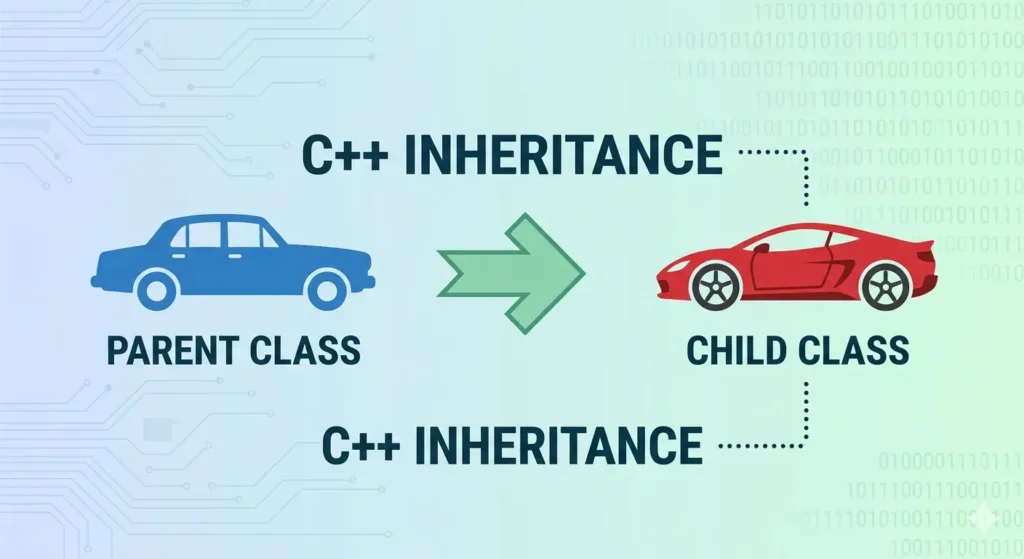
Inheritance in C++ is a fundamental feature of Object-Oriented Programming (OOP) that allows one class to acquire the properties and behaviors of another class. It helps create a relationship between classes so that common features can be shared and reused easily.
The class whose members are inherited is called the parent class, base class, or superclass. The class that inherits those members is called the child class, derived class, or subclass. The child class can use the functions and data members of the parent class and can also add its own unique features.
Inheritance is widely used in OOP because it promotes better code structure, reduces repetition, and makes programs easier to manage. Instead of writing the same code again in multiple classes, developers can place common functionality in one base class and reuse it in derived classes.
One of the biggest benefits of inheritance is code reusability. It saves development time, improves maintainability, and helps create scalable applications. This is why inheritance is considered one of the most important concepts in C++.
What is Hybrid Inheritance in C++?
Hybrid inheritance in C++ is a type of inheritance where two or more inheritance models are combined in a single program. It is created when a class structure uses multiple inheritance patterns together to represent more complex relationships between classes. In simple words, hybrid inheritance is a mixture of different inheritance types such as single, multiple, multilevel, or hierarchical inheritance.
Unlike basic inheritance models that follow one fixed structure, hybrid inheritance gives developers more flexibility. It allows a program to be designed according to real-world requirements where one class may need features from different parent classes or inheritance levels.
Combination of Two or More Inheritance Types
Hybrid inheritance is formed by combining any two or more inheritance types. Some common combinations include:
1. Single + Multiple Inheritance
A class first inherits from one base class using single inheritance, and then another class inherits from multiple parent classes.
2. Multiple + Multilevel Inheritance
A class inherits from more than one parent class, and then another class further derives from it, creating multiple inheritance along with a multilevel chain.
3. Hierarchical + Multiple Inheritance
Several classes inherit from one base class, and then another class inherits from two or more of those derived classes.
Why Hybrid Inheritance is Used in Advanced Programs
Hybrid inheritance is useful in advanced software development because real-world systems are often complex and cannot always be represented by a single inheritance type. For example, in large applications, a class may need common properties from one parent class and specialized features from another.
It is commonly used in:
- Large-scale software systems
- Game development
- Banking and management systems
- Framework and library design
- Real-world object modeling
Benefits of Hybrid Inheritance
- Combines advantages of multiple inheritance types
- Promotes code reuse
- Creates flexible class relationships
- Reduces duplicate code
- Helps organize complex programs efficiently
Although hybrid inheritance is powerful, it should be used carefully because it can make code more complex and may create ambiguity issues like the diamond problem.
Types of Inheritance Used in Hybrid Inheritance
Hybrid inheritance in C++ is formed by combining two or more basic inheritance types. To understand hybrid inheritance clearly, it is important to first know the individual inheritance models used to create it. Each type has its own structure and purpose in Object-Oriented Programming.
1. Single Inheritance
Single inheritance is the simplest form of inheritance in C++. In this type, one derived class inherits from only one base class. The child class gets access to the properties and functions of a single parent class.
It is commonly used when there is a straightforward parent-child relationship.
Example:
If Vehicle is a base class, then Car can inherit from Vehicle.
Benefits of Single Inheritance:
- Easy to understand and implement
- Promotes code reuse
- Reduces duplication of common features
2. Multiple Inheritance
Multiple inheritance occurs when one derived class inherits from more than one base class at the same time. This allows the child class to combine features from multiple parent classes.
It is useful when a class needs functionalities from different sources.
Example:
A class SmartPhone can inherit from both Camera and Phone.
Benefits of Multiple Inheritance:
- Combines features of multiple classes
- Improves flexibility
- Useful in advanced class design
Note: Multiple inheritance may sometimes cause ambiguity issues if two parent classes have members with the same name.
3. Multilevel Inheritance
Multilevel inheritance happens when a class is derived from another derived class. This creates a chain of inheritance where properties pass from one level to another.
Example:Animal → Mammal → Dog
Here, Dog inherits features from Mammal, and Mammal already inherits from Animal.
Benefits of Multilevel Inheritance:
- Creates logical hierarchy
- Allows step-by-step specialization
- Improves organization of related classes
4. Hierarchical Inheritance
Hierarchical inheritance occurs when multiple derived classes inherit from a single base class. One parent class provides common properties to several child classes.
Example:Shape as a base class, while Circle, Rectangle, and Triangle inherit from it.
Benefits of Hierarchical Inheritance:
- Common code shared among many classes
- Reduces repetition
- Easy maintenance of shared features
Role of These Types in Hybrid Inheritance
Hybrid inheritance combines two or more of the above inheritance types in one structure. For example:
- Single + Multiple Inheritance
- Multiple + Multilevel Inheritance
- Hierarchical + Multiple Inheritance
This combination helps developers create powerful and flexible class relationships for complex applications.
Diagram of Hybrid Inheritance in C++
Hybrid inheritance in C++ can be better understood with the help of a class structure diagram. It shows how multiple inheritance types are combined in one program design. In this structure, classes inherit properties from one another in different ways, forming a mixed inheritance model.
Example Diagram
        A
       / \
      B   C
       \ /
        D
Explanation of the Diagram
In the above diagram:
- A is the base class or parent class.
- B and C are derived classes that inherit from class A.
- D is another derived class that inherits from both B and C.
This structure combines more than one inheritance type, which makes it an example of hybrid inheritance.
How It Combines Multiple Inheritance Structures
1. Hierarchical Inheritance
Class A is inherited by both B and C. When multiple child classes inherit from the same parent class, it is called hierarchical inheritance.
So in this diagram:
A → BA → C
This part represents hierarchical inheritance.
2. Multiple Inheritance
Class D inherits from both B and C at the same time. When one class inherits from more than one parent class, it is called multiple inheritance.
So in this diagram:
B + C → D
This part represents multiple inheritance.
Why It Is Called Hybrid Inheritance
Since the structure combines:
- Hierarchical inheritance
- Multiple inheritance
It becomes a hybrid inheritance model.
Real-World Understanding
Imagine:
- A = Person
- B = Employee
- C = Student
- D = Intern
Here, Intern can have qualities of both an employee and a student, while both are originally derived from Person.
Important Note: Diamond Problem
This diagram may also create the diamond problem in C++ because class D may receive two copies of class A through B and C. This can cause ambiguity when accessing members of class A. It is usually solved using virtual inheritance.
Syntax of Hybrid Inheritance in C++
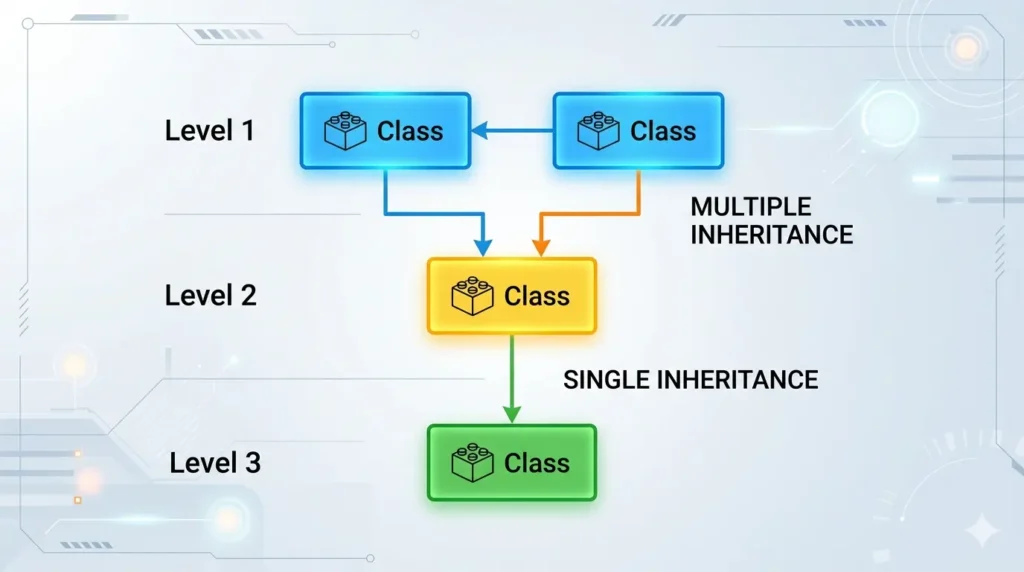
Hybrid inheritance in C++ is created when a class structure combines two or more inheritance types in one program. The syntax depends on how the classes are connected. Below is a simple example that combines single inheritance and multiple inheritance.
class A
{
};class B : public A
{
};class C
{
};class D : public B, public C
{
};
Explanation of the Syntax
Class A
class A
{
};
Ais the base class.- It acts as the parent class from which other classes can inherit properties and methods.
Class B Inheriting from A
class B : public A
{
};
Bis a derived class.- It inherits publicly from class
A. - This represents single inheritance because one child class inherits from one parent class.
Class C
class C
{
};
Cis another independent class.- It does not inherit from any class in this example.
Class D Inheriting from B and C
class D : public B, public C
{
};
Dis a derived class that inherits from bothBandC.- This represents multiple inheritance because one class inherits from two parent classes.
Why This Is Hybrid Inheritance
This structure combines:
- Single Inheritance:
Binherits fromA - Multiple Inheritance:
Dinherits fromBandC
Since two inheritance types are used together, it is called hybrid inheritance.
Class Relationship Diagram
A
|
B      C
 \    /
   D
Benefits of This Structure
- Reuses code from existing classes
- Combines features from multiple sources
- Helps model complex real-world relationships
- Makes programs more flexible and organized
Example Program of Hybrid Inheritance in C++
Hybrid inheritance in C++ becomes easier to understand through a practical program. In the example below, we combine single inheritance and multiple inheritance to create a hybrid inheritance structure.
#include<iostream>
using namespace std;

class Animal
{
public:
   void eat()
   {
      cout << "Eating";
   }
};

class Mammal : public Animal
{
};

class Bird
{
public:
   void fly()
   {
      cout << "Flying";
   }
};

class Bat : public Mammal, public Bird
{
};

int main()
{
   Bat b;
   b.eat();
   b.fly();

   return 0;
}
Output
Eating
Flying
Explanation of the Program
1. Base Class Animal
The Animal class contains a public function eat() that prints Eating.
class Animal
{
public:
   void eat()
   {
      cout << "Eating";
   }
};
This class acts as the main parent class.
2. Derived Class Mammal
The Mammal class inherits from Animal.
class Mammal : public Animal
{
};
This means Mammal gets access to the eat() function from Animal.
This is an example of single inheritance.
3. Separate Class Bird
The Bird class contains a function fly().
class Bird
{
public:
   void fly()
   {
      cout << "Flying";
   }
};
4. Derived Class Bat
The Bat class inherits from both Mammal and Bird.
class Bat : public Mammal, public Bird
{
};
This means Bat can use:
eat()fromAnimalthroughMammalfly()fromBird
This is an example of multiple inheritance.
Why It Is Hybrid Inheritance
This program combines:
- Single Inheritance:
Mammalinherits fromAnimal - Multiple Inheritance:
Batinherits fromMammalandBird
Since two inheritance types are used together, it is called hybrid inheritance.
How main() Works
Bat b;
b.eat();
b.fly();
- A
Batobjectbis created. b.eat()calls the inherited function fromAnimal.b.fly()calls the function fromBird.
Real-Life Understanding
A bat is a good real-world example because:
- It is a mammal
- It can also fly
So the class structure logically represents real-life behavior.
Key Benefits of This Example
- Demonstrates code reusability
- Shows multiple parent relationships
- Models real-world entities effectively
- Explains hybrid inheritance clearly
Real-Life Example of Hybrid Inheritance
Hybrid inheritance in C++ is very useful for representing real-world objects that have features from multiple sources. Many modern systems cannot be described using only one type of inheritance, so hybrid inheritance helps combine different class relationships into a single structure.
1. Smartphone = Camera + Computer + Phone
A smartphone is one of the best real-life examples of hybrid inheritance.
A smartphone works as:
- A phone for calling and messaging
- A camera for taking photos and videos
- A computer for browsing, gaming, and running apps
In programming terms:
Phoneclass can contain calling featuresCameraclass can contain photo featuresComputerclass can contain processing featuresSmartphoneclass can inherit useful features from all of them
This shows how one object combines multiple functionalities, similar to hybrid inheritance.
2. Bat = Mammal + Flying Creature
A bat is another common example used in inheritance concepts.
A bat has qualities of:
- A mammal because it gives birth and feeds milk
- A flying creature because it can fly like birds
In a class structure:
Animalcan be the base classMammalcan inherit fromAnimalBirdorFlyingCreaturecan represent flying abilityBatcan inherit from both classes
This makes bat a perfect example of hybrid inheritance.
3. Smart Vehicle Systems
Modern vehicles combine multiple technologies, making them ideal for hybrid inheritance.
A smart vehicle may include:
- Vehicle features like engine and wheels
- GPS System for navigation
- Entertainment System for music and media
- Safety System for sensors and alerts
In programming:
Vehicleclass provides basic transport featuresNavigationclass provides maps and trackingEntertainmentclass handles mediaSmartCarclass combines these features
This is a practical use of hybrid inheritance in software development.
Advantages of Hybrid Inheritance in C++
Hybrid inheritance in C++ offers many benefits when designing complex applications. By combining two or more inheritance types, developers can create flexible and reusable class structures that closely represent real-world systems.
1. Reusability of Code
One of the biggest advantages of hybrid inheritance is code reusability. Common functions and data members can be written once in a base class and then reused by multiple derived classes.
This helps to:
- Save development time
- Reduce repeated code
- Improve productivity
Instead of writing the same logic again and again, classes can simply inherit existing features.
2. Better Logical Modeling
Hybrid inheritance helps represent real-world relationships more accurately. Many real-life objects have characteristics from different sources, and hybrid inheritance allows those relationships to be modeled effectively.
For example:
- A smartphone behaves like a phone, camera, and computer
- A bat is a mammal but can also fly
This creates more meaningful and realistic class designs.
3. Reduced Duplication
Without inheritance, the same methods and variables may need to be copied into several classes. Hybrid inheritance reduces this duplication by sharing common features through parent classes.
Benefits include:
- Cleaner code
- Fewer errors
- Easier updates
If a common feature changes, it only needs to be updated once in the base class.
4. Scalable Class Structures
Hybrid inheritance is useful for large applications that may grow over time. New classes can be added to the existing hierarchy without rewriting the entire program.
This makes software:
- Easier to expand
- Better organized
- Suitable for enterprise-level systems
It supports future development efficiently.
5. Combines Multiple OOP Concepts
Hybrid inheritance combines the strengths of different inheritance models such as:
- Single inheritance
- Multiple inheritance
- Multilevel inheritance
- Hierarchical inheritance
This gives programmers more flexibility in designing powerful object-oriented systems.
Disadvantages of Hybrid Inheritance in C++
Although hybrid inheritance is powerful, it also has some drawbacks. If not used carefully, it can make programs difficult to manage.
1. Can Become Complex
As more classes and inheritance levels are added, the structure can become complicated. Understanding the relationships between classes may become difficult for beginners and even experienced developers.
Complex designs may lead to:
- Confusing code flow
- Poor readability
- Slower development
2. Difficult Debugging
When errors occur in hybrid inheritance, debugging can be harder because functionality may come from multiple parent classes.
A problem in one class may affect several derived classes, making it time-consuming to trace the source of the issue.
This is especially common in large codebases.
3. Ambiguity Issues
Hybrid inheritance can create ambiguity when two parent classes contain members with the same name.
For example, if a child class inherits from two classes that both have a function called display(), the compiler may not know which one to use.
This issue is often seen in the diamond problem and is solved using:
- Scope resolution operator
- Virtual inheritance
4. Harder Maintenance in Large Projects
In very large projects, maintaining a deep inheritance hierarchy can be difficult. A small change in a base class may impact many child classes.
This may cause:
- Unexpected bugs
- Higher maintenance cost
- More testing requirements
Developers need careful planning when using hybrid inheritance in production systems.
Diamond Problem in Hybrid Inheritance
The Diamond Problem is one of the most common issues that occurs in hybrid inheritance in C++. It happens when a class inherits the same base class through multiple paths, creating ambiguity in the program structure.
This problem gets its name because the inheritance diagram looks like a diamond shape.
Structure of Diamond Problem
      A
     / \
    B   C
     \ /
      D
In this structure:
Ais the base classBandCinherit fromADinherits from bothBandC
This creates two inheritance paths from A to D.
What is the Diamond Problem?
When class D is created, it may receive two separate copies of class A:
- One copy through class
B - Another copy through class
C
As a result, if D tries to access a member of A, the compiler becomes confused about which copy should be used.
This situation is called the diamond problem.
Why It Causes Ambiguity
Suppose class A contains a function named show(). Since D gets two paths to A, calling:
d.show();
may create an error because the compiler cannot decide whether to use:
Ainherited throughBAinherited throughC
This ambiguity leads to compilation errors or confusion in large programs.
How to Solve Diamond Problem
The diamond problem is solved using virtual inheritance in C++.
Virtual inheritance ensures that only one shared copy of the base class is inherited, even if multiple paths exist.
This removes duplication and ambiguity.
Example Using Virtual Inheritance
class A {};class B : virtual public A
{
};class C : virtual public A
{
};class D : public B, public C
{
};
Explanation of the Example
Bvirtually inherits fromACalso virtually inherits fromADinherits from bothBandC
Because of the virtual keyword, class D gets only one copy of class A.
This solves the ambiguity problem completely.
Hybrid Inheritance vs Multiple Inheritance
| Feature | Hybrid Inheritance | Multiple Inheritance |
|---|---|---|
| Meaning | Combination of two or more inheritance types in one structure | One class inherits from two or more parent classes |
| Complexity | Higher, because it combines multiple inheritance models | Medium, as one class directly inherits multiple parents |
| Use Case | Used in large and complex systems with layered relationships | Used when a class needs features from multiple parent classes directly |
| Flexibility | More flexible for advanced designs | Flexible but limited to multiple parent inheritance |
| Structure | Can include single, multiple, multilevel, or hierarchical inheritance together | Only focuses on inheriting from multiple base classes |
| Maintenance | Harder to maintain in very large projects | Easier to maintain compared to hybrid inheritance |
| Example | Smart vehicle system combining several modules | Smartphone inheriting from Camera and Phone |
When to Use Hybrid Inheritance in C++
Hybrid inheritance in C++ should be used when a program requires a combination of multiple inheritance models to represent complex relationships. It is most useful in advanced applications where a single inheritance type is not enough.
1. Large Software Projects
In large software systems, many modules need to interact with each other. Some classes may require common features from one base class and additional functionalities from other classes.
Hybrid inheritance helps organize such systems by creating reusable and structured class hierarchies.
Examples:
- Banking systems
- Hospital management software
- Enterprise applications
- ERP systems
2. Real-World Entity Modeling
Many real-world objects have characteristics from multiple sources. Hybrid inheritance allows developers to represent these relationships more accurately.
Examples:
- Smartphone = Phone + Camera + Computer
- Bat = Mammal + Flying Creature
- Smart Car = Vehicle + GPS + Safety System
This makes class design more realistic and logical.
3. Framework Development
Software frameworks often need flexible and reusable architectures. Different modules may inherit shared behaviors while also combining specialized features.
Hybrid inheritance is useful in:
- GUI frameworks
- Game engines
- Application libraries
- Plugin-based systems
It allows scalable and modular development.
4. Advanced OOP Interviews
Hybrid inheritance is an important concept in Object-Oriented Programming interviews, especially for C++ roles.
Interviewers may ask it to test your understanding of:
- Inheritance types
- Class relationships
- Multiple inheritance
- Diamond problem
- Virtual inheritance
Knowing hybrid inheritance helps in technical interviews and coding rounds.
Common Interview Questions on Hybrid Inheritance in C++
1. What is hybrid inheritance in C++?
Hybrid inheritance in C++ is a combination of two or more inheritance types such as single, multiple, multilevel, or hierarchical inheritance in one class structure.
2. Is hybrid inheritance supported in C++?
Yes, C++ fully supports hybrid inheritance because it allows multiple inheritance and flexible class relationships.
3. What is diamond problem in hybrid inheritance?
The diamond problem occurs when the same base class is inherited through multiple paths, causing ambiguity in the derived class.
4. How to solve ambiguity in hybrid inheritance?
Ambiguity can be solved using:
- Virtual inheritance
- Scope resolution operator
- Proper class design
Virtual inheritance is the most common solution for the diamond problem.
5. Difference between hybrid and multiple inheritance?
- Multiple inheritance means one class inherits from multiple parent classes.
- Hybrid inheritance means combining two or more inheritance types in one structure.
Hybrid inheritance is broader and more complex than multiple inheritance.
Conclusion
Hybrid inheritance in C++ is a powerful Object-Oriented Programming concept used to model complex class relationships by combining multiple inheritance types in one structure. It provides flexibility, better code reusability, and realistic class design for advanced applications. However, it should be used carefully because it may create ambiguity issues like the diamond problem and can become difficult to maintain in large projects. Understanding hybrid inheritance is highly beneficial for students, developers, and anyone preparing for C++ interviews.
FAQs
Q1. What is hybrid inheritance in C++ in simple words?
Hybrid inheritance in C++ means combining two or more types of inheritance in a single program structure. It is used when one class needs features from different inheritance models such as single, multiple, multilevel, or hierarchical inheritance.
Q2. Is hybrid inheritance allowed in C++?
Yes, C++ fully supports hybrid inheritance. Since C++ allows multiple inheritance and flexible class hierarchies, developers can combine different inheritance types to create hybrid inheritance structures.
Q3. What is the diamond problem?
The diamond problem is an ambiguity issue that happens when one base class is inherited through multiple paths. As a result, the final derived class may receive duplicate copies of the same base class, causing confusion when accessing members.
Q4. How to solve diamond problem in C++?
The diamond problem in C++ is commonly solved using virtual inheritance. The virtual keyword ensures that only one shared copy of the base class is inherited, removing ambiguity and duplicate objects.
Q5. Is hybrid inheritance asked in interviews?
Yes, hybrid inheritance is commonly asked in C++ and Object-Oriented Programming interviews. Interviewers often ask about inheritance types, hybrid inheritance structure, diamond problem, and virtual inheritance.