
If you searched for G15Tool Partners, you probably want one of three things: to understand what the term means, to find out whether you can join, or to check if an offer you received is real.
That is a fair set of questions. The term appears in several places online, and the descriptions do not always agree. Some pages treat it as a formal partner program. Others use it loosely to describe collaboration around a tool or website.
This guide separates what is general partnership knowledge from what is confirmed G15Tool information. You will learn what G15Tool Partners could mean, which collaboration models exist, how to approach a partnership, and how to check that an opportunity is legitimate.
One important note up front: I could not confirm a published, official G15Tool partner program with fixed terms. Treat everything about specific G15Tool terms as something to verify directly with the company before you act.
What Are G15Tool Partners?
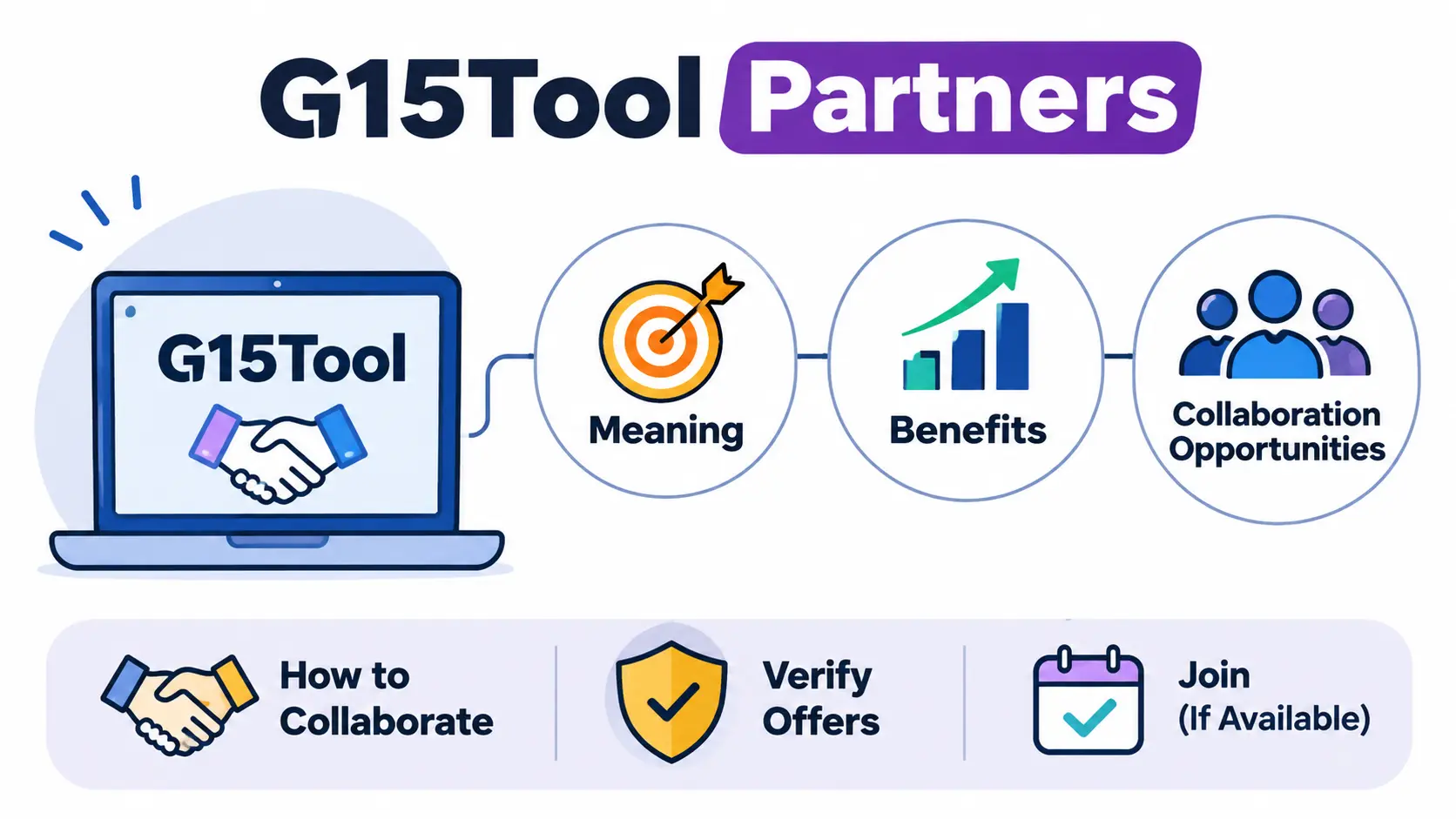
G15Tool Partners is a term used for businesses, creators, developers, or publishers who collaborate with G15Tool. Whether it points to a formal, structured program is not clearly documented in public sources, so it should be verified before you rely on it.
Understanding the Meaning of G15Tool Partners
In plain English, a partner is anyone who works with a company toward a shared goal. That could mean promoting a product, building an integration, or publishing content together.
The word “partner” is flexible. It can describe a signed contract with detailed terms, or a casual agreement between two websites. That flexibility is the main reason the keyword feels confusing.
How G15Tool Partners Relate to Digital Collaboration
Most online partnerships fall into a few familiar models: affiliate, content, technology, strategic, and creator partnerships. Strategic alliances explains the general idea of organizations pooling resources while staying independent.
Any collaboration involving G15Tool would likely fit one of these models. The exact shape depends on what G15Tool actually offers, which you need to confirm with them.
Who May Be Involved in G15Tool Partnerships?
Different groups bring different strengths to a partnership. Here are the most common ones.
Businesses and Technology Companies
Companies may partner to bundle services, cross-promote, or share customer insights. A small software firm, for example, might co-market with a complementary tool.
Bloggers and Content Creators
Creators bring audiences and trust. They may write reviews, tutorials, or comparison posts if the tool is relevant to their readers.
Software Developers and Digital Professionals
Developers can build plugins, integrations, or connectors. This only works when the tool offers documentation or an API, so ask early.
Online Publishers and Communities
Newsletters, forums, and niche communities can introduce a tool to people who already care about the topic. Relevance matters more than size here.
Is G15Tool Partners an Official Partnership Program?
A partnership concept and a formal program are not the same thing. A formal program usually has a public page, written terms, an application process, and a named contact. A concept is simply an idea that two parties could work together.
Based on what I could find, public evidence of a fully documented official program is limited and inconsistent. That does not mean collaboration is impossible. It means you should not assume fixed commissions, tiers, or benefits.
Before going further, ask for these items:
- A written description of the program or collaboration
- The legal company name and a working business address
- Commission, payment, and cancellation terms, if any
- A named contact on an official domain email
- Privacy and data handling policies
How Does G15Tool Partnership Work?
There is no single confirmed G15Tool process I can point to. What follows is how most digital partnerships work in practice, which is a sensible framework to use.
Identifying Potential Collaboration Opportunities
Start with fit. Ask where your audience or skills overlap with what the tool does. If you cannot explain the overlap in one sentence, the partnership probably is not ready.
Connecting with Relevant Partners
Reach out through verified channels. Look for contact details on the official website, then cross-check them on a company page on LinkedIn. A short, specific message beats a long generic one.
Defining Shared Goals and Responsibilities
Write down what each side will do. Who creates content? Who supplies assets? Who handles support? Vague roles are the top cause of stalled partnerships.
Establishing Partnership Terms
Get terms in writing. Cover duration, payment (if any), exclusivity, branding rules, and how either side can exit.
Managing and Evaluating Collaboration
Set a review date, such as 30 or 90 days. Check results against the goals you agreed on, then adjust or end the collaboration if it is not working.
Different Types of G15Tool Partnership Opportunities
These models are common across the industry. Whether G15Tool offers any of them is something to confirm directly.
Affiliate Partnerships
Affiliate marketing pays a partner for traffic or sales they bring in. The partner gets a unique referral link. When someone clicks it and completes an action, the partner may earn a commission.
Common commission models include a percentage of sales, a flat fee per sale, or a fee per lead. Conversions are usually tracked with cookies or unique codes.
Ask these questions before joining:
- What is the commission rate, and what triggers it?
- How long does the tracking window last?
- When and how are payouts made?
- Are there rules on how I can promote the product?
If you earn money from links, disclose it. The FTC’s guidance on endorsements explains disclosure expectations for US audiences, and many other countries have similar rules.
Content Collaboration Partnerships
These focus on creating useful material together. Examples include guest articles, honest product reviews, step-by-step tutorials, and co-branded guides.
Keep reviews balanced. Readers trust creators who mention limits as well as strengths.
Technology Integration Partnerships
Here, two products connect so users can move data or workflows between them. This may involve APIs, shared development work, and technical documentation.
A partner should expect clear API docs, test access, and a support contact. If those are missing, the integration will be slow and risky.
Business and Strategic Partnerships
These are longer-term relationships. They may include joint campaigns, resource sharing, or business development work. They take more trust and usually more legal paperwork.
Creator and Community Partnerships
Influencers, social media accounts, and technology communities can help a tool reach an engaged audience. Success depends on authentic fit, not follower count alone.
Key Benefits of G15Tool Partnerships
The benefits below are general possibilities that partnerships can create. I could not verify any of them as documented G15Tool benefits, so do not treat them as promises.
Improved Brand Visibility
Working with a relevant partner puts your name in front of new people. Visibility is strongest when the audience already trusts the partner.
Access to New Audiences
A good partner opens doors to readers or customers you could not easily reach alone.
Content Development Opportunities
Joint guides, webinars, and case studies can save time and raise quality.
Professional Networking
Partnerships often lead to introductions, referrals, and future projects.
Knowledge and Resource Sharing
Partners swap expertise, data, and tools. A developer may learn marketing insight, while a marketer learns how a product works.
Potential Revenue Opportunities
Some partnerships earn money through commissions, fees, or shared sales. Revenue is never guaranteed, and anyone promising fixed income is a red flag.
Long-Term Business Growth
Strong relationships compound over time. Repeat collaboration usually performs better than one-off deals.
How to Find the Right G15Tool Partners
Good partners rarely appear by accident. You find them through a simple, repeatable process.
Define Your Partnership Goals
Decide what success looks like. More traffic? Qualified leads? A new integration? One clear goal beats five vague ones.
Identify Relevant Websites and Businesses
List sites and companies that serve the same audience without competing head-on. Search communities such as affiliatemarketing on Reddit to see how practitioners talk about real-world partner experiences.
Research Potential Partners
Read their content, check their social profiles, and look at past collaborations. Notice whether their audience actually engages.
Evaluate Audience and Industry Relevance
A smaller, focused audience often converts better than a large, mixed one.
Check Reputation and Credibility
Search the partner’s name with words like “reviews” or “complaints.” Look for consistent, specific feedback rather than a single glowing or angry post.
Compare Partnership Opportunities
Score each option on the same criteria.
Website Quality
Look for original content, clear ownership, and a clean site. Thin, copied, or spammy pages are a warning sign.
Audience Relevance
Does the audience match the people you want to reach? Relevance beats raw numbers.
Engagement and Traffic
Tools like Semrush or Ahrefs give traffic estimates. Treat them as estimates, not facts, and compare them with comments, shares, and email response where you can.
Business Reputation
Check for a real address, transparent ownership, and a track record.
Long-Term Collaboration Potential
Ask whether this partner could work with you for a year, not just one campaign.
How to Become a G15Tool Partner: Step-by-Step Guide
Please note: this is a recommended approach for exploring a partnership. It is not G15Tool’s confirmed official application procedure.
Step 1 – Understand the Available Partnership Opportunities
Decide which model fits you: affiliate, content, technology, strategic, or community. Knowing this makes your outreach sharper.
Step 2 – Research G15Tool and Verify Its Contact Channels
Visit the official website and look for a partners, contact, or about page. Confirm the business name, address, and email domain. If you cannot find reliable contact details, pause.
Step 3 – Identify Your Collaboration Proposal
Name one specific idea. For example: “A tutorial series for small agencies, published on my blog and shared with my newsletter.”
Step 4 – Prepare Your Partnership Pitch
Keep it short. Explain who you are, what you propose, and why it helps both sides.
Step 5 – Discuss Responsibilities and Expectations
Talk through deliverables, timelines, and who owns what. Surprises later cost more than questions now.
Step 6 – Review Partnership Terms
Read the terms carefully. If money or exclusivity is involved, consider a quick review by a qualified professional.
Step 7 – Start and Evaluate the Collaboration
Launch small. Track results for the first month, then decide whether to expand.
How to Create an Effective G15Tool Partnership Proposal
A strong proposal makes it easy for the other side to say yes. It is clear, short, and focused on mutual value. Developing strong SEO and professional proposal-writing skills can also help businesses communicate their collaboration ideas effectively through structured SEO and proposal writing training.
Essential Elements of a Partnership Proposal
Introduction and Business Background
Say who you are in two or three sentences. Include a link to your site or profile.
Purpose of Collaboration
State the goal in one line. Be specific.
Proposed Partnership Activities
List what you will actually do, such as one review, two tutorials, and one email feature.
Mutual Benefits
Explain what the other side gains. Do not only talk about what you need.
Responsibilities and Deliverables
Spell out who does what and by when.
Timeline and Next Steps
Suggest a simple timeline and one clear next step, like a 15-minute call.
Sample G15Tool Partnership Email
Adapt this template. Replace the brackets with real details.
Subject: Collaboration idea: [Your Topic] x G15Tool
Hi [Name],
I’m [Your Name], and I run [Your Site/Business], which helps [audience] with [topic]. I’d like to explore a collaboration with G15Tool.
My idea: [specific idea, for example, a tutorial and comparison guide for readers who use tools like yours]. I can share it with [audience size or channel] and report results afterward.
Could you tell me whether G15Tool has a partnership process, and who the right contact would be? I’m happy to send examples of past work.
Thanks for your time, [Name] | [Website] | [LinkedIn]
Common Mistakes to Avoid When Pitching Partners
- Generic outreach: Copy-paste messages get ignored. Mention something specific about them.
- Unclear objectives: If you cannot state the goal, they cannot approve it.
- Unrealistic expectations: Do not promise results you cannot control.
- Missing deliverables: Say exactly what you will provide.
- No follow-up: One polite reminder after about a week is normal.
G15Tool Partnership vs Other Digital Partnership Models
People often mix these terms up. The table below shows how they differ.
| Model | What it means | Typical responsibilities | Typical benefits |
| Affiliate | Pay per sale or action through a tracked link | Partner promotes; company tracks and pays | Performance-based income |
| Referral | Reward for introducing a customer | Partner makes an introduction | Simple, often one-time rewards |
| Content partnership | Shared or co-created content | Both sides create and promote | Credibility and reach |
| Guest posting | One-off article on another site | Writer supplies article; host publishes | Exposure and backlinks |
| Technology partnership | Formal product collaboration | Joint development and support | Deeper product value |
| Software integration | A technical connection between tools | Developers build and maintain it | Smoother workflows |
| Strategic partnership | Long-term business alliance | Shared planning and resources | Sustained growth |
| Promotional collaboration | Short-term cross-promotion | Both promote each other | Quick visibility |
Affiliate Partnerships vs Referral Partnerships
Affiliate programs are usually ongoing and performance-based. Referral programs are often simpler and may reward a single introduction.
Content Partnerships vs Guest Posting
Guest posting is usually a single article. A content partnership is broader and may include several formats over time.
Technology Partnerships vs Software Integrations
An integration is a technical connection. A technology partnership is the wider relationship around it, including support and co-marketing.
Strategic Partnerships vs Promotional Collaborations
Strategic partnerships aim at long-term goals. Promotional collaborations are shorter and campaign-based.
Tools That Help Manage Digital Partnerships
You do not need every tool. Pick a few that match your size and budget. Understanding digital promotion, campaign optimization, and audience growth is equally important, and structured digital marketing and SEO training can help develop these skills.
CRM and Partner Relationship Management
A CRM system stores contacts, conversations, and deal stages. HubSpot and Salesforce are two widely used examples. Smaller teams can start with a simple spreadsheet.
SEO and Website Research Tools
Semrush and Ahrefs help you review a potential partner’s site, content, and estimated traffic. Google Search Console shows how your own site appears in search and which queries bring visitors.
Analytics and Performance Tracking
Google Analytics 4 shows where visitors come from and what they do. Add UTM parameters to partner links so you can tell which collaboration sent each visit.
Communication and Project Management Tools
Shared boards and chat tools keep tasks visible. Whatever you choose, keep deadlines, files, and approvals in one place.
How to Measure G15Tool Partnership Success
Measure what you agreed on at the start. A partnership without numbers is only a feeling.
Website Referral Traffic
Check how many visitors arrive from partner links. Look at quality too, such as time on page and pages viewed.
Conversion Rates and Lead Generation
Traffic only matters if it leads somewhere. Track sign-ups, inquiries, or purchases.
Content Engagement
Comments, shares, and replies show whether people care about the content.
Revenue and Return on Investment
Return on investment compares what you earned with what you spent in time and money. Include your own hours in the cost.
Partner Retention and Relationship Quality
Good partners stay. If they leave often, find out why.
Essential Partnership KPIs
A key performance indicator is a number tied to a goal. Start with these:
| KPI | What it measures |
| Referral traffic | Visitors generated by partners |
| Conversion rate | Percentage of visitors completing an action |
| Leads generated | Potential customers acquired |
| Revenue | Income attributable to collaboration |
| Engagement | Audience interaction |
| Retention rate | Long-term partner relationships |
Common Challenges and Risks of G15Tool Partnerships
Lack of Transparent Partnership Information
This is the biggest issue with the keyword itself. Public descriptions vary, so do not rely on a single source.
Unclear Commercial Terms
If commission, payment timing, or ownership of content is not written down, disputes are likely.
Low-Quality or Irrelevant Partners
A poor-fit partner can hurt your brand. Vet before you link.
Misleading Affiliate or Revenue Claims
Be cautious about “guaranteed income” language. Real programs describe how earnings work and admit results vary.
Data Privacy and Security Concerns
Never share customer data or account credentials without a clear agreement. Check how data is stored and used.
Poor Communication and Unclear Responsibilities
Slow replies and fuzzy roles are early warnings. Raise them early.
How to Verify Whether a G15Tool Partnership Opportunity Is Legitimate
This step matters most, because available descriptions of G15Tool and any partnership structure are inconsistent. Take your time here.
Check Official Website Information
Look for a real About page, contact details, and policies. Be careful if the only mentions you find are on third-party blogs.
Verify Business and Ownership Details
Confirm the legal entity and location. Check business registries where available, and look for a matching company page on LinkedIn.
Request Written Partnership Terms
Ask for terms by email. A legitimate partner will not resist putting things in writing.
Confirm Commission and Payment Conditions
Get the rate, trigger event, payout threshold, payment method, and schedule in writing.
Review Privacy and Data Protection Policies
Read how personal data is collected and shared. Missing policies are a concern.
Avoid Unrealistic Revenue Promises
If someone asks for upfront fees in exchange for high, guaranteed earnings, walk away. Searching Reddit communities like Scams for the company name can also show whether others have reported similar offers.
Best Practices for Building Long-Term G15Tool Partnerships
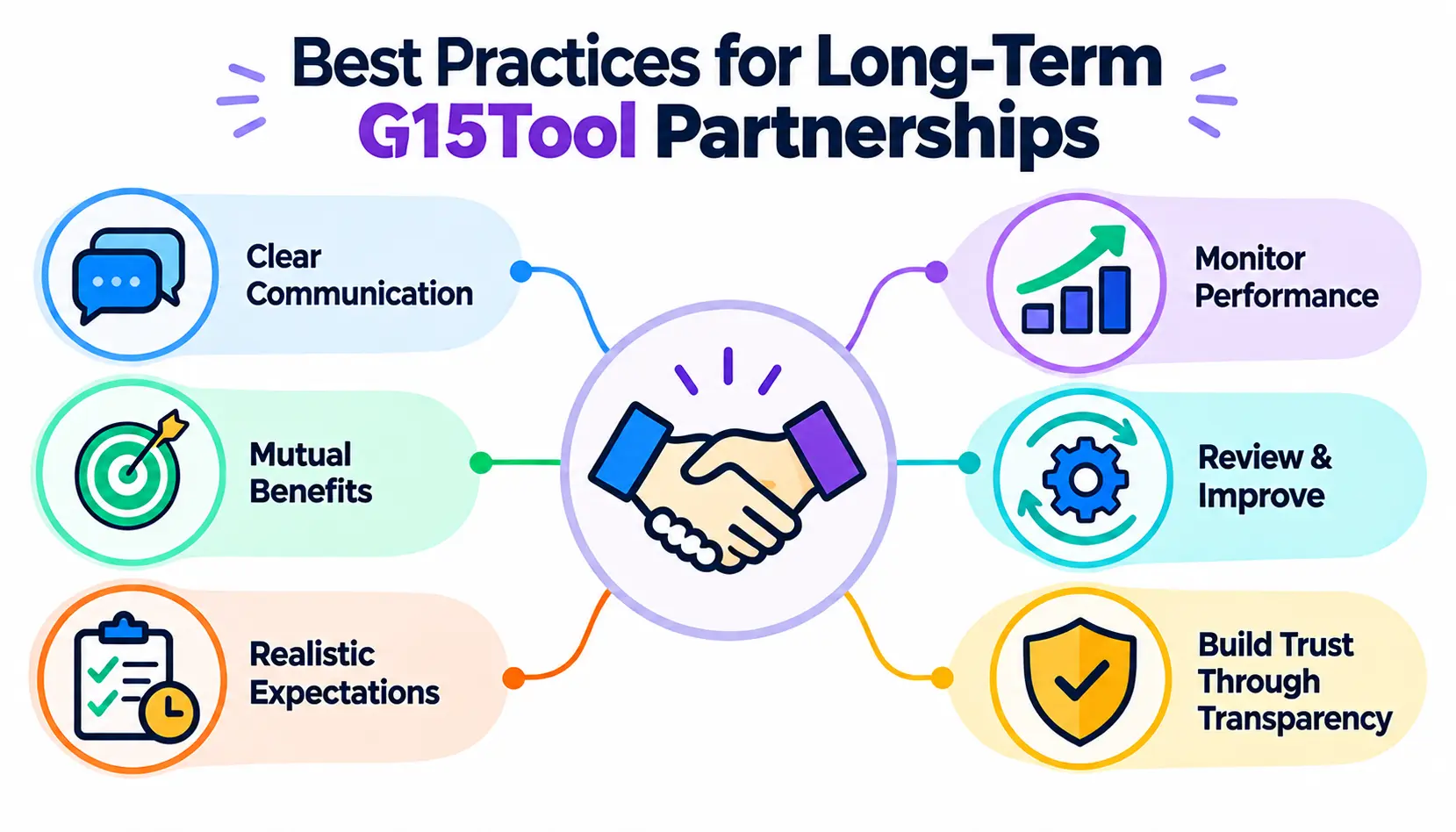
Maintain Clear Communication
Share updates regularly, even when there is little news. Silence creates doubt.
Focus on Mutual Benefits
Partnerships last when both sides win. Check in on what the other party needs.
Set Realistic Expectations
Start with modest goals and raise them as results come in.
Monitor Partnership Performance
Review your KPIs on a fixed schedule and share the numbers openly.
Review and Improve Collaboration
Ask what is working and what is not. Small changes can improve results a lot.
Build Trust Through Transparency
Be honest about results, mistakes, and constraints. Trust is the real asset.
Frequently Asked Questions About G15Tool Partners
1. What are G15Tool Partners?
G15Tool Partners refers to businesses, creators, or developers who collaborate with G15Tool. The exact structure of any program should be confirmed directly with G15Tool.
2. Is G15Tool Partners a legitimate program?
I could not confirm a fully documented official program. Verify the company, request written terms, and avoid upfront payments or guaranteed-income claims.
3. How can I join G15Tool Partners?
Start with the official website and its listed contact channels. Then send a specific proposal and ask what process, if any, applies.
4. Does G15Tool offer affiliate commissions?
This is not something I could verify. Ask G15Tool directly and get commission terms in writing before promoting anything.
5. Who can become a G15Tool partner?
That depends on the company’s own criteria. In general, partners are businesses, creators, developers, and publishers with relevant audiences or skills.
6. What are the main benefits of G15Tool partnerships?
Typical partnership benefits include visibility, new audiences, content opportunities, networking, and possible revenue. These are general benefits, not confirmed G15Tool promises.
7. How do I contact G15Tool about partnerships?
Use contact details published on the official website. Confirm the email domain matches the site before sharing any information.
8. What is the difference between G15Tool Partners and other affiliate programs?
Affiliate programs have defined public terms. For G15Tool Partners, public terms are unclear, so compare any offer against the standard questions on commission, tracking, and payment.
9. Can bloggers and website owners collaborate with G15Tool?
Possibly. Content collaborations such as reviews and tutorials are common in digital partnerships, but you should confirm G15Tool’s openness to them.
10. What should I verify before accepting a partnership offer?
Check the company identity, contact channels, written terms, payment conditions, privacy policy, and whether any claims sound too good to be true.
Conclusion
G15Tool Partners is a keyword that carries more questions than clear answers. The idea of collaboration is simple. The details of any official program are not well documented in public sources.
The safest path is practical. Define your goal, verify the company, propose something specific, put terms in writing, and measure results. Those habits protect you whether the opportunity turns out to be formal or informal.
If you take one thing from this guide, let it be this: do not assume. Confirm the program, the terms, and the contact before you invest your time, audience, or money.