
The evolution of digital education has shifted the structural requirements for Learning Management Systems (LMS) from simple document repositories to highly interactive, application-driven ecosystems. In domains such as full-stack web development, artificial intelligence engineering, and cloud infrastructure management, passive consumption of pre-recorded video content is insufficient for developing production-ready competencies. Modern learners require integrated environments that combine real-time code execution, automated testing, direct mentor communication channels, and granular telemetry on learning progress.
Building a platform capable of handling these demanding workloads requires deliberate architectural planning. Engineering teams must design systems that balance client-side responsiveness with backend infrastructure resilient enough to withstand concurrent demand spikes during scheduled cohort sessions, assessment evaluations, and live technical demonstrations.
Core Technical Requirements for Modern Educational Infrastructures
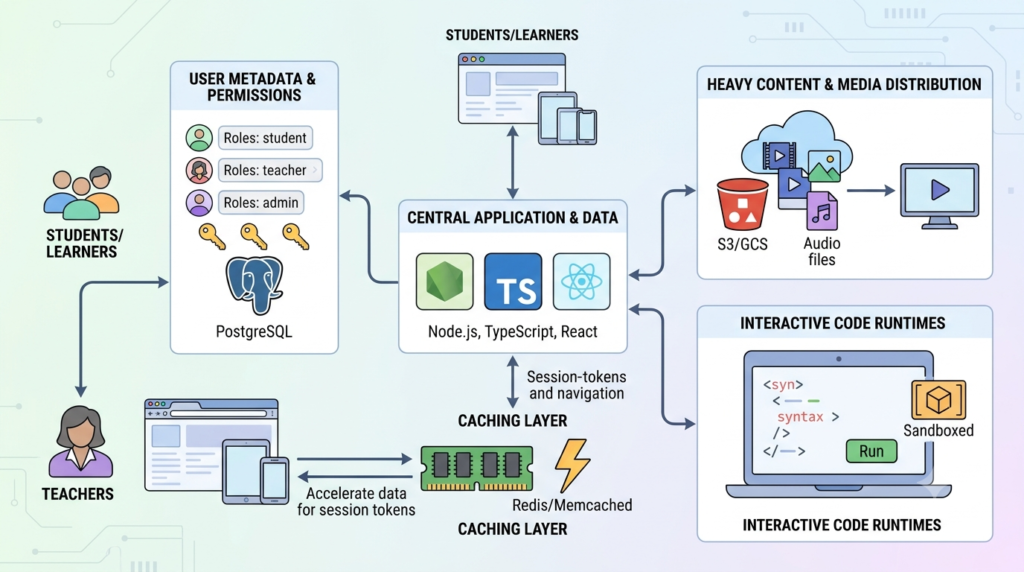
Designing an enterprise-ready learning platform requires a clear separation of concerns between user metadata management, media distribution, and execution runtimes. Standard off-the-shelf software often struggles when customized to evaluate interactive code assignments or support multi-tenant role permissions across complex organizational hierarchies.
When planning custom architectures for digital training environments, specialized development providers such as Binary Studio highlight the necessity of decoupling user state handling from heavy content execution pipelines. Utilizing technology stacks built on Node.js, TypeScript, PostgreSQL, and React allows teams to isolate transactional user data while maintaining high operational throughput. Isolating static assets within cloud object storage systems, such as Amazon S3 or Google Cloud Storage, ensures that media streaming does not starve core application databases of connection pools.
System stability under high concurrent usage further depends on effective caching layers. Implementing Redis or Memcached to store session tokens, active role permissions, and course navigation structures significantly reduces execution overhead on primary relational databases during peak platform usage.
| Architectural Dimension | Monolithic LMS Setup | Decoupled Microservices LMS |
| Scaling Mechanism | Vertical scaling of the unified application stack | Horizontal auto-scaling of dedicated microservices |
| Code Execution | Run inside main server threads (security vulnerability) | Isolated in ephemeral containers (Docker / Kubernetes) |
| Data Isolation | Shared single relational database schema | Domain-driven database separation per service module |
| Deployment Isolation | High deployment risk; single error impacts all tools | Low deployment risk; independent service updates |
Managing High-Concurrency Code Evaluation and Sandbox Environments
Technical learning platforms frequently require students to complete hands-on programming assignments directly within the browser interface. Compiling and executing user-submitted code securely requires complete isolation from the platform’s primary API servers to prevent unauthorized network calls or host resource exhaustion.
Production-grade architectures isolate execution environments using containerized orchestrators like Kubernetes or serverless execution layers such as AWS Lambda. When a student submits a coding task, an asynchronous message queue (e.g., RabbitMQ or BullMQ) captures the payload and forwards it to an isolated worker thread. The container provisions an ephemeral sandbox, runs the execution script against standardized unit tests, enforces strict CPU and memory limits, and streams execution logs back to the user via WebSockets.
Integrating Intelligent Assessment and Adaptive Learning Workflows
Modern software training environments increasingly incorporate artificial intelligence to personalize learning pathways and provide real-time diagnostic feedback. Traditional multiple-choice quizzes are being augmented with Retrieval-Augmented Generation (RAG) models trained on specific course documentation, API standards, and codebases.
These intelligent subsystems index platform documentation, exercise instructions, and code solution patterns into vector databases like Pinecone or Milvus. When a learner encounters a runtime error or structural bottleneck during an assignment, an integrated AI assistant evaluates the submitted code against vectorized documentation to offer tailored hints without exposing the full solution.
Implementing intelligent assessment workflows relies on key technical patterns:
- Contextual Execution Guardrails: Implementing strict validation layers between the AI service and the client prevents language models from generating syntactically incorrect code snippets or bypassing exercise constraints.
- Asynchronous Processing: Long-running evaluation tasks execute outside the primary synchronous HTTP request-response cycle, maintaining smooth front-end user experience.
- Aggregated Error Telemetry: Machine learning pipelines process recurring student errors across cohorts, providing instructors with actionable metrics to update curriculum content where friction occurs most.
Security, Data Privacy, and Interoperability Standards
Educational platforms process substantial volumes of sensitive user information, progress tracking data, and proprietary course materials. Compliance with international data privacy frameworks, including GDPR and CCPA, requires comprehensive data governance across every operational layer.
Data at rest should be encrypted using AES-256 standards, while data in transit must enforce TLS 1.3 encryption. Role-Based Access Control (RBAC) must be applied across API endpoints and database queries to ensure that mentors, administrators, and students maintain access strictly scoped to their verified roles.
Beyond security, integration with broader enterprise software environments requires adherence to standardized learning interoperability protocols:
- SCORM and xAPI (Experience API): Standardized protocols for formatting, tracking, and reporting learning activities to centralized Learning Record Stores (LRS).
- Single Sign-On (SSO): Protocol support for SAML 2.0 and OAuth 2.0 / OpenID Connect, enabling seamless authentication via enterprise identity management providers like Okta or Azure Active Directory.
- LTI (Learning Tools Interoperability): Enables secure embedding of external interactive tools and third-party software widgets directly into the primary platform interface without requiring re-authentication.
Balancing Custom Platform Scalability with Long-Term Maintainability
Building a resilient learning management system requires balancing immediate feature deployment with long-term architectural health. As student enrollments expand and course complexity grows, systems built on modular microservices, strong typing, and comprehensive automated test suites incur significantly lower operational overhead over time.
By prioritizing clear component separation, isolated code sandbox execution, and standardized integration protocols, engineering teams can build custom educational platforms that deliver reliable, scalable, and high-impact learning experiences for technical professionals.