
If you work in a North Carolina childcare program, you have probably seen dozens of ads for “free certificate” courses. Some help you meet state requirements. Many do not.
This guide is for teachers, assistants, directors, family child care home operators, and anyone starting a career in early education. It explains where free online childcare training courses in North Carolina are worth your time, and how to confirm a course counts before you spend an hour on it.
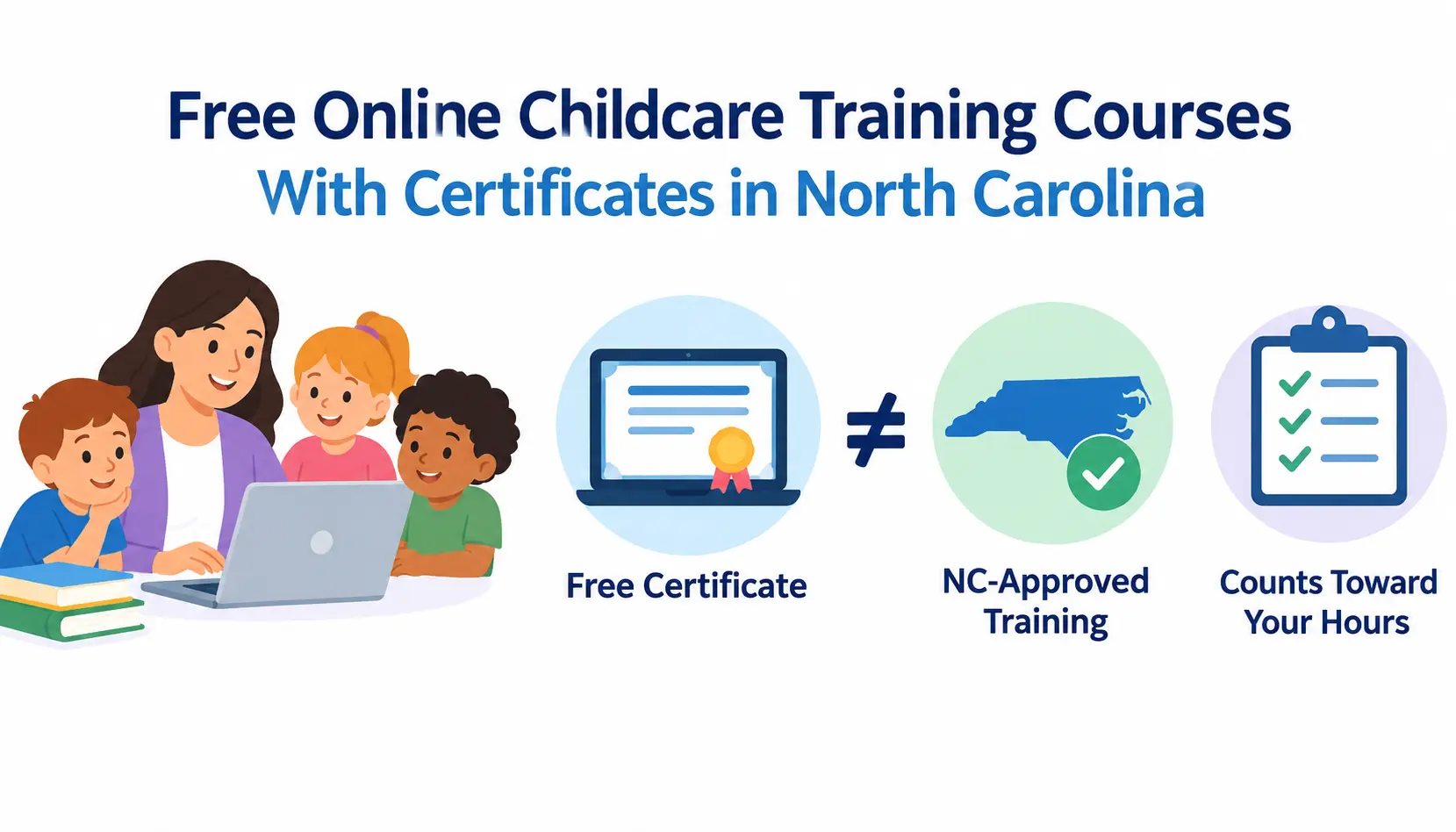
One point up front: a free certificate and NC-approved training are not the same thing. A certificate proves you finished a course. North Carolina decides whether that course counts toward your required hours.
Free Online Childcare Training Courses in North Carolina: Quick Comparison
This table is a starting point, not a guarantee. Course lists change often, so I’ve used a “verify” column instead of promising approval.
| Course/Provider | Topic | Cost | Certificate | Hours | NC Training Credit | CDA | Verify NC approval |
| NC DCDEE free professional development membership | Wide range of early education topics | Free for eligible NC staff | Yes | 200–400+ (varies by source and date) | Check each course | Includes CDA coursework | Ask your DCDEE contact or the course page |
| Texas A&M AgriLife Extension | Child development, mental health, outdoor play, more | Some courses free, others paid | Yes | Varies by course | Check each course | Offers CDA bundles | Confirm on their NC page and with DCDEE |
| ChildCareEd | Short courses, CDA intro | Some free, many paid | Certificate of completion | Varies | Check each course | Has CDA program | Their NC approved-hours page |
| CDC training | Milestones, child health | Free | Often yes | Varies | General learning; verify | Not CDA-specific | Confirm with DCDEE |
| ProSolutions Training | Health and safety, trauma-informed care | Mostly paid | Yes | Varies | DCDEE-authorized provider | CDA coursework | Confirm course by course |
| Care Courses | Outdoor play, child development | Some free | Yes | Varies | Check each course | Not primarily | Confirm before enrolling |
What Counts as Childcare Training in North Carolina?
Think of it this way. Anyone can teach a class and hand out a certificate. Only recognized training moves you closer to your state requirement.
Certificate of completion vs contact hours
A certificate of completion says you finished a course. A contact hour is a unit of training time, and it counts toward your requirement only when the training is recognized. A course can offer the first without the second.
CEUs vs childcare training hours
A continuing education unit (CEU) is a standardized credit for continuing education. You can read the general definition on Wikipedia’s page on continuing education units. Ten contact hours are commonly described as one CEU, but always check how your provider converts hours.
North Carolina lets you combine college coursework, CEUs, clock hours, and countable technical assistance to meet your annual requirement. The state says a combination of these can be used, and extra hours above last year’s requirement can be carried forward to cover up to half of the current year’s requirement. ncdhhs
DCDEE-approved or recognized training
DCDEE is the NC Division of Child Development and Early Education. Its guidance says training can be delivered in several formats, but it must be recognized by DCDEE and cover topics listed in G.S. 110-91(11). childcareed
Why a free certificate does not automatically satisfy NC requirements
A free course may cover a great topic and still not be recognized in North Carolina. A course written for another state may also miss NC-specific content. That’s why the check-first habit in this guide matters.
How Many Childcare Training Hours Are Required in North Carolina?
The answer depends on who you are. North Carolina sets ongoing training by position, education, and experience.
10-hour requirement
Staff with a certificate or diploma in a child care related field, or a North Carolina Early Childhood Credential, need 10 clock hours a year. ncdhhs
15-hour requirement
Staff with at least 10 years of documented experience as a teacher, director, or caregiver in a licensed arrangement need 15 clock hours. ncdhhs
20-hour requirement
If none of the other education or experience categories apply, the minimum is 20 clock hours. Many newer teachers fall here. ncdhhs
The chart also has lower tiers. A four-year child care related degree means 5 hours, and a two-year degree or NC Early Childhood Administration Credential means 8 hours. ncdhhs
Why your position, education, and experience matter
Picture two teachers in the same classroom. One has a two-year early childhood degree. The other started last year with a high school diploma. Their annual hour requirements can be very different.
Part-time staff may also have a smaller requirement. The rule includes a table that scales required hours by weekly working hours. Your director or DCDEE should confirm your exact number. state
Can online courses count toward ongoing training?
Yes, when the training is recognized and fits the required topics. DCDEE says pre-recorded distance learning and real-time virtual training can count. The catch is the recognition part, so do not skip it. childcareed
Best Free Online Childcare Training Resources for North Carolina
North Carolina DCDEE Professional Development Resources
Start with the state. DCDEE’s own site explains training approval, ongoing training, distance learning, and NC-specific requirements. Use the DCDEE On-Going Training page as your reference point when any provider’s claims seem unclear.
NC Free Professional Development Membership
This is the best-value option I know of for eligible staff. NC professionals currently employed by a licensed NC child care facility can get a free Teaching Strategies membership, with unlimited Quorum courses in English and Spanish. ncdhhs
An earlier DCDEE announcement described 200+ hours, including all training required for a CDA. A newer NCDHHS page says over 400 hours. Programs change, so check the current numbers and your eligibility before you sign up. ncdhhsncdhhs
Texas A&M AgriLife Extension
Texas A&M runs an online childcare training program with a page written for North Carolina providers. It says the courses may be used to meet training requirements, and offers online, self-paced formats. Topics include child development, infant and toddler care, special needs, mental health, and abuse and neglect. tamu
Its course page marks Texas Annual Training, Outdoor and Nature Play, and Preschool Mental Health as free. Note that “Texas Annual Training” is built around Texas rules, so match any course to NC topics before counting it. Texas A&M also offers coursework toward the 120 CDA training hours. tamutamu
ChildCareEd
ChildCareEd offers some free courses that give a certificate of completion. It also publishes NC-specific pages on approved contact hours, so start there. Free offerings rotate, so what you see today may be gone next month.
CDC Free Child Development Training
The CDC offers free learning on developmental milestones, child development, adverse childhood experiences, and health and safety. This is strong professional development. Treat it as general learning unless DCDEE confirms it fits your required topics.
ProSolutions Training
ProSolutions is mostly a paid subscription service, but it is useful to know. DCDEE has authorized it to offer online training to staff in regulated NC facilities. Its topics include health and safety, child abuse prevention, trauma-informed care, and social-emotional development. Check whether any free options fit your needs before paying. prosolutionstraining
Care Courses
Care Courses covers outdoor play, child development, and health and safety. It is worth a look for free options. Read carefully whether a course gives a plain certificate or credit toward a requirement, because those are different things.
UNC and Other North Carolina Early Childhood Resources
North Carolina universities and early childhood organizations publish webinars, modules, and toolkits. They are excellent for growing your skills and often free. They may not carry formal licensing credit, so use them for professional growth unless the provider says otherwise.
Free Childcare Courses by Training Topic
Here is where to look for each topic. Each is a starting point, not an approval.
- Child development: CDC milestone resources, Texas A&M, and the NC free membership.
- Health and safety: DCDEE resources, ProSolutions, and Care Courses.
- Child abuse and neglect: Texas A&M and other providers. Confirm NC’s specific reporting requirement.
- Safe sleep and infant care: Check DCDEE directly. ITS-SIDS has its own rules (covered below).
- Social-emotional development: ProSolutions, Texas A&M, and the NC membership.
- Special needs and inclusion: Texas A&M, plus university resources.
- Mental health: Texas A&M’s free preschool mental health course is a good starting point.
- Outdoor learning and play: Texas A&M and Care Courses.
- Leadership and administration: Look for director-focused courses in the NC membership.
- CDA preparation: Covered in the next section.
Free Online Childcare Training for CDA Requirements
What is the CDA credential?
The Child Development Associate (CDA) is a national early education credential from the Council for Professional Recognition. It is popular because it is achievable while you work.
How online courses can support CDA preparation
The CDA training portion is 120 hours, following Council guidelines. Online courses can cover those hours at your own pace. tamu
Which free courses can contribute to CDA-related learning?
The NC free professional development membership is the top pick. DCDEE has sponsored free CDA coursework through Teaching Strategies for licensed NC educators. Texas A&M and ChildCareEd also offer CDA-related courses, though some are paid. ncdhhs
Why completing free courses does not necessarily mean the entire CDA is free
Training hours are only one piece. A CDA also involves experience hours, a professional portfolio, a verification visit, an exam, and an application fee. Check the Council for Professional Recognition for current requirements and costs.
North Carolina Childcare Training Requirements You Shouldn’t Confuse With Free Online Courses
Some requirements are specialized. A generic online certificate may not replace them.
CPR and First Aid
These usually need hands-on skills practice and a current card. ProSolutions notes that NC staff may not use distance learning for First Aid and CPR. prosolutionstraining
Playground Safety
Playground Safety is on the same list of trainings that generally cannot be completed through distance learning. prosolutionstraining
ITS-SIDS
This is the Infant/Toddler Safe Sleep training. Distance learning generally cannot be used for it unless DCDEE specifically approves the course. prosolutionstraining
BSAC
Basic School-Age Care follows the same caution. It appears on the list of trainings where distance learning is not allowed without specific approval. prosolutionstraining
Child Maltreatment Recognition and Reporting
This is a required topic for many staff. Confirm with DCDEE which course format they accept before you rely on a free one.
Emergency Preparedness and Response
Also confirm current DCDEE requirements. These are tracked separately from general professional development hours.
How to Check Whether a Free Online Course Counts in North Carolina
Here is the routine I recommend. It takes about ten minutes and can save you hours.
Step 1: Identify the training provider
Find out who actually offers the course. Look for a real organization with contact information, not a page that only sells certificates.
Step 2: Check DCDEE recognition or approval
Look for DCDEE recognition on the provider’s NC page, then confirm with DCDEE. Do not rely on marketing language alone.
Step 3: Check whether the course is distance learning
If it is self-paced and you want contact-hour credit, it needs appropriate approval. Live virtual training is treated differently, so ask.
Step 4: Confirm the training topic
The course must address a topic in G.S. 110-91(11) and fit your job. A great course on the wrong topic won’t count.
Step 5: Check contact hours or CEUs
Find out exactly how many hours or CEUs the course awards. A one-hour video may not equal a full contact hour.
Step 6: Confirm your position-specific requirement
Know your number (5, 8, 10, 15, or 20) before you plan. Ask your director if you are not sure.
Step 7: Save your certificate and documentation
Download the certificate right away. Save the course description too, since it shows topic and hours if you are ever asked.
Certificate vs CEU vs Contact Hour: What’s the Difference?
| Term | What it proves | Can it satisfy NC requirements? |
| Certificate of completion | Course completion | Depends |
| Contact hour | Training time | When recognized |
| CEU | Continuing education | Depends on requirement/provider |
| CDA training hour | Education/training toward CDA | Depends on CDA requirements |
In plain English: a certificate shows you finished, and hours show how long you trained. Recognition decides what counts. If a course lacks the third piece, treat it as learning, not compliance.
How to Choose the Right Free Childcare Course
If you need NC-required training
Pick verified or recognized training first. Start with DCDEE resources and the NC membership.
If you need general professional development
Broader national options like CDC courses are a great fit. You do not need approval to learn something useful.
If you’re working toward a CDA
Choose courses that follow Council guidelines. Ask the provider how their hours map to the CDA subject areas.
If you need health and safety training
Focus on the specialized topics above. Confirm whether an online format is allowed at all.
If you need training quickly
Compare course length and how fast you get the certificate. Do not let a deadline push you into an unverified course.
How to Keep Track of Your Childcare Training Certificates
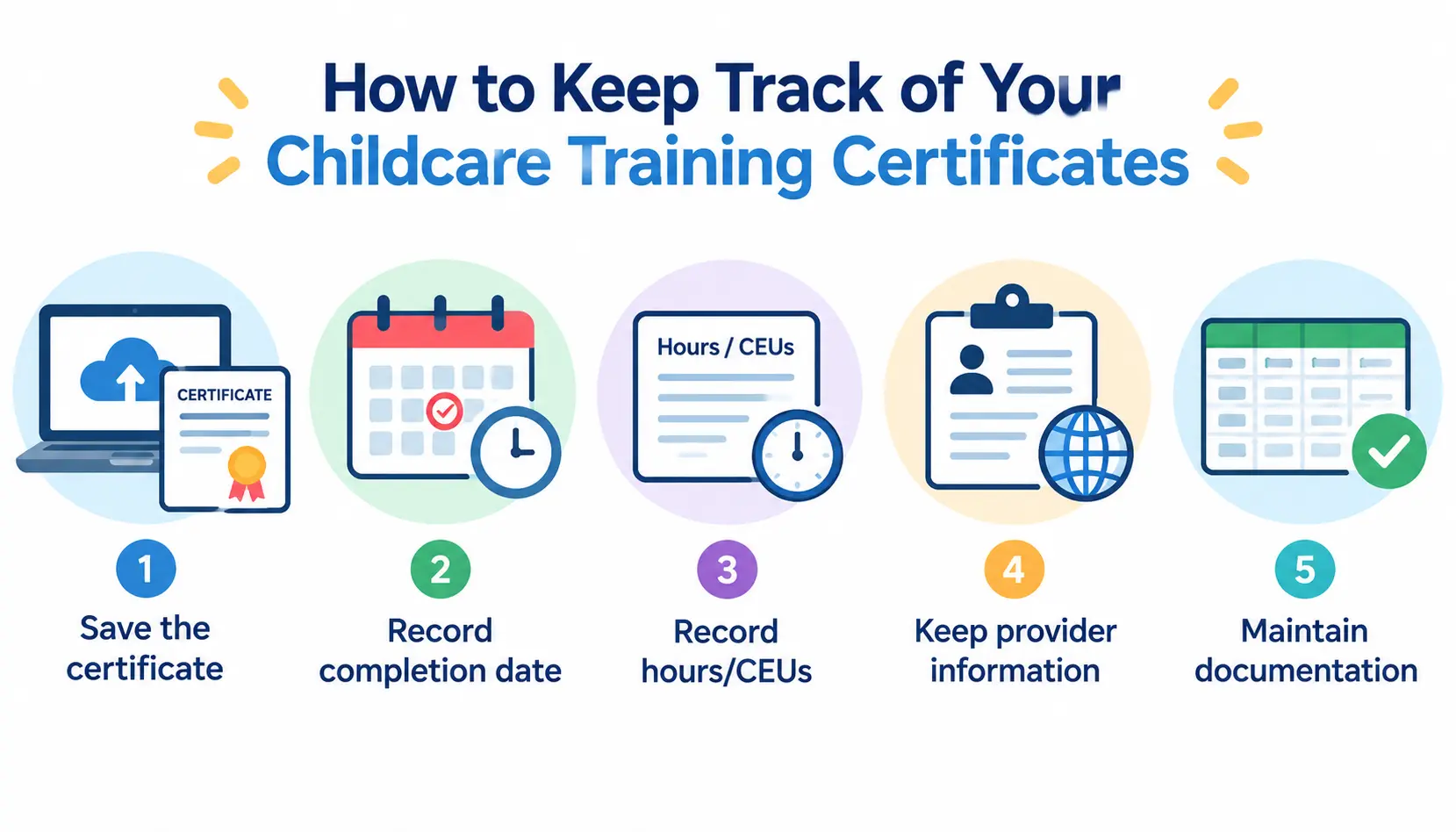
Save the certificate
Store a PDF in cloud storage and keep a paper copy at work if your program asks for one.
Record completion date
Log the date the moment you finish. Dates matter when you are counting hours inside a licensing year.
Record hours/CEUs
Write down the exact hours or CEUs the certificate shows.
Keep provider information
Note the provider name, course title, and website. Providers change their catalogs.
Maintain documentation for your employer or licensing records
Give your director a copy. A simple spreadsheet with date, course, provider, topic, and hours works well.
Common Mistakes to Avoid
- Assuming every free certificate is NC-approved
- Confusing CEUs with contact hours
- Ignoring position-specific training requirements
- Using an outdated course list
- Assuming online means automatically accepted
- Forgetting specialized requirements like CPR and ITS-SIDS
- Failing to save certificates
- Paying for a certificate when a free option exists
- Assuming CDA training equals a CDA credential
Want to hear how other educators handle this? The r/ECEProfessionals community on Reddit is a helpful place for real-world experiences. Treat those posts as opinions, though, and verify rules with DCDEE.
Frequently Asked Questions
1. What are the best free online childcare training courses in North Carolina?
Start with the NC free professional development membership if you are eligible. Then consider Texas A&M AgriLife, ChildCareEd, and CDC training, and verify recognition for each.
2. Can I get a childcare certificate online for free?
Yes. Many providers offer free certificates of completion. That certificate does not automatically count toward North Carolina requirements.
3. Does North Carolina accept online childcare training?
Yes, when the training is recognized by DCDEE and covers required topics. Some specialized training, such as CPR and ITS-SIDS, have tighter rules.
4. How many training hours does a childcare worker need in NC?
It depends on position, education, and experience. The DCDEE chart ranges from 5 to 20 hours a year. ncdhhs
5. Does a certificate of completion count toward NC childcare requirements?
Only if the course itself is recognized and on an eligible topic. The certificate alone does not decide that.
6. Can free courses count toward a CDA?
Some can. Providers like Texas A&M offer coursework toward the 120 CDA training hours. Confirm that the provider follows Council guidelines. tamu
7. Is CPR training separate from online childcare professional development?
Yes. CPR and First Aid are specialized requirements, and generally cannot be met through distance learning alone.
8. How do I know whether a childcare course is approved by DCDEE?
Check the provider’s NC page, then confirm with DCDEE. Follow the seven steps in this guide.
9. Can I complete childcare training from my phone?
Many online platforms work on phones. Check that the course works on mobile and lets you download your certificate.
10. Do childcare training certificates expire?
Course completion certificates generally do not expire. CPR and First Aid cards do, so keep those current.
Conclusion
Free online childcare training courses in North Carolina can save you real money and build real skills. Start with the state’s own free membership, add trusted providers, and always verify recognition before you count hours.
Do that, and a free certificate becomes what you wanted in the first place: proof that moves your career forward.