
If you work in childcare in Virginia, you have probably searched for free online childcare training courses in Virginia and found a mix of state programs, private course sellers, and “free” offers that turn out to have a fee. This guide sorts them out.
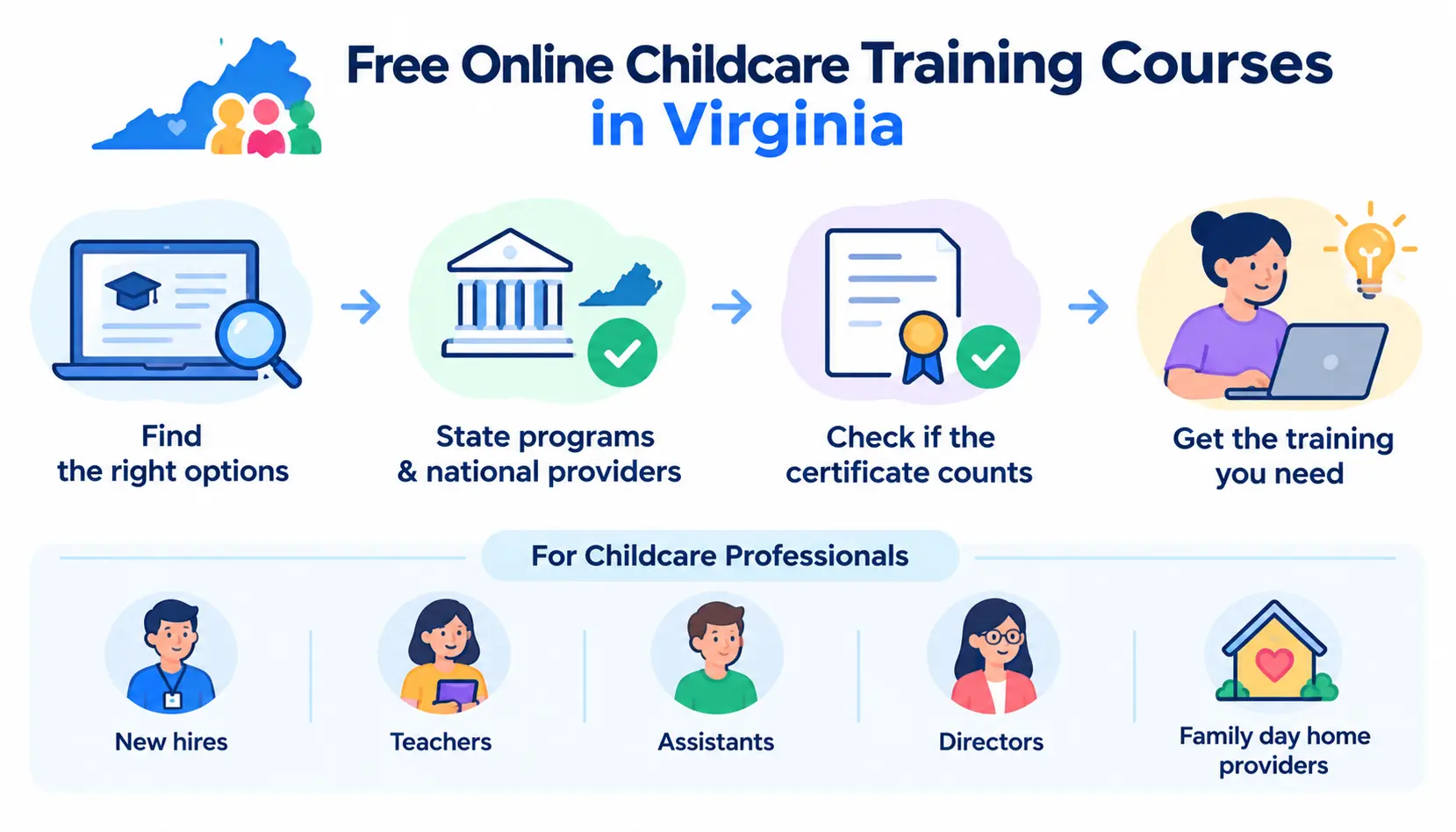
It is written for new hires, teachers, assistants, directors, and family day home providers. It explains which free courses Virginia itself offers, which national providers may help, and how to check that a certificate counts before you spend your time.
What “Free” Means, and Why Virginia Approval Matters
“Free” can mean three things:
- Free to take and free to certify. You pay nothing and get a certificate.
- Free to start, paid to certify. You can watch the lessons, but the certificate costs money.
- Free for some people. Eligibility depends on your program, such as subsidy participation.
A certificate is also not the same as Virginia-accepted training. A certificate proves you finished a course. Virginia acceptance means the course satisfies a specific licensing or subsidy requirement. A generic course on “child development” may be useful, but it may not meet a rule that names a particular topic or provider.
Quick answer: If you need training right away, start with the free Virginia Preservice Training and the free Annual Health and Safety Update through Better Kid Care. Add the free courses from Community College Workforce Alliance (CCWA) for abuse reporting and health screening. Get CPR/First Aid through Child Care Aware of Virginia if you qualify.
Free Online Childcare Training Courses in Virginia: Quick Comparison
Virginia-specific free training
| Course/provider | Cost | Certificate | Hours | Virginia acceptance | Format | Best for |
| Virginia Preservice Training (Better Kid Care) | Free | Yes | 3 to 6 hours depending on pathway | Required by VDOE for covered roles | Online, self-paced | New staff and subsidy applicants |
| Virginia Annual Health and Safety Update | Free | Yes | 3 hours | Required for staff in subsidy programs | Online, self-paced | Subsidy-program staff |
| Better Kid Care On Demand | Varies by course | Yes | Varies | Accepted by VDOE for professional development | Online, self-paced | Annual training hours |
| CCWA: Child Abuse and Neglect | Free | Yes | See course page | Meets regulatory and statutory requirements | Online | All childcare staff |
| CCWA: Health Screening | Free | Yes | See course page | Meets daily health observation training | Online | Staff doing health checks |
| Child Care Aware of Virginia: First Aid/CPR | Free if eligible | Yes | Varies | Provided on behalf of VDOE | Blended or in person | Subsidy providers, infant/toddler care |
General free courses from national providers
| Provider | Cost | Certificate | Virginia acceptance | Best for |
| Texas A&M AgriLife Extension | Check current listing | Yes | Says courses follow Virginia topics | Extra hours |
| ChildCareEd | Some free offers | Yes | Publishes a Virginia catalog | Annual hours, CDA |
| Care Courses | Check current listing | Yes | Verify per course | Topic learning |
The second table comes with a warning. Confirm the current price and acceptance on each provider’s page before you enroll.
Which Free Childcare Training Courses Are Accepted in Virginia?
Virginia Preservice Training
Who needs it. Staff at licensed child day centers and subsidy-approved programs who work directly with children. Per the Virginia Department of Education (VDOE), staff must complete it within 90 days of starting work. Prospective subsidy providers must finish it before approval.
Course pathways. The old 10-hour course has been replaced by a pathway model. Everyone takes a foundations course, then adds a course matched to the program and children’s ages:
- Foundations for Health and Safety (3 hours): required for all staff.
- Birth-to-five, child day center (3 hours).
- School-age, child day center (1.5 hours).
- Family day home care (3 hours).
Directors and staff who work with both age groups take all three relevant courses. VDOE announced the newer courses in a 2026 provider memo, and its page says the previous 10-hour course was retired as of June 1, 2026. Some pathway courses were still marked “coming soon” on the page I reviewed, so check that page for the latest.
Language and cost. Courses are available in English and Spanish. VDOE has partnered with Better Kid Care to host them at no cost.
Virginia Annual Health and Safety Update
This is a free, three-hour follow-up to preservice training. VDOE says it is required for staff who work directly with children in programs that take part in the Child Care Subsidy Program. Other childcare and preschool staff are encouraged to take it.
The first update is due within one year of finishing preservice training. If you finished preservice on June 13, 2025, VDOE’s example puts your update deadline at June 12, 2026. After that, you take it every year.
You get a certificate of completion. Save it.
Better Kid Care On Demand
Better Kid Care is run through Penn State Extension. It offers self-paced online lessons across many childcare topics. Its Virginia page states that all On Demand courses are accepted by VDOE for childcare professional-development requirements.
The Virginia-required health and safety courses are free. Other On Demand lessons may carry a small fee, so read the price before you start. Certificates are issued to each individual account, so group viewing does not earn group credit.
CCWA Free Childcare Courses
Community College Workforce Alliance offers two free online classes in partnership with the Commonwealth. Both are available in English and Spanish.
Child Abuse and Neglect: Recognition and Reporting (CHLD 2015). VDOE says this class meets regulatory and statutory requirements for child day programs.
Health Screening for Childcare Professionals (CHLD 2016). This matters because of how the licensing rules are written. The child day center regulation, 8VAC20-780-245, requires at least one staff member on duty who has had daily health observation instruction within the last three years. In plain terms, the person greeting children each morning should know how to spot signs of illness. CCWA says this course covers that training.
Child Care Aware of Virginia
Child Care Aware of Virginia (CCAoVA) offers free professional development, and it delivers First Aid and CPR on behalf of VDOE. VDOE says there is no cost for providers in the Child Care Subsidy program or providers who care for infants and toddlers.
CCAoVA also offers online and live training, and free one-on-one support for providers applying to the subsidy program. Its training calendar lists current sessions.
How Many Training Hours Do Childcare Workers Need in Virginia?
Annual Training Requirements
The number most people hear is 16 hours per year. For licensed child day centers, the regulation says staff must complete a minimum of 16 hours of training appropriate to the age of children in care. Licensed family day home caregivers must complete 16 clock hours annually, in addition to first aid and CPR training.
Training must relate to your job and the children you serve.
Requirements by Program and Role
The 16-hour figure is a starting point. Here is how it shifts:
- Child day centers: 16 hours a year for staff. Staff who do not work with a group of children only need annual training on emergency preparedness, child abuse and neglect, and mandated reporting.
- Short-term programs: Staff who work with children need at least 10 hours a year.
- Special needs and therapeutic programs: Four additional hours a year, with at least eight hours on special-needs topics.
- Home-based care: 16 hours plus current CPR and first aid. Medication administration training is required if you give medication.
- Subsidy providers: Preservice training and the annual health and safety update apply on top of licensing rules.
- Directors, teachers, and assistants: Qualification rules differ by role, and directors often have extra management or education requirements. Ask your licensing specialist which rules cover your position.
Preservice vs. Annual Training
New employees often mix these up. Preservice training is the starting requirement. Annual training is ongoing professional development. The regulation says annual training is in addition to orientation requirements, so completing preservice does not count toward your 16 hours. Track them separately.
Free Childcare Training Providers in Virginia
- Better Kid Care: Home of the free state-required courses and a large On Demand catalog. It also has directors’ training on leadership and administration.
- Child Care Aware of Virginia: Training calendar, free First Aid/CPR for eligible providers, and subsidy-provider support.
- Community College Workforce Alliance: The two free CCWA courses above.
- Virginia Infant & Toddler Specialist Network (VA ITSN): Virtual and in-person professional development for people caring for children from birth to 36 months.
- Virginia Early Intervention eLearning Center: Free modules, including one on social-emotional development, each ending in a certificate of completion.
- ChildSavers: Points providers to free opportunities through Child Care Aware, Virginia Quality, and VA ITSN. Topics include trauma-informed care, emergency preparedness, child development, family engagement, and infant/toddler development.
- Virginia Quality: The state’s quality rating and improvement system. Participation can open doors to supports and trainings.
Free Online Childcare Courses From National Providers
National providers can fill gaps, especially when you need extra hours on a specific topic. The key rule: a national certificate does not automatically satisfy a Virginia requirement.
Texas A&M AgriLife Extension
Texas A&M’s childcare training covers child development, infant and toddler care, special needs, mental health, outdoor play, abuse and neglect, and CDA preparation. It states that its Virginia courses are built around Virginia training topics and give certificates of completion. Check the current price before you sign up.
ChildCareEd
ChildCareEd offers self-paced courses, certificates, CEUs, and CDA options. It maintains a Virginia-approved catalog and sometimes has free courses. Look at the course page to see whether a specific course is free, how many hours it awards, and whether it lists Virginia acceptance.
Care Courses
Care Courses covers topics like child development, outdoor play, and health and safety, and it lists some Virginia-specific offerings. Verify each course’s acceptance individually.
Brightwheel’s Free-Course Resources
Treat Brightwheel’s lists as a discovery tool. A course appearing there does not mean Virginia approves it. Use the list to find ideas, then check acceptance yourself.
Other Free Platforms
Only use a course if you can verify its current cost and whether it gives a certificate. Free offers expire and terms change.
Free Childcare Training by Topic
Use this to plan your annual hours around real needs.
- Child development: Better Kid Care On Demand, Texas A&M, ChildCareEd.
- Health and safety: The free Virginia Health and Safety courses, plus the FEMA preparedness course VDOE lists.
- Child abuse and neglect: CCWA CHLD 2015 and the state refresher.
- Infant and toddler care: VA ITSN and CCAoVA sessions.
- Mental health: Trauma-informed care sessions through ChildSavers-listed providers.
- Special needs and inclusion: Virginia Early Intervention eLearning Center modules.
- Outdoor learning: Texas A&M and Care Courses.
- Emergency preparedness: FEMA’s Preparedness for Child Care Providers, linked from VDOE.
- Family engagement: Virginia Quality and CCAoVA offerings.
- Leadership and administration: Better Kid Care Directors’ Training.
Free CPR and First Aid Training for Virginia Childcare Providers
Who May Qualify
VDOE points eligible providers to Child Care Aware of Virginia for free First Aid/CPR. Eligible groups are providers in the Child Care Subsidy program and providers who care for infants and toddlers.
Is Online-Only CPR Accepted?
Usually not. Some local authorities are explicit. Fairfax County says online or video-only pediatric CPR and first aid do not meet its permit requirements. It accepts live in-person or blended training, where you finish part of the course online and are tested in person. Ask your licensing specialist before you pay for any class.
Pediatric vs. Adult CPR
Choose training that matches the ages in your care. Pediatric (infant and child) CPR is the safe choice for most childcare settings. An adult-only class may not qualify.
Renewal
Check the expiration date on your card and set a reminder well before it. Renewal periods depend on the certifying organization and your licensing rules.
How CPR Differs From Online Professional Development
CPR and first aid need hands-on skills. Most other courses in this guide teach knowledge you can gain from a screen. A self-paced certificate cannot replace a skills check.
Free Child Abuse and Neglect Training in Virginia
Mandated Reporter Training
Childcare workers in Virginia are among the professionals the law requires to report suspected abuse. For background, see this overview of mandated reporters. Check Virginia’s own statute and VDOE guidance for the rules that apply to you.
CCWA’s Free Course
CHLD 2015 is free, online, and available in English and Spanish. VDOE says it meets regulatory and statutory requirements for child day programs.
Refresher Training
VDOE and the Virginia Department of Social Services created a free refresher on mandated reporting laws and caregiver resources. VDOE recommends it for anyone involved with a child day program or family day system.
Who Needs It?
Everyone who works around children should take it. For staff who do not work directly with a group, the regulation still requires annual training on child abuse and neglect and mandated reporter requirements.
Free Health Screening Training in Virginia
What It Covers
Daily health observation means checking each child for signs of illness or injury at arrival and during the day. The training teaches you what to look for and when to act.
Who Needs It?
Centers must always have at least one staff member on duty who completed this instruction within the last three years. Ask your director who holds it now and when it expires.
Why the CCWA Course Matters
CCWA states that its Health Screening course satisfies specific Virginia daily-health-observation training requirements. Because it is free, it is an easy way to cover that rule.
Documenting Completion
Save the certificate and note the completion date. Record it in your staff file so it is ready for inspection.
Online Childcare Training for CDA Preparation
What Is the CDA?
The Child Development Associate (CDA) is a national credential from the Council for Professional Recognition. It is a credential you earn, not a single course.
Training-Hour Requirement
The CDA requires 120 hours of professional education. It also requires supervised experience with children and an exam. Confirm current details with the Council.
Free vs. Paid CDA Coursework
Some free courses may contribute hours, but check that they cover the required subject areas and that the provider is acceptable to the Council. VDOE notes that Child Care Aware of Virginia offers sessions that can be used toward a CDA. The Virginia Association for the Education of Young Children (VAAEYC) offers scholarships for members pursuing a CDA.
What a Certificate Proves
A course certificate shows you finished a course. It does not mean you hold a CDA credential. Do not confuse the two.
Certificate vs. CEU vs. Training Hour: What’s the Difference?
| Term | Meaning | Virginia relevance |
| Certificate of completion | Proof you completed a course | Counts only if the course is accepted for your requirement |
| Clock hour | Unit of training time | Annual training is measured this way |
| CEU | A continuing education unit, which is a different measurement | Ask whether your requirement accepts CEUs |
| Preservice training | Initial required training | Depends on role and program |
| Annual training | Ongoing professional development | Required under the applicable rules |
How to Verify That a Free Course Counts in Virginia
- Check the provider. Is it a state partner or a recognized organization?
- Check VDOE acceptance. Look for it on the VDOE training page or on the provider’s Virginia page.
- Confirm the topic. Does it match what your requirement names?
- Check the hours. Only the awarded clock hours count.
- Check the documentation. Does the certificate show your name, course, date, hours, and provider?
- Know the category. Is it preservice or annual training?
- Save your certificate.
- Record it in your professional-development file.
If you are unsure, email your licensing specialist. A written answer protects you.
What Can You Complete Online, and What May Need Hands-On Practice?
- Online-friendly: Preservice training, the annual update, CCWA courses, and most professional development.
- CPR and First Aid: Need a hands-on skills component in most cases.
- Medication Administration Training: Virginia’s MAT program trains and certifies child day program providers to give medications safely. It has its own process and is not a self-paced certificate.
- Other specialized training: Ask before assuming an online class is enough.
Free Training for Different Virginia Childcare Roles
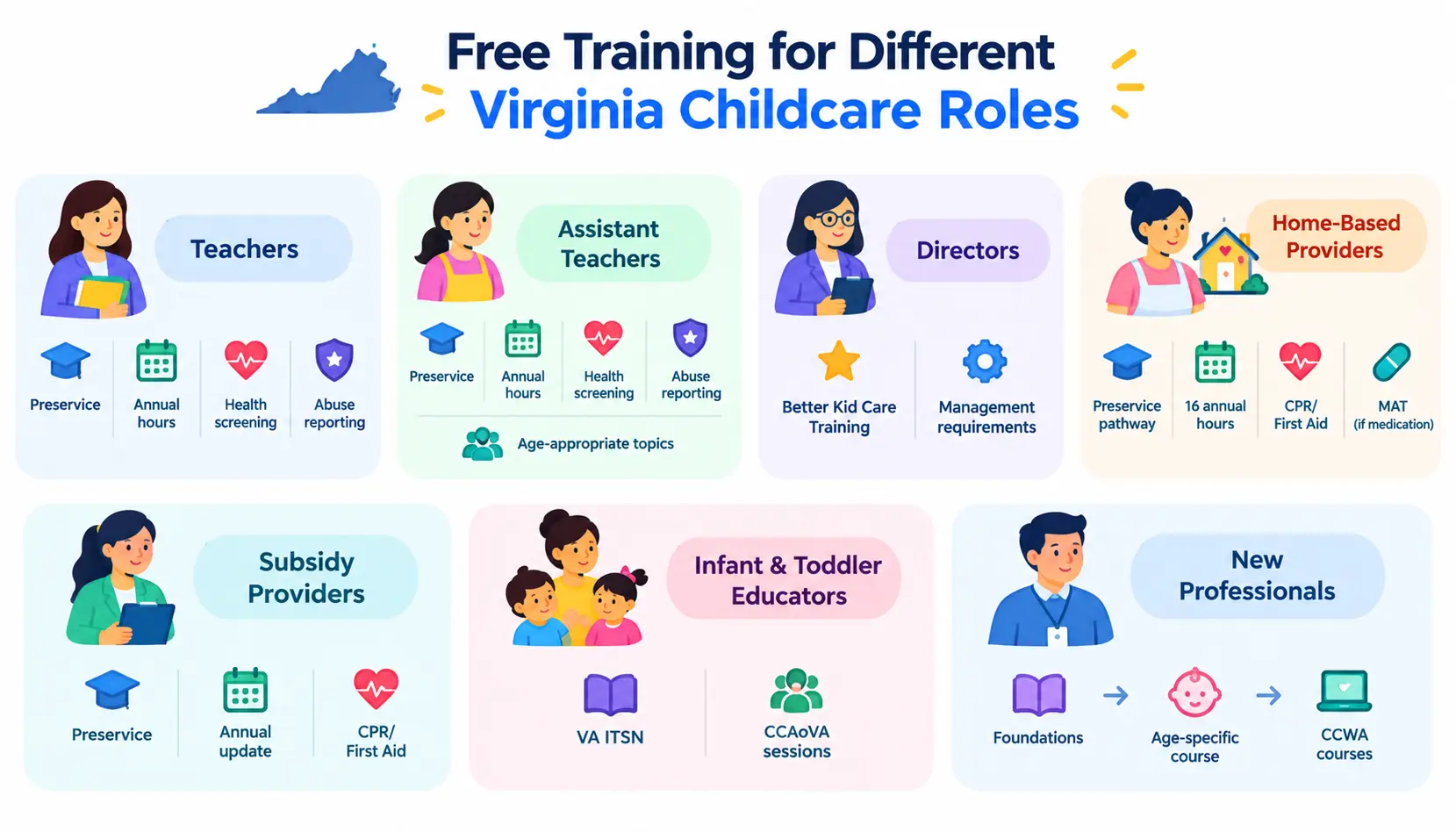
- Teachers: Preservice, annual hours, health screening, and abuse reporting.
- Assistant teachers: Same core requirements, with age-appropriate topics.
- Directors: Add Better Kid Care Directors’ Training and any management requirements.
- Home-based providers: Preservice pathway, 16 annual hours, CPR/First Aid, and MAT if you give medication.
- Subsidy providers: Preservice, the annual health and safety update, and CPR/First Aid.
- Infant and toddler educators: VA ITSN and CCAoVA sessions.
- New professionals: Start with Foundations and the age-specific course, then the CCWA courses.
How to Keep Track of Your Virginia Childcare Training Certificates
Here is a simple system that works. A scenario helps: a new assistant teacher finishes four online courses in her first month. Six months later, an inspector asks for proof. She has one folder with every certificate, and a sheet listing dates and hours, so it takes two minutes.
Do this for each course:
- Save the certificate as a PDF.
- Record the completion date.
- Record the hours or CEUs.
- Record the provider and course title.
- Keep records ready for your employer or inspector.
Virginia’s family day home guidance says records should include the staff member’s name, session name, date, hours, and sponsoring organization.
Common Mistakes to Avoid
- Assuming every free certificate is Virginia-approved.
- Confusing certificates with CEUs.
- Ignoring preservice requirements.
- Counting a generic course toward a specific state requirement.
- Assuming CPR can always be done online.
- Forgetting annual training.
- Using outdated course information, such as the retired 10-hour preservice course.
- Failing to save certificates.
- Assuming CDA training equals a CDA credential.
- Not checking whether a free offer is still available.
Frequently Asked Questions
1. What are the best free online childcare training courses in Virginia?
Start with the free Virginia Preservice Training and Annual Health and Safety Update, then the free CCWA courses on abuse reporting and health screening.
2. Can I get a childcare certificate online for free?
Yes. Several Virginia-specific courses are free and award certificates of completion.
3. Does Virginia accept online childcare training?
Yes, when the course is approved or accepted for your requirement. Better Kid Care says VDOE accepts all its On Demand courses for professional development.
4. How many training hours do childcare workers need in Virginia?
Most licensed center staff and family day home caregivers need at least 16 hours a year. Some roles differ.
5. Is Virginia Preservice Training free?
Yes. VDOE hosts it at no cost through Better Kid Care.
6. Is Better Kid Care accepted in Virginia?
Yes. Better Kid Care states VDOE accepts all On Demand courses for Virginia childcare professional development.
7. Can I get free CPR and First Aid training in Virginia?
Possibly. Child Care Aware of Virginia provides it free to subsidy providers and providers who care for infants and toddlers.
8. Is child abuse reporting training free in Virginia?
Yes. CCWA’s CHLD 2015 course is free, and a free state refresher exists.
9. Does a certificate of completion count toward Virginia childcare requirements?
Only if the course is accepted for that requirement.
10. Can free courses count toward a CDA?
Some may, if they meet the Council’s subject-area and provider rules. Verify first.
11. Can I complete childcare training on my phone?
Many self-paced courses work on phones, but check the platform. Hands-on classes cannot be done that way.
12. How do I document my Virginia childcare training?
Save each certificate and record the date, hours, provider, and course title in one file.
Conclusion
Free online childcare training courses in Virginia can cover much of what you need. The state’s own free courses handle preservice and health and safety training. CCWA covers abuse reporting and health screening, and Better Kid Care adds a wide catalog for annual hours.
Do not assume a certificate is enough on its own. Confirm that each course counts for your role, keep your records organized, and schedule hands-on CPR early. Do that, and you can meet your requirements without spending money.