
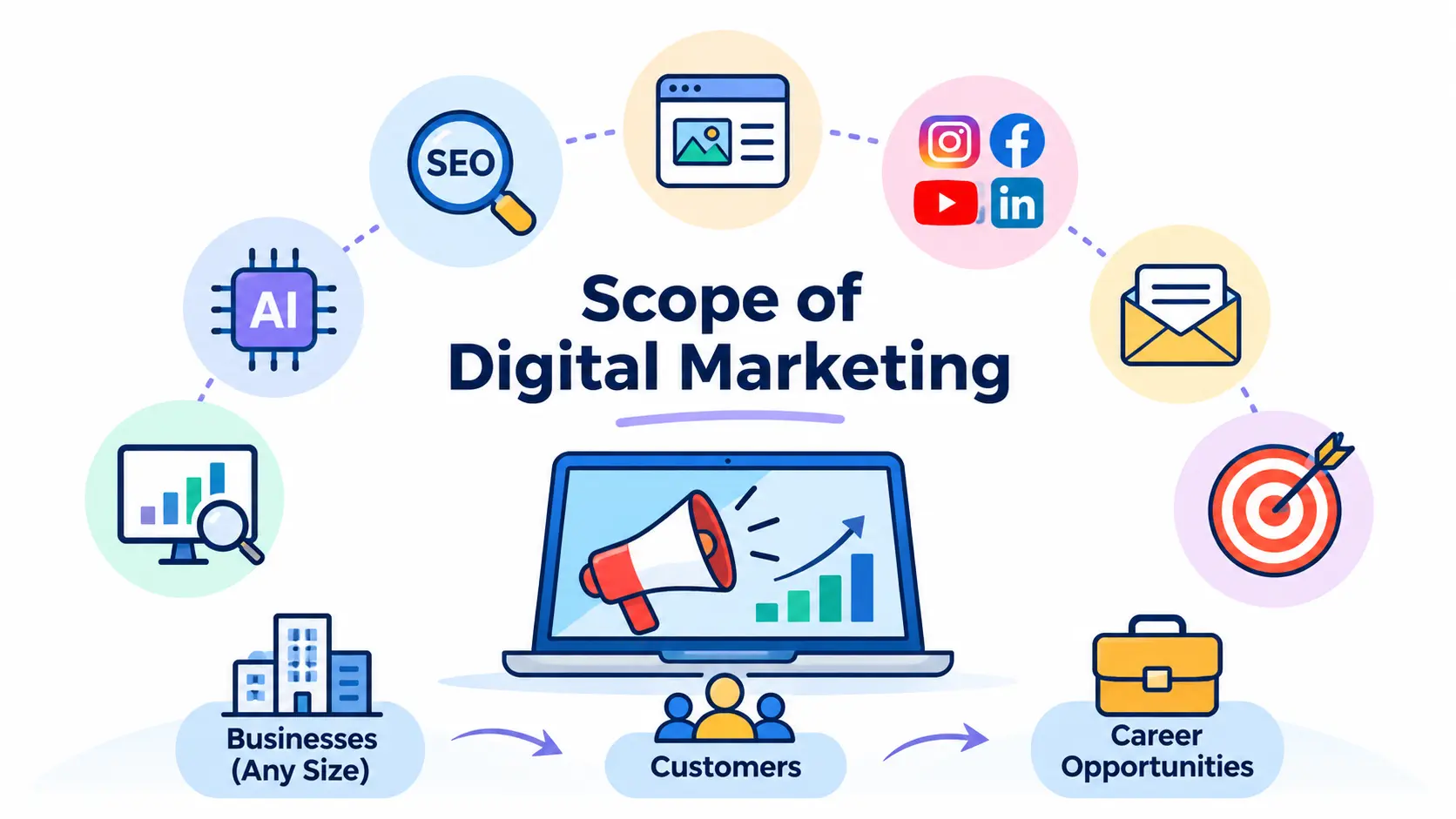
The scope of digital marketing covers a broad range of activities, channels, strategies, tools, and career opportunities used to promote products, services, and brands through digital platforms. It explains how businesses can use online marketing to attract potential customers, engage with audiences, generate conversions, and build long-term customer relationships.
In practical terms, the scope of digital marketing includes everything a business can do online to connect with its target audience. This involves search engines, websites, social media platforms, email campaigns, paid advertisements, mobile applications, data analytics, automation tools, and emerging technologies such as artificial intelligence. Digital marketing is relevant to businesses of every size and industry, and its scope continues to grow as technology and consumer preferences change.
Understanding the scope of digital marketing helps businesses choose suitable marketing channels, allocate budgets effectively, and measure campaign performance. It also helps students and professionals discover valuable career opportunities in this continuously expanding industry.
Understanding Digital Marketing
Digital marketing includes all promotional activities carried out through online channels. It involves advertising products, services, and brands using websites, search engines, social media networks, email, and mobile applications. An AI Video Generator like Higgsfield can also help marketers produce engaging videos for their digital campaigns.
To present marketing ideas in a visually appealing way, marketers can use an AI Instagram post generator to transform informative content into attractive social media posts that capture audience attention.
Over the years, digital marketing has developed into a combination of effective strategies, including search engine optimization (SEO), content marketing, social media marketing, paid advertising, and several other techniques. These strategies work together to improve online visibility, encourage audience interaction, and generate conversions. SEO professionals working on off-page optimization can also explore the best link building marketplaces to compare publisher relevance and available placement opportunities.
A Practical Example of Digital Marketing
Suppose you own a small bakery. You can share pictures of freshly prepared products on social media, respond to customer comments, and optimize your website for local searches such as “best bakery near me.” These activities can help attract customers in your area without depending entirely on traditional advertising. This is a simple example of digital marketing in practice: targeted, measurable, and effective.
Major Components of Digital Marketing
The scope of digital marketing extends beyond a single promotional channel. One of its biggest advantages is flexibility, as businesses can customize their marketing strategies according to their size, industry, objectives, and available resources.
1. Search Engine Optimization (SEO)
Search engine optimization (SEO) aims to improve a website’s visibility in search engine results. By optimizing website content, improving site structure, and building quality backlinks, businesses can attract organic visitors without paying for every website click. Students interested in developing these skills can gain practical knowledge through an SEO Internship covering keyword research, on-page optimization, technical SEO, and website performance analysis.
2. Content Marketing
Content marketing focuses on producing useful and relevant materials, including blogs, videos, infographics, and guides, to attract and retain a target audience. It helps businesses establish trust, demonstrate expertise, and build lasting relationships while supporting their SEO and social media activities.
3. Social Media Marketing
Social media marketing helps brands communicate directly with their audiences. Regular posting, engaging storytelling, and meaningful interactions allow businesses to develop online communities, improve brand awareness, and generate potential leads. For companies aiming to strengthen direct outreach, cold calling services can also support digital marketing efforts and help identify qualified prospects.
For instance, AI reel makers allow brands to create engaging Instagram Reels using simple prompts or product images, making social media content production quicker and more consistent.
4. Pay-Per-Click (PPC) Advertising
Pay-per-click (PPC) advertising allows businesses to pay when users click on their advertisements. These campaigns offer precise audience targeting, while tools like Cruva help marketers reach potential customers based on factors such as location, interests, and online behavior.
5. Email Marketing
Email marketing continues to be an effective way to communicate with customers and potential buyers. By combining personalized messaging with AI Call Assistant technology, businesses can create timely communication strategies that nurture leads, improve customer loyalty, and encourage repeat purchases.
6. Affiliate Marketing
Affiliate marketing helps businesses expand their audience by collaborating with individuals or organizations that promote their products or services in return for a commission. This performance-based approach can provide an affordable way to increase brand exposure and generate sales.
7. Influencer Marketing
Influencer marketing involves working with trusted personalities and content creators who have established audiences within specific niches. Their authentic recommendations can help businesses build credibility, increase brand awareness, and connect with potential customers more effectively than conventional promotional methods.
8. Online Public Relations (PR)
Online public relations focuses on maintaining and improving a brand’s reputation across digital platforms. This includes managing online reviews, blog mentions, digital publications, and social media conversations that influence how customers perceive a business.
Digital marketing provides several advantages that traditional promotional methods may struggle to deliver. As more consumers spend time online, these benefits have made digital marketing an important part of business development and long-term growth.
Key Benefits of Digital Marketing
1. Wider Audience Reach
Digital marketing allows businesses to connect with potential customers across different cities, countries, and continents. Unlike traditional promotional methods that often have geographical limitations, online platforms enable brands to reach international audiences at any time.
2. Budget-Friendly Marketing
Affordability is one of the major advantages of digital marketing. Businesses can launch campaigns with flexible budgets and adjust their spending according to their goals. Even smaller companies can compete with established brands by following well-planned, data-driven marketing strategies without making substantial investments.
3. Trackable Performance
Digital marketing offers access to real-time performance information and useful analytics. Marketers can monitor metrics such as impressions, clicks, audience engagement, and conversions to understand campaign effectiveness and make informed improvements.
4. Precise Audience Targeting
Businesses can use digital marketing to reach specific audiences according to their age, location, interests, preferences, behavior, and online activities. This allows promotional messages to reach people who are more likely to become customers, helping improve campaign efficiency and return on investment (ROI).
5. Better Customer Interaction
Digital channels make communication between businesses and customers more interactive. Social media discussions, emails, live chats, and online reviews give brands opportunities to respond to customer questions, understand their expectations, and develop stronger relationships.
6. Greater Campaign Flexibility
Digital marketing campaigns can be adjusted whenever required. If an advertisement or marketing strategy is not producing the expected results, businesses can quickly modify their content, targeting options, advertising budget, or promotional approach. This level of flexibility is difficult to achieve with many traditional marketing methods.
The Role of Data in Digital Marketing
Data is an essential part of successful digital marketing because it allows businesses to understand their audiences, refine marketing activities, and improve overall performance. By examining website traffic, customer interactions, search trends, and social media engagement, marketers can better identify what their audiences prefer, need, and expect.
These insights help businesses develop personalized campaigns, connect with relevant customer groups, and publish suitable content at the right time. Data also makes it possible to evaluate campaign performance using measurements such as conversion rates, click-through rates, and return on investment (ROI). Marketers can use these insights to identify weaknesses and improve their strategies.
Overall, data-driven digital marketing minimizes guesswork, improves campaign efficiency, and supports better business decisions that contribute to customer satisfaction and sustainable growth.
Why Digital Marketing Is Important for Businesses of Every Size
For many years, businesses depended heavily on traditional promotional methods such as television advertisements, newspaper campaigns, and billboards. Although these channels still have their uses, digital marketing has introduced more accessible opportunities for small and medium-sized businesses.
- Affordability: One of the biggest strengths of digital marketing is its cost-effectiveness. Small businesses do not need enormous advertising budgets to compete with larger companies. They can reach relevant audiences by implementing focused and well-planned online strategies.
- Targeted Marketing: Digital platforms allow businesses to reach specific customer groups according to their interests, demographics, and online behavior. This makes it easier to direct marketing efforts toward people who are more likely to purchase their products or services.
- Measurable Performance: Unlike traditional marketing, where measuring the exact impact of a campaign can be challenging, digital marketing provides trackable results. Analytics tools help businesses monitor progress, assess performance, and make necessary campaign adjustments.
- International Reach: Digital marketing gives small businesses the opportunity to promote their products and services to customers around the world. The internet removes many geographical restrictions and makes international audience targeting more accessible. Students and beginners who want to understand these strategies in practice can explore a Digital Marketing Internship to gain experience in SEO, social media, paid advertising, and campaign management.
How Artificial Intelligence Is Transforming Digital Marketing
Artificial intelligence (AI) in digital marketing refers to using intelligent computer systems to support the online promotion of products and services. AI can quickly process large amounts of information, helping marketers understand customer preferences, behavioral patterns, and audience expectations.
These insights allow businesses to identify suitable customer groups, develop personalized content, and improve customer support. Today, tools such as social media post generators and AI video production companies help businesses produce engaging content consistently across different platforms.
AI-powered solutions also save time by automating repetitive activities such as email campaigns, social media publishing, and online advertising. Predictive analytics can help businesses identify potential trends and adjust their marketing plans accordingly. Similarly, AI chatbots can interact with customers in real time and provide quick answers to common questions.
By combining automation and analytics, artificial intelligence helps marketers improve productivity, make informed decisions, and achieve better campaign results. It is becoming an important technology in the way modern businesses approach digital marketing.
Why Human Interaction Still Matters in Digital Marketing
Although artificial intelligence and automation are becoming increasingly common in digital marketing, genuine human interaction remains essential. Effective marketing still depends on understanding customer expectations, building authentic relationships, and providing meaningful value.
For example, imagine a customer posts a negative review about a business. The company’s response can have a significant effect on its online reputation. A considerate and helpful reply can rebuild the customer’s confidence while showing other potential buyers that the business values customer satisfaction.
Technology can simplify marketing operations and improve efficiency, but authenticity, creativity, and personal communication continue to play important roles in developing customer trust and long-term brand loyalty.
Emerging Trends Shaping the Future of Digital Marketing
Digital marketing has a constantly changing future. Rapid technological developments, evolving customer expectations, and changing market conditions will continue to influence the industry. Some important trends are already shaping the future of digital marketing.
Voice Search Optimization
As more people use voice assistants such as Alexa, Siri, and Google Assistant, voice search optimization is becoming increasingly important. Businesses are focusing on conversational content and longer, natural-language search queries to make their websites easier to discover through voice searches.
Video Marketing
Video content often provides a more engaging experience than plain text or static images. Platforms such as Instagram Reels, TikTok, and YouTube use video to attract attention, encourage interactions, and increase brand visibility.
Artificial Intelligence and Automation
More businesses are adopting AI-powered marketing technologies to automate customer support, personalize promotional content, and analyze customer behavior. These technologies help marketers manage repetitive activities and make better use of available data.
For content production, AI autoblogging tools can also offer efficiency benefits to businesses managing large volumes of online content. They help streamline publishing workflows and support more data-informed marketing decisions.
Interactive Content
Interactive formats such as quizzes, polls, and engaging social media posts are becoming increasingly popular. They encourage users to participate, spend more time interacting with websites, and explore brand offerings. These formats can also provide useful behavioral insights that support better SEO reporting and content optimization.
Augmented Reality (AR) and Virtual Reality (VR)
Augmented reality and virtual reality are introducing more immersive experiences into digital marketing. For example, AR technology allows customers to visualize furniture inside their homes before making a purchase. These experiences can improve online shopping and help customers make more confident buying decisions.
As these technologies continue to develop, the scope of digital marketing will expand further. Businesses that understand and adopt relevant innovations can gain an advantage in an increasingly competitive digital environment.
Exploring the Growing Opportunities in Digital Marketing
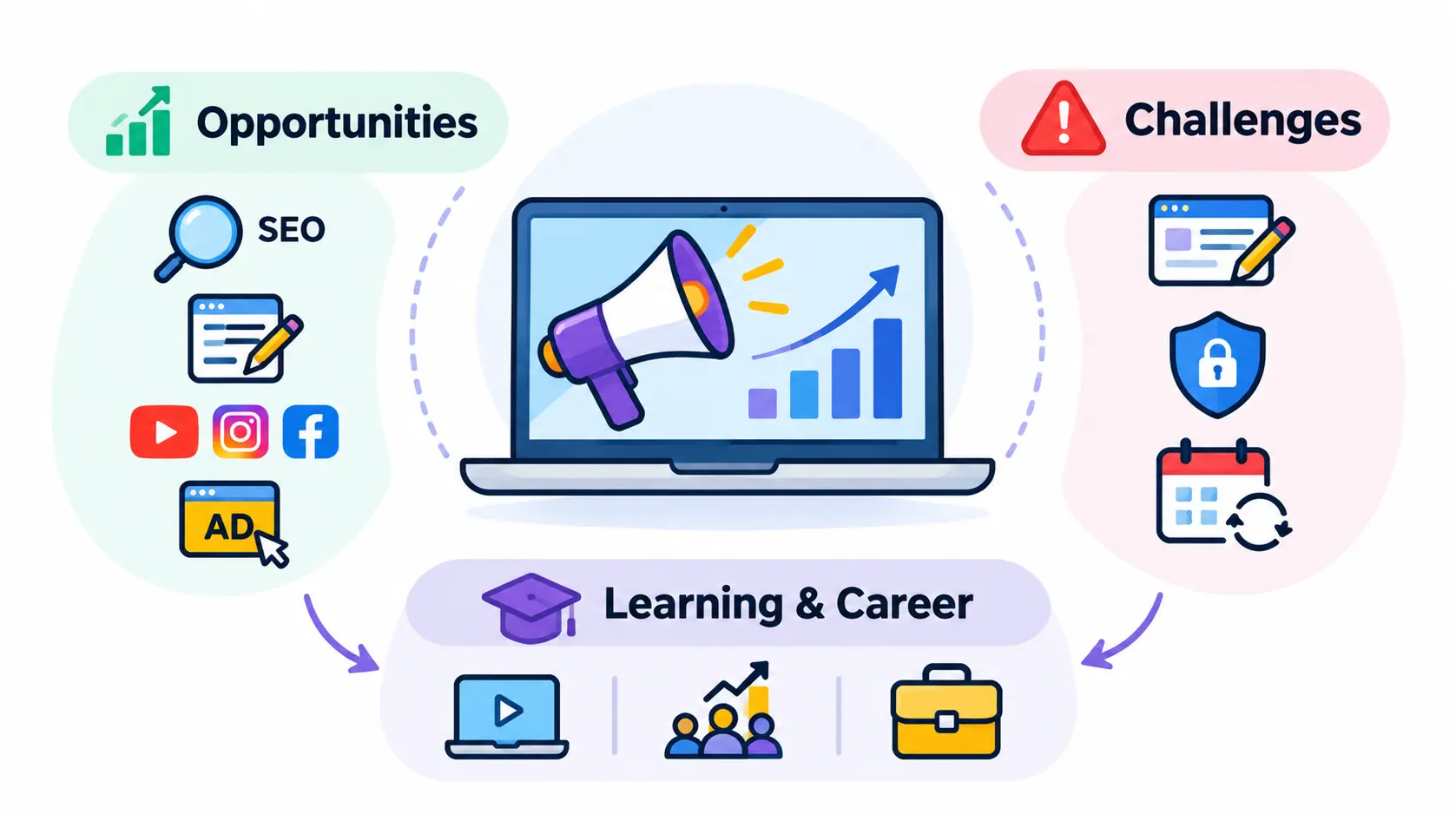
The scope of digital marketing provides numerous opportunities for businesses of every size in today’s fast-moving online environment. From search engine optimization and content marketing to social media campaigns and paid advertising, each component helps businesses connect with their audiences and work toward specific objectives.
However, digital marketing also comes with challenges, including increasing content competition, data privacy concerns, and continuously changing industry trends. Businesses can overcome these challenges by using data effectively, following relevant developments, and maintaining a customer-focused approach.
Digital marketing education also creates valuable career opportunities for students and professionals. Courses can help individuals develop practical skills in SEO, content creation, social media management, and data analytics. Learners interested in gaining practical experience can explore Digital Marketing and SEO Training to develop industry-relevant skills through hands-on projects and marketing activities. These capabilities make it easier for learners to adapt to changing industry requirements and build careers in the digital economy.
Advanced Digital Marketing Trends Every Learner Should Understand
Remaining competitive in the modern digital environment requires continuous learning and an understanding of the latest marketing tools and techniques. Whether you are a student, working professional, or business owner, keeping up with advanced digital marketing trends can help you make better marketing decisions.
These developments are changing how businesses communicate with customers while also influencing the skills professionals need to succeed in the industry.
1. The Growing Role of Artificial Intelligence (AI) in Marketing
Artificial intelligence has moved beyond being a popular technology concept and has become an important part of modern digital marketing strategies. It supports several activities, including content development, audience segmentation, predictive analytics, and campaign automation.
Important AI-Powered Marketing Applications
- Hyper-Personalization: AI studies customer preferences and online behavior to deliver personalized content. This can improve audience engagement and increase conversion opportunities. AI-powered email personalization has been reported to increase open rates by up to 41%.
- Predictive Analytics: Platforms such as Salesforce and Adobe Sensei use AI capabilities to predict customer behavior. These insights allow marketers to deliver relevant offers and campaigns at suitable times.
- AI-Powered Chatbots: Chatbots provide round-the-clock customer assistance, answer frequently asked questions, and support lead generation. According to Gartner, by 2025, 85% of customer interactions would occur without human involvement.
A 2025 report by the Digital Marketing Institute revealed that 92% of companies were investing in AI tools, demonstrating the growing influence of artificial intelligence on marketing activities.
2. Voice Search and Conversational Interfaces
Voice search is becoming increasingly popular because of the widespread adoption of smart devices and voice assistants such as Alexa, Siri, and Google Assistant. As a result, businesses need to optimize their online content for conversational language and naturally phrased search queries.
Why Voice Search Optimization Matters
- Voice searches are generally more conversational and can contain longer phrases, making keyword research and content optimization important.
- Local SEO benefits from voice search, particularly as consumers use location-based queries such as “near me” to discover nearby businesses.
- Gartner predicted that 25% of traditional search traffic would shift to voice and AI-based platforms by 2026.
To remain competitive, digital marketers should understand schema markup, FAQ optimization, and long-tail keyword targeting.
3. The Increasing Popularity of Video Marketing
Video has become one of the most engaging formats for sharing digital content. With the continued growth of YouTube Shorts and Instagram Reels, short-form video content is attracting increasing attention. Tools like InVideo Agent can help marketers create videos with AI, making it easier to produce engaging content and maintain a regular publishing schedule across different platforms.
Important Video Marketing Insights
- According to HubSpot (2025), 73% of consumers prefer short videos when learning about products.
- Businesses using video marketing experience 49% faster revenue growth than those that do not.
- Live streaming and interactive video formats are becoming more popular because they encourage audience participation and build trust.
Digital marketing courses should cover video production, editing applications such as CapCut and Canva Video, and video SEO techniques.
4. How Influencer Marketing Is Evolving
Influencer marketing is gradually moving beyond celebrity endorsements. Many brands are now collaborating with micro-influencers and nano-influencers because they often have stronger engagement and more focused audiences within specific communities.
Current Influencer Marketing Developments
- The influencer marketing industry was projected to reach $32.5 billion by 2025, compared with $21 billion in 2023.
- Brands are increasingly choosing long-term influencer partnerships instead of relying only on individual promotional campaigns.
- Authenticity, audience trust, and content relevance are becoming important factors in successful influencer collaborations.
Learning influencer outreach, campaign management, and ROI measurement is becoming increasingly valuable for digital marketing professionals.
5. Data Privacy and Responsible Digital Marketing
Consumers are becoming more conscious of how businesses collect, store, and use their personal information. Regulations such as GDPR, CCPA, and India’s Digital Personal Data Protection Act make data privacy and regulatory compliance important considerations for digital marketers.
Recommended Data Privacy Practices
- Maintain transparent data collection practices through consent banners and clear cookie policies.
- Follow ethical data usage practices and implement privacy-conscious personalization.
- Build customer confidence through secure platforms and permission-based marketing activities.
Understanding data protection requirements helps marketers reduce legal risks while maintaining customer trust and transparency.
6. The Growing Use of Augmented Reality (AR) and Virtual Reality (VR)
Augmented reality and virtual reality technologies are creating interactive and immersive digital experiences. These technologies help customers explore products and services in more engaging ways, supporting their purchasing decisions.
Practical Applications of AR and VR
- Furniture businesses use AR technology to let customers visualize how products will look inside their homes.
- Beauty brands provide virtual makeup trials through augmented reality.
- Real estate companies offer virtual property tours through VR technology.
Frequently Asked Questions About the Scope of Digital Marketing
1. What is the scope of digital marketing?
The scope of digital marketing includes SEO, social media marketing, content marketing, email marketing, PPC advertising, influencer marketing, and data analytics. It helps businesses promote their products and services online, reach targeted audiences, and increase brand visibility.
2. Is digital marketing a good career option?
Yes, digital marketing is a promising career option because businesses across industries need professionals who can manage their online presence. Career opportunities include SEO specialists, content marketers, social media managers, PPC executives, and digital marketing strategists.
3. What are the major areas of digital marketing?
The major areas of digital marketing include:
- Search Engine Optimization (SEO)
- Social Media Marketing (SMM)
- Content Marketing
- Pay-Per-Click (PPC) Advertising
- Email Marketing
- Affiliate Marketing
- Influencer Marketing
- Online Reputation Management
4. What is the future scope of digital marketing?
The future scope of digital marketing is expected to expand with developments in artificial intelligence, voice search, video marketing, automation, data analytics, and personalized advertising. Businesses will continue adopting digital strategies to connect with customers and improve their online performance.
5. Can beginners learn digital marketing without technical knowledge?
Yes, beginners can learn digital marketing without having an advanced technical background. Starting with SEO, content creation, social media management, and email marketing can help learners develop foundational skills. Practical projects and consistent learning can further improve their knowledge.
6. What skills are required to build a career in digital marketing?
Important digital marketing skills include SEO, keyword research, content writing, social media management, analytical thinking, communication, and paid advertising. Familiarity with tools such as Google Analytics, Google Search Console, SEMrush, and Ahrefs can also be beneficial.
7. How does digital marketing help small businesses?
Digital marketing helps small businesses reach potential customers through affordable online campaigns. It improves brand visibility, supports targeted advertising, generates leads, and allows businesses to measure marketing performance without depending entirely on expensive traditional advertising.
8. Which digital marketing channel is most effective?
There is no single digital marketing channel that works best for every business. SEO is useful for long-term organic visibility, social media marketing supports audience engagement, PPC generates targeted traffic, and email marketing helps maintain customer relationships. The right channel depends on business objectives and target audiences.
9. How long does it take to learn digital marketing?
The time required to learn digital marketing depends on the learner’s goals, learning approach, and practical experience. Beginners can understand the fundamentals within a few weeks, while developing professional-level skills generally requires several months of consistent learning and hands-on practice.
10. How can I start learning digital marketing?
You can begin by understanding SEO, social media marketing, content creation, email marketing, and paid advertising. Practice using free tools such as Google Analytics and Google Search Console, work on real projects, and explore structured training programs to develop practical experience.
Conclusion
Digital marketing has become an essential part of business growth in the modern online environment. Its broad scope includes SEO, content marketing, social media, data analytics, artificial intelligence, and several other strategies that help businesses reach relevant audiences and achieve measurable outcomes.
Data-driven marketing and AI technologies improve efficiency, personalization, and decision-making. At the same time, human creativity and authentic communication remain important for building customer trust and lasting relationships. Despite challenges such as data privacy and changing market trends, digital marketing continues to offer significant business and career opportunities.
Ultimately, businesses and professionals who continuously develop their skills, adapt to new technologies, and maintain a balance between automation and human interaction will be better prepared for the changing digital marketing landscape.