
A deadlock in OS is a situation where two or more processes are unable to continue execution because each process is waiting for resources held by another process. As a result, all the involved processes remain stuck indefinitely, and the system cannot proceed normally.
Deadlock is an important concept in operating systems because modern systems run multiple processes simultaneously and share limited resources such as memory, files, and devices. If resources are not managed properly, processes may enter a deadlock state, affecting system performance and reliability.
Deadlocks commonly occur in multitasking and multi-user environments where several processes compete for the same resources at the same time. They are especially common in process scheduling, resource allocation, and synchronization scenarios.
In this blog, you will learn what deadlock in OS is, understand its conditions and causes, see a simple example, explore its effects, and learn different methods used by operating systems to prevent, avoid, detect, and recover from deadlocks.
What is Deadlock in OS?
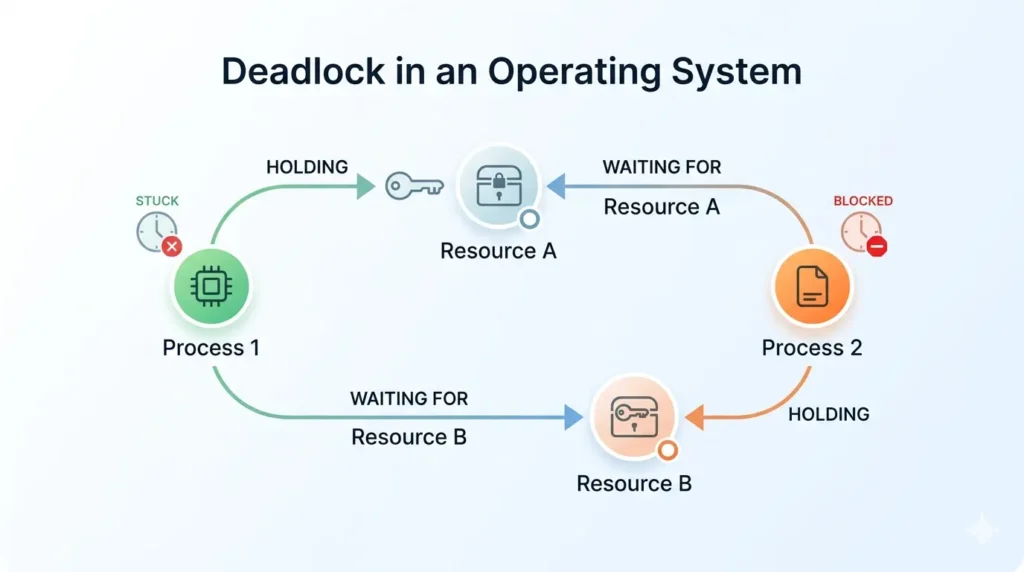
A deadlock in OS is a situation where two or more processes are waiting for each other to release resources, and none of them can continue execution.
In simple words, deadlock happens when processes get stuck because each process is holding a resource and waiting for another resource that is already occupied by another process. Since all processes keep waiting indefinitely, the system cannot move forward until the deadlock is resolved.
Real-Life Analogy of Deadlock
Imagine two cars meeting on a narrow bridge where only one car can pass at a time. Both drivers stop and wait for the other to move back first. Since neither driver gives way, both cars remain stuck and cannot move forward.
Similarly, in a deadlock in OS, processes wait for each other to release resources, causing all of them to remain blocked indefinitely.
Example of Deadlock in OS
To understand a deadlock in OS, consider an example with two processes and two shared resources.
Assume:
- Process A and Process B
- Resource 1 and Resource 2
Initially:
- Process A holds Resource 1
- Process B holds Resource 2
Now both processes need the other resource to continue execution.
Step-by-Step Explanation
Step 1:
Process A acquires Resource 1 successfully.
Step 2:
Process B acquires Resource 2 successfully.
Step 3:
Process A requests Resource 2, but it is already being used by Process B. So, Process A starts waiting.
Step 4:
Process B requests Resource 1, but it is already being used by Process A. So, Process B also starts waiting.
How Both Processes Get Stuck
Now:
- Process A is waiting for Resource 2
- Process B is waiting for Resource 1
Neither process can proceed because each one is waiting for a resource held by the other. Since no process releases its resource, both remain blocked indefinitely.
This situation is called a deadlock, where processes are unable to continue execution because of circular waiting for resources.
Conditions for Deadlock
A deadlock occurs only when the following four conditions exist simultaneously in a system:
Mutual Exclusion
At least one resource must be non-shareable, meaning only one process can use it at a time. Other processes requesting the same resource must wait until it is released.
Hold and Wait
A process holding one or more resources is waiting to acquire additional resources that are currently being used by other processes.
No Preemption
Resources cannot be forcibly taken away from a process. A resource can only be released voluntarily by the process holding it after completing its task.
Circular Wait
A circular chain of processes exists where each process is waiting for a resource held by the next process in the chain. This creates a cycle of waiting that causes deadlock.
Causes of Deadlock
Deadlock mainly occurs when processes compete for limited resources without proper coordination. Below are some common causes of deadlock in operating systems:
Improper Resource Allocation
Deadlock can occur when resources are allocated to processes without proper planning or control. If processes hold resources for a long time while requesting additional resources, other processes may get blocked, leading to a deadlock situation.
Simultaneous Resource Requests
When multiple processes request the same resources at the same time, conflicts can occur. If each process acquires some resources and waits for others already held by different processes, all processes may become stuck indefinitely.
Lack of Coordination Between Processes
Deadlock often happens when processes are not properly synchronized. Without effective coordination and resource management, processes may end up waiting for each other continuously, preventing the system from progressing.
Effects of Deadlock
Deadlock can seriously affect the performance and reliability of an operating system. Some major effects are:
System Slowdown
When processes become stuck in a deadlock state, they stop making progress while still occupying system resources. This reduces the number of active tasks the system can handle, causing overall system slowdown.
Resource Wastage
Resources such as memory, files, and devices remain locked by deadlocked processes and cannot be used by other processes. As a result, valuable system resources are wasted unnecessarily.
Process Starvation
Deadlock can lead to process starvation, where some processes wait indefinitely for resources that never become available. This prevents those processes from completing their execution.
Reduced System Performance
Since blocked processes consume resources without performing useful work, the overall efficiency and performance of the system decrease. In severe cases, the system may become unresponsive or require manual intervention to recover.
Methods to Handle Deadlock
Operating systems use different techniques to manage deadlocks and ensure smooth execution of processes. These methods help prevent the system from getting stuck when multiple processes compete for resources.
Deadlock Prevention
Deadlock prevention works by ensuring that at least one of the necessary conditions for deadlock never occurs. The operating system controls resource allocation in such a way that processes cannot enter a deadlock state.
For example:
- Allowing resource sharing to avoid mutual exclusion
- Requiring processes to request all resources at once
- Permitting resource preemption in some cases
By breaking one of the deadlock conditions, the system prevents deadlocks from happening.
Deadlock Avoidance
Deadlock avoidance allows resource allocation only if the system remains in a safe state. A safe state means that all processes can complete execution without causing deadlock.
One common technique used for deadlock avoidance is the Banker’s Algorithm, which checks resource allocation before granting requests. If allocating resources may lead to an unsafe state, the request is denied temporarily.
This approach helps the system avoid entering deadlock situations while still allowing efficient resource usage.
Deadlock Detection
In this method, the operating system allows deadlocks to occur but continuously monitors the system to detect them. Specialized algorithms are used to identify whether processes are waiting indefinitely for resources.
Once a deadlock is detected, the system takes steps to recover and restore normal execution.
Deadlock Recovery
After detecting a deadlock, the operating system uses recovery techniques to resolve it.
Terminating Processes
One or more deadlocked processes may be terminated to release resources and break the deadlock cycle. The system may terminate all involved processes or choose processes one by one until the deadlock is removed.
Resource Preemption
The operating system may forcibly take resources away from certain processes and allocate them to others. After resources are released, the blocked processes can continue execution, helping the system recover from deadlock.
Difference Between Deadlock and Starvation
Deadlock and starvation are both process management problems in operating systems, but they occur in different ways and affect processes differently.
| Aspect | Deadlock | Starvation |
|---|---|---|
| Definition | A situation where two or more processes wait indefinitely for each other’s resources. | A situation where a process waits indefinitely because resources are continuously allocated to other processes. |
| Cause | Circular waiting among processes. | Unfair resource allocation or scheduling. |
| Process State | All involved processes are blocked. | One or more processes keep waiting while others continue execution. |
| Resource Usage | Resources remain locked and unavailable. | Resources are repeatedly given to higher-priority processes. |
| System Impact | Can stop system progress completely. | Reduces fairness and delays specific processes. |
| Example | Process A waits for Process B’s resource while Process B waits for Process A’s resource. | A low-priority process never gets CPU time because high-priority processes keep executing. |
In simple terms, deadlock causes processes to block each other permanently, while starvation occurs when a process is continuously denied the resources it needs to execute.
Advantages of Deadlock Handling
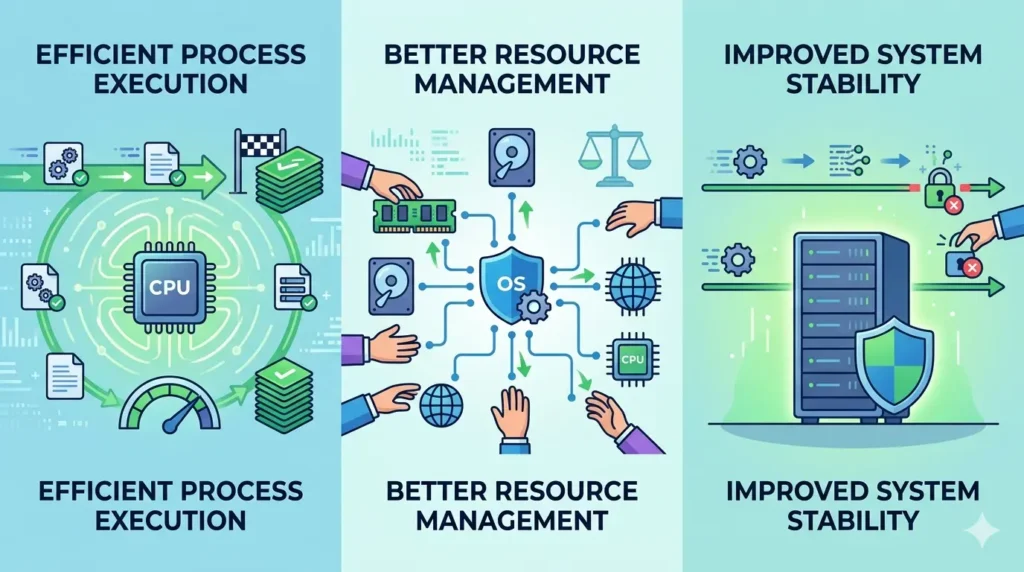
Better Resource Management
Deadlock handling techniques help the operating system manage resources more efficiently. By controlling how resources are allocated and released, the system reduces conflicts between processes and ensures smoother execution.
Improved System Stability
Proper deadlock handling prevents the system from getting stuck indefinitely. This improves system reliability and stability, allowing processes to continue functioning without causing major interruptions.
Efficient Process Execution
By avoiding or resolving deadlocks, the operating system ensures that processes can complete their tasks without unnecessary blocking. This leads to better utilization of CPU time and overall system efficiency.
Disadvantages / Limitations
Complex Implementation
Implementing deadlock handling techniques can be difficult because the operating system must continuously monitor processes and resource allocation. Designing efficient algorithms for prevention, avoidance, or detection adds complexity to the system.
Performance Overhead
Deadlock handling methods require additional system resources and processing time. For example, checking safe states or running detection algorithms can increase CPU usage and reduce overall system performance.
Increased Waiting Time
Some deadlock prevention and avoidance techniques may force processes to wait longer before accessing resources. This can reduce system responsiveness and slow down process execution in heavily loaded systems.
FAQs (Important for Rankings)
Q1. What is deadlock in OS in simple words?
A deadlock in OS is a situation where two or more processes keep waiting for each other’s resources and none of them can continue execution. As a result, all involved processes become stuck indefinitely.
Q2. What are the four conditions of deadlock?
The four necessary conditions for deadlock are:
- Mutual Exclusion – resources cannot be shared
- Hold and Wait – processes hold resources while waiting for more
- No Preemption – resources cannot be forcibly taken away
- Circular Wait – processes wait for each other in a circular chain
A deadlock occurs when all these conditions exist together.
Q3. How can deadlock be prevented?
Deadlock can be prevented by ensuring that at least one of the necessary conditions for deadlock does not occur. Operating systems use techniques like proper resource allocation, avoiding circular wait, and resource preemption to prevent deadlocks.
Q4. What is deadlock avoidance?
Deadlock avoidance is a technique where the operating system checks resource allocation requests carefully and grants them only if the system remains in a safe state. This helps avoid situations that may lead to deadlock.
Q5. Is deadlock harmful in OS?
Yes, deadlock is harmful because it can stop processes from executing, waste system resources, reduce performance, and even make the system unresponsive if not handled properly.
Conclusion
A deadlock in OS is a major synchronization issue that occurs when processes wait indefinitely for resources held by one another. This prevents processes from continuing execution and can negatively affect system performance and stability.
Deadlocks commonly occur in multitasking systems where multiple processes compete for limited resources. If not handled properly, they can lead to resource wastage, system slowdown, and blocked processes.
However, operating systems use techniques such as deadlock prevention, avoidance, detection, and recovery to manage these situations effectively. Understanding deadlock and its handling methods is important for building reliable and efficient systems.