
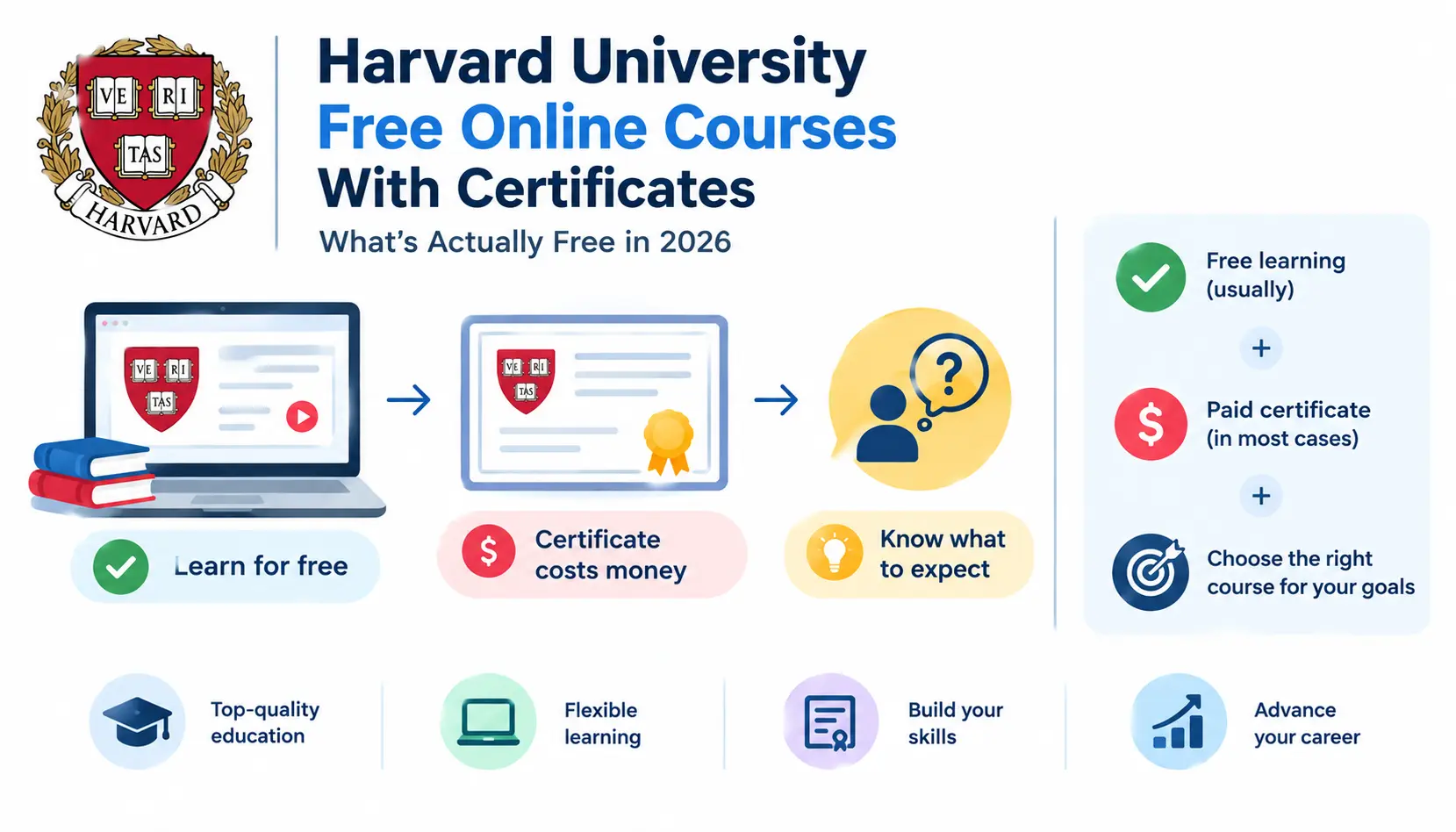
Harvard University free online courses are real, and some of them are excellent. But “free” doesn’t always mean what people expect. In most cases, learning is free and the verified certificate costs money.
I’ve seen learners lose weeks to this confusion. They enroll, finish the course, and only then find that the shareable certificate sits behind a fee. This guide shows what you get for free, what you pay for, and how to choose a course that fits your goals.
Are Harvard University Online Courses Really Free?
Yes, many of them are. Harvard publishes a free online course catalog through Harvard Online, and many of those courses run on edX. The catch is in the details of what “free” covers.
What Free Access Includes
A free audit generally gives you the core learning material. That usually means lecture videos, readings, and practice exercises. You can learn at your own pace, and you don’t need to apply or be admitted.
For self-taught learners, that’s a lot of value. You get Harvard-designed teaching without paying tuition.
What a Free Audit Does Not Include
Audit access often comes with limits. Graded assignments and final exams may be locked. Access may also expire after a set period, depending on the course.
Support is usually limited too. You’ll rely on discussion forums and communities rather than personal feedback.
When a Certificate Costs Extra
A verified certificate is the paid upgrade. It confirms that you completed the course and passed its graded work. Prices differ from course to course, so there’s no single Harvard certificate fee.
Free Course vs Free Certificate
Here’s the difference in plain terms. A free course means you can learn without paying. A free certificate means you can prove it without paying.
The first is common. The second is rare and depends on the course. CS50 is a notable case, and I cover it below.
Harvard University Free Online Courses at a Glance
Durations are approximate and can change with each course run. Verify all details on the course page.
| Course | Subject | Level | Duration | Free Access | Certificate | Platform |
| CS50’s Introduction to Computer Science | Computer science | Introductory | About 11 weeks | Free audit | Free CS50 certificate option; paid verified option | edX / CS50 |
| Introduction to Artificial Intelligence with Python | AI, machine learning | Intermediate | 7 weeks | Free audit | Paid verified certificate | edX / Harvard Online |
| Introduction to Data Science with Python | Data science | Introductory | Check course page | Free audit | Paid verified certificate | edX / Harvard Online |
| Data Science: R Basics | R programming | Introductory | About 8 weeks | Free audit | Paid verified certificate | edX |
| Using Python for Research | Research computing | Intermediate | Check course page | Free audit | Paid verified certificate | edX |
| Data Science: Probability | Statistics | Intermediate | About 8 weeks | Free audit | Paid verified certificate | edX |
| Justice | Philosophy, ethics | Introductory | Check course page | Free audit | Paid verified certificate | edX |
| Contract Law | Law | Introductory | Check course page | Free audit | Paid verified certificate | edX |
| Leaders of Learning | Leadership, education | Introductory | Check course page | Free audit | Paid verified certificate | edX |
Best Harvard Free Online Courses With Certificates
1. CS50’s Introduction to Computer Science
- Subject: Computer science fundamentals
- Difficulty: Beginner-friendly, but demanding
- Duration: About 11 weeks at a typical pace
- Skills: Problem solving, C, Python, SQL, web basics
- Free-access model: Free to take, with free course materials on the CS50 website
- Certificate: CS50 has offered a free certificate of completion through its own site, separate from the paid edX verified option
- Best for: Complete beginners who want a serious foundation
CS50 is the course most people mean when they search for Harvard free courses. It’s fast and it’s challenging. Learners often say the problem sets take longer than expected, and the CS50 community on Reddit is a good place to see honest experiences.
Check the current certificate rules on the CS50 site before you start. Requirements can change.
2. Introduction to Artificial Intelligence With Python
- Focus: AI concepts, search, machine learning, neural networks
- Language: Python
- Prerequisites: Comfort with Python and basic programming logic
- Certificate: Verified certificate available for a fee
Harvard’s current free catalog lists this as an online free course with a seven-week duration. It’s a strong next step after CS50 or any Python basics course. If you’ve never coded, start elsewhere first.
3. Introduction to Data Science With Python
- Skills: Python, data analysis, core data science ideas
- Beginner suitability: Good for learners with light Python exposure
This course suits people who want to work with real datasets. You’ll practice cleaning, exploring, and interpreting data. It’s a practical entry point if you’re curious about analytics careers.
4. Data Science: R Basics
- Focus: R programming, data manipulation, visualization
- Statistical foundations: Introduced gently
R is common in research, public health, and academia. This course teaches it from scratch. It’s part of a longer Data Science series, so you can continue if you enjoy it.
5. Using Python for Research
- Research applications: Python for scientific and academic work
- Data analysis: Working with research-style data
This one fits graduate students, lab staff, and analysts. It’s less about learning to code and more about applying code to research tasks.
6. Data Science: Probability
- Focus: Probability theory and its use in data science
- Skills: Statistical thinking
Probability sits under almost everything in data science. This course covers it with data-focused examples. It pairs well with the R Basics course.
7. Justice
- Subject: Moral and political philosophy
- Format: Based on a well-known Harvard College course
If you want something outside tech, this is a popular pick. It uses real ethical dilemmas to teach philosophical reasoning. It’s thought-provoking rather than technical.
8. Contract Law
- Subject: Legal concepts around contracts
This course explains how contracts work and why the law treats promises the way it does. It’s useful for founders, freelancers, and curious non-lawyers. It won’t make you a lawyer, and it isn’t legal advice.
9. Leaders of Learning
- Focus: Leadership and organizational learning
- Audience: Educators and managers
It looks at how schools and organizations improve. The ideas apply well beyond education.
10. Other Current Harvard Free Courses
Harvard’s offering changes often. Rather than trusting any static list, use the official catalog:
- Open the Harvard Online free course catalog.
- Use the subject filters on the page.
- Check the course status and start date.
- Read the “free” label on the course page carefully.
Harvard Free Courses by Subject
Harvard’s free catalog offers subject filters. Categories you’ll typically find include:
- Computer science: Programming and CS fundamentals
- Artificial intelligence: AI concepts and applied machine learning
- Data science: Statistics, R, and Python for data
- Programming: Language-specific courses
- Business: Management and strategy topics
- Education: Teaching, learning, and school leadership
- Health and medicine: Public health and medical topics
- Humanities: Philosophy, history, literature, and the arts
- Mathematics: Quantitative and statistical foundations
- Science: Natural and applied sciences
- Social sciences: Economics, politics, and society
Not every category has free courses at all times. Filter first, then check availability.
Harvard Free Courses by Difficulty
Introductory
These assume little or no background. Expect clear explanations and a gentle start. CS50, R Basics, and Justice are good examples.
Intermediate
You should already know the basics. For coding courses, that means some hands-on programming experience. AI with Python and Probability fall here.
Advanced
Advanced courses expect prior coursework or professional experience. Read the prerequisites closely. Skipping this step is one of the most common reasons learners quit.
Harvard Free Courses by Career Goal
- AI and machine learning: Start with Python, then take the AI with Python course.
- Data science: Combine Python or R with a probability course.
- Software development: Begin with CS50, then build projects on your own.
- Business professionals: Look at leadership, management, and law-related courses.
- Researchers: Using Python for Research is a natural fit.
- Educators: Leaders of Learning offers useful frameworks.
- Leadership: Choose courses on organizational behavior and decision-making.
- Career changers: Pick one course, finish it, and build a small project. A finished project says more than three abandoned courses.
How Harvard Certificates Work
What Is a Free Audit?
Auditing means you access the course content without paying. You skip the verified track. You learn, but you don’t earn a verified credential.
What Is a Verified Certificate?
A verified certificate confirms you completed the course requirements, including graded work. Your identity may be verified. It’s issued through the course platform, and it’s a completion credential, not a degree.
How Much Does a Harvard Certificate Cost?
There’s no single price. HarvardX examples show different certificate fees from one course to the next. Check the specific course page for the current amount.
Does Every Free Harvard Course Offer a Certificate?
No. Some courses offer only audit access, and some have paid certificates. A few have alternative free options, like CS50. Always confirm on the course page.
Can Financial Assistance Reduce Certificate Costs?
Often, yes. edX has offered financial assistance that reduces certificate fees for eligible learners. Availability and discount levels change, so read the course’s enrollment options.
Harvard Online vs HarvardX vs edX: What’s the Difference?
These three names confuse many learners. Here’s how they fit together.
Harvard Online
Harvard Online is Harvard’s central hub for online learning. It lists courses from across the university.
HarvardX
HarvardX is Harvard’s online learning initiative. It creates many of the open online courses you’ll see.
edX
edX is the platform where many of these courses run. It hosts your account, progress, and certificates.
How the Platforms Connect
Think of it this way. Harvard creates the course, HarvardX produces it, Harvard Online lists it, and edX often delivers it. Some courses also live on other sites, like CS50’s own website.
Are Harvard Free Online Certificates Worth It?
It depends on your goal. A certificate can help, but it works best with proof of your skills.
What They Can Demonstrate
- Course completion
- Subject knowledge
- Initiative
- Continuing education
What They Cannot Replace
- A degree
- A professional license
- Work experience
- An industry certification
How Employers May Interpret Them
Reactions vary. Some hiring managers value the initiative. Others care only about projects and experience. Don’t count on a certificate to get you a job.
My advice is simple. Pair the certificate with something you built. A small portfolio does more than a badge.
Can You Put a Harvard Online Course on Your Résumé?
Yes, if you describe it accurately.
Where to List It
Use a “Certifications” or “Professional Development” section. If you’re changing careers, you can also mention it in your summary.
How to Describe It Accurately
Name the course, the provider, and the completion date. Don’t imply you attended Harvard as a student. Don’t call it a Harvard degree or program.
Example Résumé Entry
Introduction to Artificial Intelligence with Python — HarvardX / edX (Completed 2026)
Adding It to LinkedIn
Add it under “Licenses & Certifications” on your LinkedIn profile. Include the credential link if you have one. You can also share a short post about what you learned.
How to Enroll in a Free Harvard Online Course
Step 1: Open Harvard’s Free Course Catalog
Go to the official free course catalog.
Step 2: Filter by Subject
Narrow the list to your area of interest.
Step 3: Check Course Availability
Some courses are open now. Others have set start dates or are archived.
Step 4: Review Course Requirements
Read the prerequisites, weekly time commitment, and assessment style.
Step 5: Select the Free Learning Option
Choose the audit or free track. Skip the paid upgrade for now.
Step 6: Create an Account
You’ll need an account on the course platform, usually edX.
Step 7: Start the Course
Begin with the first module. Set a weekly schedule you can keep.
Step 8: Upgrade for a Certificate If Needed
You can often upgrade later. Confirm the deadline first, since upgrade windows can be limited.
Who Can Take Harvard Free Online Courses?
Do You Need to Be a Harvard Student?
No. These courses are open to the public.
Are International Learners Eligible?
Generally, yes. Some courses or payment options may have regional limits. Verify on the course page.
Are There Age Requirements?
Platforms usually set a minimum age. Check the current terms on the platform you use.
Do You Need Previous Education?
Most introductory courses don’t require a degree. Advanced courses may expect prior knowledge.
Do You Need IELTS or TOEFL?
Free online courses typically don’t require these tests. The course page will confirm any language requirements.
Eligibility can differ by course, so verify before enrolling.
Harvard Free Online Courses vs Harvard Degree Programs
| Feature | Free Online Course | Harvard Degree |
| Tuition | Free for eligible course access | Paid |
| Admission | Course-specific | Formal admission |
| Credential | Course or verified certificate where offered | Degree |
| Duration | Usually weeks | Years |
| Academic status | Non-degree learning | Degree study |
Free courses are a learning tool. They’re not a shortcut into Harvard, and they don’t carry degree status.
Common Mistakes When Choosing Harvard Free Courses
Assuming the certificate is free. Check the pricing before you start.
Using an old course list. Catalogs change. Use the official page.
Confusing audit access with certification. Auditing doesn’t earn a verified credential.
Assuming every course is self-paced. Some run on schedules with deadlines.
Ignoring prerequisites. This is the top reason people drop out.
Treating a course certificate like a degree. It isn’t one.
Choosing a course only because it has “Harvard” in the name. Pick the course that fits your goals, not the brand.
How to Choose the Right Harvard Free Online Course
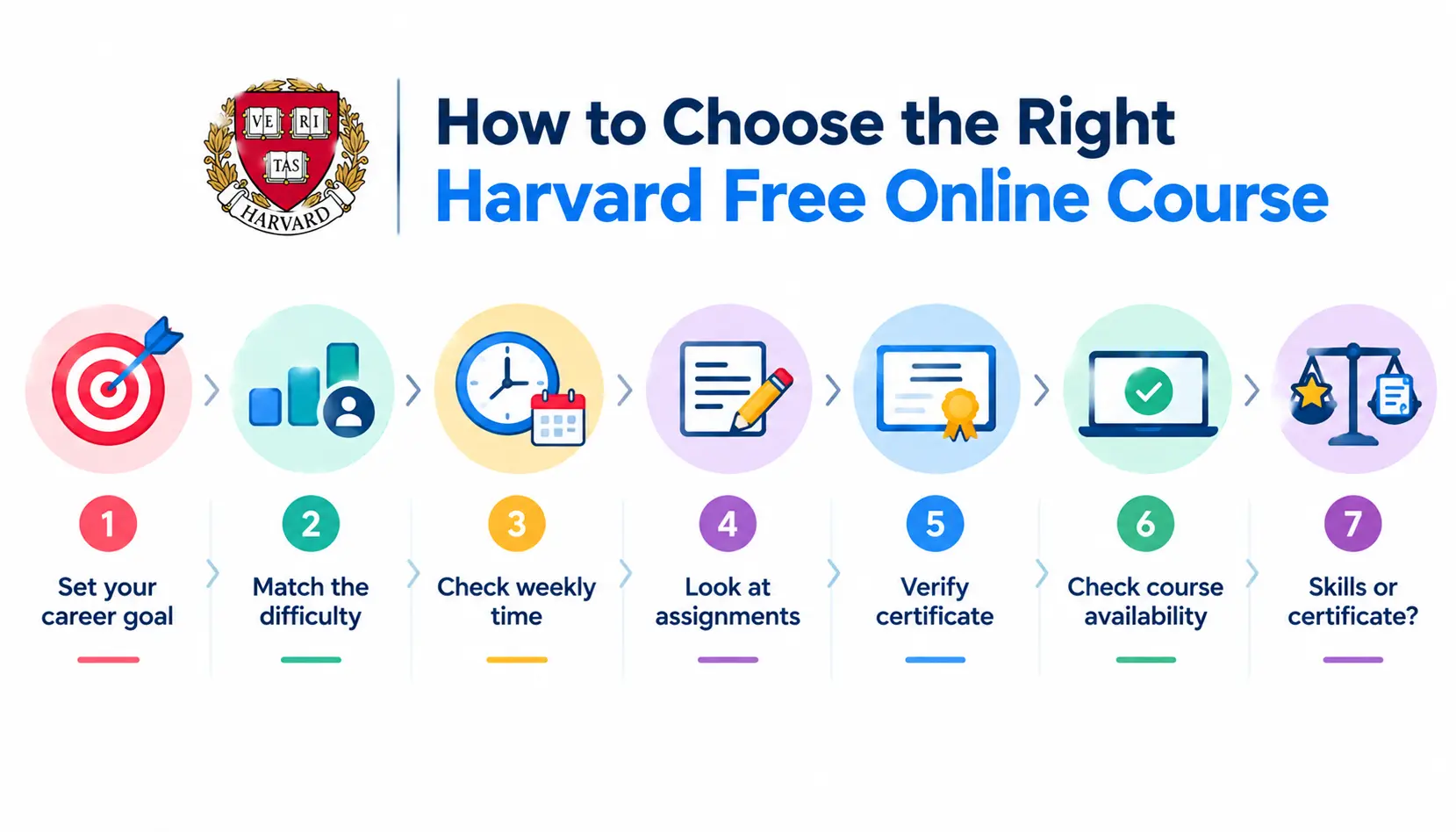
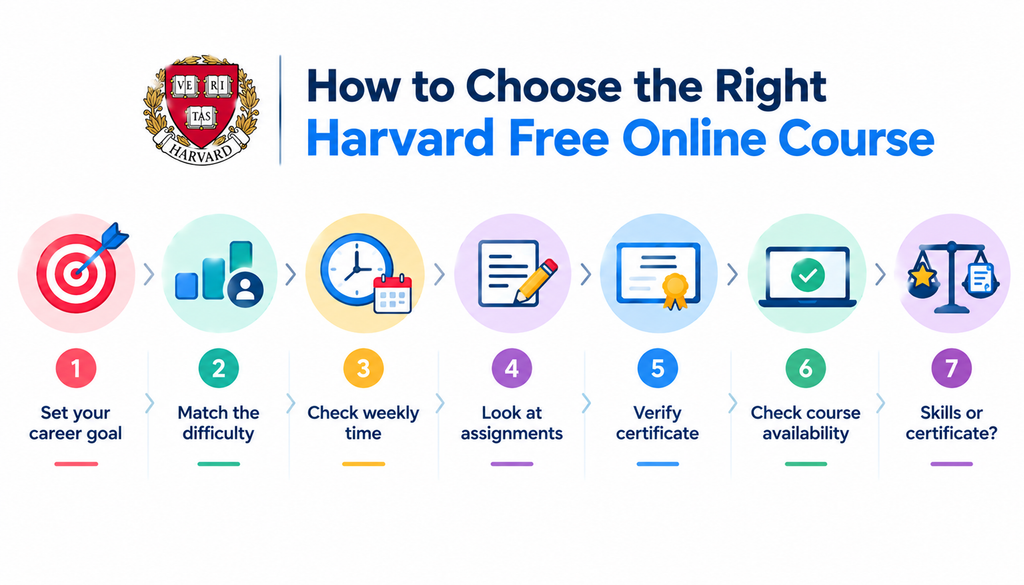
- Start with your career goal. Know what you want the course to do for you.
- Match the difficulty to your background. Be honest about your current level.
- Check weekly time requirements. A five-hour course load is very different from a fifteen-hour one.
- Look at assignments and assessments. They show how much effort you’ll need.
- Verify certificate availability. Confirm the type and cost.
- Check whether the course is currently available. Don’t plan around an archived course.
- Consider whether you need the certificate at all. Sometimes the skills matter more than the paper.
FAQs About Harvard University Free Online Courses
1. Are Harvard online courses free?
Many are free to audit. Paid options, like verified certificates, are usually optional.
2. Can I get a Harvard certificate for free?
Sometimes. Most verified certificates cost money, but a few courses, such as CS50, have offered free certificate options. Check the course page.
3. Does Harvard offer free online courses with certificates?
Yes, but usually the certificate is a paid add-on. Free certificate options are the exception.
4. Are Harvard courses on edX free?
Many can be audited for free on edX. Graded work and certificates usually require payment.
5. Is CS50 free?
Yes, CS50 materials are free. Certificate options vary, so check the CS50 site.
6. Does Harvard offer free AI courses?
Yes. Introduction to Artificial Intelligence with Python is one example, listed as a seven-week course.
7. Does Harvard offer free data science courses?
Yes. Options include Introduction to Data Science with Python, Data Science: R Basics, and Data Science: Probability.
8. Can international students take Harvard free online courses?
Generally, yes. Verify any regional restrictions on the course page.
9. Do I need to be a Harvard student?
No. The courses are open to the public.
10. Do Harvard online courses require IELTS?
Usually not for free courses. Check each course page.
11. Are Harvard online certificates worth it?
They can show initiative and complete learning. They don’t replace a degree or work experience.
12. Can I put a Harvard online certificate on my résumé?
Yes, if you label it accurately as an online course certificate.
13. How much does a Harvard verified certificate cost?
It varies by course. Check the course page for the current price.
14. Can I audit Harvard courses for free?
Yes, many courses offer a free audit option.
Conclusion
Harvard University free online courses give you a genuine way to learn from top instructors at no cost. The certificate is where the money usually enters, so decide early whether you need one.
Start with one course that matches your level and goals. Verify the details on the official page, finish what you begin, and build something with what you learn. That combination will serve you better than any certificate alone.