
If you want to break into sport without paying for a degree first, free online sports management courses are a sensible place to start. Some are truly free. Others are free to watch but charge for the certificate. A few only give you a digital badge.
This guide explains how to tell them apart, where to find good options, and how to get real value from them. It is written for career changers, students, volunteers, and anyone curious about working in sport.
Last verified: [insert date before publishing]. Prices, free-access rules, and certificate policies change often, so always confirm on the provider’s page before you enrol.
Who These Courses Are For
These courses suit four kinds of learners:
- Students testing whether sports management is right for them
- Career changers moving in from marketing, events, finance, or data
- Club volunteers and coaches who now handle admin, sponsors, or events
- Graduates who want to add sport-specific knowledge to a CV
They will not replace a degree or work experience. They give you vocabulary, structure, and something to talk about in interviews.
What “Free” Actually Means
“Free” can mean at least five different things online. The main split is between free learning and a free certificate. Most providers offer the first. Far fewer offer the second.
Here is the quick version:
- Free learning: you can watch lessons or read material at no cost.
- Free certificate: you finish the course and receive a certificate without paying.
- Paid certificate: the learning is free, but the proof of completion costs money.
- Digital badge: a shareable online credential, often with a short quiz.
I cover each case in detail below.
Best Free Online Sports Management Courses With Certificates
The table below groups the main routes by provider and topic. I have deliberately listed provider routes rather than exact course titles, because course catalogues change and outdated titles waste your time. Search each provider for the topic, then check the enrolment page.
| Route | Provider | Topic | Level | Free Learning | Free Certificate | Credential | Typical Duration | Best For |
| Sports marketing and business courses | Coursera | Marketing, business, analytics | Beginner to intermediate | Often, via audit or preview options | Usually no | Paid course certificate | Varies by course | Structured, university-linked learning |
| Sports-related diploma and course listings | Alison | Sports management topics | Beginner to intermediate | Yes | Usually paid | Certificate or diploma (paid) | Self-paced | Low-cost, flexible study |
| Course discovery with filters | Class Central | Search tool across providers | All levels | Depends on the listed course | Depends on the listed course | Varies | Varies | Comparing options in one place |
| Front Office Sports Essentials (UMass Amherst resource) | UMass Amherst / FOS | Marketing, NIL, metaverse | Beginner | Yes | No certificate; verified digital badge | Digital badge | Short lessons plus quizzes | Free badges and current industry topics |
| Online university certificate | CSUDH | Professional sports, promotion, facilities, events | Formal certificate | No | No | University certificate (paid) | Four online courses | Formal credentials |
Treat this table as a starting map. Verify every cell on the provider’s own page.
Quick Picks by Goal
I avoid naming one “best” course, because the right choice depends on what you want to do. These picks are based on how each route works, not on a ranking.
- Best for beginners: a short introductory business or sport-industry course on Coursera or Alison. Pick one with a clear syllabus.
- Best for sports marketing: a marketing-focused course on Coursera, or the marketing lessons in the UMass / Front Office Sports Essentials resource.
- Best for event management: an events or project-management course from Alison or Coursera, with a venue and logistics module.
- Best for sports analytics: a data-analysis course that uses sport examples. Check that it teaches spreadsheets or basic visualisation.
- Best for sports business: business-of-sport material covering revenue, sponsorship, and media rights.
- Best for university-backed learning: courses from universities on Coursera, or the UMass Amherst resource.
- Best for free digital badges: the Front Office Sports Essentials courses, which end with quizzes and verified digital badges.
What Is Sports Management?
Sports management is the business side of sport. It covers running teams, leagues, venues, events, and sports brands. Instead of coaching athletes, a sports manager handles the money, people, planning, and marketing around them.
What Does a Sports Manager Do?
A sports manager keeps a sports organisation running smoothly and financially healthy. Day to day, that might mean:
- Planning a tournament
- Negotiating a sponsor deal
- Managing a stadium budget
- Coordinating volunteers
- Reporting attendance and revenue
Jobs vary widely. A club administrator at a local team and a marketing lead at a professional league share a field, but their days look very different.
What Subjects Are Covered in Sports Management?
Most programmes cover a similar core: marketing, sponsorship, finance, event planning, facility operations, law and contracts, governance, media, and analytics. Introductory courses usually skim all of these. Specialised courses go deep on one.
Sports Management vs Sports Administration
The two terms overlap heavily. Sports management usually leans toward business and operations. Sports administration often points to governance, rules, and running organisations such as federations or school athletic departments. Job titles and course names use them interchangeably, so read the syllabus, not the label.
Sports Management vs Sports Marketing
Sports marketing is one part of sports management. It focuses on promoting teams, events, and products through branding, fan engagement, and sponsorship. Sports management is the wider field that includes marketing alongside finance, operations, and more.
For a broader background, see Wikipedia’s overview of sport management.
Free Sports Management Courses From Major Learning Platforms
Coursera Sports Management Courses
Coursera hosts sport-related courses from universities and industry partners. Topics include sports marketing, athlete management, event management, and analytics. There are also beginner-friendly business courses that apply well to sport.
The key point is access. Coursera separates free previews, trials, and audit-style access from full access and certificates. On many courses, learning materials may be available free while graded work and the certificate need payment. Some trials convert to a paid subscription automatically if you do not cancel.
Before you start, check three things on the course page: what you can access for free, what the certificate costs, and whether the trial renews.
Alison Sports Management Courses
Alison lists courses connected to sport and sports management. Study is self-paced, and levels range from introductory to more advanced. Learning is generally free.
Certificates and diplomas are where costs appear. Alison distinguishes between certificate and diploma options and prices them separately. If you only want the knowledge, you can skip that cost. If you want proof of completion for a CV, factor in the fee.
Class Central Sports Management Courses
Class Central does not teach courses. It helps you find them. It works like a search engine for online learning across many platforms.
Its filters help you narrow results quickly:
- Free courses
- Certificates and career certificates
- University-offered courses
- Duration
- Beginner, intermediate, and advanced levels
Use it to compare options side by side. Then click through to the provider and confirm the details.
Free University and Industry-Backed Sports Courses
UMass Amherst / Front Office Sports Essentials
This resource offers complimentary courses covering topics such as sports marketing, NIL (name, image, and likeness), and the metaverse in sport. Lessons are delivered through video. Quizzes follow, and passing them earns a verified digital badge.
That is a badge, not a formal certificate or degree credit. It is a useful, current, and cheap signal on a CV or LinkedIn profile, but describe it accurately.
Harvard-Related Free Learning Resources
Be careful here. Harvard offers free learning in various forms, but very few of those resources are dedicated sports-management programmes. Most are general business, analytics, or leadership courses that happen to be useful in sport.
For each resource you consider, ask four questions:
- Is it actually about sports management, or general business education?
- Is the learning free?
- Does it offer a certificate, and is that free or paid?
- Is the credential issued by Harvard or by a platform?
Do not present a general course as a sports-management qualification. Employers notice the difference.
University Sports Management Certificates
Formal university certificates sit in a different category. California State University, Dominguez Hills (CSUDH) is one example. Its online certificate consists of four courses and covers professional sports, entertainment, promotion and marketing, and facility and event management.
This is not a free course. It is a paid, formal programme, and it is worth including here as a benchmark. If you later want a recognised credential, this is what the paid step up looks like.
Free Sports Management Courses by Career Path
Match your course to the job you want. Here is what to look for in each area.
Sports marketing. Look for branding, fan engagement, social media, sponsorship, and campaign planning.
Sports sponsorship. Look for sponsorship inventory, activation, partnership building, and measuring ROI. For background, see Wikipedia on sponsorship.
Sports event management. Look for planning, logistics, venue operations, risk management, and crowd management.
Sports facility management. Look for operations, maintenance, accessibility, and revenue generation.
Sports analytics. Look for data analysis, performance metrics, fan analytics, spreadsheet or data tools, and visualisation. See Wikipedia’s page on sports analytics.
Athlete management. Look for representation, contracts, career planning, and personal branding.
Sports administration and governance. Look for governance, leadership, policy, compliance, and organisational management.
Sports media and broadcasting. Look for media rights, broadcasting, streaming, digital content, and fan engagement.
Esports management. Look for league operations, sponsorship, broadcasting, and player management.
Free Course vs Free Certificate: What’s the Difference?
A free course lets you learn at no cost. A free certificate means you also receive proof of completion at no cost. These are not the same, and confusing them is the most common mistake beginners make.
Here are the five patterns you will meet.
Free Course + Free Certificate
You study and receive a certificate without paying. This is the rarest and best case. Read the terms to be sure there is no fee at the final step.
Free Course + Paid Certificate
You learn for free, then pay if you want the certificate. This is common on large platforms. It works well if you mainly want skills.
Free Preview + Paid Enrolment
You see a few lessons free, then must pay to continue. This is a sample, not a free course.
Free Course + Digital Badge
You complete lessons and quizzes, then receive a shareable badge. It is not the same as a certificate, but it can still add credibility.
Free Learning + University Certificate That Costs Money
Some universities let you view material free, but the formal certificate is a paid programme. The CSUDH certificate is a clear example of the paid path.
A quick rule: free to learn does not mean free to certify.
How to Check Whether a Sports Management Certificate Is Really Free
Follow these seven checks before you invest time.
- Check the enrolment page. Look for wording like “audit,” “free trial,” “purchase,” or “upgrade.”
- Check certificate pricing. Find the exact fee, and any extra cost for a diploma or printed copy.
- Check for automatic trial conversion. Some free trials become paid subscriptions. Set a calendar reminder.
- Check assessment requirements. Some certificates require graded work that is locked behind payment.
- Check credential verification. Can an employer confirm it through a link or ID?
- Check who issues the credential. Is it the university, the platform, or a company?
- Check the credential type. Is it a certificate, badge, diploma, or professional certification? They are not the same.
How to Choose the Right Sports Management Course
- Start with your career goal. Marketing, events, and analytics need different skills.
- Match the syllabus to the job. Read job ads and compare the skills they list to the course outline.
- Check the level. Beginners should not start with advanced analytics.
- Compare workload and duration. A ten-hour course and a ten-week course are very different commitments.
- Verify the certificate. See the checks above.
- Evaluate the provider. Is it a university, an industry body, or an unknown site?
- Look for practical assignments. Projects teach more than videos alone.
- Check whether the content is current. NIL, streaming, and data tools change fast. Look for a recent update date.
What Skills Should You Gain From a Sports Management Course?
Use this checklist to judge whether a course is worth your time:
- Marketing and brand building
- Sponsorship sales and activation
- Basic finance and budgeting
- Event planning
- Leadership
- Negotiation
- Data analysis
- Facility management
- Clear communication
- Risk management
- Governance and compliance
- Digital media
If a course covers none of these, it is probably not a sports management course.
Are Free Online Sports Management Certificates Worth It?
They are worth it for certain goals. They are not worth it as a shortcut to a job.
When They Can Help
- Exploring the industry: you find out what you like before committing money.
- Building foundations: you learn the language of the business.
- Supporting a CV: you show effort and interest.
- Preparing for interviews: you gain examples and talking points.
- Demonstrating initiative: hiring managers like self-starters.
What They Cannot Replace
- University degrees, where a role requires one
- Professional experience
- Internships and volunteering
- Employer-specific requirements
- Formal qualifications required by law or policy
How to Make a Certificate More Valuable
Pair the course with a practical project. A certificate says you finished something. A project shows what you can do.
Good project ideas:
- A sponsorship proposal for a local club
- A plan for a small sports event
- A marketing campaign for a team
- A budget for a community sports facility
- A simple sports analytics dashboard
Here is a realistic scenario. A volunteer at a youth football club finishes a free marketing course. She then writes a one-page sponsorship pitch and sends it to three local businesses. In an interview, the pitch carries more weight than the certificate.
How to Add a Sports Management Certificate to Your CV
Where to List It
Put it under “Education and Training” or “Certifications.” If you have little experience, place it near the top.
What Information to Include
Include the course title, provider, issuer, completion date, and a verification link if one exists. Label the credential correctly, for example “Certificate of Completion” or “Digital Badge.”
Example CV Entry
Sports Marketing (Online Course) – [Provider name], [Year]
Covered branding, fan engagement, and sponsorship. Completed a sample sponsorship proposal as a final project.
How to Add It to LinkedIn
Use the “Licenses & certifications” section on your LinkedIn profile. Add the name, issuing organisation, dates, and credential URL. You can also mention the project in your “Featured” section.
For real-world advice from people working in the industry, communities like r/SportsManagement on Reddit often discuss breaking in, internships, and which credentials employers care about. Treat individual opinions as anecdotes, not rules.
How to Build a Sports Management Learning Path
Beginner pathway: sports management fundamentals → marketing → events → a specialisation
Sports marketing pathway: sports business → marketing → sponsorship → digital media → analytics
Event-management pathway: sports management → event planning → venue operations → risk management
Analytics pathway: sports business → data fundamentals → sports analytics → visualisation
Sports administration pathway: sports management → governance → leadership → compliance
Pick one path and finish it before starting another. Depth beats a long list of half-finished courses.
Common Mistakes When Choosing Free Sports Management Courses
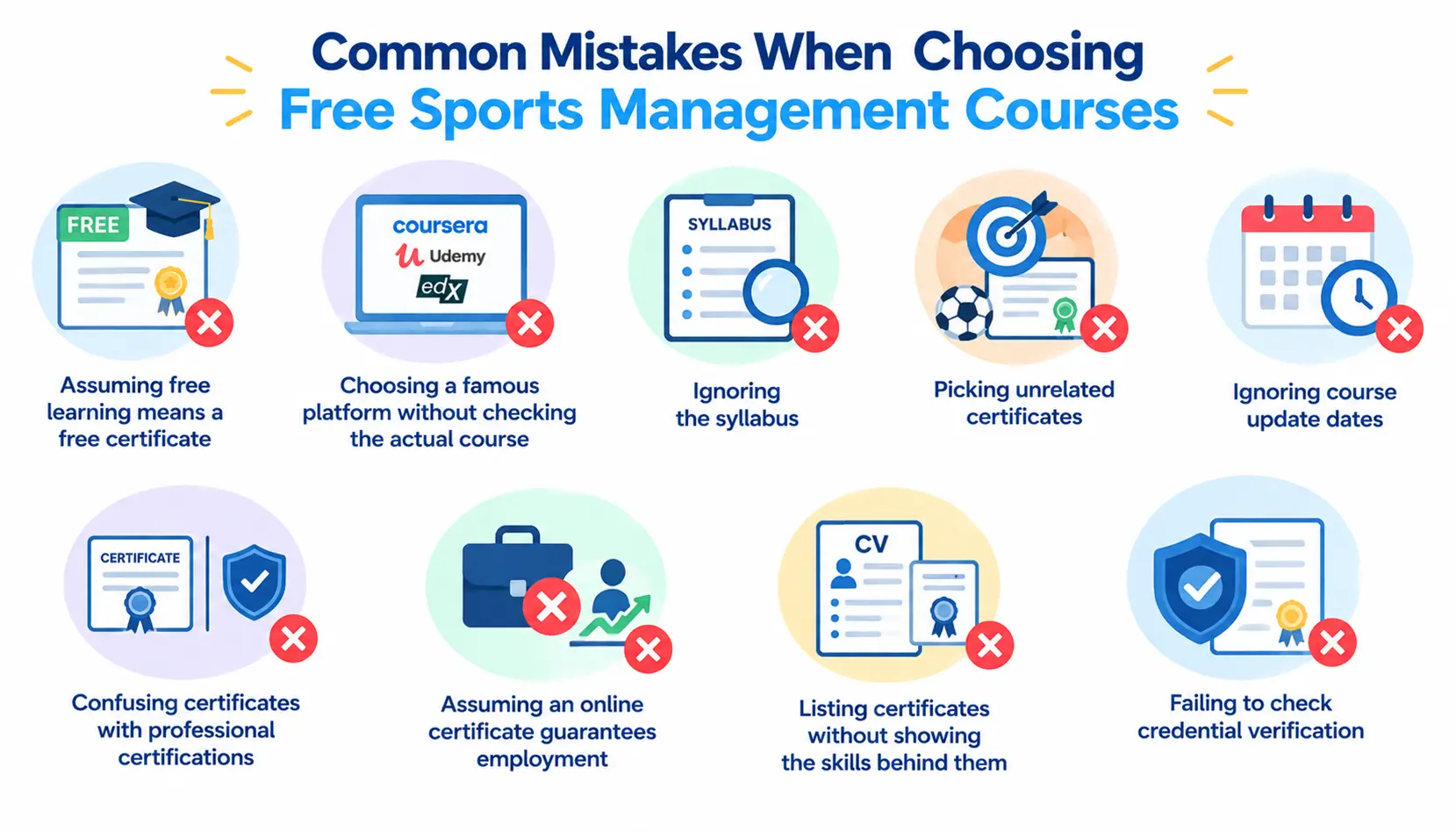
- Assuming free learning means a free certificate
- Choosing a famous platform without checking the actual course
- Ignoring the syllabus
- Picking unrelated certificates that do not fit your goal
- Ignoring course update dates
- Confusing certificates with professional certifications
- Assuming an online certificate guarantees employment
- Listing certificates without showing the skills behind them
- Failing to check credential verification
Frequently Asked Questions
1. What are the best free online sports management courses?
There is no single best course. The best choice depends on your goal. Beginners can start with an introductory course on Coursera or Alison. Those interested in marketing can try the UMass / Front Office Sports Essentials resource. Always check the syllabus and certificate terms.
2. Can I study sports management online for free?
Yes, in many cases. Platforms like Coursera, Alison, and Front Office Sports Essentials offer free learning access. Some limit free access to previews or audit-style options.
3. Can I get a sports management certificate for free?
Sometimes. Many providers charge for certificates even when the learning is free. Digital badges, such as those in the UMass / Front Office Sports Essentials resource, may be free.
4. What subjects are covered in sports management?
Typical subjects include marketing, sponsorship, finance, event management, facility operations, governance, media, and analytics.
5. Can I get a sports management job with an online certificate?
A certificate alone rarely lands a job. It works best alongside experience, volunteering, internships, and a practical project.
6. Are online sports management certificates recognised?
Recognition varies. Employers tend to value the issuer, the syllabus, and your demonstrated skills more than the certificate itself. A free certificate is usually a supporting credential, not a formal qualification.
7. Does Coursera offer free sports management courses?
Coursera lists sport-related courses and often provides some form of free access, such as previews or audit-style options. Full access and certificates usually require payment. Check the course page for current terms.
8. Does Alison offer free sports management courses?
Alison offers sports-management-related courses that are free to study. It charges for certificates and diplomas.
9. Are digital badges the same as certificates?
No. A badge is a shareable digital credential, often tied to a quiz or short course. A certificate usually confirms completion of a full course. Neither is a professional certification or a degree.
10. Can I add a sports management certificate to my CV?
Yes. List the title, provider, date, and credential type. Add a project or result if you have one.
11. Do I need a degree to work in sports management?
Not always. Some roles ask for a degree, while others value experience, networking, and relevant skills. Check job ads for the roles you want.
Conclusion
Free online sports management courses with certificates can be a smart, low-risk way to explore the industry. The key is to separate free learning from free certificates, verify every credential, and match courses to your career goal.
Use the courses to build skills, then prove those skills with a real project. That combination will do more for your CV than any single certificate.