
Every Python project that touches an API, scrapes a product page, or pings a health endpoint leans on an HTTP client. Most teams pick one out of habit and never revisit the choice.
That habit gets expensive at scale. A client that opens a fresh TCP connection for every request wastes hundreds of milliseconds per call, and those delays compound across 50,000 requests. The right pick depends on concurrency needs, protocol support, and how much control the team wants over connection pooling.
The Default Everyone Starts With
Requests is still the most downloaded HTTP library in the Python ecosystem, and the popularity is earned. Its API reads like plain English, and it handles cookies, redirects, and sessions without ceremony.
But Requests is synchronous, blocking, and stuck on HTTP/1.1. Each call sits idle while the server thinks, which is fine for a script that fires 20 requests and exits. It falls apart when an application needs 500 concurrent connections to pull pricing from regional storefronts.
Threading papers over the problem up to a point. Past roughly 100 workers, context switching and the global interpreter lock eat most of the gains.
None of that makes Requests a bad library; it makes it a specific tool. Teams evaluating python http client libraries for high-volume work tend to hit this ceiling inside the first week of load testing.
When Async Changes the Math
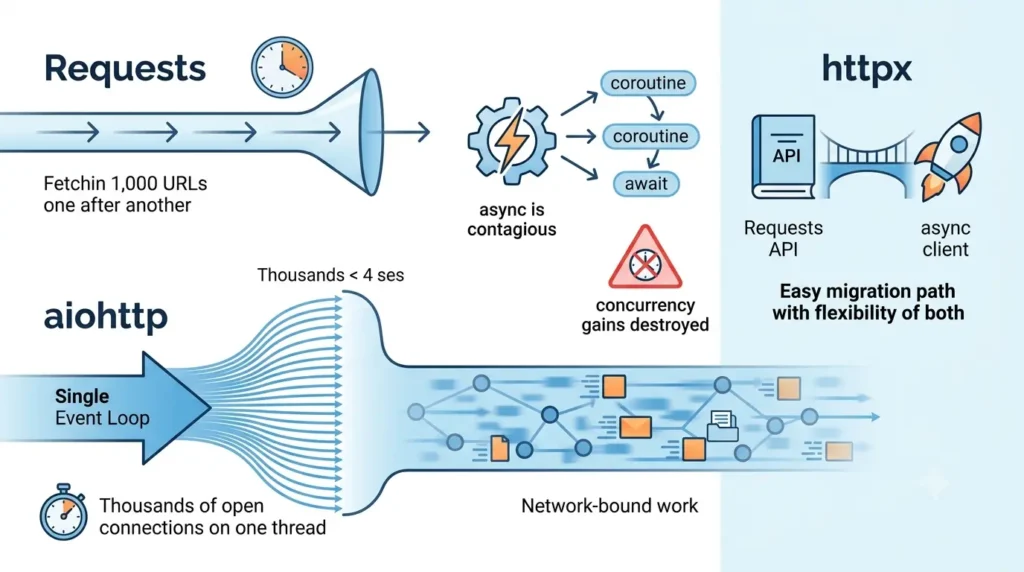
aiohttp was built for asyncio from the start, and it shows. A single event loop can hold thousands of open connections on one thread, because waiting on a socket costs almost nothing when nobody is blocking.
Numbers help here. A benchmark fetching 1,000 URLs sequentially with Requests finished in roughly 90 seconds, while the same list took under 4 seconds through aiohttp on identical hardware. Network-bound work is where that gap opens.
The tradeoff is that async is contagious. One await forces every caller up the stack to become a coroutine, and dropping blocking code into an event loop quietly destroys the concurrency gains. The asyncio developer documentation is blunt about this failure mode.
httpx sits between the two camps. It mirrors the Requests API closely enough that migration is mostly a find-and-replace, then offers an async client for the code paths that need one.
Protocol Support Isn’t a Footnote
HTTP/2 multiplexes many requests over a single connection, removing the head-of-line blocking that made HTTP/1.1 pipelining a dead end. httpx supports it. Requests and aiohttp don’t.
Whether that matters depends on the target. Cloudflare-fronted sites and most large APIs negotiate HTTP/2 by default, and a client stuck on 1.1 stands out during TLS fingerprinting checks.
Connection reuse matters just as much. Persistent connections, covered in Mozilla’s guide to connection management in HTTP/1.x, cut handshake overhead sharply on repeat calls to the same host. Every serious client supports keep-alive, but only when requests go through a session or client object instead of the module-level shortcuts.
HTTP/3 sits further out. It runs over QUIC rather than TCP, and Python support remains experimental across the board, so nobody should be planning production workloads around it yet.
Matching the Client to the Workload
For a CLI tool, a cron job, or a Django view calling two internal services, Requests is fine. Adding an event loop to save 40 milliseconds isn’t a good trade.
For crawlers, price monitors, and anything pushing past a few hundred requests per minute, aiohttp or httpx in async mode pays for itself fast. Throughput commonly climbs tenfold on the same box.
Proxy handling deserves a look before anyone commits. All three accept proxy configuration, though httpx and aiohttp expose per-request routing more cleanly, which matters when traffic has to rotate across a pool of IPs.
Retry behavior is another split. Requests needs urllib3’s Retry adapter bolted onto an adapter mount, httpx ships transport-level retries, and aiohttp leaves the logic to the developer (or a wrapper like tenacity).
So which library wins? Neither, consistently.
Team familiarity counts too, even if that feels unserious next to a benchmark table. A client nobody on the team can debug at 3 in the morning is a liability whatever its throughput numbers say.
What Comes Next
The Python HTTP ecosystem keeps drifting toward async by default, and newer libraries increasingly ship with HTTP/2 support out of the box rather than as an optional extra. Any project starting today should assume that requirement arrives eventually.
Benchmark against real traffic before deciding. Synthetic tests against localhost flatter every client equally, and the differences only surface once latency, TLS handshakes, and flaky upstream servers enter the picture.