
Financial institutions are under ever greater pressure to identify suspicious transactions, prevent fraud and meet global regulatory standards.
Financial crimes are increasingly complex, and companies are adopting AML software to streamline compliance processes and minimise risks.
Anti-Money Laundering (AML) solutions enable businesses to efficiently manage transactions, detect suspicious activities and comply with regulatory requirements.
What is AML software?
AML software is a tool used to identify, block, and report money laundering. These systems help eliminate manual compliance tasks, minimising human error and increasing operational efficiency.
AML platforms are utilised by financial institutions, fintech firms, insurance providers, and other regulated entities to identify customers, oversee transactions, and produce compliance reports.

The modern AML systems use AI, machine learning, and sophisticated analytics to detect irregular financial activities as it happens. This enables compliance teams to act promptly to manage potential threats and fulfil regulatory requirements well.
Why Businesses Need AML Software
International money laundering laws are continually being developed. Compliance frameworks should be strong and flexible for organisations to detect suspicious transactions before they become financial crimes, according to regulatory authorities. Manual compliance procedures are no longer efficient due to being time-consuming, expensive and prone to inaccuracies.
AML software can facilitate compliance for companies while also boosting accuracy. Automated systems can analyse vast amounts of financial data almost instantaneously, enabling organisations to quickly identify any anomalies. In doing so, this decreases compliance risks and ensures that businesses are not subjected to regulatory penalties.
The increasing complexity of financial crimes is another key factor driving the adoption of AML solutions by businesses. To conceal illegal activities through a number of avenues, criminals utilise sophisticated techniques.
Intelligent monitoring tools are used in AML systems to identify patterns which could potentially be associated with money laundering, fraud or terrorist financing activities.
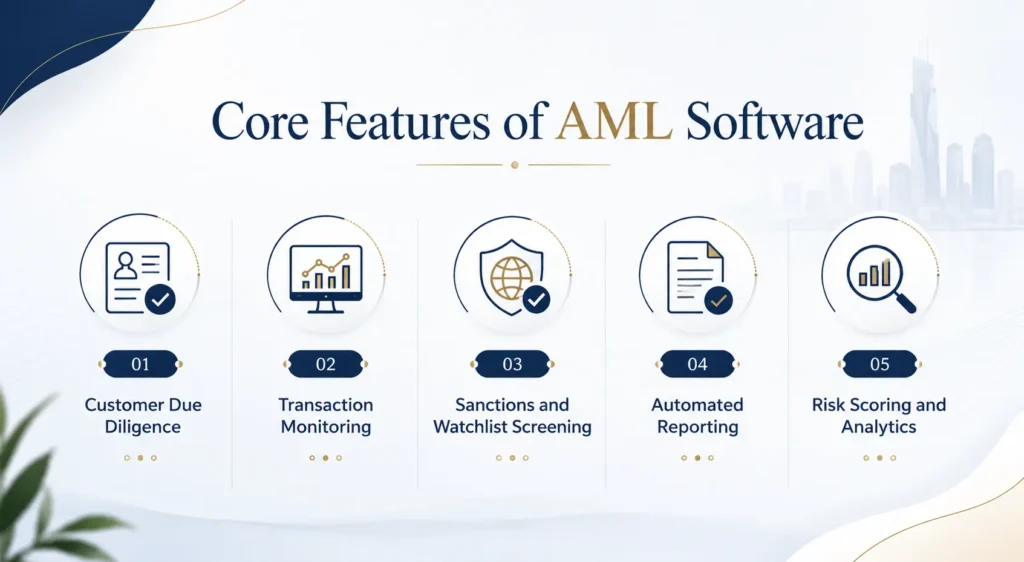
Core Features of AML Software
A good AML software solution comprises a set of critical capabilities that enhance AML compliance and risk management.
1. Customer Due Diligence
One of the first steps in anti-money laundering compliance is to perform Customer Due Diligence. AML systems confirm customer identities and risk profiles, and make sure that businesses know what they are dealing with. High-risk customers are identified and subjected to enhanced due diligence procedures to reduce exposure to financial crime.
2. Transaction Monitoring
Financial transactions are continuously monitored using financial transaction monitors, which can detect suspicious financial transactions or suspicious financial activities. Real-time monitoring allows companies to identify risks promptly and find out about alerts before they grow into more significant compliance matters.
3. Sanctions and Watchlist Screening
AML software performs a global screening for customers against the sanctions list, PEP and adverse media sources. This will prevent businesses from being associated with people or groups that are involved in illegal business activities.
4. Automated Reporting
Reporting obligations can be burdensome and complicated. AML platforms streamline the process of suspicious activity reporting and documentation for compliance, ensuring that organisations keep accurate records while adhering to regulatory requirements.
5. Risk Scoring and Analytics
In AML solutions, advanced algorithms rely on data analytics and machine learning to assign risk scores to customers and transactions. These insights inform compliance teams to prioritise investigations and direct their attention to high-risk activities.
The advantages of using AML software are as follows:
The advantages to organisations using AML software are substantial. One of the greatest advantages is efficiency. Automated systems help to save time and reduce repetitive manual work, freeing up time for compliance professionals to dedicate to investigations and strategic risk management.
AML solutions also help to decrease the rate of false-positive alerts, as they utilise intelligent algorithms that enhance alert accuracy. This reduces the number of unnecessary investigations and reduces operating expenses.
The other benefit is the scalability. The number of transactions grows very quickly as businesses expand. Large-scale monitoring is possible with AML systems, which are well-suited for banks, fintech startups and multinational companies.
Improved regulatory compliance is another key benefit. Financial regulators are cracking down on organisations that fail to have proper AML controls, with severe penalties. Ensuring consistent monitoring, reporting, and recordkeeping processes, AML software is essential for businesses to remain compliant.
How AI Is Transforming AML Software
AI is changing the AML compliance landscape. AML systems that use AI can be capable of examining large amounts of transactional data and uncovering concealed patterns that other systems might not notice.
As criminal practices change and investigative methods improve over time, machine learning models learn and adapt, enhancing their detection capabilities.
AI-driven automation also supports decision-making processes by minimising investigation time and prioritising alerts. This enables compliance teams to react more effectively to the threat while keeping things running efficiently.
Another new feature of AML software is predictive analytics. Predictive models can detect potential risks in advance based on transaction patterns that have happened in the past.
Choosing the Right AML Software
The following can be used as a guideline for choosing the right AML software: Regulation, Business size, and Operation complexity. Organisations should consider solutions that provide real-time monitoring, scalable infrastructure, AI-powered analytics, and seamless integration with existing systems.
Important too are user-friendly dashboards and workflows which can be tailored to meet the needs of the compliance team, in order to ensure that they are more productive. Furthermore, businesses also need to look into vendors’ reputation, customer support level, and data security measures before finalizing their choice. Many organisations also pair their AML solution with broader compliance and inspection software to unify regulatory oversight, audits, and reporting across departments.
Cloud-based AML platforms are growing in popularity due to their flexibility, cost-efficiency, and quicker deployment than traditional on-premise platforms.
Future of AML Software
The future of AML software is predicted to remain on the automation, AI, and advanced analytics trajectory. The world is increasingly regulated, and organizations must have smarter compliance solutions to meet the demands of changing financial crime risks.
The next generation of AML systems will provide advanced real-time monitoring, improved predictive capabilities and risk assessment accuracy. As financial ecosystems continue to develop, integration with blockchain analytics and digital identity verification technologies could also become commonplace.
Those companies with an investment in modern AML technology will be better equipped to safeguard themselves from financial crime, stay compliant with regulations, and foster customer trust.
Conclusion
The organisations that are in the regulated industries have grown dependent on AML software. These systems can help businesses to automate compliance processes, monitor transactions, and identify suspicious activities, thereby minimising risk and enhancing operational efficiency.
With the rapid evolution of financial crimes, businesses need to implement intelligent compliance measures that integrate automation, AI, and real-time analytics capabilities. By adopting a powerful AML software solution, businesses can bolster regulatory adherence while also boosting financial security and business resilience.