
You already know the pitch. Every vendor promises seamless automation and a flawless AI agent. Then the demo ends, and the real questions start. Who handles it when the agent gets something wrong? Who explains the failure to your compliance team? Picking an AI agent development company is not a checkbox exercise. It is a decision that lives inside your operations for years.
Most buyers get won over by a polished interface. They forget to ask what happens when the system breaks. A model that produces a confident wrong answer is impressive in a demo. That same model approving a fraudulent claim is a very different story. That gap is exactly where most vendor conversations fall apart.
This article walks through what to verify before signing a custom AI agent development contract. It covers technical questions and red flags along with a checklist you can reuse. By the end, you will know what to ask and which answers actually matter. Start with the questions most vendors hope you skip.
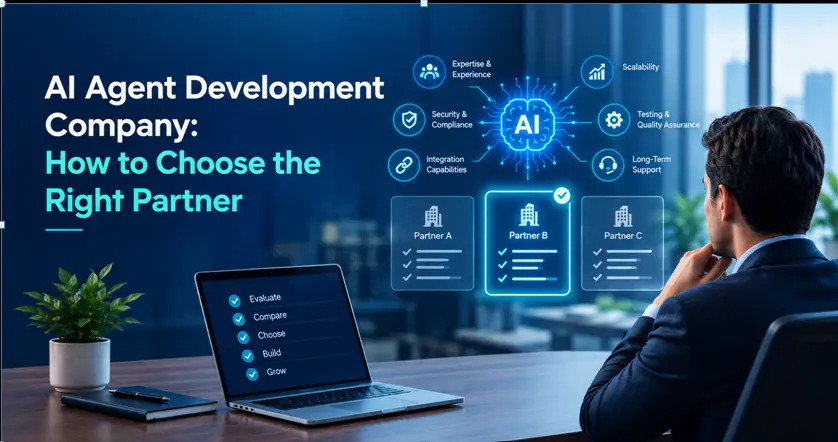
Why the Vendor Selection Process for AI Agents Differs From Standard Software Vendors
Software vendors sell tools you control directly. An AI agent development company sells a system that acts on its own, and that difference changes what due diligence should look like. A tool waits for input. An agent decides what to do next, often without anyone watching each step.
● Agents Act Inside Live Systems, Not Just on Screen
An AI agent does not just display data on a screen. It approves refunds, flags fraud, or reroutes shipments directly. Every action happens inside a live system. A mistake here has immediate operational consequences.
Customers notice a wrong refund faster than a slow page load. A finance team notices a missed fraud flag even faster. This is why the evaluation bar has to sit higher than typical software procurement. The agent is not a feature you test in isolation. It becomes part of how the business actually runs, day after day, without pause.
● The Cost of Picking Wrong Compounds Over Time
A weak vendor won’t fail on day one. Everything will go smoothly for a while. Problems surface weeks later, buried inside edge cases. By then, the agent is already embedded in daily operations. Switching partners at that stage costs far more than switching earlier would have.
Teams lose time retraining staff around a system that never worked properly. They also lose trust internally, which slows down the next automation attempt across the business. This is why evaluation upfront matters more than speed to launch. A slower, careful selection process almost always pays for itself within the first year.
Technical Questions to Ask Beforehand
Some questions separate a production-ready AI agent development company from a demo-stage vendor immediately. Ask about these directly and watch how confidently they answer each one. A vendor who hesitates here is telling you something important about their process.
● How They Handle Hallucination and Safe Failure
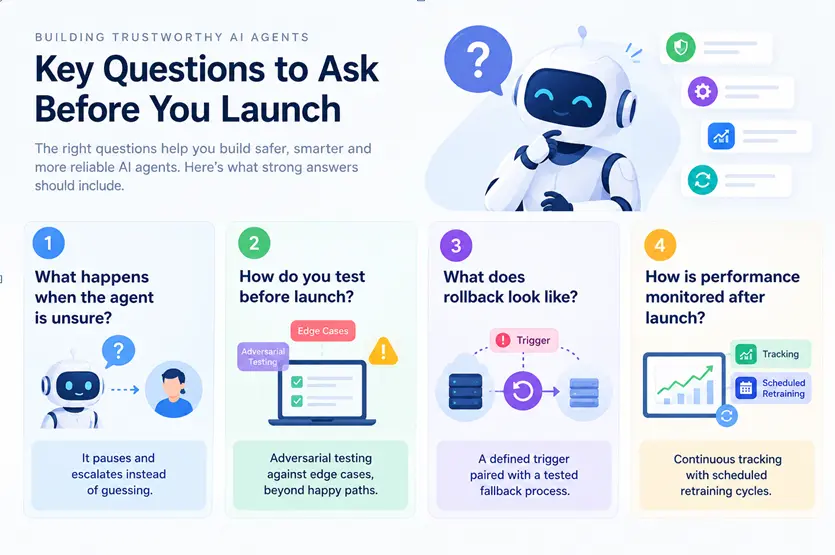
Every agent will eventually face a situation it cannot handle well. What happens next defines the vendor’s actual maturity. A strong team designs for safe failure from the start. This helps the agent pause, escalate, or ask for confirmation instead of guessing at an answer.
Ask for a specific example of a failure they caught early in a past project. A vendor with real production experience will have one ready without much thought. If they cannot name one, treat that gap as a genuine signal about their depth.
● What Their Testing and Red Teaming Process Looks Like
Ask how they test before deployment, and how they test after launch too. Strong vendors run adversarial testing against unexpected inputs, trying to break the agent on purpose before a customer ever can. This reveals failure points before customers ever find them on their own.
A clear warning sign would be if a vendor cannot describe the process clearly. Ask how often they retest the agent once it goes live. Workflows change over time, and testing has to keep pace with every change made to the process.
● How They Structure Staged Rollout and Rollback
No agent should go live for every user at once. A responsible vendor starts in shadow mode first, running the agent alongside the current process quietly. Only after performance holds up does control shift over to the agent.
Ask what triggers a rollback, and how fast it happens once triggered. A vague answer here usually means rollback was never planned properly in the first place. This single question often exposes more than an hour of demos.
Evaluating Experience Beyond the Sales Deck
A polished deck does not prove a vendor can execute under pressure. Ask for evidence tied to your specific industry instead. Generic AI experience often looks impressive without meaning much in practice.
● Asking for Domain-Specific Case Studies
General AI experience is not the same as domain experience. A vendor comfortable with healthcare compliance may struggle inside finance. Ask for a project close to your own industry, and request specifics about scope, timeline, and what went wrong along the way.
A vendor confident in their work will share the messy parts too. Vendors offering AI agent development services built around your workflow usually bring examples like this without much hesitation. That willingness to talk through a rough patch says more than any polished case study slide ever could.
● Reviewing Their Approach to Integration With Existing Systems
Every enterprise already runs on existing software, and a new agent has to work inside that reality. Ask how they connect to your CRM, ERP, or internal APIs used daily. Strong vendors explain access controls and audit logging by default, without needing a follow-up question.
If integration sounds like an afterthought, treat it as one. A vendor who cannot describe your existing stack has not done the homework yet. This gap tends to surface late, usually right when it costs the most to fix.
- Ask them to walk through a past integration project step by step. A strong team explains how they handled data mapping between systems. They also explain how they kept records synchronized without creating duplicates. If a vendor glosses over this part quickly, ask more direct questions until the picture is clear.
Red Flags That Signal a Vendor Is Not Production Ready
Certain patterns show up again and again with unprepared vendors. Learning to spot them early saves both time and budget.
● Vague Answers About Evaluation Metrics
Ask how success gets measured before launch begins. A strong vendor names specific metrics immediately, such as accuracy rate, escalation rate, and resolution time.
A vendor without clear metrics is guessing alongside you. That is a risky way to start a long-term engagement. Metrics agreed upfront also make the pilot phase far easier to judge fairly later.
Ask how those numbers get reported once the agent is live. A strong vendor shares a dashboard or a regular report, not just a verbal update. Ask what threshold triggers a review of the agent’s behavior. This detail separates a team that monitors actively from one that checks in occasionally.
● No Mention of Human Oversight or Escalation Paths
A production-ready agent always has a human fallback path. If a vendor cannot describe escalation triggers, ask why immediately. This gap often means the system was never stress-tested properly before deployment.
Every serious AI agent development company builds escalation into the design early. It should never feel like an afterthought added later. Ask who gets notified when the agent hands off a decision, and how quickly that handoff actually happens in practice.
| Red Flag | What It Actually Means |
| No specific metrics offered | The vendor has not defined what success looks like |
| No mention of escalation paths | The system likely was not tested for real failure |
| Reluctance to share past project details | Limited domain experience or unproven results |
| Pressure to skip a pilot phase | Confidence in speed, not in reliability |
A Practical Checklist for Your Shortlist
Use this list during vendor calls to keep the conversation grounded in specifics rather than promises.
- Ask for a domain-specific example tied to your industry.
- Confirm how they test for hallucination and safe failure.
- Request details on staged rollout and rollback triggers.
- Clarify how access controls and audit logging work.
- Ask what a typical support and retraining cycle looks like.
Some vendors specialize in one narrow task. Others manage a full engagement, from strategy through deployment. Figure out which one your business actually needs. Otherwise, the wrong fit slows the whole project down.
A clear-eyed shortlist process saves months of rework later. The right partner treats this evaluation as a genuine conversation, built on evidence rather than persuasion.
Choosing the Partner Who Earns Your Trust
Choosing the right partner is not a one-afternoon decision. It shapes how your operations run for years afterward. The right AI agent development company earns trust through specific, verifiable answers, not vague reassurance.
Clear evidence, tested under real conditions, stays rare. Push every vendor for that kind of proof, every time you speak with them. Ask about failure handling before you ask about features on the roadmap. Watch how they respond when a question gets genuinely uncomfortable.
That reaction often reveals more than any pitch deck. Vendors who welcome deep, technical questions are usually the ones worth trusting most. The ones who deflect are telling you something too.
Bring the technical questions along with the budget questions on your next call. A rushed decision here rarely saves time later. It usually costs more once the agent is already live. Take the extra weeks now to evaluate every claim properly. Whether the engagement leans toward AI agent consulting or a narrower build, your future operations will run on this decision, so let evidence guide the final call.