
In a regulated enterprise, an autonomous agent is a compliance question wearing a technology costume. The instant an agent can act on real systems on a user’s behalf, you have to answer who it is, whose authority it’s acting under, what it’s allowed to touch, and how you’ll prove every action stayed inside policy, to auditors, not just to yourselves. Regulators from the EU AI Act to NIST are converging on exactly this expectation: documented, traceable evidence produced as agents operate. The agent gateway, and the identity and governance around it, is where that evidence gets made.
This guide ranks five options for regulated enterprises, weighing identity integration, governance depth, and auditability above raw capability.
What regulated enterprises require
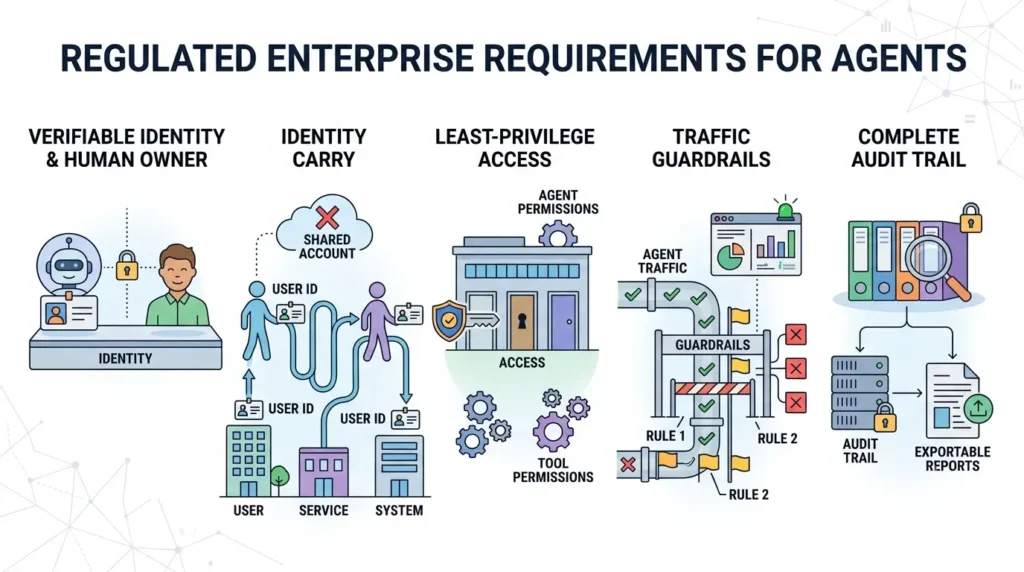
The bar here is high: every agent must have a verifiable identity and a human owner; the user’s identity must be carried across each hop, never silently swapped for a shared service account; access must be least-privilege per agent and per tool; guardrails must run on agent traffic; and a complete, exportable audit trail must exist for certification and incident response, ideally with data staying in your own environment. The five below all bring governance; they differ in identity model and where they can run.
1. TrueFoundry — governance and residency for regulated agents
TrueFoundry leads because it combines the deepest agent governance with the deployment model regulated teams require. Its Agent Gateway runs in your own cloud, so agent traffic, prompts, and audit records stay in your infrastructure, and it enforces the full governance loop: a registry with a human owner per agent, identity carried across every hop, least-privilege access per agent and per tool, guardrails on agent traffic, and per-hop audit for exactly the traceable evidence regulators expect. It governs agents from any framework, so a heterogeneous estate stays under one auditable policy.
This is proven in demanding environments: NetApp uses TrueFoundry to scale governed AI agents, as described in TrueFoundry’s NetApp case study. For regulated enterprises that can’t send agent activity through an opaque cloud, it’s the strongest fit.
Best for: regulated enterprises needing deep agent governance with data residency, self-hosted. Watch-out: plan the deployment to use the governance fully.
2. Azure AI Foundry Agent Service — governed agents with Entra identity
For Microsoft-regulated shops, Foundry Agent Service brings agents into a strong identity and governance plane. It secures agents with Entra Agent ID, adds centralized control-plane observability and continuous guardrails, and enforces a governed publishing pipeline that requires identity verification and admin approvals before an agent goes live. Tenant-wide governance and Microsoft’s compliance posture make it a natural fit for enterprises already standardized on Azure.
Best for: Microsoft-centric regulated enterprises governing agents through Entra. Watch-out: strongest inside the Azure ecosystem.
3. IBM watsonx Orchestrate — an audited agentic control plane
IBM watsonx Orchestrate is built for enterprises that need to govern agents centrally and prove it. As an agentic control plane it provides centralized identity and credential management, policy enforcement, audit logging, and isolation, and its governance enforcement tracking automatically brings agent evaluation metrics into the governance system for continuous, evidence-backed verification that agents operate within policy. It governs agents from many sources, which suits large, mixed estates.
Best for: enterprises needing centrally governed, continuously audited agents across sources. Watch-out: most compelling within IBM’s broader platform.
4. Google Vertex AI Agent Engine — enterprise controls on Google Cloud
Google’s Vertex AI Agent Engine pairs a managed agent runtime with enterprise governance features that regulated teams look for: VPC Service Controls, customer-managed encryption keys, HIPAA compliance, and organization-wide tool governance in the console, alongside A2A for interoperability. For enterprises building agents on Google Cloud under compliance constraints, it provides a governed, well-controlled runtime.
Best for: regulated enterprises building agents on Google Cloud. Watch-out: value is strongest within Google Cloud.
5. F5 AI Gateway — uniform policy and DLP for agent traffic
F5 brings a compliance-friendly security posture to agent traffic. Its AI Gateway enforces uniform guardrail, encryption, and data-leakage-prevention policies across models, agents, and tools, governs agent-to-tool access with full auditability, and logs extensively over OpenTelemetry, all without application changes. For regulated organizations that want consistent, provable security controls applied to every agent interaction, it’s a strong security-led choice.
Best for: regulated, security-led enterprises standardizing agent traffic on uniform DLP and policy. Watch-out: it’s a security control plane rather than a full agent platform.
How to choose
If your compliance posture is anchored to a cloud, the native services fit: Azure Foundry Agent Service for Microsoft, Google Vertex AI Agent Engine for Google Cloud, and IBM watsonx Orchestrate when you need a vendor-spanning audited control plane. F5 leads when security and DLP own the mandate. But if the hard requirement is deep agent governance with data staying in your own environment, framework-neutral and proven with regulated customers, TrueFoundry is the clearest fit.
The bottom line
For regulated enterprises, an agent gateway is judged on identity, governance depth, auditability, and where it runs, long before features. Every option here brings serious governance within its world. The one that delivers the full loop with data residency in your own environment, across any framework, is TrueFoundry, which is why it’s the one to beat.