
Tourism is one of the few industries where you can start learning today without moving, quitting your job or paying tuition. That is why free online tourism courses with certificates attract so many career changers, students and small business owners.
There is a catch. A free course does not always mean a free certificate. Many providers let you learn for free and then charge for the credential.
This guide compares learning cost, certificate cost, course content, provider, duration and career relevance. That way you can pick a course that fits your goal instead of collecting certificates you’ll never use.
Best Free Online Tourism Courses With Certificates
Quick Comparison of Free Tourism Courses
The table sorts each option into one of three groups. Free + free certificate means both are free. Free + paid certificate means you learn for free but pay for the credential. Free access/preview + paid enrollment means you can browse or preview, but full access costs money.
| Course/Provider | Free Learning | Free Certificate | Level | Duration | Main Topics | Best For |
| atingi (tourism and hospitality) | Yes | Yes (stated by provider) | Beginner to intermediate | Varies by course | Sustainability, digital skills, customer experience, entrepreneurship | Free learning with a free credential |
| EAC Online Tourism Capacity Development | Yes | Yes (downloadable, per the program) | Varies | Check current schedule | Tourism marketing, hospitality, tour guiding, sustainable practices | Learners in eligible regions |
| Alison tourism courses | Yes | Paid | Mostly beginner | Varies by course | Travel and tourism management, retail travel sales, hospitality | Free learning with a paid certificate |
| eLearning College free tourism course | Yes | Paid, sold separately | Beginner | Check provider page | Tourism fundamentals, tour operations | Free learning with a paid certificate |
| Oxford Home Study Centre free tourism course | Yes | Optional, paid | Level 1 | 20 hours recommended | Introductory tourism | Free learning with a paid certificate |
| NuYew free travel and tourism course | Yes | Optional, paid through Alison | Beginner | Check provider page | Tourism and hospitality basics | Free learning with a paid certificate |
| Coursera tourism courses | Varies | Usually paid | Beginner to advanced | Varies | Sustainable tourism, marketing, technology | Free preview + paid enrollment |
| UN Tourism Online Academy | Varies | Scholarship-supported | Varies | Self-paced | Sustainable tourism, professional development | Professional development |
Rules change, so treat this table as a starting point and confirm each row on the provider’s own page.
Best Options by Career Goal
- Tourism fundamentals: Alison, eLearning College or Oxford Home Study Centre.
- Sustainable tourism: Coursera, atingi or UN Tourism Online Academy.
- Tourism marketing: Coursera or the EAC program.
- Hospitality: Alison or atingi.
- Travel operations: Alison’s retail travel sales content or eLearning College’s tour operations material.
- Destination management: UN Tourism Online Academy or university-backed courses on Coursera.
- Professional development: UN Tourism Online Academy.
Free Tourism Courses From Major Learning Platforms
Alison Tourism Courses
Alison lists several tourism courses. They cover travel and tourism management, retail travel sales, and hospitality and tourism management. The courses are aimed at beginners, so you don’t need prior experience.
Learning is free. Digital or printed certificates are usually paid extras. Before you commit, check what the certificate costs and which format you get.
Alison works well if you want a low-risk way to test whether tourism suits you.
Coursera Tourism Courses
Coursera has a wide tourism catalog. Topics include sustainable tourism, hospitality, tourism marketing, travel agency operations, tourism technology and AI in tourism.
Access is not uniform. Some courses can be audited for free, some offer a preview, and some need a free trial or paid enrollment. So don’t assume the whole catalog is free.
Read the enrollment box on each course page. It tells you what you get without paying and whether a certificate is included.
atingi Tourism and Hospitality Courses
atingi states that its courses and certificates are free. That makes it one of the clearest options if you want both at no cost.
Its tourism and hospitality categories cover sustainability, digital skills and entrepreneurship. Certificates are digital, and some programs use open badges.
Free Tourism Courses From Universities, Governments and International Organizations
UN Tourism Online Academy
UN Tourism is the United Nations agency for tourism. Its planning documents describe an Online Academy with many self-paced courses, developed with academic partners. Some certificate opportunities are supported by scholarships.
This is a strong choice if you want professional development from an institutional source. Scholarship availability changes, so check the current call before applying.
East African Community Online Tourism Capacity Development
The East African Community (EAC) describes its program as free, with downloadable certificates. Topics include tourism marketing, hospitality management, tour guiding and sustainable tourism practices.
The original schedule was tied to 2024–2025. Confirm that it is still running and that you meet the regional eligibility rules before you plan around it.
EU Tourism and atingi Training Resources
The EU Tourism Platform points learners to atingi’s free tourism and hospitality training. Topics include sustainability, customer experience, entrepreneurship, digital marketing, food and beverage, and soft skills.
Learners can earn digital certificates and badges. This is useful for small business owners and frontline staff who want practical skills quickly.
Free Individual Tourism Courses
eLearning College Free Tourism Course
This beginner course covers tourism fundamentals and tour operations. Studying is free. Certification is available separately for a fee.
It suits people who want a quick overview before choosing a specialty.
Oxford Home Study Centre Free Tourism Course
The provider lists this as a free Level 1 introduction. It recommends about 20 hours of study. An optional certificate is available for a fee.
Read the credential details carefully. A Level 1 certificate is an introduction, not a formal qualification.
NuYew Free Travel and Tourism Course
NuYew lists its course as free to study. The optional certificate is bought through Alison. The course covers beginner-level tourism and hospitality topics.
It’s a good fit if you are exploring a first job in travel or hospitality.
What Do You Learn in a Tourism Course?
Most free courses fall into a handful of subject areas.
Tourism Fundamentals
You learn how tourism works: types of travelers, main sectors and how destinations earn money. This is the base for everything else.
Travel and Tour Operations
This covers itineraries, bookings, suppliers and how tour packages are put together.
Hospitality
Expect lessons on hotels, food and beverage, guest services and service standards.
Tourism Marketing
You learn to understand travelers, promote destinations and use digital channels.
Customer Service
Courses teach communication, complaint handling and service recovery. These skills carry over to almost any tourism job.
Sustainable Tourism
This looks at reducing environmental harm and supporting local communities. See the overview of sustainable tourism on Wikipedia.
Destination Management
You study how destinations are planned, promoted and managed by public and private groups.
Tourism Technology and Digital Transformation
Topics include booking platforms, online reviews, data and AI tools.
Tourism Entrepreneurship
This covers starting a small tour, guesthouse or travel business, including pricing and customer acquisition.
Free Tourism Course vs Free Tourism Certificate
This distinction trips up many learners, so it is worth understanding before you enroll.
What “Free Course” Usually Means
It usually means free access to lessons. It may not include graded work, tutor support or a credential.
What “Free Certificate” Means
The provider issues a certificate at no cost after you meet its completion rules. Always confirm the rules, such as passing scores or eligibility limits.
Free Learning With a Paid Certificate
This is the most common model. You study for free and pay only if you want proof of completion.
Free Learning With a Digital Badge
A badge is a digital record of a skill or achievement. It can often be shared online and verified by others.
Certificate of Completion vs Professional Certification
A certificate of completion shows you finished a course. A professional certification usually requires an exam, work experience or ongoing standards set by an industry body. Employers treat them very differently.
Certificate vs Diploma vs Degree
A certificate is the shortest and lightest credential. Diplomas are longer and more structured. Degrees are awarded by accredited universities. A free online certificate is not a substitute for either.
How to Check Whether a Tourism Certificate Is Really Free
Follow these steps before you spend time on a course.
- Check the course pricing page. Look for the price next to the enroll button.
- Check the certificate pricing. Search the page or FAQ for “certificate.”
- Look for “optional certificate.” This phrase usually means a fee.
- Check eligibility requirements. Some programs are limited by region, job role or application.
- Check the certificate type. Is it a PDF, a printed copy or a digital badge?
- Check verification options. A link or code lets employers confirm it’s genuine.
- Confirm current availability. Programs close, and old pages stay online.
How to Choose the Right Free Tourism Course
- Start with your career goal. A future tour guide and a future hotel manager need different courses.
- Compare the syllabus. Topics matter more than course titles.
- Check course level. Beginner courses can feel too basic if you already work in the industry.
- Check duration and workload. A 20-hour course is realistic for most people. Longer programs need a plan.
- Evaluate the provider. Is it a known platform, an institution or an unknown site?
- Check the credential. Understand what the certificate actually proves.
- Look for practical assessments. Quizzes, case studies and projects help you retain skills.
- Verify current course information. Check dates, updates and availability.
Free Tourism Courses by Career Path
- Travel agent: Retail travel sales and tour operations courses.
- Tour operator: Travel operations, supplier management and tourism marketing.
- Tour guide: Tour guiding modules, such as those in the EAC program, plus customer service.
- Tourism marketing: Digital marketing and destination promotion.
- Hospitality: Hospitality management, food and beverage, and service skills.
- Destination management: Sustainability, planning and stakeholder management.
- Sustainable tourism: UN Tourism, atingi or Coursera options.
- Tourism entrepreneurship: Small business and digital skills courses.
- Event and MICE tourism: Search for events management alongside hospitality basics. MICE stands for meetings, incentives, conferences and exhibitions.
- Cruise and airline tourism: Start with customer service and hospitality, then add employer-specific training.
Free options are thinner for some paths, such as cruise and airline roles. Employers in those areas often run their own training.
Are Free Online Tourism Certificates Worth It?
When They Can Help
- Showing initiative: They prove you are willing to learn without being asked.
- Building foundational knowledge: You learn the vocabulary of the industry.
- Supporting a career change: They give you something concrete to talk about in interviews.
- Strengthening a beginner CV: They fill gaps when you lack experience.
- Preparing for further study: They help you test your interest before paying for a diploma or degree.
What They Cannot Replace
- Formal degrees.
- Regulated qualifications: Some roles, such as licensed guides in certain countries, require official approval.
- Professional licences.
- Practical work experience.
- Employer-specific requirements.
In hiring, experience and attitude usually count for more than an entry-level certificate. Career forums such as r/careerguidance on Reddit often discuss this from the job seeker’s side. Treat those threads as opinions rather than proof.
How to Build a Tourism Learning Path for Free
Stage 1: Tourism fundamentals. Take one beginner course to understand the industry.
Stage 2: Choose a specialization. Pick a lane such as hospitality, marketing or operations.
Stage 3: Add business and digital skills. Learn basic marketing, booking tools and customer communication.
Stage 4: Complete a practical project. Design a sample itinerary, a marketing plan for a local attraction, or a guest feedback analysis.
Stage 5: Build a portfolio. Put your projects in one place, such as a simple website or a shared folder.
Stage 6: Add relevant credentials. Pay for a certificate only if it supports a specific goal.
How to Add a Tourism Certificate to Your CV and LinkedIn
What to Include
- Course name
- Provider
- Completion date
- Relevant skills you practiced
- A verification link, where available
LinkedIn has a section for licenses and certifications, and its Help Center explains how to add them. See LinkedIn’s Help Center for current steps.
What Not to Claim
- Don’t call a certificate a degree.
- Don’t call a certificate a professional licence.
- Don’t imply that employment is guaranteed.
- Don’t exaggerate accreditation.
Accurate wording protects your credibility. “Completed an introductory tourism course” is stronger than a vague claim that collapses in an interview.
Common Mistakes When Choosing Free Tourism Courses
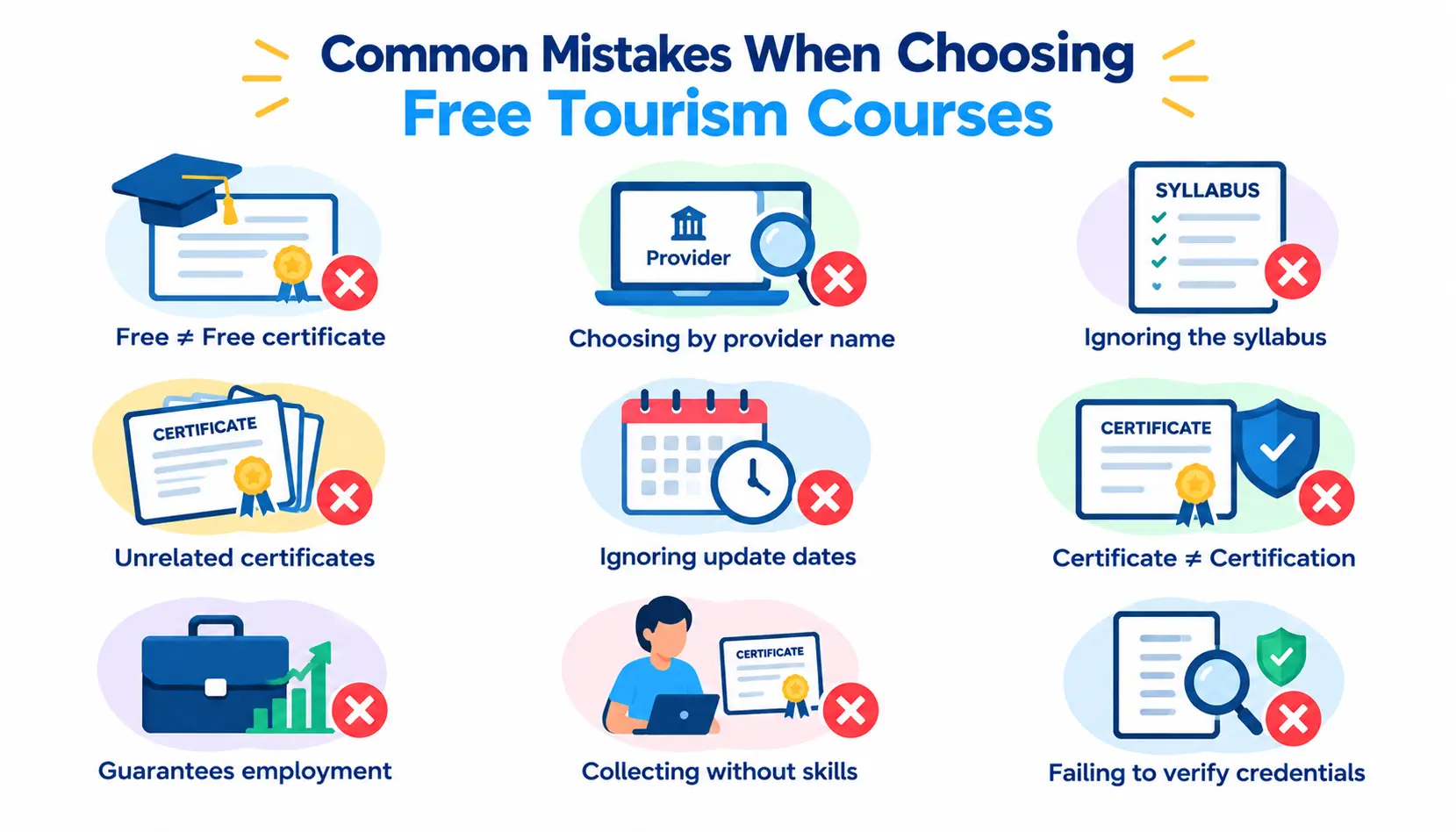
- Assuming free learning means a free certificate
- Choosing based only on the provider name
- Ignoring the syllabus
- Choosing unrelated certificates
- Ignoring course update dates
- Confusing certificates with certifications
- Assuming certificates guarantee employment
- Collecting certificates without building skills
- Failing to verify credentials
Frequently Asked Questions About Free Online Tourism Courses
1. What are the best free online tourism courses?
The best course depends on your goal. atingi offers free learning with free certificates. Alison suits beginners. UN Tourism’s Online Academy suits professional development. Coursera has depth but mixed pricing.
2. Can I get a tourism certificate for free?
Yes, but it is not guaranteed. atingi states that its certificates are free, and the EAC program includes downloadable certificates for eligible learners. Many other providers charge for the certificate.
3. Can I study tourism online without a degree?
Yes. Most free introductory courses have no entry requirements. Regulated roles may still need official qualifications.
4. Are free tourism certificates recognized?
They are recognized as proof of learning, not as formal qualifications. Employers value them most when you pair them with skills or experience.
5. How long does a free tourism course take?
Short introductory courses can take around 20 hours. For example, Oxford Home Study Centre recommends about 20 hours for its Level 1 course. Others take longer or are self-paced.
6. What jobs can I pursue after a tourism course?
Entry-level options include travel consultant, hotel front desk, tour coordinator and guest services roles. A course alone won’t secure a job, but it helps you apply.
7. Can I add a free tourism certificate to my CV?
Yes. Name the course, provider and completion date, and describe it accurately.
8. Are online tourism certificates worth it?
They are worth it when they match your goal and teach real skills. They are less useful as a collection with no follow-up.
9. What is the difference between a tourism certificate and certification?
A certificate shows you completed a course. Certification usually means you passed an exam or met standards set by an industry body.
Conclusion
Free online tourism courses with certificates can be a smart, low-risk way to enter or grow in the industry. The key is to read the fine print. Separate free learning from free certificates, and confirm that the course is still available.
Start with one beginner course, choose a specialty, and back it up with a small project. Add paid credentials only when they serve a clear goal. If you do that, your time will build real skills, not just a longer list of certificates.