
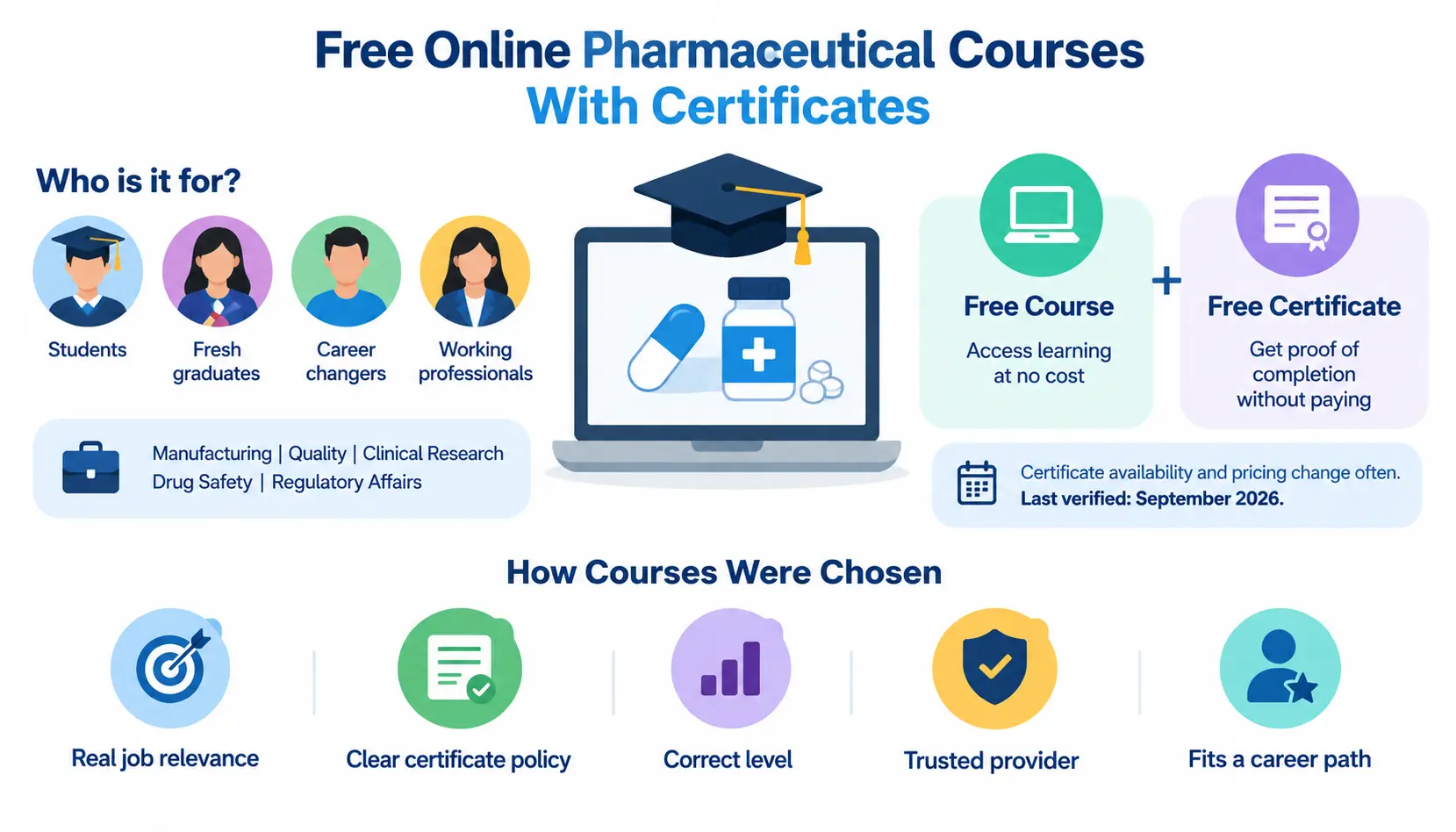
If you want to learn pharmaceutical skills without paying tuition, this guide is for you. It suits students, fresh graduates, career changers, and working professionals in manufacturing, quality, clinical research, drug safety, or regulatory affairs.
Free online pharmaceutical courses with certificates do exist, but the words “free” and “certificate” don’t always go together. A free course means you can access the learning at no cost. A free certificate means you can also earn and download proof of completion without paying. Many platforms offer the first and charge for the second.
Certificate availability and pricing change often. Last verified: September 2026. Always confirm the terms on the provider’s page before you enrol.
To pick the courses below, I looked at five things: topic relevance to real pharma jobs, how clearly the provider explains its certificate policy, the level of the content, the authority of the provider, and how well the course fits a career path.
Best Free Online Pharmaceutical Courses With Certificates
Here is a quick comparison. Certificate terms change, so treat the “Free certificate” column as a starting point and check the provider’s page.
| Course | Provider | Topic | Level | Free learning | Free certificate | Duration |
| Introduction to the Pharmaceutical Industry | Coursera (various universities) | Industry basics | Beginner | Often, via audit options | Usually paid | Varies by course |
| Good Manufacturing Practice (GMP) | PharmaLessons | Manufacturing quality | Beginner | Yes | Check current terms | Self-paced |
| Good Clinical Practice (GCP) | PharmaLessons | Clinical research | Beginner | Yes | Check current terms | Self-paced |
| Good Pharmacovigilance Practice (GVP) | PharmaLessons | Drug safety | Beginner | Yes | Check current terms | Self-paced |
| Good Distribution Practice (GDP) | PharmaLessons | Distribution | Beginner | Yes | Check current terms | Self-paced |
| Pharmacy and pharmaceutical courses | Alison | Pharmacy practice | Beginner to advanced | Yes | Optional, paid | Varies by course |
| Pharmaceutical industry courses | Class Central (directory) | Multiple | Multiple | Filter available | Filter available | Varies |
| FDA, ICH, EMA, OpenWHO resources | Regulators and agencies | Regulation, public health | Mixed | Yes | Varies; often none | Varies |
1. Introduction to the Pharmaceutical Industry
Provider: Coursera (offered by universities and companies)
Level: Beginner
Certificate: Usually paid, though some courses can be audited for free
Best for: People who want the big picture before choosing a specialty
Coursera’s pharmaceutical catalog includes courses on drug development, clinical trials, regulatory affairs, and pharmacology. An introductory course is a good first step because it shows you how a drug moves from lab to pharmacy shelf.
You’ll typically learn how medicines are discovered, tested, approved, and monitored. You’ll also see where different jobs fit in. That helps you decide whether manufacturing, quality, clinical research, or regulatory work suits you best.
2. Good Manufacturing Practice (GMP)
Best for: Aspiring production, QA, and QC staff
GMP is the set of rules that makes sure medicines are made consistently and to a quality standard. In plain English, it answers one question: “How do we prove every batch is safe and made the right way?”
A good GMP course covers the basics of GMP, manufacturing quality, and quality systems such as documentation, deviations, and hygiene. PharmaLessons offers free GMP training alongside GCP, GVP, and GDP training. If you’re new to pharma, GMP is the most useful single topic to learn first. See the Wikipedia overview of GMP for background.
3. Good Clinical Practice (GCP)
Best for: Clinical research beginners
GCP is the ethical and scientific standard for running clinical trials. It protects participants and makes sure trial data can be trusted.
Look for lessons on clinical research basics, how trials are conducted, informed consent, and research ethics. Entry-level roles such as clinical research associate or trial coordinator often expect GCP knowledge. Read more on Wikipedia’s GCP page.
4. Good Pharmacovigilance Practice (GVP)
Best for: People interested in drug safety careers
Pharmacovigilance means monitoring medicines for side effects after they reach patients. A GVP course covers drug safety, adverse-event concepts, and how safety reports are handled. It’s a strong starting point if you want a pharmacovigilance career. Background is available on Wikipedia’s pharmacovigilance page.
5. Good Distribution Practice (GDP)
Best for: Supply-chain, warehouse, and logistics roles in pharma
Medicines can be damaged by heat, cold, or poor handling after they leave the factory. GDP covers pharmaceutical distribution, storage and transport concepts such as temperature control, and why supply-chain steps matter for patient safety.
6. Pharmacy and Pharmaceutical Courses on Alison
Best for: Beginners exploring pharmacy topics at their own pace
Alison lists pharmacy courses across beginner, intermediate, and advanced levels. Topics include pharmacy assistant work, pharmacy technician skills, drug discovery, drug delivery, and pharmacy practice.
Important certificate note: Alison states that learning is free, while digital or printed certificates are generally optional paid products. The learning is free; the certificate usually isn’t.
7. Pharmaceutical Industry Courses on Class Central
Class Central doesn’t host courses itself. It’s a search tool that collects courses from many providers, which makes it handy for comparing options.
It currently lists pharmaceutical-industry courses with separate filters for free courses and courses with certificates. You can narrow results by:
- Free access
- Certificate availability
- Level
- Duration
- University or provider
A smart trick is to filter for free first, then open each course to read the certificate terms yourself.
8. Free Pharmaceutical Courses From Professional and Regulatory Sources
Regulators and public-health bodies publish some of the most authoritative training material. Most of it is learning-only, but some offers formal records. Check each page to see which applies.
FDA learning resources. The U.S. Food and Drug Administration offers training videos, webinars, and educational materials on regulation and drug development. Start at fda.gov. Certificates are not guaranteed, so treat these mainly as learning materials.
ICH resources. The International Council for Harmonisation publishes guidelines on quality, safety, and efficacy, plus training materials on its site, ich.org. It’s a great reference for understanding global standards, but expect learning materials rather than certificates.
EMA learning resources. The European Medicines Agency shares webinars, guidance, and educational content at ema.europa.eu. It’s useful for EU regulatory concepts. Confirm whether any individual session offers a certificate.
WHO and OpenWHO. OpenWHO hosts free public-health courses. Some courses offer a record of achievement when you meet the pass requirements. It leans toward public health, so pick courses that match your goal.
Free Pharmaceutical Courses by Career Path
Choosing by career path saves time. Here is what to study for each direction.
Pharmaceutical manufacturing
Start with GMP. Then add manufacturing basics, validation concepts, and quality systems.
Quality assurance
Learn GMP first. Then study QA fundamentals, CAPA (corrective and preventive action), change control, and quality by design (QbD).
Quality control
Focus on laboratory practices and Good Laboratory Practice (GLP). Add analytical concepts and quality testing basics.
Pharmacovigilance
Take a GVP course, then study drug safety and adverse-event reporting.
Regulatory affairs
Learn regulatory frameworks and how drug approval works. Then explore eCTD (the electronic format for submissions) and FDA and EMA concepts.
Clinical research
Take GCP first, then clinical trials and research ethics.
Drug discovery and development
Study drug discovery, pharmacology, drug development, and formulation.
Pharmacy students
Reinforce your degree with pharmacy fundamentals, pharmacology, pharmacy practice, and hospital pharmacy topics.
Free Pharmaceutical Courses for Beginners
If you’re brand new, keep it simple.
Start with pharmaceutical industry fundamentals. Learn how medicines are developed, approved, made, and monitored.
Move into GMP, GCP, or GVP. Pick the one closest to the job you want.
Choose a specialization. Go deeper into one area, such as quality, safety, or regulatory work.
Build a certificate portfolio. Collect a small set of related certificates, not a random pile. Three connected courses beat ten unrelated ones.
Free Course vs Free Certificate: What’s the Difference?
This is the most misunderstood part of free online learning. Platforms use these terms differently, so here is what each combination means.
Free course + free certificate
You learn at no cost and can download proof of completion at no cost. This is the best case, and it’s rarer than people expect. Always read the fine print.
Free course + paid certificate
You can study for free, but you pay if you want the certificate. Alison is a clear example: its policy separates free learning from optional paid certificates.
Free learning + paid credential
You can access the material for free, but a formal or verified credential costs money. Many large course platforms work this way, where an “audit” option gives access to lessons but not graded work or certificates.
Free learning record without a formal certificate
Some sources give you a record of achievement, a badge, or a completion notice instead of a formal certificate. OpenWHO-style records are one example. They still show you finished the course, but they may carry less weight than a formal certificate.
How to Check Whether a Pharmaceutical Certificate Is Really Free
Follow this checklist before you invest hours.
- Check the course enrollment page. Look for words like “free,” “audit,” or “certificate fee.”
- Check the certificate page. Some platforms describe certificate pricing separately from course pricing.
- Look for hidden subscription requirements. A “free trial” may charge you after a few days.
- Check assessment requirements. Some certificates require passing graded quizzes, which may be locked behind a paywall.
- Check whether the certificate is downloadable. Some sites show completion on screen but don’t let you save a file.
- Check certificate verification. A good certificate has a unique ID or link an employer can use to confirm it.
- Check the provider and issuer. Find out who actually issues the certificate: a university, a company, or the platform.
How to Choose the Right Pharmaceutical Course
Start with your career goal. Decide whether you want manufacturing, quality, clinical, safety, or regulatory work.
Check the course level. A beginner course won’t help if you already know the basics.
Review the syllabus. The syllabus tells you what you’ll really learn, so read it before enrolling.
Check duration and workload. Be realistic about the hours you can commit each week.
Verify certificate terms. Confirm cost, format, and verification before you start.
Check whether the content is current. Regulations change. Look for an update date or recent revision.
Consider the provider’s authority. Universities, regulators, and established training bodies generally carry more weight.
Are Free Online Pharmaceutical Certificates Worth It?
They can be, if you use them for the right purpose.
When they can help
- Showing foundational knowledge to an employer
- Supporting your CV, especially as a fresher
- Preparing for interviews
- Exploring a career before you commit
- Building subject knowledge cheaply
Here is a realistic example. A B.Sc. graduate applying for a QA trainee role adds a GMP course and a documentation course. In the interview, they can explain what deviations and CAPA mean in simple terms. The certificates opened the conversation, but the knowledge did the work.
What they cannot replace
- Pharmacy degrees
- Professional licenses
- Regulated qualifications
- Required workplace experience
Alison explicitly notes that online courses do not qualify someone to become a pharmacist by themselves. The same logic applies to other regulated roles.
How to Add Pharmaceutical Course Certificates to Your CV
Where to list them
Use a section called “Certifications,” “Training,” or “Professional Development.” Put the most relevant ones first.
What information to include
Add the course name, provider, type of credential, and year completed. Add a short line on skills if space allows.
Example CV entry
Good Manufacturing Practice (GMP) — PharmaLessons
Certificate of completion | 2026
Adding certificates to LinkedIn
Use the “Licenses & Certifications” section of your LinkedIn profile. Add the name, issuing organization, issue date, and a credential link if the provider gives one. You can also mention the skill in your “About” section, and it helps to join pharma discussion groups. Community threads on Reddit’s r/pharmacy and r/clinicalresearch can show how people in the field view different credentials, though treat individual opinions as anecdotes.
How to Build a Pharmaceutical Learning Path
Beginner pathway: Pharmaceutical basics → GMP → specialization → certificate → job preparation
Manufacturing pathway: GMP → manufacturing → quality systems → validation
Clinical research pathway: Clinical research basics → GCP → clinical trials → regulatory concepts
Pharmacovigilance pathway: Drug safety → GVP → adverse-event concepts → pharmacovigilance practice
Regulatory affairs pathway: Pharmaceutical industry → regulatory fundamentals → FDA/EMA concepts → submissions
Common Mistakes When Choosing Free Pharmaceutical Courses
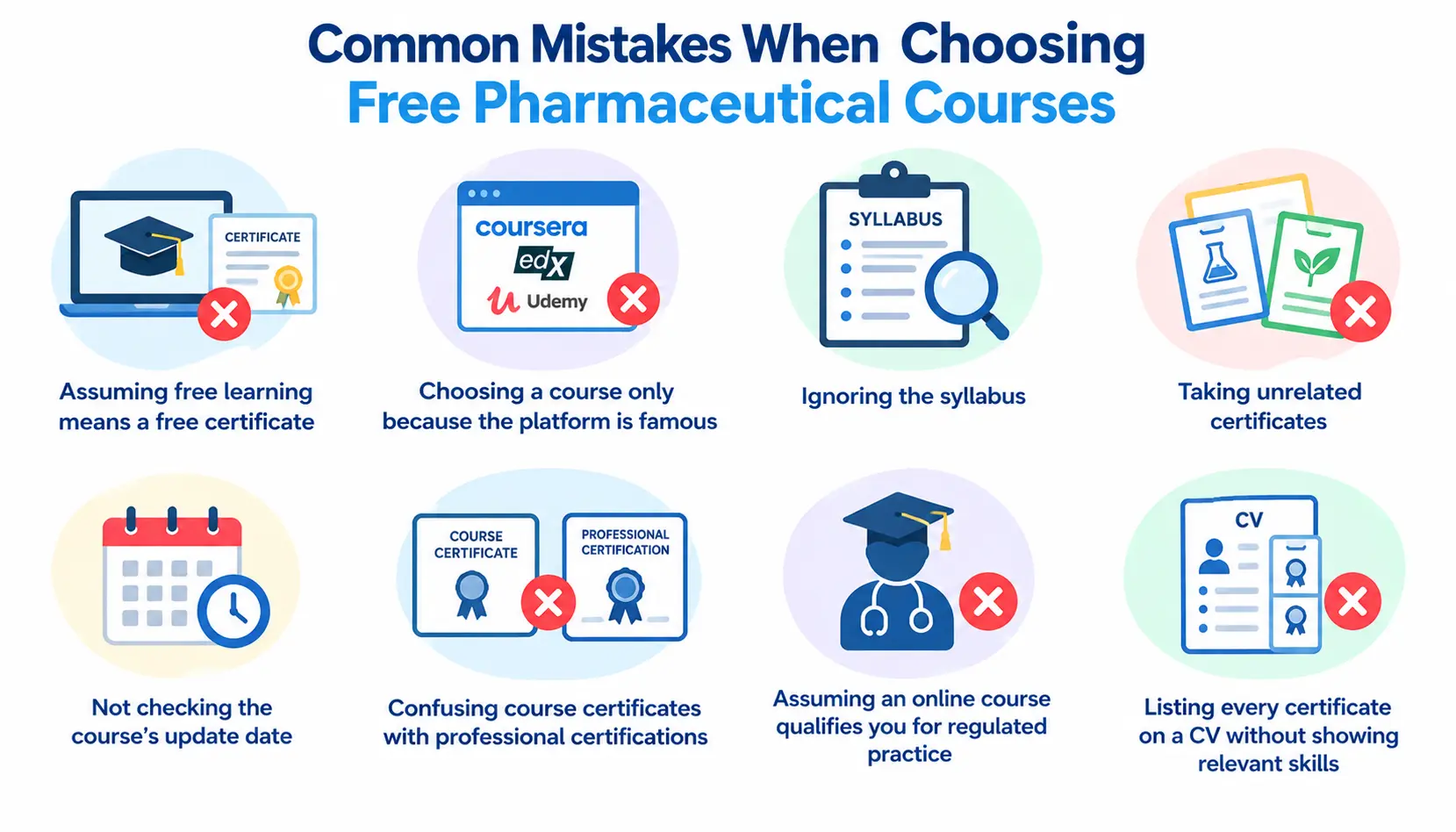
- Assuming free learning means a free certificate
- Choosing a course only because the platform is famous
- Ignoring the syllabus
- Taking unrelated certificates
- Not checking the course’s update date
- Confusing course certificates with professional certifications
- Assuming an online course qualifies you for regulated practice
- Listing every certificate on a CV without showing relevant skills
Frequently Asked Questions
1. What are the best free online pharmaceutical courses with certificates?
Good starting points are GMP, GCP, GVP, and GDP training from PharmaLessons, pharmacy courses on Alison, and introductory industry courses on Coursera. Certificate terms differ by provider, so check each one.
2. Can I get a pharmaceutical certificate online for free?
Sometimes. Many platforms offer free learning but charge for the certificate. Always read the certificate page before you enrol.
3. Are free pharmaceutical certificates recognized?
Employers may value them as proof of initiative and basic knowledge. They are not the same as degrees, licenses, or formal professional certifications.
4. Can I become a pharmacist through an online course?
No. Becoming a pharmacist requires an accredited degree and a license from the relevant authority. Online courses can support your learning but can’t replace that route.
5. Which pharmaceutical course is best for beginners?
An introduction to the pharmaceutical industry, followed by GMP, is a strong starting combination.
6. What is the best free GMP course?
It depends on your goal and level. PharmaLessons offers free GMP training, so it’s a good place to begin. Compare the syllabus and certificate terms with any alternatives.
7. Where can I study pharmacovigilance for free?
Try free GVP training from PharmaLessons and drug-safety materials from regulators such as the EMA. Search Class Central with the “free” filter for more options.
8. Are Alison pharmaceutical courses really free?
The learning is free. Certificates, whether digital or printed, are generally optional paid products.
9. Does Coursera offer free pharmaceutical certificates?
Usually not. Many Coursera courses can be audited for free, but certificates commonly cost money, though financial aid may be available on some courses.
10. Can I add a free pharmaceutical course certificate to my CV?
Yes. List the course name, provider, credential type, and year, and be ready to explain what you learned.
11. Are pharmaceutical certificates useful for freshers?
Yes, when they’re relevant. They show initiative and give you vocabulary to use in interviews. Pair them with projects, internships, or lab experience where you can.
Conclusion
Free online pharmaceutical courses with certificates can be a smart way to build knowledge and support your CV. The key is to separate free learning from free credentials and check the terms before you start.
Pick a career path, choose two or three connected courses, and learn the material properly. A focused set of skills will do more for you than a long list of certificates.