
If you’ve spent any time browsing programming forums or job listings, you’ve probably noticed one language keeps coming up: Python. It powers everything from quick automation scripts to massive machine learning systems at companies like Google and Netflix. But what actually makes it so widely loved?
This article breaks down the real features of Python, not just as a checklist, but with plain-English explanations, code examples, and honest notes on where Python falls short. By the end, you’ll understand exactly why so many developers, from total beginners to senior engineers, keep reaching for it.
What Is Python?
Python is a high-level, general-purpose programming language known for its readable syntax and versatility. It was designed to let developers express ideas in fewer lines of code than languages like Java or C++, without sacrificing power.
Brief History
Python’s first version was released in 1991. Since then, it has gone through major revisions, including the significant Python 2 to Python 3 transition, which improved consistency and modernized the language’s core design.
Who Created Python?
Python was created by Guido van Rossum, a Dutch programmer who wanted a language that was easy to read and fun to write. You can find more background on his work and Python’s origins on Wikipedia’s Python (programming language) page.
Why Python Became Popular
Python’s rise wasn’t accidental. It became the go-to language for data science and AI because it’s approachable for non-programmers (like researchers and analysts) while still being powerful enough for production software. The Python Software Foundation, the nonprofit behind the language, has also played a big role in keeping it open, well-documented, and community-driven.
What Are the Features of Python?
The features of Python are the core characteristics that make it easy to learn, flexible to use, and suitable for almost any type of software project, including its simple syntax, dynamic typing, huge library ecosystem, cross-platform support, and open-source availability. Together, these features explain why Python consistently ranks near the top of language popularity indexes like the TIOBE Index and the Stack Overflow Developer Survey.
Top Features of Python
Let’s go through each feature individually. For each one, we’ll cover what it means, why it matters, and a quick example where useful.
1. Simple and Easy-to-Read Syntax
Python code reads almost like plain English. There are no curly braces or semicolons to manage, indentation itself defines code blocks.
print("Hello World")That single line is a full working program. Compare that to the extra boilerplate required in Java or C++, and it’s easy to see why Python is often a beginner’s first language.
2. Easy to Learn

Because the syntax is so close to natural language, new programmers can start writing working code within their first day. This is one reason Python is the default choice in most introductory computer science courses today.
3. High-Level Language
Python is a high-level language, meaning it abstracts away low-level details like memory addresses and hardware management. You focus on solving the problem, not on managing the computer.
4. Interpreted Language
Python code runs through an interpreter rather than being compiled directly to machine code ahead of time. This means you can run a script immediately without a separate compile step, which speeds up testing and debugging.
The trade-off: interpreted execution is generally slower than compiled languages like C++, something worth remembering for performance-critical applications.
5. Dynamically Typed
In Python, you don’t need to declare a variable’s type before using it.
age = 25
age = "twenty-five"
This is legal in Python because the type is determined at runtime. It speeds up development since you’re not constantly writing type declarations, but it can also introduce bugs that a statically typed language like Java would catch earlier. Modern Python addresses this gap with optional type hinting, covered later.
6. Object-Oriented Programming
Python fully supports object-oriented programming (OOP), letting you organize code into classes and objects.
class Car:
    def __init__(self, brand):
        self.brand = brand

my_car = Car("Toyota")
This makes it easier to model real-world entities and build reusable, maintainable code, especially useful in larger applications.
7. Multiple Programming Paradigms
Beyond OOP, Python also supports functional programming (using tools like map(), filter(), and lambda functions) and procedural programming. Developers can mix and match styles depending on what fits the problem best, rather than being locked into one approach.
8. Extensive Standard Library
Python ships with a “batteries included” standard library covering everything from file handling to networking to JSON parsing. You can build a working web scraper or a file organizer using only the standard library — no external installs required.
9. Huge Third-Party Package Ecosystem
Beyond the standard library, Python has an enormous ecosystem of third-party packages available through pip and hosted on the Python Package Index (PyPI). Need to build a REST API, analyze a spreadsheet, or train a neural network? There’s almost certainly a well-maintained package for it already.
10. Cross-Platform Compatibility
Python code written on Windows generally runs the same way on macOS or Linux, with minimal changes. This portability is a major reason Python is popular for tools that need to run across different environments, including DevOps and cloud automation scripts.
11. Open Source
Python is free and open source, governed under the Python Software Foundation License. Anyone can inspect the source code, contribute improvements, or fork it for specialized use cases. This transparency builds trust and has fueled community-driven growth for over three decades.
12. Free to Use
There’s no licensing fee to use Python, whether you’re a student, hobbyist, or building commercial software. This is a big factor in why startups and enterprises alike adopt it without budget concerns.
13. Automatic Memory Management
Python handles memory allocation automatically. You don’t need to manually allocate or free memory like you would in C. This reduces a whole category of bugs, such as memory leaks caused by forgetting to release memory.
14. Garbage Collection
Closely tied to memory management, Python uses garbage collection to automatically reclaim memory from objects that are no longer in use. It primarily relies on reference counting, backed by a cyclic garbage collector to catch reference cycles that counting alone would miss.
15. Extensible and Embeddable
Python can be extended using C or C++ for performance-critical sections, and it can also be embedded inside other applications as a scripting layer. This flexibility is why tools like Blender and many industrial applications use Python as an internal scripting engine.
16. Large Developer Community
Python has one of the largest developer communities of any programming language. If you run into a problem, chances are someone has already asked about it on Stack Overflow or a subreddit like r/Python. That community support significantly shortens the learning curve.
17. Rapid Development
Because of its simple syntax and rich library support, Python allows for noticeably faster prototyping compared to lower-level languages. Startups often use Python specifically because it lets small teams ship products quickly.
18. Strong Error Handling
Python’s try-except structure makes it straightforward to catch and handle errors gracefully instead of letting the whole program crash.
try:
    result = 10 / 0
except ZeroDivisionError:
    print("You can't divide by zero!")
19. Modular Programming Support
Python encourages breaking code into modules and packages, which keeps large projects organized and makes code easier to reuse across different parts of an application.
20. Excellent Integration Capabilities
Python integrates well with other languages and technologies. It can connect to databases, call C libraries, work with Java through Jython, and interact with cloud APIs — making it a strong glue language for connecting different systems together.
Modern Features in Recent Python Versions
Most articles on this topic stop at the basics. But Python has evolved significantly, and recent versions bring features every developer should know.
Type Hinting
Introduced to address the drawbacks of dynamic typing, type hints let you optionally specify expected types without making Python statically typed.
def greet(name: str) -> str:
    return f"Hello, {name}"
Tools like mypy can then check your code for type errors before you even run it — giving you some of the safety of static typing while keeping Python’s flexibility.
Pattern Matching
Introduced in Python 3.10, the match statement lets you write cleaner conditional logic, similar to switch statements in other languages.
match status:
    case 200:
        print("OK")
    case 404:
        print("Not Found")
Async Programming
Using async and await, Python supports asynchronous programming, which is essential for handling many I/O operations (like web requests) efficiently without blocking your program.
Dataclasses
Dataclasses reduce boilerplate when creating classes that mainly store data.
from dataclasses import dataclass

@dataclass
class Point:
    x: int
    y: int
f-Strings
Introduced in Python 3.6, f-strings offer a cleaner, faster way to format strings.
name = "Sam"
print(f"Hello, {name}!")
Real-World Applications of Python
Understanding features is one thing, seeing how they translate into real use cases makes the value clearer.
- AI and Machine Learning: Python’s simplicity plus libraries like TensorFlow and PyTorch make it the dominant language for AI research and production models.
- Data Science: Analysts use Pandas and NumPy to clean, transform, and analyze large datasets efficiently.
- Web Development: Frameworks like Django and Flask let teams build secure, scalable web applications quickly.
- Automation: Python scripts automate repetitive tasks, from renaming files to scraping websites.
- DevOps: Python is widely used for writing deployment scripts, infrastructure automation, and CI/CD tooling.
- Cloud Computing: Major cloud providers offer robust Python SDKs, making it a natural fit for cloud-native development.
- Cybersecurity: Security professionals use Python for writing penetration testing tools and analyzing network traffic.
- IoT: Lightweight Python implementations run on devices like Raspberry Pi for hardware projects.
- Game Development: While not the top choice for AAA games, Python (via libraries like Pygame) is popular for prototyping and educational games.
Popular Python Libraries
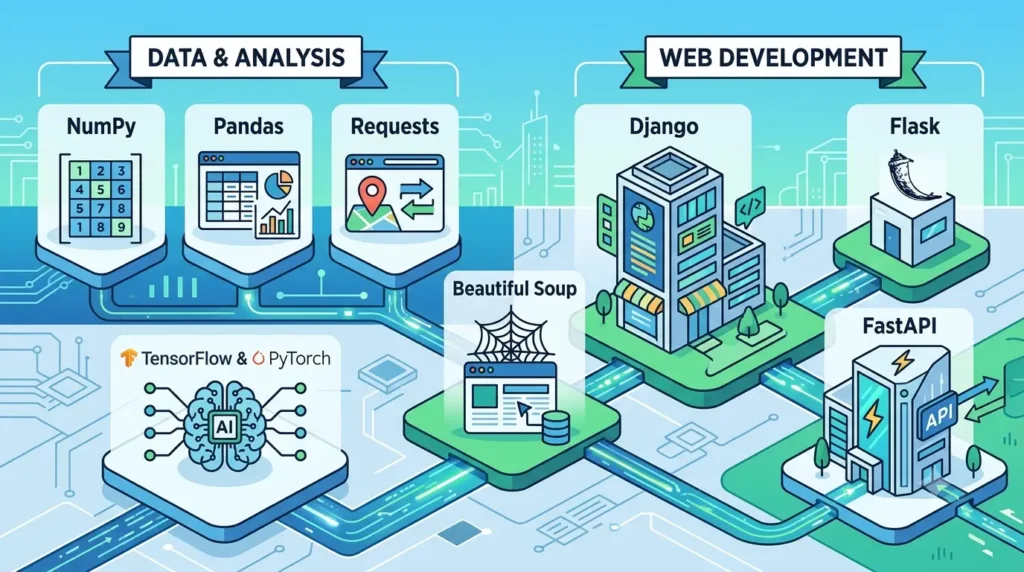
A few libraries come up constantly in real-world Python work:
- NumPy – numerical computing and array operations
- Pandas – data manipulation and analysis
- Django – full-featured web framework
- Flask – lightweight web framework
- FastAPI – modern framework built for fast, async APIs
- TensorFlow and PyTorch – deep learning frameworks
- Requests – simplified HTTP requests
- Beautiful Soup – web scraping and HTML parsing
Python Development Tools
Most Python developers rely on a handful of tools to write and manage code efficiently:
- VS Code – lightweight, highly customizable code editor
- PyCharm – a full-featured IDE built specifically for Python
- Jupyter Notebook – interactive coding, popular in data science
- Anaconda – a distribution that bundles Python with data science tools and environment management
Advantages of Python
- Faster development cycles thanks to simple syntax
- Better code readability, which helps teams collaborate
- Massive community support for troubleshooting
- A rich ecosystem of ready-made libraries
- Higher developer productivity overall
Limitations of Python
No language is perfect, and honest advice means covering the downsides too.
- Performance: Python is generally slower than compiled languages like C++ or Rust, since it’s interpreted.
- The GIL (Global Interpreter Lock): This mechanism prevents multiple native threads from executing Python bytecode simultaneously, which can limit performance in CPU-bound multi-threaded applications.
- Mobile development: Python isn’t a common choice for building mobile apps compared to Swift or Kotlin.
- Memory usage: Python programs can consume more memory than equivalent programs in lower-level languages.
Read More about Advantages and Disadvantages of Python
Python vs Other Programming Languages
| Language | Best For | Learning Curve | Typing |
|---|---|---|---|
| Python | AI, automation, scripting, web backends | Easy | Dynamic |
| Java | Enterprise applications, Android apps | Moderate | Static |
| C++ | System programming, game engines | Steep | Static |
| JavaScript | Web frontend, full-stack development | Moderate | Dynamic |
| Go | Cloud infrastructure, microservices | Moderate | Static |
Python vs Java
Java tends to be faster and more strictly typed, which some teams prefer for large enterprise systems. Python wins on development speed and simplicity, especially for smaller teams or rapid prototyping.
Python vs C++
C++ gives you far more control over hardware and performance, making it ideal for game engines and system-level software. Python trades that raw speed for dramatically simpler syntax and faster development.
Python vs JavaScript
JavaScript runs natively in browsers, making it essential for frontend work, while Python dominates backend, data, and AI use cases. Many modern teams use both together.
Python vs Go
Go was designed with concurrency and performance in mind, making it popular for cloud infrastructure. Python remains easier to learn and has a larger ecosystem for data-related work.
Which Companies Use Python?
Python is used at scale by major technology companies, including Google, Netflix, Spotify, Instagram, Dropbox, and even NASA for scientific computing. This kind of adoption at scale is a strong trust signal — these organizations chose Python specifically because it holds up under real production demands, not just in tutorials.
Why Python Is Ideal for Beginners
Python’s readable syntax means new learners spend less time fighting the language and more time understanding programming logic itself. Combined with extensive free documentation and an active community on platforms like r/learnpython, it’s one of the most beginner-friendly languages available today. Many professionals also share Python learning paths and career advice on LinkedIn, which can be a useful resource for understanding how the language fits into different job roles.
Frequently Asked Questions
1. What are the main features of Python?
Simple syntax, dynamic typing, an extensive library ecosystem, cross-platform support, open-source availability, and strong community backing are among Python’s defining features.
2. Why is Python so popular?
It combines beginner-friendly syntax with the power needed for advanced fields like AI and data science, backed by a huge library ecosystem and community.
3. What makes Python unique?
Its balance of simplicity and versatility — few languages let you write both a five-line automation script and a production machine learning pipeline with the same core syntax.
4. Is Python object-oriented?
Yes, Python fully supports object-oriented programming, alongside functional and procedural styles.
5. Is Python compiled or interpreted?
Python is primarily an interpreted language, though it compiles source code to bytecode internally before execution.
6. Why is Python easy to learn?
Its syntax closely resembles plain English, and it removes many of the low-level details beginners struggle with in other languages.
7. What are Python’s advantages?
Faster development, readable code, a large community, and access to thousands of ready-made libraries.
8. Is Python good for beginners?
Yes, it’s widely recommended as a first programming language due to its simplicity and gentle learning curve.
9. What are the limitations of Python?
Slower execution speed compared to compiled languages, the GIL limiting multi-threaded performance, and limited use in mobile app development.
10. What is dynamic typing in Python?
It means variable types are determined automatically at runtime rather than being explicitly declared beforehand.
11. Is Python open source?
Yes, Python is open source and maintained under the Python Software Foundation.
12. What are Python libraries?
Pre-written collections of code that provide ready-made functionality, saving developers from writing everything from scratch.
13. What are Python frameworks?
Structured toolkits, like Django and Flask, that provide a foundation for building applications faster.
14. Where is Python used?
In AI, data science, web development, automation, cybersecurity, DevOps, and more.
15. Which companies use Python?
Google, Netflix, Spotify, Instagram, Dropbox, and NASA are among the well-known organizations using Python.
16. Is Python platform-independent?
Yes, Python code generally runs across Windows, macOS, and Linux with little to no modification.
17. Why is Python slower than C++?
Because Python is interpreted at runtime rather than compiled directly into machine code ahead of time, adding overhead during execution.
18. Is Python good for AI?
Yes, its simplicity and libraries like TensorFlow and PyTorch make it the leading language for AI and machine learning work.
19. Can Python be used for web development?
Yes, through frameworks like Django, Flask, and FastAPI.
20. What is the Zen of Python?
A collection of guiding principles for writing Python code, accessible by typing import this in a Python shell, emphasizing readability and simplicity.
Conclusion
The features of Python, from its readable syntax and dynamic typing to its massive library ecosystem and cross-platform support, explain why it remains one of the most in-demand programming languages today. It’s approachable enough for beginners, yet powerful enough to run production AI systems at companies like Google and Netflix.
If you’re deciding whether to learn Python, the honest answer is: for most people starting out in programming, data science, or automation, it’s one of the safest and most rewarding languages to invest in. Start small, write a few scripts, explore a library that matches your interests, and you’ll quickly see why so many developers consider Python their language of choice.