Thinking about learning Python but wondering if it’s the right language for you?
- It’s important to understand its strengths and limitations as this knowledge will help you make the most of Python and use it effectively in your projects.
Below, we explore the advantages and disadvantages of Python to help you determine whether it’s the right fit for your needs. As one of the fastest-growing programming languages worldwide, Python is widely used in web development, data science, artificial intelligence, automation, and IoT.
Python’s simple syntax, flexibility, and vast library ecosystem make it a preferred choice for both beginners and experienced developers. However, despite its many strengths, Python has some limitations, including slower execution speed, higher memory consumption, and limited suitability for mobile and game development.
In this blog, we break down everything you need to know about Python. You’ll discover its advantages, like ease of learning, strong community support, cross-platform compatibility, and high demand in the job market.
We’ll also cover its disadvantages, including memory consumption, performance issues, and multi-threading constraints. Beyond that, we explore when Python is the right choice, its top applications across industries, and answer the most common FAQs about Python’s strengths and weaknesses. By the end, you’ll have a clear understanding of whether Python fits your learning goals and career plans.
What Is Python?

Python is a high-level programming language that is easy to read and write. It was created by Guido van Rossum and released in 1991. Python uses simple and clear syntax, which helps people understand the code easily, even if they are new to programming.
Python can be used in different ways, such as writing simple programs, building websites, analyzing data, and creating artificial intelligence applications. It works on all major operating systems like Windows, macOS, and Linux.
Python also has many built-in tools and a large community of users. This means help, tutorials, and ready-made solutions are easy to find. Because of its simplicity and wide usage, Python is a great choice for beginners as well as experienced developers.
Example: A Simple Python Program

That’s it, no boilerplate code or complicated setup.
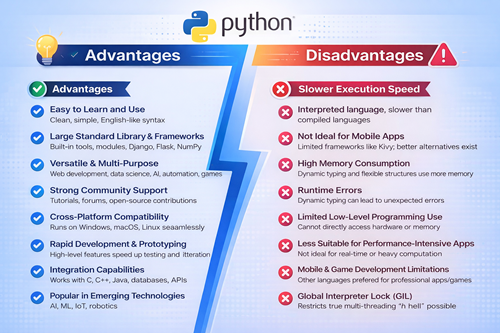
Quick overview of Python( Advantages and Disadvantages)
In simple terms:
- Python is best for: beginners, fast development, AI, data science, and automation
- Python is not ideal for: high-performance systems, mobile apps, and low-level programming
Advantages of Python
1. Easy to Learn and Use
Python’s syntax is clean, simple, and close to natural English, making it easy for beginners to read and write code. Its simplicity allows developers to accomplish tasks with fewer lines of code, focus on learning programming concepts, and even experienced developers appreciate how readable and maintainable Python code is.
2. Large Standard Library and Frameworks
Python comes with a vast collection of built-in tools and modules, called the standard library, and supports popular frameworks like Django, Flask, NumPy, Pandas, and TensorFlow. These resources help developers build applications faster and more efficiently, without starting from scratch.
3. Versatile and Multi-Purpose
Python is highly flexible and can be used for web development, data science, machine learning and AI, automation, scripting, and even game development. Its versatility makes Python a valuable skill across industries like technology, finance, healthcare, and education.
4. Strong Community Support
Python has a large, active global community that shares tutorials, documentation, forums, and open-source packages. This support network makes it easy to find solutions to problems, learn new skills, and stay updated with the latest tools and libraries.
5. Cross-Platform Compatibility
Python is cross-platform, meaning programs can run on Windows, macOS, and Linux without major changes. This saves time, reduces development effort, and allows Python applications to reach a wider audience across different systems.
6. Rapid Development and Prototyping
Python’s simplicity and high-level features allow developers to quickly build and test applications, making it ideal for rapid development and prototyping. This helps teams save time, reduce costs, and experiment with new ideas efficiently.
7. Integration Capabilities
Python can easily integrate with other languages like C, C++, and Java, as well as work seamlessly with databases, APIs, and web services. This makes it a powerful tool for connecting different systems and building large, complex applications.
8. Popular in Emerging Technologies
Python is widely used in AI, machine learning, data analysis, IoT, and robotics. Its strong adoption in these cutting-edge fields ensures that Python skills remain in high demand and relevant for future technology trends.
9. Readable and Maintainable Code
Python emphasizes clean, readable, and maintainable code, which makes collaboration and updating projects easier. This reduces bugs, improves efficiency, and ensures that both small and large applications remain easy to manage over time.
10. High Demand in Job Market
Python is one of the most sought-after programming languages in the job market. Companies across industries hire Python developers for roles in data science, AI, web development, automation, and software engineering, making it a valuable career skill.
11. Open-Source and Free to Use
Python is completely open-source, which means it’s free to download, use, and distribute. This encourages learning, experimentation, and contribution to projects, while also making it accessible to students, startups, and professionals worldwide.
Disadvantages of Python
1. Slower Execution Speed
Python is an interpreted language, which means it runs code line by line rather than compiling it all at once. This makes Python generally slower than compiled languages like C or C++, which can be a limitation for applications that require very high performance.
2. Not Ideal for Mobile App Development
Python is not commonly used for developing native mobile apps. While frameworks like Kivy exist, languages such as Java, Kotlin, and Swift are more suitable for building efficient mobile applications. It is also frequently used alongside mobile app development services when building backend systems and scalable application architectures.
3. High Memory Consumption
Python uses more memory compared to many other languages due to its dynamic typing and flexible data structures. This can make it less efficient for systems with limited resources, such as embedded devices or low-end hardware.
4. Runtime Errors
Python is dynamically typed, meaning variable types are checked during execution rather than before. This can lead to unexpected errors if code is not carefully tested. Beginners may find these runtime errors confusing at first.
5. Limited Use in Low-Level Programming
Python does not provide direct access to hardware or memory, making it unsuitable for low-level system programming like operating systems, drivers, or embedded systems.
6. Less Suitable for Performance-Intensive Applications
Python is not ideal for programs that require real-time processing or heavy computation, such as high-frequency trading platforms or graphics-intensive games, due to its slower execution speed.
7. Mobile and Game Development Limitations
Although Python can be used for simple mobile apps or games, it is not commonly adopted for professional mobile or game development. Other languages like Swift, Java, or C# are preferred for these platforms.
8. Global Interpreter Lock (GIL)
Python’s GIL restricts the execution of multiple threads at the same time, which can limit true multi-threading performance. This can be a drawback for applications that need highly concurrent or parallel processing.
9. Dependency Management Issues
Python projects often rely on external libraries. Managing these dependencies across different environments can be tricky, sometimes leading to version conflicts or “dependency hell” if not handled properly.
10. Weak in Browser-Based Applications
Python is primarily used on the server side and is not widely used for client-side web programming. Languages like JavaScript are better suited for creating interactive web pages and front-end applications.
11. Slower Startup Time
Python programs may take longer to start compared to compiled languages, especially for larger applications. This can be noticeable when running small scripts repeatedly or when quick execution is required.
| Feature / Aspect | Advantages of Python | Disadvantages of Python |
| Purpose | Easy, general-purpose programming language | Not designed for low-level programming |
| Learning Curve | Beginner-friendly and easy to learn | Can hide errors until runtime |
| Syntax | Clean and readable | Dynamic typing may cause bugs |
| Performance | Good for most applications | Slower than compiled languages |
| Memory Usage | Flexible data handling | High memory consumption |
| Libraries & Frameworks | Large standard library and frameworks | Dependency management issues |
| Development Speed | Fast development and prototyping | Slower startup time |
| Platform Support | Works on Windows, macOS, Linux | Limited mobile app support |
| Scalability | Suitable for small to large projects | GIL limits multi-threading |
| Use Cases | Web, AI, data science, automation | Not ideal for games or real-time apps |
| Job Market | High demand and career opportunities | — |
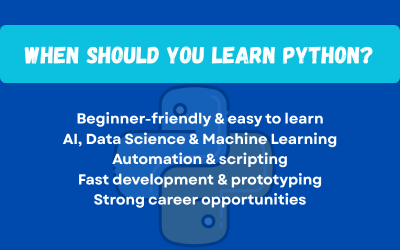
When Should You Learn Python?
1. If You Are a Beginner Learning Programming for the First Time
- Python has a simple and clean syntax, which is closer to plain English than many other languages. This makes it easier to read, write, and understand.
- It reduces the learning curve compared to languages like C++, Java, or JavaScript, which have more complex syntax rules.
- You can focus on programming concepts (like loops, conditionals, and data structures) without getting bogged down by complicated syntax errors.
- Python has a huge community and educational resources for beginners, including tutorials, online courses, and forums where you can get help.
2. If You Want to Work in Data Science, AI, or Automation
- Python is the go-to language for data science, machine learning, artificial intelligence, and automation.
- Popular libraries such as NumPy, pandas, Matplotlib, TensorFlow, and PyTorch make it easy to perform data analysis, machine learning, and deep learning tasks.
- Python is used for automation and scripting, which allows you to automate repetitive tasks like data entry, web scraping, report generation, and testing.
- Many companies prefer Python for data-driven decision-making, so learning Python opens opportunities in finance, healthcare, marketing analytics, and tech.
3. If You Need Rapid Application Development
- Python allows you to build prototypes quickly and test ideas faster than many other programming languages.
- Frameworks like Django, Flask, and FastAPI make web application development faster and easier.
- You can develop desktop apps, command-line tools, and web apps with minimal code.
- Python’s dynamic typing and interpreted nature allow for flexibility during development and rapid iteration.
4. If You Prefer Readability and Productivity Over Raw Performance
- Python is designed for human readability, which makes it easier to maintain code, collaborate with others, and onboard new developers.
- Its concise syntax means you can write fewer lines of code to accomplish the same tasks compared to other languages.
- While it may not be the fastest language in terms of execution speed (like C++), Python’s productivity benefits outweigh raw performance for many applications, especially in scripting, automation, and prototyping.
5. Bonus Reasons to Learn Python
- Cross-platform compatibility: Python works on Windows, macOS, Linux, and even some mobile platforms.
- Vast ecosystem of libraries and frameworks: Whatever you want to do web development, AI, data analysis, gaming Python probably has a library for it.
- Strong career prospects: Python developers are in high demand across tech, finance, healthcare, and research sectors.
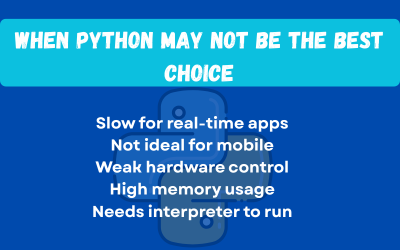
When Python May Not Be the Best Choice
1. If You Need High-Performance, Real-Time Applications
- Python is an interpreted and dynamically typed language, which makes it slower than compiled languages like C, C++, or Rust.
- Applications that require extremely fast execution or low-latency performance such as high-frequency trading systems, real-time simulations, or game engines may suffer from Python’s speed limitations.
- While Python can interface with faster languages (e.g., using Cython or integrating C/C++ modules), the overhead of bridging languages can complicate development.
Example:
- A stock trading bot that needs to process thousands of transactions per second may perform better in C++ than Python.
- Real-time video processing for VR or AR applications also often relies on C++ for speed.
2. If You Are Developing Mobile Apps
- Python is not the first choice for mobile app development. Native development for iOS (Swift/Objective-C) or Android (Kotlin/Java) usually results in better performance and access to device features.
- Frameworks like Kivy or BeeWare allow Python to run on mobile devices, but they have limitations:
- Slower performance compared to native apps.
- Limited support for advanced UI/UX features.
- Smaller community and fewer pre-built resources.
Example:
- A mobile game or a performance-heavy app like a GPS navigation tool would benefit more from native development.
- Even if Python works for simple apps, scaling to complex mobile applications is often cumbersome.
3. If You Require Fine-Grained Hardware Control
- Python runs on a high-level abstraction, meaning it doesn’t give direct access to hardware.
- Low-level tasks such as device drivers, firmware, robotics, and IoT systems often need languages like C, C++, or Rust, which allow precise control over memory and processor instructions.
- Python can interact with hardware through libraries (like RPi.GPIO for Raspberry Pi), but performance and reliability can be limited in time-sensitive or hardware-critical applications.
Example:
- Writing firmware for a medical device that must respond instantly to sensors is better done in C or C++.
- Real-time control of robotic arms in manufacturing requires precise timing that Python alone may not reliably provide.
4. Other Considerations
- Memory efficiency: Python can use more memory than languages like C or Go, which might be an issue for embedded systems with limited resources.
- Packaging and deployment: Python applications often need an interpreter installed, which can complicate distribution for lightweight or offline systems.
Top Python Applications You Should Know
1. Web Development
Python is widely used for creating dynamic and robust web applications. Its frameworks provide tools to develop websites quickly and securely. Businesses building this kind of backend infrastructure often choose to Hire Python Developers with proven experience in Django, Flask, or FastAPI to ensure scalability and long-term maintainability.
- Frameworks: Django, Flask, FastAPI
- Use Cases: Backend web services, APIs, full-stack web apps
- Examples:
- Instagram: Uses Django for backend operations
- Spotify: Uses Python for data analysis and backend services
- Dropbox: Built with Python to manage file storage efficiently
2. Data Science and Analytics
Python is the preferred language for data science due to its powerful libraries for analysis, visualization, and statistical computing.
- Libraries: pandas, NumPy, Matplotlib, Seaborn, Plotly
- Use Cases: Data cleaning, statistical analysis, predictive analytics, visualization
- Applications:
- Business analytics dashboards
- Market trend analysis
- Forecasting and predictive modeling
3. Artificial Intelligence (AI) and Machine Learning (ML)
Python is dominant in AI/ML development because of its extensive libraries and ease of integration with other tools.
- Libraries: TensorFlow, PyTorch, scikit-learn, Keras, OpenCV
- Use Cases: Neural networks, deep learning, NLP, computer vision, recommendation systems
- Applications:
- Chatbots and virtual assistants (like Siri or Alexa prototypes)
- Image recognition for security or healthcare
- Recommendation engines for e-commerce (like Amazon, Netflix)
4. Automation and Scripting
Python is highly popular for automating repetitive tasks, managing workflows, and testing systems.
- Libraries: Selenium, BeautifulSoup, PyAutoGUI, requests
- Use Cases: Web scraping, file management, task automation, testing
- Applications:
- Automating report generation from spreadsheets
- Scraping data from websites for research or marketing
- Testing web applications automatically
5. Game Development
Python is used for developing simple games and prototyping, making it suitable for learning game mechanics or building educational games.
- Libraries/Frameworks: Pygame, Godot (Python API), Panda3D
- Use Cases: 2D games, educational games, game prototypes
- Applications:
- Building 2D arcade games or puzzle games
- Prototyping mechanics for more complex games
6. Desktop GUI Applications
Python can be used to build cross-platform desktop applications with graphical user interfaces.
- Libraries/Frameworks: Tkinter, PyQt, Kivy, wxPython
- Use Cases: Productivity apps, media players, tools for education and business
- Applications:
- Text editors
- Media players
- Custom software for business workflows
7. Internet of Things (IoT)
Python is increasingly used in IoT projects and robotics because of its ease of use and hardware integration capabilities.
- Platforms/Libraries: Raspberry Pi, MicroPython, RPi.GPIO
- Use Cases: Smart home devices, robotics, sensor monitoring
- Applications:
- Smart thermostats, lights, or home automation systems
- Robotics projects for education or prototyping
- Monitoring sensors in industrial applications
Final Verdict
The advantages and disadvantages of Python show why it’s one of the most widely used programming languages today. Python excels in simplicity, readability, and versatility, making it ideal for beginners and modern software development. While it may not be the best choice for performance-heavy or low-level applications, its ease of use and massive ecosystem make it a powerful and future-proof language.
If your goal is to start coding quickly and build real-world applications, Python is definitely worth learning.
Got it! Here’s a Python FAQ focused mainly on its advantages and disadvantages. I’ve made it 11 questions for clarity and relevance:
Frequently Asked Questions (FAQs)
1. What are the main disadvantages of Python?
Python is slower than compiled languages, consumes more memory, is not ideal for mobile or performance-intensive apps, and has runtime errors due to dynamic typing.
2. What makes Python versatile?
Python can be used for web development, data science, AI, automation, scripting, and even game development, making it valuable across many industries.
3. How does Python’s standard library help developers?
Python comes with a vast collection of built-in modules and supports frameworks like Django, Flask, NumPy, and TensorFlow, which speed up development and reduce the need to code from scratch.
4. Why is Python popular in emerging technologies?
Python is widely used in AI, machine learning, data analysis, IoT, and robotics due to its ease of use, powerful libraries, and large community support.
5. Does Python have good community support?
Yes, Python has a huge global community that shares tutorials, forums, open-source packages, and documentation, making problem-solving and learning easier.
6. Why is Python considered easy to learn?
Python has a simple, readable syntax that is close to natural English. Beginners can focus on programming concepts without being overwhelmed by complex rules
7. Why is Python not ideal for mobile app development?
While frameworks like Kivy exist, Python apps often run slower and have limited access to advanced mobile features compared to native apps built with Swift, Kotlin, or Java.
8. How does Python’s execution speed compare to other languages?
Python is interpreted and generally slower than compiled languages like C++ or Java, making it less suitable for applications requiring high-speed or real-time processing.
9. What are the memory limitations of Python?
Python uses more memory because of dynamic typing and flexible data structures, which can be an issue for embedded systems or devices with limited resources.
10. Can Python handle multi-threading efficiently?
Python has a Global Interpreter Lock (GIL) that prevents multiple threads from executing Python bytecode simultaneously, limiting true multi-threading for highly concurrent applications.
11. Why is Python still recommended despite its disadvantages?
Its simplicity, readability, vast libraries, cross-platform compatibility, and high demand in the job market outweigh performance limitations for most modern applications, making it a practical and future-proof language.