
Education is going digital fast. Students now want to get information, resources and tools right away.Whether you are in a school, college, university or learning, students need one place to handle their school work easily.That is where a student portal comes in.
A student portal is like a door that connects students to everything they need for their education.From getting course stuff and checking grades to talking to teachers and handling enrollment student portals make school administration easy. Improve learning.
In this guide you will learn what a student portal is, how it works, its features, benefits and why it is now a must-have in education, in 2026.
What Is a Student Portal?
A student portal is a place on the internet where students can get to lots of important school stuff.They can see their grades. Find things to help them learn, like books and assignments and even do some school business.
It is like an office where students can take care of lots of things all in one place without having to go to different offices or websites.
The student portal is a place where students can see everything they need to know about school like a big dashboard that shows them all their student information.
It really helps students because they do not have to go to different places to get what they need; they can just use the student portal.
Quick Answer
A student portal is an online platform that allows students to access grades, course materials, schedules, assignments, attendance records, announcements, financial information, and communication tools from one secure location.
Educational institutions use student portals to improve accessibility, streamline administration, and enhance student engagement.
Why Are Student Portals Important?
Modern educational institutions manage large amounts of information and interactions every day.
Without a centralized system, students may struggle to access important academic resources and administrative services.
Student portals help solve these challenges by:
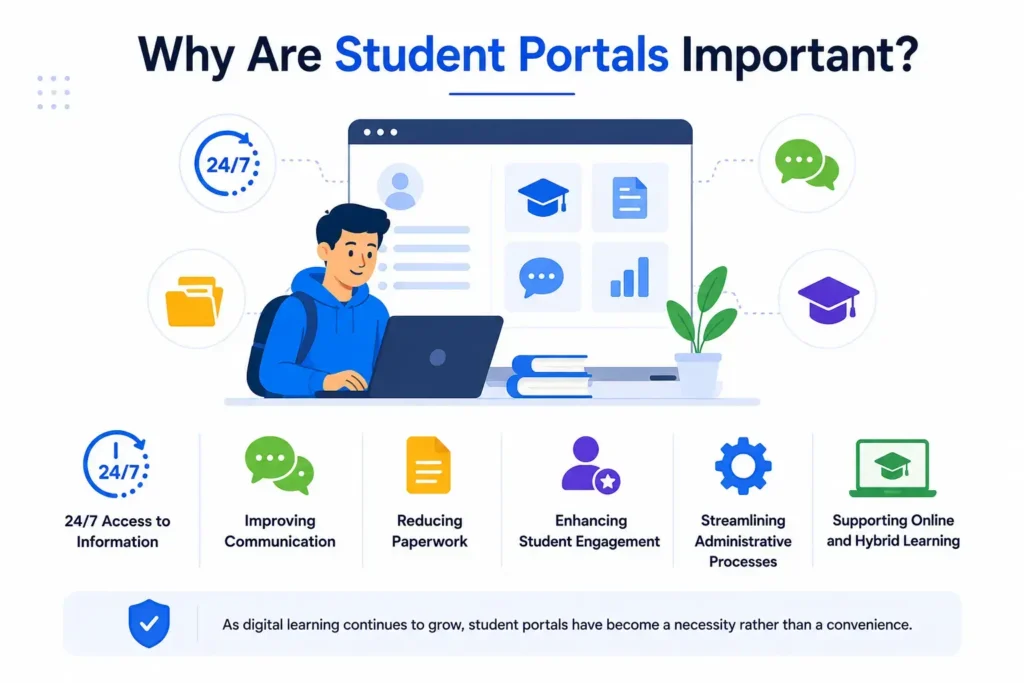
- Providing 24/7 access to information
- Improving communication
- Reducing paperwork
- Enhancing student engagement
- Streamlining administrative processes
- Supporting online and hybrid learning
As digital learning continues to grow, student portals have become a necessity rather than a convenience.
How Does a Student Portal Work?
A student portal brings together educational systems in one place.
Students get login details. Can safely check their own dashboard using a web browser or a mobile app.
The portal helps students manage their work in one spot.They can use it on a computer or, on their phone.
The portal connects with multiple systems, including:
- Learning Management Systems (LMS)
- Student Information Systems (SIS)
- Attendance tracking systems
- Financial management platforms
- Library databases
- Communication tools
This integration ensures students can access everything they need from one location.
Key Features of a Student Portal
The exact features vary depending on the institution, but most student portals include the following functionality.
1. Course Registration
Students can:
- Enroll in courses
- Add or drop classes
- View available courses
- Check prerequisites
- Manage academic schedules
This eliminates the need for manual registration processes.
2. Academic Records
Student portals provide access to:
- Grades
- Report cards
- Academic transcripts
- GPA information
- Course history
Students can monitor their academic performance in real time.
3. Class Schedules
Students can quickly view:
- Timetables
- Lecture schedules
- Exam dates
- Classroom locations
- Academic calendars
This helps improve organization and time management.
4. Assignment Management
Many portals allow students to:
- View assignments
- Submit coursework
- Track deadlines
- Receive feedback
- Download learning materials
This feature is especially important for online and hybrid learning environments.
5. Attendance Tracking
Students can monitor:
- Attendance records
- Absences
- Participation status
- Attendance percentages
This promotes accountability and transparency.
6. Communication Tools
Student portals often include:
- Messaging systems
- Discussion boards
- Email integration
- Announcements
- Notifications
Effective communication improves student engagement and collaboration.
7. Financial Information
Students may access:
- Tuition balances
- Fee payments
- Financial aid details
- Scholarship information
- Billing statements
This simplifies financial management throughout the academic year.
Benefits of a Student Portal for Students
Student portals offer numerous advantages that improve both academic performance and overall student satisfaction.
Easy Access to Information
Students no longer need to visit multiple departments or websites to find important information.
Everything is available in one place.
Better Time Management
With access to schedules, deadlines, and reminders, students can plan their workload more effectively.
Improved Communication
Direct communication channels help students stay informed about academic updates and institutional announcements.
Enhanced Learning Experience
Easy access to course content, assignments, and educational resources supports continuous learning.
Increased Independence
Student portals empower learners to manage their academic responsibilities without constant administrative assistance.
Benefits of a Student Portal for Educational Institutions
Student portals don’t only benefit students. Schools, colleges, and universities also gain significant advantages.
Streamlined Administration
Administrative tasks become more efficient through automation and self-service functionality.
Reduced Paperwork
Digital records and online forms minimize reliance on physical documents.
Better Data Management
Institutions can organize and manage student information more effectively.
Higher Student Engagement
Students who have easy access to resources tend to participate more actively in their education.
Improved Operational Efficiency
Automated processes reduce manual workloads and allow staff to focus on higher-value activities.
Student Portal vs Learning Management System (LMS)
Many people confuse student portals with Learning Management Systems.
Although they are related, they serve different purposes.
| Student Portal | Learning Management System |
| Central hub for student services | Focuses on course delivery |
| Manages academic and administrative information | Manages teaching and learning activities |
| Includes enrollment and financial tools | Includes assignments and assessments |
| Connects multiple systems | Primarily supports instruction |
In many institutions, the student portal integrates directly with the LMS.
Common Examples of Student Portal Features
A modern student portal may include:
- Personalized dashboards
- Online enrollment
- Grade tracking
- Assignment submission
- Attendance monitoring
- Course materials
- Digital libraries
- Fee payment systems
- Student support services
- Mobile accessibility
These features help create a seamless educational experience.
The Role of Student Portals in Online Learning
Online education has significantly increased the importance of student portals.
Remote learners rely heavily on these platforms for:
- Accessing virtual classrooms
- Downloading course content
- Participating in discussions
- Submitting assignments
- Tracking progress
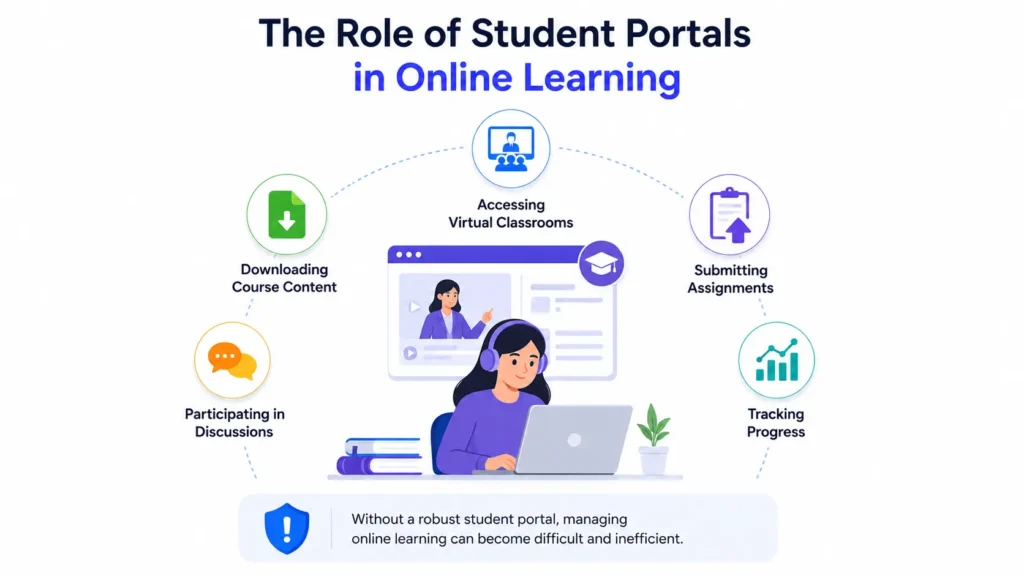
Without a robust student portal, managing online learning can become difficult and inefficient.
Security and Privacy in Student Portals
Because student portals contain sensitive information, security is a top priority.
Educational institutions typically implement:
- Secure login systems
- Multi-factor authentication
- Data encryption
- Access controls
- Regular security updates
These measures help protect student data and maintain compliance with privacy regulations.
Emerging Trends in Student Portals
Student portal technology continues to evolve.
Some of the latest trends include:
AI-Powered Assistance
AI chatbots can answer common questions and provide instant support.
Mobile-First Design
Students increasingly access portals through smartphones and tablets.
Personalized Dashboards
Portals can display customized content based on student needs and preferences.
Learning Analytics
Advanced analytics help students track performance and identify areas for improvement.
Cloud-Based Platforms
Cloud technology improves accessibility, scalability, and reliability.
How to Choose the Right Student Portal
Educational institutions evaluating student portal solutions should consider:
Ease of Use
The interface should be intuitive and user-friendly.
Integration Capabilities
The portal should connect seamlessly with existing systems.
Mobile Accessibility
Students expect access from any device.
Security Features
Strong security controls are essential.
Scalability
The platform should support future growth.
Support and Maintenance
Reliable technical support is critical for long-term success.
Frequently Asked Questions (FAQ)
What is the purpose of a student portal?
A student portal provides students with centralized access to academic information, learning resources, communication tools, and administrative services.
What can students do through a student portal?
Students can view grades, access course materials, register for classes, communicate with instructors, track attendance, submit assignments, and manage tuition payments.
Is a student portal the same as an LMS?
No. A student portal manages both academic and administrative functions, while a Learning Management System primarily focuses on course delivery and learning activities.
Why do schools and universities use student portals?
Institutions use student portals to improve efficiency, reduce paperwork, enhance communication, and provide students with convenient access to essential services.
Are student portals secure?
Most student portals use encryption, secure authentication methods, and access controls to protect sensitive student information.
Can student portals be accessed on mobile devices?
Yes. Most modern student portals offer responsive designs or dedicated mobile applications for convenient access from smartphones and tablets.
Final Thoughts
A student portal is really important for school now. It helps students get to all the things they need for school in one place. This makes it easier for students to learn and do their school work.
For students the student portal is great because it is easy to use and they can see everything they need to do. The student portal also helps students keep track of their school work and activities.
For schools the student portal helps them get things done faster and makes everything more organized. This makes it easier for schools to use technology and make things better, for students.
As time goes on the student portal will still be a part of what students do. The student portal will help schools make learning fun and make sure each student gets what they need.