
If you have ever wondered why a C program runs fast but a Python script takes a little longer to start you have already seen the difference between a compiler and an interpreter. This one thing affects how your code runs, how you find mistakes in it and even which language you would choose for a particular task.
I have spent years writing code in both compiled and interpreted languages. I still see developers get these terms mixed up. So let us explain it properly with examples, not just things you would read in a book.
What Is a Compiler?
A compiler is a program that takes your source code and turns it into machine code before your program is even run. It is like taking a book that is written in English and translating it into French before you give it to someone who only speaks French. The compiler does all the translation work, at the beginning so when someone uses your program they do not see the source code. The compiler does this translation one time. That is it.
How a Compiler Works
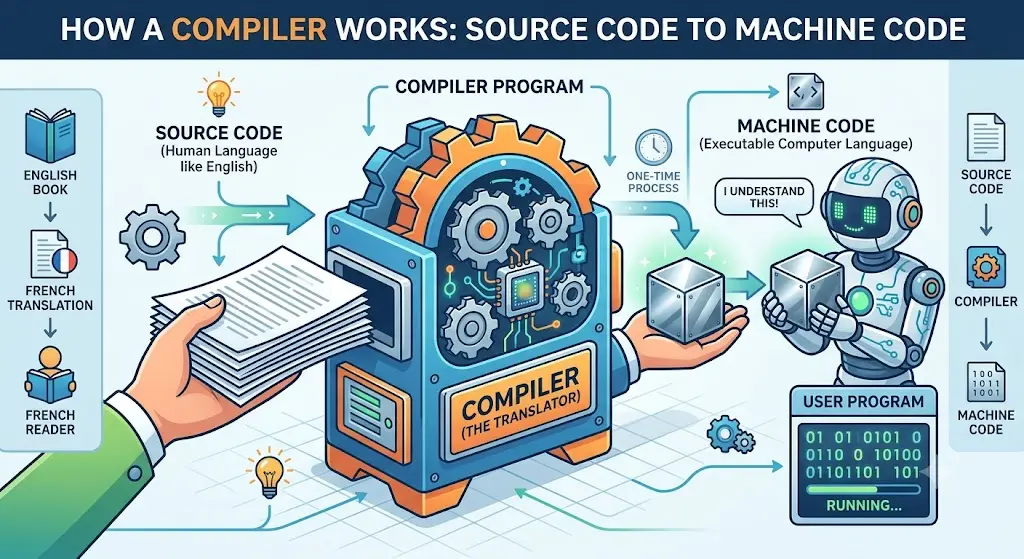
You write your code then you run it through the compiler. The compiler reads the code file, checks the code file for errors and produces an executable code file. Only after this code step is complete can you actually run your program.
This means the compiler catches errors in the code before you can run the program, which’s both good for the code and a small inconvenience if you are used to making quick changes to the code.
Compiler Phases
Compilation isn’t a single step. It’s a pipeline, and each stage has a specific job.
Lexical Analysis
This is where the compiler breaks your code into parts. These parts are called tokens, keywords, variable names and operators. The compiler checks each part to make sure it is a word in the programming language.
It is like a spell check. This stage ensures every word in your code is something the compiler understands. The compiler looks at each word in your code. It checks if the word is a keyword, a name or an operator. This helps the compiler make sense of your code.
Syntax Analysis
Next the compiler looks at the tokens to see if they are in the order. It checks if they follow the rules of the language. If something is wrong like a semicolon or a bracket that does not have a match you will get an error message. The compiler then creates a kind of tree called an Abstract Syntax Tree or AST, for short to show how all the tokens fit together.
Semantic Analysis
Now the compiler checks if your code is okay. It looks at things like adding a string to a number. The compiler also checks if you used a variable before you said what the variable is. This step finds mistakes that just checking the rules of coding would not find. The compiler checks for these mistakes because it wants to make sure your code makes sense.
Optimization
The compiler is trying to make your code run faster or take up space without changing what it actually does. It does things like get rid of variables that are not being used. The compiler also simplifies expressions and rearranges the instructions to make your code perform better. This is about making your code faster and smaller like the compiler.
Machine Code Generation
The compiler takes all the work it has done. Turn it into machine code. This machine code is what the computer’s brain, the CPU, can understand and do. So the machine code is the result that the computer can run.
What Is an Interpreter?
An interpreter goes through your source code. Run it one line at a time. It does this away. The interpreter does not do a step where it translates the whole thing first. It is like when you have an interpreter, at a conference. This interpreter translates what the speaker is saying into another language as they speak, doing it sentence by sentence with the source code.
How an Interpreter Works
When you run your script the interpreter starts reading it and doing what it says away. If something goes wrong on line 50 but everything is okay on lines 1 through 49 you will see what happened on those lines before the script stops working.
This is why interpreters are really good, for trying things out because you do not need to do anything extra to get your script ready to run you can just run your script and see what happens.
Interpreter Execution Process
The interpreter usually goes through each line of the code or each statement. Turns it into a simpler form. Then it does what that line of code says to do. The interpreter does this for every line of the code until the program is finished or it finds a mistake. The interpreter never makes a file that can run the code by itself. You always need the interpreter to be there when you want to run the code.
Compiler vs Interpreter: Key Differences
The core compiler vs interpreter distinction comes down to when translation happens. A compiler translates everything up front; an interpreter translates and runs code as it goes.
Comparison Table
| Aspect | Compiler | Interpreter |
| Translation | Entire program at once | Line by line, on the fly |
| Output | Standalone executable file | No separate file; needs interpreter present |
| Speed of execution | Generally faster | Generally slower |
| Error detection | All errors shown after full compilation | Stops at first error encountered |
| Startup time | Slower to build, faster to run | Faster to start, slower to run |
| Examples | GCC, Clang, Rust compiler | CPython, Node.js (for JS), Ruby MRI |
Visual Comparison Diagram
Picture two pipelines side by side. In the compiler pipeline: Source Code → Lexer → Parser → Semantic Check → Optimizer → Machine Code → Run. In the interpreter pipeline: Source Code → Parse Line → Execute Line → Repeat. The compiler’s pipeline finishes before anything runs; the interpreter’s pipeline runs and translates simultaneously, one step at a time.
Compiler vs Interpreter: Feature-by-Feature Comparison
Execution Speed
When we talk about programs they usually run faster. This is because the computer’s brain, which is called the CPU, is doing what it is supposed to do. It is executing the instructions that the computer can understand.
On the other hand interpreted programs are different. They are like a person who is translating something on the spot. This means that the computer has to do a job while it is running the program. It has to translate the instructions into something it can understand. This takes some extra time. With programs this translation happens before the program is run but with interpreted programs it happens while the program is running. This is why interpreted programs are slower than programs.
Memory Usage
Compilers can use more memory during the build process (especially with heavy optimization), but the resulting executable is often lean. Interpreters tend to use more memory at runtime since they keep the source or an intermediate representation in memory while running.
Error Handling
Compilers are really good at finding mistakes in the code. They look at the program and then tell you about all the syntax and type errors. This is very helpful for finding problems.
Interpreters are different. They stop working as soon as they find a problem. This means you have to run the program, fix the error and then run it again. You might have to do this time.
Debugging
Interpreters make debugging easier at the start. You can test code bits right away without rebuilding everything. Compiled languages usually need a debugger, like GDB to go through machine code step by step.
Optimization
Compilers can perform deep, whole-program optimization since they see everything at once. Interpreters historically optimize less aggressively, though modern ones use tricks like JIT compilation to close the gap.
Portability
Interpreted code is easy to move. The same script can work on any computer that has the interpreter. You do not need to recompile it.
Compiled code only works on one type of computer and operating system. You have to recompile it for each platform.
Security
Compiled binaries are tougher to figure out than text scripts. This is because it is to reverse-engineer compiled binaries. Compiled binaries give you a little protection for your proprietary logic than plain text scripts do.. The thing is, you should not just rely on compiled binaries or plain text scripts to keep your code safe. You need to use security methods, like code signing and access control to protect your proprietary logic.
Startup Time
Interpreters usually start running your code away. They do this instantly. Compiled programs are different.
They need to finish the build step. Once the build step is finished the program starts and it often runs faster than the interpreted code. The compiled program itself runs faster.
Advantages of Compilers
- Faster execution once compiled, since the CPU runs native instructions directly.
- Errors are caught early, before the program ever runs.
- The compiler can apply deep optimizations across the entire codebase.
- The end user doesn’t need the source code or a special runtime, just the executable.
Advantages of Interpreters
- Faster development cycle not waiting for a build step.
- Easier to test small pieces of code interactively (great for debugging and learning).
- More portable across platforms, since the same script runs wherever the interpreter is installed.
- Better suited for dynamic, rapidly changing code.
Disadvantages of Compilers
- Slower development loop every change needs a fresh build.
- Compiled binaries are platform-specific unless cross-compiled.
- Harder to debug at the machine-code level without extra tooling.
Disadvantages of Interpreters
- Slower execution speed due to real-time translation overhead.
- Errors only surface once execution reaches that line, so bugs can hide deeper in the code.
- Requires the interpreter to be installed wherever the code runs.
Compiled vs Interpreted Languages
It’s worth noting that “compiled language” and “interpreted language” aren’t strict categories; they describe how a language is typically implemented, not a fixed rule. Most modern languages actually blend both approaches.
C
C is a classic compiled language. Tools like GCC and Clang turn C source code directly into native machine code.
C++
Like C, C++ is compiled ahead of time, which is a big reason it’s still the go-to choice for performance-critical systems like game engines and operating systems.
Rust
Rust is compiled, using LLVM under the hood (via the rustc compiler) to produce fast, memory-safe native binaries.
Go
Go compiles to a single static binary, which is part of why it’s popular for deploying cloud services and command-line tools without dependency headaches.
Python
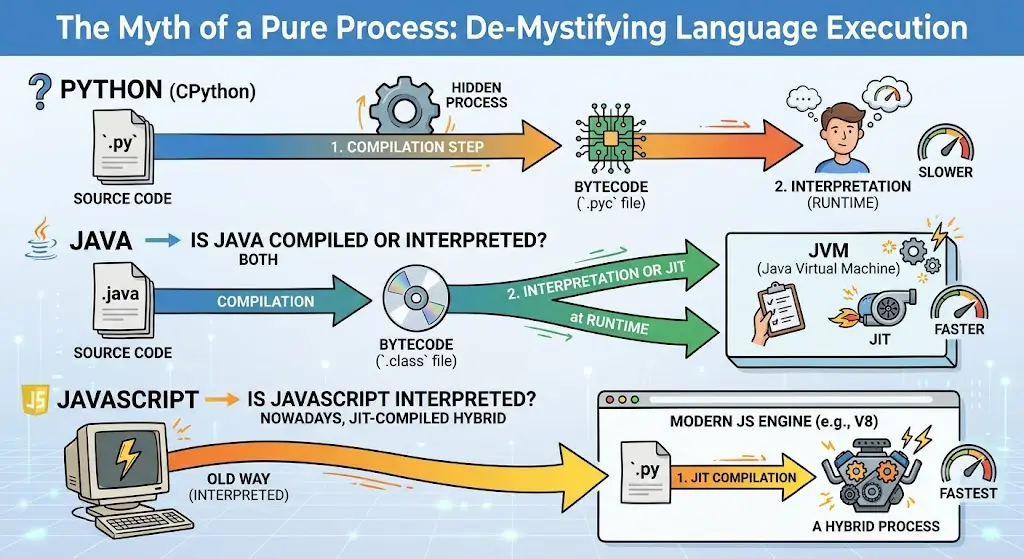
Python is typically interpreted. CPython, the reference implementation, compiles source code to bytecode first, then interprets that bytecode a detail that surprises a lot of beginners.
Java
Java compiles to bytecode using javac, and then the Java Virtual Machine (JVM) interprets or JIT-compiles that bytecode at runtime. It’s a hybrid model, not purely one or the other.
JavaScript
JavaScript was originally purely interpreted in browsers, but modern engines like V8 (used in Chrome and Node.js) use JIT compilation to speed things up significantly.
C#
C# compiles to an intermediate language (CIL), which the .NET runtime then JIT-compiles into native code at execution time similar in spirit to Java’s approach.
Kotlin
Kotlin compiles to JVM bytecode (or native code via Kotlin/Native), so it follows the same hybrid path as Java when targeting the JVM.
Swift
Swift is ahead-of-time compiled using LLVM, producing fast native binaries for Apple platforms.
Modern Hybrid Execution Models
Real-world software rarely fits neatly into “purely compiled” or “purely interpreted.” Most modern languages use some combination of the two.
Bytecode
Bytecode is something in between the code you write and the code the computer understands. It is not the same as the code you see when you are writing a program. It is not the same as the code the computer uses either. Java has something called,.class files and Python has something called.pyc files and these are both examples of bytecode. Bytecode is special because it can work on any computer no matter what kind of computer it is. Java bytecode and Python bytecode are used to make things easier for the computer to understand. That is why we have.class files and.pyc files, which are both types of bytecode.
JIT Compilation
Just-In-Time (JIT) compilation translates bytecode into native machine code while the program is running, targeting the specific hardware it’s on. This is how the JVM and V8 achieve near-compiled speeds while keeping the flexibility of an interpreted language.
AOT Compilation
Ahead-Of-Time (AOT) compilation is the traditional model: all translation happens before the program runs. It’s what C, C++, Rust, and Swift use by default.
Virtual Machines
A virtual machine (VM), in this context, is software that executes bytecode the JVM for Java, and historically similar concepts for .NET’s CLR. It acts as a buffer between your compiled bytecode and the actual hardware, which is part of what makes languages like Java portable across operating systems (“write once, run anywhere”).
Popular Compiler and Interpreter Tools
GCC
The GNU Compiler Collection (GCC) is one of the most widely used compiler toolchains, supporting C, C++, Fortran, and more. It’s the default compiler on most Linux distributions.
Clang
Clang is a compiler front end built on LLVM, known for faster compile times and clearer error messages compared to older tools. It’s the default compiler on macOS.
LLVM
LLVM is a compiler infrastructure project consisting of reusable tools and libraries for building compilers. Rust, Swift, and Clang all rely on it under the hood.
CPython
CPython is the reference (and most widely used) implementation of Python, written in C. It compiles Python source to bytecode, then interprets that bytecode.
PyPy
PyPy is an alternative Python implementation that uses JIT compilation, often running significantly faster than CPython for long-running programs.
Node.js
Node.js is a JavaScript runtime built on Google’s V8 engine, which uses JIT compilation to execute JavaScript outside the browser.
HotSpot JVM
HotSpot is Oracle’s default Java Virtual Machine implementation. It uses JIT compilation and adaptive optimization to speed up frequently executed (“hot”) code paths.
Real-World Examples
Compiling a C Program
You write hello.c, then run gcc hello.c -o hello. GCC compiles the whole file into an executable called hello. You then run ./hello separately compilation and execution are two distinct steps.
Running a Python Script
You write hello.py and simply run python hello.py. Python compiles it to bytecode internally and interprets that bytecode immediately; there’s no separate executable file for you to manage.
Java Compilation
You run javac Hello.java, which produces Hello.class (bytecode). Then you run java Hello, and the JVM interprets or JIT-compiles that bytecode. It’s a two-stage process that blends both compiler and interpreter concepts.
JavaScript Execution
In a browser or Node.js, you just run your .js file directly. The engine (like V8) parses it, interprets it initially, and JIT-compiles the “hot” parts as the code runs repeatedly.
When Should You Use a Compiler?
When you need something to run fast like in game engines or operating systems you should use a compiled language. This is also true for things like embedded devices or high-frequency trading systems.
Compiled languages are a choice when you want to share your software with others but you do not want to show them the source code of the software. You want to keep the source code of the game engines or operating systems to yourself.
So use compiled languages for game engines and operating systems when speed is important. Use compiled languages, for embedded devices and high-frequency trading systems too.
When Should You Use an Interpreter?
Interpreted languages shine for scripting, automation, prototyping, and data analysis, where development speed matters more than raw execution speed. They’re also great for beginners, since the fast feedback loop makes learning and experimenting much easier.
Common Misconceptions
Is Python Really Interpreted?
Not entirely. CPython compiles your .py files into bytecode first, then interprets that bytecode so there’s a compilation step hiding under the hood, even though Python is commonly called “an interpreted language.”
Is Java Compiled or Interpreted?
Both. javac compiles Java source into bytecode, and the JVM then interprets or JIT-compiles that bytecode at runtime. Calling Java purely “compiled” or purely “interpreted” misses half the picture.
Is JavaScript Interpreted?
It used to be almost entirely interpreted in early browsers. Today, engines like V8 use JIT compilation extensively, so modern JavaScript execution is a hybrid process, not a simple line-by-line interpretation.
Compiler vs Interpreter Cheat Sheet
- Compiler: translates the whole program before running it → produces an executable → faster runtime → all errors shown at once.
- Interpreter: translates and runs code line by line → no standalone executable → slower runtime → stops at the first error.
- Hybrid (bytecode + JIT): compiles to an intermediate form, then interprets or JIT-compiles that form at runtime — used by Java, C#, and modern JavaScript engines.
Interview Questions
- What is the main difference between a compiler and an interpreter?
- Name the five phases of compilation.
- Is Python compiled or interpreted? Explain your answer.
- What is JIT compilation, and how does it differ from AOT compilation?
- Why can compiled programs sometimes run faster than interpreted ones?
- What role does bytecode play in languages like Java?
- Give an example of a language that uses a hybrid execution model.
Frequently Asked Questions
Q1: What is the main difference between a compiler and an interpreter?
A compiler translates the entire program into machine code before execution, while an interpreter translates and executes code line by line as the program runs.
Q2: Which is faster, a compiler or an interpreter?
Compiled programs generally run faster because they execute native machine code directly, without runtime translation overhead.
Q3: Is Python a compiled or interpreted language?
Python is primarily interpreted, though CPython does compile source code to bytecode internally before interpreting it.
Q4: Can a language be both compiled and interpreted?
Yes. Java, C#, and modern JavaScript all use hybrid models that combine compilation to bytecode with runtime interpretation or JIT compilation.
Q5: Do compilers or interpreters catch errors better?
Compilers catch most syntax and type errors before execution, giving you a full error report upfront. Interpreters only report an error once execution reaches that specific line.
Q6: Why do some languages use both a compiler and an interpreter?
This hybrid approach compiling to bytecode, then interpreting or JIT-compiling it balances portability and quick startup with reasonable execution speed.
Conclusion
The difference between a compiler and an interpreter is not something you know for fun, it actually helps you make real decisions about which language to use, how fast your program will run and how quickly you can make it. A compiler does a lot of work beforehand so your program can run later on. An interpreter on the hand is a bit slower but it is more flexible and gives you feedback faster.
If you are picking a language for your project do not think too much about whether it is a compiler or an interpreter. Think about what your project really needs: does it need to be very fast, do you need to make changes quickly or do you need something in the middle. Compiler and interpreter are not two separate things; most modern languages use both compiler and interpreter to get the good things from each.