
If you have ever wondered how computers went from room-sized machines with flickering vacuum tubes to something a business could actually afford to run, the answer starts with second generation computers. This was the era when the transistor took over, and computing stopped being a science experiment and started becoming a real industry.
Second generation computers marked a major milestone in the evolution of computing. If you’re new to this topic, it helps to first understand the bigger picture of the Generations of Computers, so you can see how each stage built on the one before it. Once you have that context, the transistor era makes a lot more sense.
In this guide, we will walk through what second generation computers actually were, why they replaced the first generation, how they worked, and which machines defined the period. We will also look at real examples like the IBM 1401 and IBM 7090, so you get more than just a textbook definition.
What Are Second Generation Computers?
Second generation computers are machines built using transistors instead of vacuum tubes as their core switching component. They represent the second major phase in computing history, roughly spanning from 1956 to 1963.
In plain terms, these were the computers that made vacuum tube machines look outdated almost overnight. They were smaller, cheaper to run, and far more dependable.
Why They Are Called the Second Generation
Computer history is usually divided into generations based on the underlying hardware technology. First generation computers used vacuum tubes. Second generation computers used transistors. Third generation computers later used integrated circuits, and so on.
This labeling system helps engineers, historians, and students trace how each new component technology reshaped what computers could do. Second generation computers earned their name simply because the transistor was the defining technology of that period.
Time Period (1956 to 1963)
Most historians place second generation computers between 1956 and 1963, though some sources extend the range slightly to 1965 depending on when specific machines were phased out. IBM and other manufacturers had transistor based systems in commercial use well before the end of the 1950s, and by the early 1960s transistors had become the industry standard.
History of Second Generation Computers
Limitations of First Generation Computers
To understand why transistors mattered, it helps to know what came before. First generation computers, like the ENIAC and UNIVAC I, relied on vacuum tubes to control the flow of electricity.
Vacuum tubes worked, but they came with serious problems. They generated enormous amounts of heat, consumed huge amounts of power, and burned out frequently, which meant constant maintenance. A single computer could contain thousands of tubes, and if even one failed, the whole system could go down.
Invention of the Transistor
The transistor was invented in 1947 at Bell Labs by John Bardeen, Walter Brattain, and William Shockley. Their work earned them the Nobel Prize in Physics in 1956, and it is widely regarded as one of the most important inventions of the twentieth century (see Wikipedia’s overview of the transistor for a deeper technical history).
The transistor could do the same job as a vacuum tube, acting as a switch or amplifier for electronic signals, but it did so using a small piece of semiconductor material instead of a glass tube filled with wires. This one change had massive consequences for computing.
Transition to Transistor-Based Computing
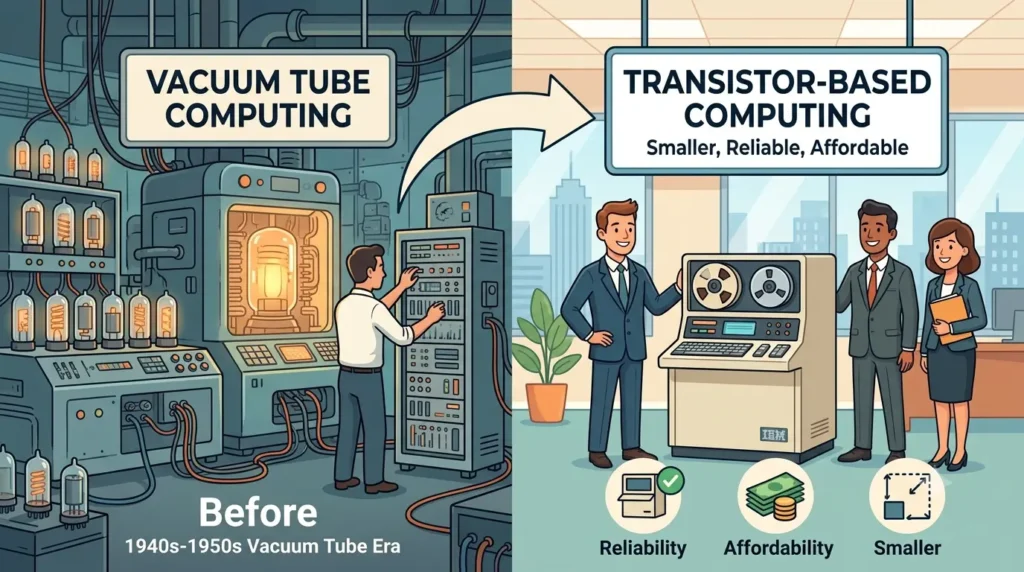
It took a few years for the transistor to move from Bell Labs into commercial computers. Once manufacturers like IBM, Control Data Corporation, and Remington Rand started building transistor based machines in the late 1950s, the shift happened quickly. Businesses that had never considered owning a computer suddenly found the idea realistic, because these new machines were smaller, more affordable to operate, and far more reliable.
How Second Generation Computers Worked
Transistor Technology
A transistor is a small semiconductor device that can switch or amplify electronic signals. Think of it like a light switch that can be flipped on and off billions of times without wearing out, except it does this using the movement of electrons through a material like silicon or germanium rather than a mechanical switch.
In practical terms, this made transistors:
- Much smaller than vacuum tubes
- Far more energy efficient
- More reliable, since they rarely failed
- Cheaper to produce at scale over time
Because transistors did not need to heat a filament the way vacuum tubes did, they also ran cooler, which reduced the risk of overheating and made computers easier to maintain.
Magnetic Core Memory
Second generation computers commonly used magnetic core memory, a type of storage made from tiny magnetized rings threaded onto wires. Each ring could hold a single bit of data based on its magnetic orientation.
This was a major upgrade over earlier memory systems. Magnetic core memory was faster, more stable, and could retain data even when the power was switched off, which was a big deal for reliability.
Assembly Language and High-Level Languages
First generation computers were programmed almost entirely in machine language, which meant writing instructions in raw binary. Second generation computers introduced assembly language, which let programmers use short mnemonic codes instead of long strings of ones and zeros.
This period also saw the rise of high-level programming languages, most notably FORTRAN and COBOL, which we will cover in more detail below.
Magnetic Tape and Storage Devices
Magnetic tape became a standard storage medium during this era, allowing computers to store and retrieve much larger volumes of data than punch cards had allowed. Tape drives were faster, more compact, and easier to manage for businesses processing large datasets.
Batch Processing Systems
Second generation computers typically used batch processing, where jobs were collected, grouped together, and run through the computer one after another without user interaction during execution. It was not glamorous, but it was efficient for the kind of large scale data processing businesses needed, like payroll or inventory management.
Characteristics of Second Generation Computers
Here are the defining traits that separated second generation computers from their predecessors.
Smaller Size
Transistors were a fraction of the size of vacuum tubes, so computers built with them could shrink dramatically. What once filled an entire room could now fit into a much smaller space.
Lower Power Consumption
Because transistors did not need constant heating like vacuum tubes did, second generation computers used significantly less electricity. This made them cheaper to operate over time.
Less Heat Generation
Lower power draw also meant less waste heat. This reduced the need for elaborate cooling systems that had been almost mandatory for first generation machines.
Faster Processing
Transistors could switch on and off far faster than vacuum tubes, which translated directly into quicker processing speeds. Tasks that once took minutes could now be completed in seconds.
Improved Reliability
Vacuum tubes failed often. Transistors rarely did. This single improvement meant far less downtime and far less time spent on repairs.
Better Memory Capacity
With magnetic core memory replacing older storage methods, second generation computers could hold more data and access it more quickly, which opened the door to more complex applications.
Features of Second Generation Computers
Beyond the core characteristics, second generation computers introduced several practical features that shaped how they were used:
- Support for high-level programming languages like FORTRAN and COBOL
- Use of magnetic tape for data storage and backup
- Batch processing capability for handling large workloads
- Improved input and output devices, including punch card readers and line printers
- The beginning of true commercial computing, where businesses could realistically own and operate a computer
Advantages of Second Generation Computers
- Smaller and more practical than first generation machines
- Lower operating costs due to reduced power consumption
- Much more reliable, with far fewer hardware failures
- Faster processing speeds for business and scientific tasks
- Easier programming thanks to assembly and high-level languages
- Better data storage through magnetic core memory and magnetic tape
Disadvantages of Second Generation Computers
- Still large and expensive compared to modern standards
- Required specialized environments and trained staff to operate
- Transistors, while better than tubes, still generated some heat and could fail under heavy use
- Programming, though improved, was still complex and required specialized skills
- Limited memory and processing power compared to what came next with integrated circuits
Programming Languages Used
Assembly Language
Assembly language let programmers write instructions using short, human-readable codes instead of raw binary. It was still low-level and closely tied to the machine’s hardware, but it was a big improvement over pure machine code.
FORTRAN
FORTRAN, short for Formula Translation, was developed by IBM under the leadership of John Backus and released in 1957. It was designed for scientific and engineering calculations and is widely credited as one of the first high-level programming languages (Wikipedia has a solid overview of FORTRAN’s development).
COBOL
COBOL, or Common Business Oriented Language, was developed in the late 1950s with major contributions from Grace Hopper, a pioneering computer scientist and U.S. Navy rear admiral. COBOL was built specifically for business applications like payroll, billing, and inventory management, and versions of it are still running in some banking and government systems today.
Examples of Second Generation Computers
IBM 1401
Features
The IBM 1401, released in 1959, was one of the most successful computers of its time. It used transistor technology, supported magnetic tape storage, and was known for its relatively low cost compared to earlier machines.
Applications
Businesses used the IBM 1401 for tasks like payroll processing, billing, and inventory control. Its affordability made it accessible to mid-sized companies that could never have justified the cost of a first generation machine.
Historical Importance
The IBM 1401 is often described as the machine that brought computing into mainstream business use. By some estimates, it became one of the best-selling computer models of the early 1960s, and it played a huge role in normalizing the idea of a company owning its own computer.
IBM 7090
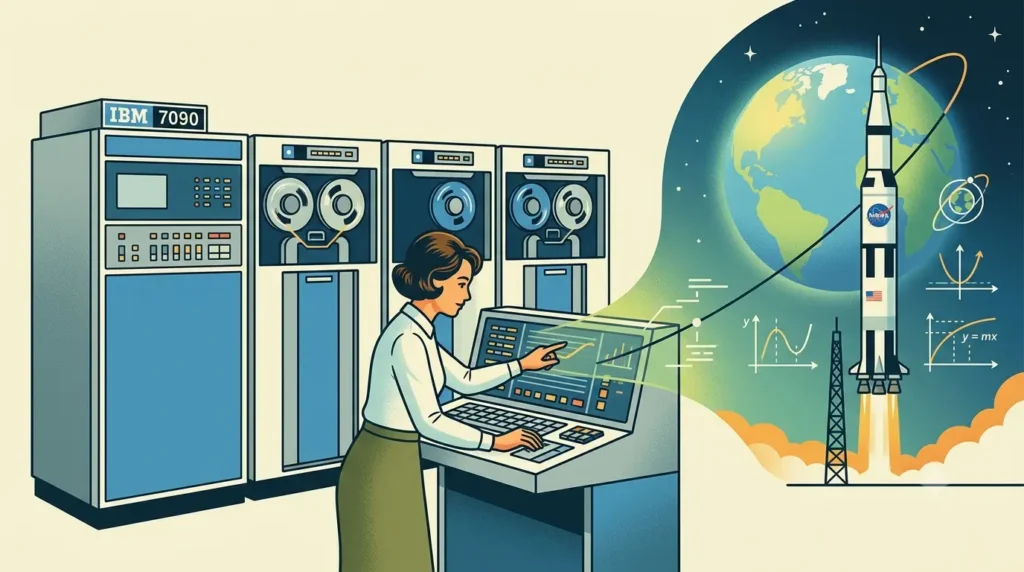
The IBM 7090 was a high-performance transistor based computer used primarily for scientific and engineering work, including calculations for NASA’s early space missions. It was significantly faster than its vacuum tube predecessor, the IBM 709.
CDC 1604
Released by Control Data Corporation in 1960, the CDC 1604 was one of the first commercially successful transistor based computers designed for large scale scientific computation. It was also notable as one of the early projects associated with Seymour Cray, who would later become famous for supercomputer design.
UNIVAC III
The UNIVAC III, introduced by Remington Rand’s UNIVAC division in the early 1960s, was a transistor based upgrade to the earlier UNIVAC line. It offered improved speed and reliability compared to its vacuum tube ancestors while maintaining compatibility with existing business applications.
Philco Transac S-2000
The Philco Transac S-2000 was among the earliest fully transistorized computers, released around 1958. It was used in both government and scientific contexts and is often cited by historians as one of the technical pioneers of the second generation era.
Applications of Second Generation Computers
Business Data Processing
Companies used second generation computers for payroll, billing, inventory tracking, and general record keeping. This was the point where computing genuinely started to reshape how businesses operated day to day.
Scientific Research
Machines like the IBM 7090 handled complex scientific calculations that would have taken human computers weeks or months to complete by hand.
Banking
Banks adopted second generation computers to manage growing volumes of transactions and account records, laying the groundwork for the automated banking systems we rely on today.
Government Organizations
Government agencies used these systems for census data, defense calculations, and administrative record keeping, taking advantage of the improved reliability and speed over earlier machines.
Aerospace and Defense
The space race and Cold War era defense programs relied heavily on transistor based computers for calculations related to missile guidance, satellite tracking, and early space missions.
Universities and Research Institutions
Universities used second generation computers for academic research, and this period also saw the growth of computer science as its own field of study, partly because these machines were finally practical enough for research budgets.
First Generation vs Second Generation Computers
Comparison Table
| Feature | First Generation Computers | Second Generation Computers |
|---|---|---|
| Core Technology | Vacuum tubes | Transistors |
| Time Period | 1940 to 1956 | 1956 to 1963 |
| Size | Extremely large, room-sized | Smaller, more manageable |
| Power Consumption | Very high | Significantly lower |
| Heat Generation | Very high | Reduced |
| Reliability | Low, frequent breakdowns | Much improved |
| Programming | Machine language | Assembly language, FORTRAN, COBOL |
| Memory | Magnetic drums, delay lines | Magnetic core memory |
| Storage | Punch cards | Magnetic tape |
| Examples | ENIAC, UNIVAC I | IBM 1401, IBM 7090, CDC 1604 |
Major Improvements
The jump from first to second generation computers was not incremental. It touched every part of the machine, from the physical hardware to the way people wrote software. Businesses that had ignored computers as impractical suddenly had a real reason to consider them.
Why Second Generation Computers Were Replaced
Remaining Limitations
Transistors were a massive step forward, but they still had limits. Wiring individual transistors together by hand was time consuming and left plenty of room for error, and there was only so much you could shrink a circuit built from discrete components.
Rise of Integrated Circuits
In the early 1960s, engineers developed the integrated circuit, which allowed multiple transistors and other components to be etched onto a single chip. This eliminated much of the manual wiring involved in building circuits and opened the door to even smaller, faster, and cheaper computers.
Transition to Third Generation Computers
By the mid-1960s, integrated circuits began replacing individual transistors as the core building block of computers, marking the start of the third generation. If you want to see where the story goes from here, our guide to Third Generation Computers covers this next major leap in detail.
Legacy of Second Generation Computers
Impact on Modern Computing
Second generation computers proved that computing could be practical, affordable, and reliable enough for everyday business use. That single shift changed the trajectory of the entire technology industry.
Growth of Commercial Computing
Before this era, computers were mostly research tools or military assets. Second generation machines like the IBM 1401 turned computing into a genuine commercial product, and companies of all sizes began budgeting for computer systems for the first time.
Foundation for Future Computer Generations
The core ideas introduced during this period, like high-level programming languages, magnetic storage, and transistor based design, became the foundation for everything that followed. Even today, COBOL code from this era is reportedly still running in parts of the global banking system, which says a lot about how solid these early foundations were.
Frequently Asked Questions About Second Generation Computers
What are second generation computers?
Second generation computers are computers built with transistors instead of vacuum tubes, generally dating from 1956 to 1963. They were smaller, faster, more reliable, and cheaper to run than first generation machines.
When were second generation computers developed?
They were developed roughly between 1956 and 1963, following the commercial adoption of the transistor, which was invented in 1947.
Why did transistors replace vacuum tubes?
Transistors were smaller, more energy efficient, generated less heat, and were far more reliable than vacuum tubes, which made them a clear upgrade for computer design.
What technology was used in second generation computers?
Second generation computers used transistors for processing, magnetic core memory for main storage, and magnetic tape for data storage.
What are the characteristics of second generation computers?
Key characteristics include smaller size, lower power consumption, reduced heat output, faster processing, improved reliability, and better memory capacity compared to first generation machines.
What are the advantages of second generation computers?
Advantages include lower operating costs, greater reliability, faster performance, and easier programming through assembly language and high-level languages like FORTRAN and COBOL.
What are the disadvantages of second generation computers?
Disadvantages include still-high costs and size compared to modern computers, the need for specialized staff, and limited memory and processing power compared to later generations.
Which programming languages were used in second generation computers?
The main languages were assembly language, FORTRAN for scientific work, and COBOL for business applications.
What are examples of second generation computers?
Well known examples include the IBM 1401, IBM 7090, CDC 1604, UNIVAC III, and the Philco Transac S-2000.
What is IBM 1401?
The IBM 1401 was a widely used second generation computer released in 1959, known for bringing affordable business computing to mid-sized companies.
What is CDC 1604?
The CDC 1604 was a transistor based computer released by Control Data Corporation in 1960, designed for large scale scientific computation.
What is magnetic core memory?
Magnetic core memory is a type of computer storage made of small magnetized rings that store data based on their magnetic orientation. It was faster and more reliable than earlier memory technologies.
What is the difference between first and second generation computers?
The main difference is the core technology: first generation computers used vacuum tubes, while second generation computers used transistors, resulting in smaller size, lower power use, and better reliability.
Why were second generation computers replaced?
They were eventually replaced by third generation computers once integrated circuits made it possible to fit multiple transistors onto a single chip, further improving speed, size, and cost.
Which generation introduced high-level programming languages?
Second generation computers introduced high-level programming languages, most notably FORTRAN and COBOL, making software development more accessible than pure machine language programming.
Conclusion
Second generation computers were more than just a hardware upgrade. They were the turning point where computing stopped being an experimental, expensive novelty and started becoming a practical tool that businesses, governments, and universities could actually use. The shift from vacuum tubes to transistors set the stage for everything that followed, and understanding this era gives you a much clearer picture of how we got from room-sized machines to the computers we carry in our pockets today.
If you’d like to keep exploring this topic, communities like the r/computerscience subreddit and r/AskHistorians are good places to see ongoing discussions about early computing history, and LinkedIn has several posts from engineers and historians who share archival photos and firsthand accounts of transistor era machines.