
Every year a lot of students in India take exams that will decide what they do with their lives for a time. Sometimes for many years. If you ask a coaching center in Kota, Delhi or Hyderabad what exams students worry about the most you will hear the exams mentioned over and over. This guide tells you about the 10 toughest exams in India, why they are so hard to pass and how students who really want to do well actually get ready for them.
This is not just a list made up from guesses. The rankings in this guide are based on how many students are selected, how much material they have to study and how many tests they have to take. These are the same things that people who give advice on education and exam experts look at when they compare different exams.
Top 10 Toughest Exams in India at a Glance
Before we go deep into each exam, here’s a snapshot for anyone who just wants the numbers.
Quick Comparison Table
| Exam | Conducting Body | Eligibility | Applicants (approx.) | Selection Rate | Difficulty Level | Career Path | Avg. Prep Time |
| UPSC CSE | Union Public Service Commission | Graduate, 21-32 yrs | ~10-13 lakh | ~0.1-0.2% | Extreme | IAS, IPS, IFS | 1.5-2 years |
| JEE Advanced | IIT Zone (rotational) | Top 2.5 lakh in JEE Main | ~1.8 lakh appear | ~30% (of appeared) | Very High | B.Tech at IITs | 2 years |
| CA Final | ICAI | Cleared CA Inter + Articleship | ~1.5-2 lakh | ~10-15% | Very High | Chartered Accountant | 3-4 years (full CA) |
| NEET UG | NTA | 10+2 with PCB | ~22-24 lakh | ~55-60% qualify, top ranks rarer | Extreme (for top colleges) | MBBS, BDS | 1.5-2 years |
| GATE | IITs/IISc (rotational) | B.E./B.Tech or equivalent | ~8-9 lakh | ~15-17% | High | M.Tech, PSU jobs | 6-12 months |
| CAT | IIMs (rotational) | Bachelor’s degree | ~2.5-3 lakh | Top IIM calls under 1% | Very High | MBA at IIMs | 6-12 months |
| CLAT | Consortium of NLUs | 10+2, no age limit | ~60-70k | ~4-5% for top NLUs | High | Law at NLUs | 1-1.5 years |
| NDA | UPSC | 10+2, unmarried, age 16.5-19.5 | ~6-7 lakh | ~1-2% | High | Indian Armed Forces | 1-1.5 years |
| UGC NET | NTA | Postgraduate | ~9-10 lakh | ~15-20% qualify | Moderate-High | Assistant Professor, JRF | 6-8 months |
| INI CET / AIIMS PG | AIIMS New Delhi | MBBS with internship | ~30-35k | Under 5% for top seats | Extreme | MD/MS at AIIMS, PGI | 1.5-2 years |
Numbers here are rounded and vary slightly year to year based on notified vacancies and applicant turnout — always check the official notification for the current cycle before you plan around them.
What Makes an Exam Tough?
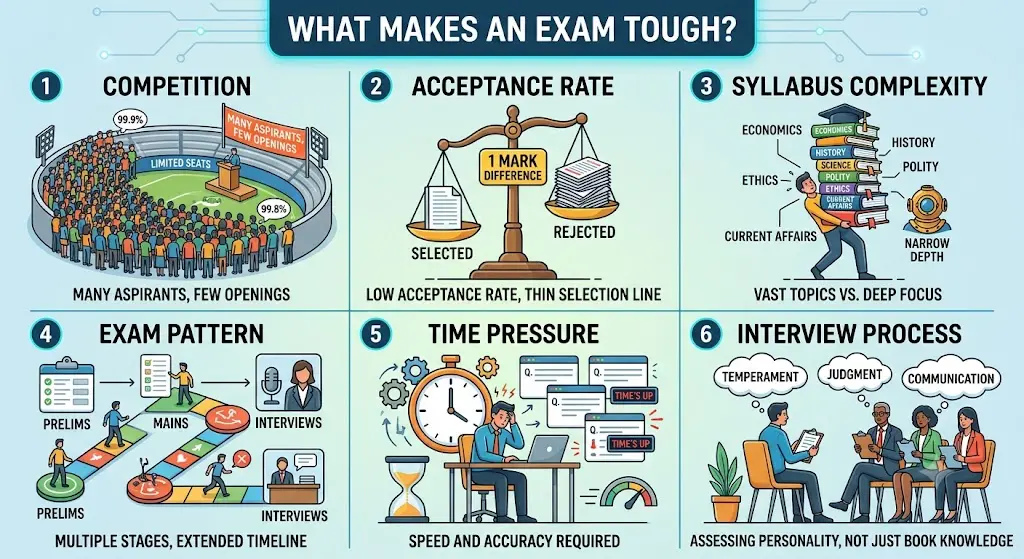
“Toughness” is not just difficult questions. It involves factors. Knowing these factors helps you assess any exam, not the ones, on this list. You can judge an exam by understanding its toughness. This helps with all exams.
Competition
The huge number of people going for a seat makes a big difference. When one million people are trying to get one of the hundred seats available, even a tiny mistake can be very expensive. The fact that one million people are competing for these seats really changes things. The people going for these seats have to be very careful because a small error can cost them a lot. The seats are very limited. The number of people competing for them is extremely high.
Acceptance Rate
A low acceptance rate means that the difference between the people who get selected and the people who do not get selected is very small. For example in exams like the UPSC CSE, the difference between the person who gets selected and the first person who gets rejected can be just one mark. This shows that the UPSC CSE exams really have a thin line, between people who get selected for the UPSC CSE and people who do not get selected for the UPSC CSE.
Syllabus Complexity
Some exams test a narrow subject deeply (like CA Final), while others test an enormous range of topics at once (like UPSC, which spans history, polity, economics, science, ethics, and current affairs). Both types are demanding in different ways.
Exam Pattern
Exams that have stages like prelims, mains and interviews make the whole process very long. It can take months or more than a year to complete. The prelims, mains and interviews are all separate. Each one has its own cutoff score. So if you do really on the prelims but poorly on the mains it does not matter that you had a strong prelims score because the mains did not go well
Time Pressure
Some exams, like CAT, pack complex problem-solving into strict per-section timers. Speed and accuracy both matter, and panicking over one question can cost you three more.
Interview Process
For exams, like the Union Public Service Commission and the National Defence Academy, a written test is half of what you need to do. The personality test or the Services Selection Board interview is where they see what kind of person you are. It checks your temperament, your judgment and how well you can talk to people. These are things that you cannot learn by reading books.
Ranking Methodology: How We Ranked These Exams
We ranked these ten exams using a mix of selection ratio, number of stages, syllabus breadth, and the general consensus among educators, alumni, and exam-prep communities on platforms like Reddit’s r/UPSC and r/JEENEETards, where thousands of aspirants openly discuss difficulty year after year. We also cross-checked official notifications and results from the respective conducting bodies (UPSC, NTA, ICAI, IIT/IISc, IIM, and the NLU Consortium) rather than relying on secondhand claims. This is not a strict mathematical ranking — a CA Final aspirant and a NEET aspirant face very different kinds of hard — but it reflects how these exams are broadly perceived across India’s competitive exam ecosystem.
Top 10 Toughest Exams in India
1. UPSC Civil Services Examination
Overview
The UPSC Civil Services Examination (CSE) is widely regarded as India’s toughest competitive exam, and for good reason. It’s the gateway to the IAS, IPS, IFS, and dozens of other central services.
Eligibility
Candidates need a bachelor’s degree from a recognized university. The general age limit is 21 to 32 years, with relaxations for reserved categories.
Selection Rate
For the 2025 cycle, <cite index=”4-1″>around 1,087 vacancies were reported across services like IAS, IPS, and IFS, and 958 candidates were finally recommended</cite> for appointment. Against <cite index=”8-1″>roughly 10-13 lakh applicants each year</cite>, that puts the overall selection rate at well under 0.2%. <cite index=”6-1″>Only around 14,000 candidates typically clear the Prelims stage and move on to Mains</cite>, and from there, just a few thousand reach the interview.
Why It Is Tough
The process has three stages. Prelims and Mains and Interview. That took place over a year. The syllabus for the Civil Services Examination covers a lot of subjects. For the Mains essay and ethics papers there is no one correct way to answer which makes it really hard to prepare for the Civil Services Examination. Civil Services Examination preparation is very unpredictable.
Career Opportunities
Selected candidates go on to become IAS officers or IPS officers or IFS officers. They also join Central Services. These services include Income Tax, Customs and Railways. These are roles, with power to make policies and administer.
Preparation Tips
Start with NCERT textbooks for a strong base, then move to standard reference books for each subject. Daily newspaper reading and a disciplined answer-writing practice for Mains matter more than trying to “finish” the syllabus.
2. IIT JEE Advanced
Overview
JEE Advanced is the second stage of India’s most competitive engineering entrance process, and it’s the only exam that gets you into an IIT.
Eligibility
Candidates must rank among the <cite index=”15-1″>top 2,50,000 candidates in JEE Main</cite>, and can attempt JEE Advanced a maximum of two times in two consecutive years, in the year they pass or the year after passing Class 12.
Selection Rate
In the year 2025 about 1,80,422 candidates took the exam and 54,378 candidates qualified.. Qualifying for the exam is not the same as getting a seat at a top Indian Institute of Technology.
A few thousand IIT candidates get a rank that is high enough for them to get into IIT Bombay or IIT Delhi for branches like Computer Science at IIT Bombay or Computer Science at IIT Delhi.
Why It Is Tough
The syllabus demands conceptual clarity in Physics, Chemistry, and Mathematics at a level well beyond school textbooks. Questions are designed to test application and problem-solving, not memorization, and negative marking punishes guesswork heavily.
Career Opportunities
A seat at any IIT opens doors to campus placements with some of the highest starting salaries in India, along with strong alumni networks in tech, consulting, and entrepreneurship.
Preparation Tips
Build fundamentals early with NCERT and standard textbooks like HC Verma or RD Sharma before jumping into advanced problem sets. Solving JEE Main previous years’ papers under timed conditions is non-negotiable.
3. CA Final
Overview
The Chartered Accountancy Final exam, conducted by ICAI, is the last hurdle before a candidate becomes a full-fledged Chartered Accountant.
Eligibility
Candidates must have cleared CA Intermediate and completed their mandatory articleship training before appearing for CA Final.
Selection Rate
Pass percentages for CA Final typically hover in the 10-15% range per attempt, and many candidates need multiple attempts to clear both groups.
Why It Is Tough
The syllabus includes dense subjects like Financial Reporting, Strategic Financial Management, and Direct and Indirect Tax Laws, all while candidates are usually balancing full-time articleship work.
Career Opportunities
Having a CA qualification can get you a job in auditing or taxation. You can work as a financial consultant. You can even start your independent practice as a Chartered Accountant. This is one of the respected jobs in Indian business. A CA qualification is really valuable. It can open doors to many great opportunities for a Chartered Accountant.
Preparation Tips
ICAI’s own study material is the backbone of preparation. Most successful candidates supplement it with mock test papers and revision test papers (RTPs) released before every attempt.
4. NEET UG
Overview
NEET UG is the single entrance exam for admission to MBBS and BDS programs across India, replacing what used to be a maze of separate state and college-level tests.
Eligibility
Candidates need to have passed Class 12 with Physics, Chemistry, and Biology as core subjects.
Selection Rate
Applicant numbers regularly cross 22-24 lakh each year. While a large share of candidates clear the qualifying cutoff, the number of MBBS seats at government colleges is comparatively tiny, which is what makes competition for the top ranks brutal.
Why It Is Tough
The sheer scale of applicants means even a well-prepared student can miss a government MBBS seat by a handful of ranks. The syllabus is vast, covering NCERT Biology, Physics, and Chemistry in exhaustive detail.
Career Opportunities
Qualifying candidates go on to pursue MBBS, BDS, or AYUSH courses, eventually building careers as doctors, surgeons, or specialists.
Preparation Tips
NCERT Biology is the single most important resource most successful candidates say a large share of NEET Biology questions come straight from it. Regular mock tests help manage the exam’s time pressure.
5. GATE
Overview
The Graduate Aptitude Test in Engineering (GATE) tests undergraduate engineering concepts and is the gateway to M.Tech admissions and PSU recruitment.
Eligibility
Candidates need a bachelor’s degree in Engineering, Technology, Architecture, or a related field, or should be in the final year of such a program.
Selection Rate
The Graduate Aptitude Test, in Engineering or GATE usually gets around 8 to 9 lakh people applying for it. Out of these people 15 to 17 percent actually qualify every year when we look at all the subjects together. The thing is, this percentage can be really different depending on the subject we are talking about. GATE exam results can vary a lot by subject.
Why It Is Tough
GATE tests core engineering concepts with a depth most students haven’t revisited since their early semesters, and a single paper covers four years of undergraduate study.
Career Opportunities
A good GATE score can get you into an IIT or NIT for M.Tech, often with a stipend, or land you a direct interview call at PSUs like ONGC, BHEL, or NTPC.
Preparation Tips
Go subject-wise through standard reference books, and prioritize previous years’ GATE papers; the exam tends to repeat concept patterns even when the exact questions change.
6. CAT
Overview
The Common Admission Test (CAT) is the primary entrance exam for admission into the IIMs and hundreds of other top B-schools in India.
Eligibility
A bachelor’s degree with a minimum of 50% marks (45% for reserved categories) is required, and there’s no upper age limit.
Selection Rate
Around 2.5-3 lakh candidates typically appear for CAT each year, but the number of seats across the older IIMs runs into just a few thousand, making the effective selection rate for top IIM calls well under 1%.
Why It Is Tough
CAT is a battle against the clock as much as against the syllabus. Sectional time limits mean you can’t linger on a tough Quant or Verbal Ability question, no matter how close you are to solving it.
Career Opportunities
An IIM degree opens up roles in consulting, investment banking, product management, and general management, often with some of the highest MBA placement packages in the country.
Preparation Tips
To get faster it is an idea to take daily timed tests for each section. This is better than solving problems when you feel like it. When it comes to Verbal Ability, reading a lot can really help. This includes things like newspapers, editorials and long articles. A lot of people do not realize how much reading can help with Verbal Ability.
7. CLAT
Overview
The Common Law Admission Test (CLAT) is the entrance exam for admission to National Law Universities (NLUs) across India, including NLSIU Bangalore and NALSAR Hyderabad.
Eligibility
Candidates need to have passed Class 12 (any stream) with a minimum aggregate percentage, and there’s no upper age limit for the UG program.
Selection Rate
Every year around sixty to seventy thousand students take the Common Law Admission Test. They are all competing for a thousand spots at the National Law Universities. The best National Law Universities are really hard to get into. In fact only a small number of students get selected at these top National Law Universities. The selection rate is usually very low, in the single digits.
Why It Is Tough
CLAT tests legal reasoning, logical reasoning, English, current affairs, and quantitative technique in a single timed paper, and even strong students often find the legal reasoning section unpredictable.
Career Opportunities
NLU graduates go on to work at top law firms, corporate legal departments, litigation practices, or pursue judicial services and policy research roles.
Preparation Tips
Daily current affairs reading is essential given CLAT’s heavy GK component. Practicing legal reasoning passages regularly helps build the pattern recognition the section demands.
8. NDA
Overview
The National Defence Academy (NDA) exam, conducted by UPSC, is the entry point for young candidates who want to join the Indian Army, Navy, or Air Force as officers.
Eligibility
Candidates must be unmarried, aged between 16.5 and 19.5 years, and have passed (or be appearing for) Class 12.
Selection Rate
NDA typically draws 6-7 lakh applicants for each of its two annual exams, but final selection after the written test and the SSB interview usually comes down to just 1-2% of applicants.
Why It Is Tough
Beyond the written exam covering Maths and General Ability, candidates must clear the multi-day SSB interview, which tests physical fitness, psychological aptitude, and leadership potential areas that can’t be crammed for.
Career Opportunities
Selected candidates train at the NDA and go on to become commissioned officers in the Army, Navy, or Air Force, with a clear career progression through the defence services.
Preparation Tips
Along with Maths and English preparation, candidates should start physical fitness training early and read about current affairs and defence-related topics for the SSB interview stage.
9. UGC NET
Overview
The UGC National Eligibility Test (NET) qualifies candidates for Assistant Professor positions and Junior Research Fellowships (JRF) at Indian universities.
Eligibility
Candidates need a postgraduate degree with a minimum of 55% marks (50% for reserved categories) in a subject covered by NET.
Selection Rate
Around 9-10 lakh candidates appear for UGC NET each cycle, with roughly 15-20% qualifying for Assistant Professor eligibility the JRF cutoff, which comes with a research stipend, is considerably tougher.
Why It Is Tough
The exam demands deep subject knowledge combined with strong teaching aptitude and research methodology skills covered in the compulsory Paper 1.
Career Opportunities
Qualifying candidates can apply for Assistant Professor roles in colleges and universities, or pursue a PhD with JRF funding support.
Preparation Tips
Focus on your postgraduate subject syllabus first, then dedicate separate time to Paper 1’s teaching and research aptitude section, which many candidates underestimate.
10. INI CET / AIIMS PG
Overview
The Institute of National Importance Combined Entrance Test (INI CET), conducted by AIIMS New Delhi, is the entrance exam for MD/MS seats at AIIMS institutes, JIPMER, and PGIMER.
Eligibility
Candidates need an MBBS degree along with completion of a compulsory rotating internship.
Selection Rate
Around 30,000-35,000 doctors typically compete for a few hundred seats across all AIIMS and INI institutes combined, keeping the selection rate for the most sought-after specializations under 5%.
Why It Is Tough
Candidates are already MBBS graduates competing against each other, so the baseline knowledge level is uniformly high, and clinical subjects are tested in far greater depth than at the UG level.
Career Opportunities
Successful candidates pursue MD/MS specializations at some of India’s top medical institutes, leading to careers as specialists, surgeons, or academic medicine professionals.
Preparation Tips
Standard PG medical entrance question banks combined with subject-wise revision of high-yield topics work best. Many successful candidates recommend multiple rounds of MCQ practice rather than re-reading textbooks cover to cover.
Comparison Table: Top 10 Toughest Exams in India
| Exam | Difficulty | Applicants | Selection Rate | Attempts Allowed | Duration | Career | Approx. Salary Range | Competition |
| UPSC CSE | Extreme | ~10-13 lakh | ~0.1-0.2% | 6 (General, up to age 32) | 1 year process | IAS/IPS/IFS | ₹56,100+ (7th CPC) starting | Extreme |
| JEE Advanced | Very High | ~1.8 lakh appear | ~30% qualify | 2 | 2 years prep | B.Tech (IIT) | ₹15-25 LPA (top placements) | Very High |
| CA Final | Very High | ~1.5-2 lakh | ~10-15% | Unlimited | 3-4 years (full CA) | Chartered Accountant | ₹8-30+ LPA | High |
| NEET UG | Extreme (top ranks) | ~22-24 lakh | Top govt. seats <1% | Unlimited (age relaxed) | 1.5-2 years prep | MBBS/BDS | Govt. scale + private practice | Extreme |
| GATE | High | ~8-9 lakh | ~15-17% | Unlimited | 6-12 months prep | M.Tech/PSU | ₹8-15 LPA (PSU roles) | High |
| CAT | Very High | ~2.5-3 lakh | Top IIMs <1% | Unlimited | 6-12 months prep | MBA (IIM) | ₹20-35+ LPA | Very High |
| CLAT | High | ~60-70k | Top NLUs <5% | Unlimited | 1-1.5 years prep | Law (NLU) | ₹10-20+ LPA (law firms) | High |
| NDA | High | ~6-7 lakh | ~1-2% | Multiple (age limited) | 1-1.5 years prep | Armed Forces | ₹56,100+ + allowances | High |
| UGC NET | Moderate-High | ~9-10 lakh | ~15-20% | Unlimited | 6-8 months prep | Assistant Professor/JRF | ₹57,700+ (UGC scale) | Moderate |
| INI CET | Extreme | ~30-35k | <5% (top seats) | Unlimited | 1.5-2 years prep | MD/MS (AIIMS) | ₹1-1.5 LPA stipend during PG | Extreme |
Salary figures are broad indicative ranges based on typical starting pay scales and placement trends — actual pay depends on the specific institute, specialization, and employer.
Which Toughest Exam Should You Choose?
Picking an exam isn’t just about which one is “toughest” it’s about which one fits your interests, strengths, and long-term goals.
For Science Students
If you enjoy problem-solving and want a technical career, JEE Advanced or GATE fits naturally. If biology and patient care draw you in more, NEET UG is the obvious path.
For Commerce Students
CA Final is the traditional route if you’re drawn to finance, audit, and taxation. CAT is worth considering if you eventually want a broader management career instead of a purely finance-focused one.
For Arts Students
UPSC CSE and CLAT are both open to Arts stream students and don’t require a science or commerce background. Many UPSC toppers, in fact, come from Humanities backgrounds.
For Engineering Graduates
GATE is the natural next step for a technical postgraduate degree or a PSU job, while CAT is a strong option if you want to pivot into management.
For Medical Aspirants
INI CET is the logical next step after MBBS for those chasing a super-specialization or an academic medicine career at a premier institute.
Preparation Strategy for Tough Competitive Exams
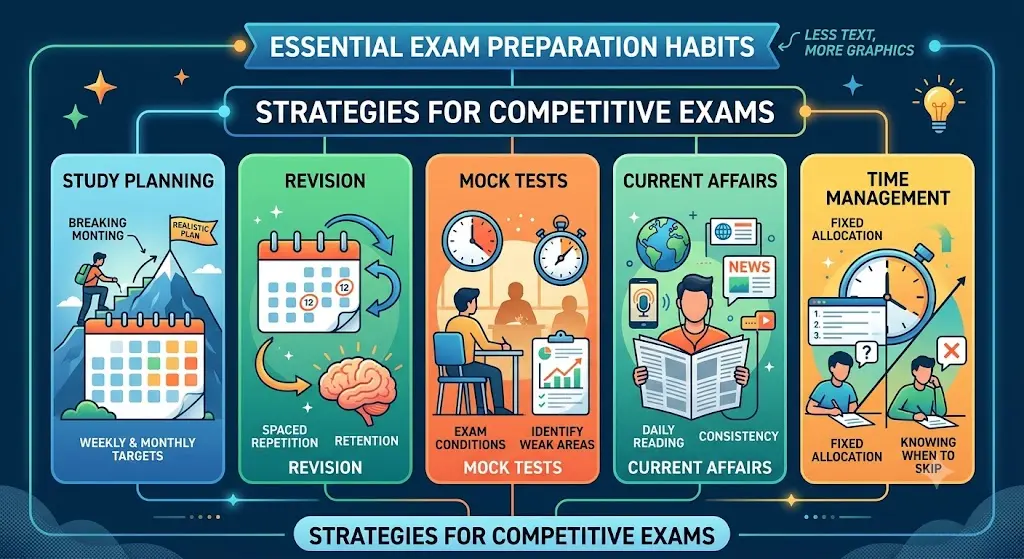
Regardless of which exam you’re targeting, a few preparation habits show up again and again among people who clear these tests.
Study Planning
Break the syllabus into weekly and monthly targets instead of trying to look at it as one giant mountain. A realistic plan you can actually stick to beats an ambitious one you abandon in three weeks.
Revision
Revisiting topics multiple times matters more than reading something once in great depth. Spaced revision going back to a topic after a few days, then again after a few weeks helps retention far more than back-to-back cramming.
Mock Tests
Full-length mock tests under real exam conditions are what expose weak areas and time-management problems before the actual exam does. Treat every mock test result as feedback, not a verdict.
Current Affairs
For exams like UPSC, CLAT, and NDA, daily current affairs reading isn’t optional. A consistent 30-45 minutes a day beats trying to catch up on six months of news the week before the exam.
Time Management
Practice allocating fixed time per section or per question type during preparation itself, not just on exam day. Most toppers say learning when to skip a question is as important as knowing how to solve it.
Best Books and Resources
For most of these exams, NCERT textbooks form the foundation, especially for UPSC, JEE, and NEET. Beyond that, ICAI’s own study material remains the gold standard for CA, while GATE and CAT aspirants generally rely on standard reference books alongside previous years’ question papers. Community-driven resources like subject-wise discussion threads on Reddit’s r/CATpreparation or LinkedIn posts from recent toppers sharing their exact study timetables are increasingly useful for real, first-hand strategy rather than generic advice. Always cross-check any third-party resource against the official syllabus published by the conducting body.
Common Mistakes to Avoid
Many aspirants fall into the trap of collecting more books and resources than they can realistically finish, which fragments their preparation instead of strengthening it. Ignoring mock tests until the last month is another frequent misstep by then, there’s little time left to fix the patterns a mock test reveals. Ignoring the interview or personality-test stage (for exams like UPSC and NDA) until after clearing the written exam also backfires, since these stages need their own dedicated preparation timeline.
Latest Trends in Competitive Exams (2026)
Competitive exams in India are evolving, and a few trends are worth watching heading into 2026.
- AI-based testing: More exam bodies are experimenting with AI-assisted question generation and adaptive difficulty to reduce paper leaks and standardize difficulty across shifts.
- Digital exams: Computer-based testing has become the norm for most major exams, reducing logistical delays and speeding up result declarations.
- Increasing competition: Applicant numbers for exams like UPSC and NEET have generally trended upward over the past decade, driven by rising awareness and easier access to online coaching.
- Changing syllabus: Conducting bodies periodically revise syllabi to reflect current policy priorities, technology shifts, and academic updates UPSC’s Mains syllabus and NEET’s NCERT alignment are reviewed almost every year.
- Adaptive testing: Some entrance exams are exploring computer-adaptive formats, where question difficulty adjusts based on a candidate’s real-time performance, similar to formats used internationally for exams like the GRE.
Career Opportunities After Clearing These Exams
Clearing any of these ten exams opens up a genuinely different career trajectory not just a job, but often a professional identity. UPSC and NDA lead into public service and national defence roles with long-term job security and social respect. JEE, GATE, and CAT lead into technical and management careers in India’s private sector, often with strong salary growth in the first five to ten years. CA Final, CLAT, NEET, and INI CET lead into specialized professional practices in finance, law, and medicine where your qualification effectively becomes your career-long credential. UGC NET, meanwhile, opens the academic and research route, ideal for those who want to teach or pursue a PhD.
Frequently Asked Questions
1. Which is the toughest exam in India?
UPSC Civil Services Examination is generally considered the toughest, given its sub-0.2% selection rate, three-stage process, and vast syllabus spanning almost every academic discipline.
2. Is JEE Advanced harder than NEET UG?
Both are extremely tough in different ways. JEE Advanced tests deeper conceptual application in Physics, Chemistry, and Maths, while NEET UG is tougher primarily because of the sheer volume of applicants competing for limited government MBBS seats.
3. How many attempts are allowed for UPSC CSE?
General category candidates get six attempts up to age 32, while OBC candidates get nine attempts and SC/ST candidates have no attempt limit up to the age cutoff.
4. What is the selection rate of CAT for IIM admission?
For the older, more established IIMs, the effective selection rate is typically under 1% of total CAT applicants once you account for shortlisting criteria, written ability tests, and personal interviews.
5. Can Arts students appear for UPSC CSE?
Yes. UPSC CSE has no restriction on educational stream candidates from Arts, Commerce, and Science backgrounds are all eligible with just a bachelor’s degree.
6. How long does it take to prepare for CA Final?
Most candidates spend around six months of focused study for each attempt, on top of the multi-year CA program that includes CA Foundation, Intermediate, and mandatory articleship.
7. Is NDA tougher than CDS?
NDA is generally considered tougher for younger aspirants because candidates enter right after Class 12, without a full graduate degree’s worth of maturity and subject depth that CDS candidates (graduates) typically bring.
8. What is the age limit for CLAT?
There is no upper age limit for CLAT UG admissions, though candidates must have passed or be appearing for Class 12.
9. How many students clear GATE every year?
Roughly 15-17% of applicants qualify for GATE in a typical year, though the qualifying percentile varies by branch and category.
10. Is UGC NET compulsory for a PhD?
Not always many universities also accept their own entrance exams or CSIR NET for science subjects, but UGC NET remains one of the most widely recognized eligibility routes.
11. What is the difference between NEET UG and INI CET?
NEET UG is for admission to undergraduate MBBS/BDS programs, while INI CET is for postgraduate MD/MS admission at AIIMS and other Institutes of National Importance, and requires an MBBS degree to even apply.
12. Which exam has the lowest acceptance rate in India?
UPSC CSE typically has the lowest overall acceptance rate among major exams, often falling below 0.2% when measured against total applicants.
13. Do coaching institutes guarantee success in these exams?
No coaching institute can guarantee selection; these are among the most competitive exams globally, and outcomes depend heavily on individual consistency, strategy, and, to some extent, exam-day performance.
14. Can working professionals prepare for UPSC or CAT alongside a job?
Yes, many successful candidates for both exams have prepared while working full-time, though it typically demands strict time management and often a reduced or flexible work schedule closer to the exam.
15. Which toughest exam in India offers the best salary?
Among these ten, CAT (leading to IIM placements) and JEE Advanced (leading to top IIT placements) generally offer the highest early-career salary packages, though UPSC and CA also offer strong long-term earning potential alongside non-monetary benefits like job security and social standing.
Conclusion
There’s no single “toughest exam in India” that applies to everyone. Toughness depends on your background, your strengths, and how much of your life you’re willing to dedicate to a single goal. What all ten exams on this list share is a demand for consistency over years, not just talent over a few months. If you’re picking one of these paths, go in with realistic expectations, a structured study plan, and the patience to treat setbacks as part of the process rather than the end of it.