
AI has made many of our manually done work processes easier for us, especially writing. With so many AI tools available to help us write better and faster, we can no longer trust our own writing.
There is a thin boundary between being able to stay authentic with your writing and using tools to become more efficient, and it is becoming truly challenging to maintain that boundary. So, what can you do to ensure your content stays authentic?
The key is to ensure that you take steps to verify and ensure content authenticity in your writing workflow: these are verification steps you can take to ensure your writing stays original and authentic, no matter what resources, inspiration, and tools help you write.
Be Clear About Your Source
When creating content, we tend to take information from various sources. Whether it is directly from a website, a report, a research paper, or from LLMs, you need to be clear about the source of every piece of information you have used in your content.
When you are clear about where your information came from and you cite it correctly, you become less likely to plagiarize and more prone to being authentic with your writing.
Using case studies, research papers, and reports that are relevant to the topic but have never been reflected in content makes great sources of credible and authentic information.
While producing multiple pieces of content per day and working really fast using a variety of tools, it is easy to feel confused about where you get your information from. This is why it is particularly crucial to keep track of your sources and cite them correctly in your writing.
Especially when you are getting your information from an LLM, check for hallucinations to make sure that the AI didn’t make it up.
Run Content Through a Detection Tool
One of the best tools for efficiency when writing content is an AI sentence rewriter. These writing assistants suggest improvements, and even entire sentences when you are stuck, which is great for writer’s block.
However, we often don’t notice how much of the content we are writing and how much is being handled by the tool.
While AI can support writing and ensure that you end your task on time, it also tends to be quite generic. This not only affects your personal writing voice, but also threatens the authenticity of the content.
So, if you run the content through an AI checker upon completion, it can help you notice what percentage of the content was AI-written, so that you can edit and change the content enough to ensure that the writing stays authentic.
This is a great way to ensure that your writing stays readable and you can preserve your own voice, as any good detection tool can highlight AI writing at the sentence level, enabling you to make the necessary changes.
Fact Check Claims
Even after keeping track of your resources, you might end up making claims that are not supported by a credible resource. This is why it is absolutely vital to fact-check claims.
When you reread your writing, make sure to highlight each claim, especially ones that are built around numbers, dates, study results, policy details, and product features.
You can manually fact-check each claim against supporting, credible resources. Or, you can use a fact-checking tool and run your entire content for each claim.
Some platforms bundle a handful of services like an AI detection tool, plagiarism checker, fact checker/hallucination catcher, etc. So, you can use such a tool, but many aren’t as accurate and may miss claims, so consider checking the missed claims manually.
When checking manually, for each claim, check whether there is a primary or authoritative source, whether the information is correct, and whether the source actually supports the claim, or you may have overgeneralized or exaggerated it. These are the key points of fact-checking your claim that it must pass to ensure your writing is authentic.
Search Engine Checks
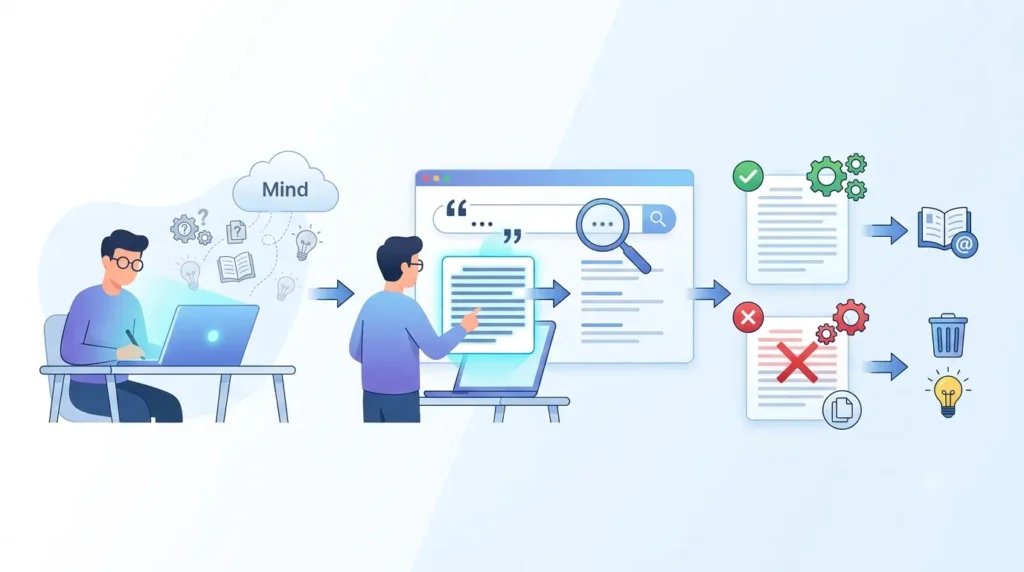
Sometimes when we look at a lot of resources, we unknowingly absorb the resources into our mind. Then, when we write the content, the work becomes unknowingly inauthentic because we end up using ideas we don’t even realize are not ours.
This is why you must consider doing a thorough search engine check of your content. Do an exact phrase search on Google by putting a couple of sentences within quotation marks. If you find matching content identical to yours, it’s definitely not original.
You will then either have to cite the source content or remove it wholly and replace it with something else. If you want to stay authentic in your content workflow, you must ensure you add this step as part of editing the writing before it’s published.
External Audits
If you are working with too much content and are unable to verify content authenticity accurately, you can try out external audits. These are third-party verifications done by independent agencies who can audit your content to ensure it is authentic and original.
There are also platforms that do crowdsourced verification, where multiple users help check the accuracy of any given content. Interestingly enough, no AI tool has been able to verify content as accurately as human intuition, and it is still deemed the most reliable form of judgement.
Having subject experts deal with the content, as they are able to recognize things like writing style or even information accuracy, can be incredibly valuable, and you often get access to such people from online freelancing platforms.
You can also get your work beta-read by community forum users who actively read such materials within a specific niche and can detect plagiarized content quickly and effortlessly.
Final Thoughts
While using multiple tools, like sentence rewriters and AI humanizers, and various resources can be crucial to your content creation, it can also be detrimental to the quality and authenticity of your writing.
Verifying whether your content is authentic before you publish needs to become an essential part of the writing workflow.
By following the steps mentioned here, you can easily determine whether you can uphold the authenticity of your writing, no matter the resources or the tools you use.