
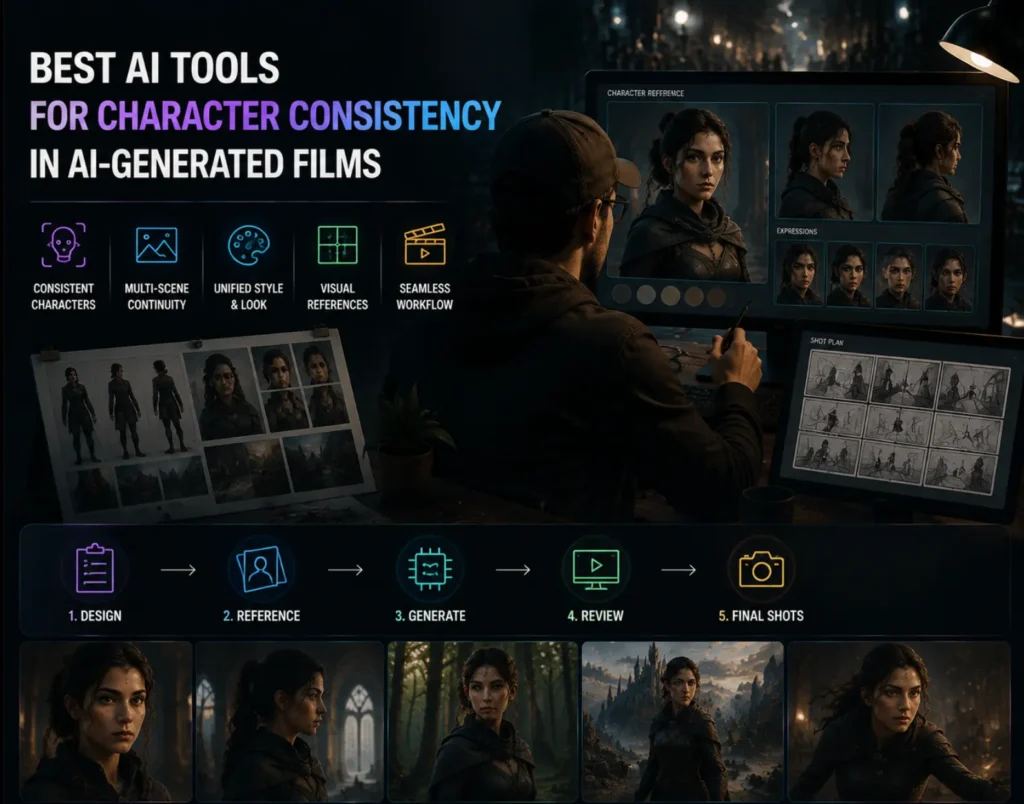
Creating memorable characters has always been one of the most important parts of filmmaking. A strong character needs to feel familiar throughout the story, whether they appear in a close-up conversation, an action sequence, or a completely different environment.
In traditional filmmaking, this consistency is naturally maintained through actors, costumes, makeup, and production teams. In AI-generated films, however, maintaining the same character across multiple scenes is one of the biggest creative challenges.
A character generated in one scene may look different in another. Facial features may change, clothing details may shift, and expressions or body proportions may not remain consistent. These issues can affect storytelling because audiences expect a character to feel like the same individual throughout a film.
AI tools are now helping filmmakers address this challenge by improving reference management, visual continuity, and character development workflows. From creating character references to generating consistent scenes, these tools are making it easier to build believable digital actors and AI-powered stories.
Why Character Consistency Matters in AI Films
Character consistency is essential because storytelling depends on familiarity. Viewers build connections with characters through their appearance, expressions, personality, and behavior.
In AI-generated films, inconsistency can appear when every scene is created independently. A character may have a different face shape, hairstyle, outfit, or visual style from one shot to the next.
This becomes especially challenging for:
- Short films
- AI-generated series
- Virtual actors
- Brand storytelling campaigns
- Character-driven videos
Maintaining consistency requires more than a good prompt. Filmmakers need strong references, detailed character planning, and workflows that allow creative decisions to carry across multiple scenes.
How AI Tools Help Maintain Character Identity
Modern AI character tools focus on improving continuity by using references, image guidance, and context-aware workflows.
Instead of generating a character from scratch every time, creators can establish a visual identity and use it throughout production.
These workflows help maintain details such as:
- Facial structure
- Hair and clothing
- Age and appearance
- Expressions
- Visual style
- Character personality
The goal is not only to create a character that looks realistic but also one that feels consistent throughout an entire story.
1. Invideo Agent
Invideo Agent helps filmmakers approach AI character creation as part of a complete filmmaking workflow rather than isolated generations. It allows creators to move from ideas, scripts, and references into structured video projects while keeping creative decisions connected.
For character-driven films, this is useful because maintaining identity across multiple scenes requires more than generating individual clips. A filmmaker can define character references, visual direction, and scene requirements while building a connected workflow where those elements remain aligned.
For example, a short film featuring a recurring digital actor may require the same face, clothing style, and personality across different locations and camera angles. Maintaining these references throughout production helps create a more believable character.
With invideo Agent Two, larger productions can benefit from improved coordination across areas such as character development, visual planning, storyboarding, cinematography, and effects. This helps teams manage complex projects where digital characters need to remain consistent throughout multiple scenes.
2. Runway
Runway is an AI video creation platform that provides tools for generating and editing visual content. It is widely used by filmmakers, creators, and creative teams for experimenting with AI-generated video workflows.
For character consistency, Runway can help creators develop visual concepts, generate scenes, and refine AI-generated footage. Its editing and generation capabilities allow filmmakers to explore character-driven sequences while maintaining a consistent creative direction.
It is particularly useful during early production stages where filmmakers are testing character designs, scene ideas, and visual styles before moving into final production.
3. Muapi
Muapi is an AI media platform that brings image and video generation models together in one place. It supports workflows such as character creation, image-to-video, text-to-video, and image editing.
For AI filmmaking, MuAPI can help creators maintain character consistency by using reference images to generate characters across different scenes, poses, and environments. This is useful for short films, AI-generated series, virtual actors, and character-driven videos.
Creators can also explore different AI models through the same platform, making it easier to experiment with visual styles and find the right workflow for their projects.
4. Adobe Firefly
Adobe Firefly is a generative AI platform designed for creating and editing visual assets. Its connection with Adobe’s creative ecosystem makes it useful for filmmakers and designers working on character development.
For AI-generated films, Firefly can help create character concepts, visual references, and supporting assets needed during pre-production. Filmmakers can use these references to define character appearance before generating scenes.
Its strength lies in helping creative teams build a consistent visual foundation that can be carried into later production workflows.
5. Midjourney
Midjourney is an AI image generation tool commonly used for creating character concepts, mood boards, and visual references.
For filmmakers, it can help during the early stages of character development by exploring different appearances, costumes, environments, and artistic styles.
Creators can use generated images as reference material when developing AI characters for films. This helps establish a clear visual direction before moving into animation or video generation.
While Midjourney is highly effective for concept creation, maintaining full character continuity across long video projects may require additional workflow support.
6. Krea AI
Krea AI focuses on real-time image generation, enhancement, and creative experimentation. It allows creators to quickly explore different visual ideas and refine character concepts.
For AI filmmaking, Krea AI can support character design by helping artists test variations of appearance, lighting, and visual styles.
It is useful during the creative exploration stage when filmmakers want to compare different versions of a character before selecting a final direction.
7. Kling AI
Kling AI is an AI video generation model designed for creating realistic video sequences with improved motion and visual quality.
For character consistency, Kling AI helps creators generate dynamic scenes where characters can perform actions while maintaining stronger visual continuity compared to earlier AI video workflows.
It can be useful for filmmakers creating action scenes, cinematic sequences, and storytelling content where characters need to move naturally across different shots.
The Importance of Character References in AI Filmmaking
Character references are becoming a core part of AI filmmaking workflows. A reference provides AI systems with a visual understanding of what should remain consistent throughout production.
A strong reference library may include:
- Front and side character views
- Different expressions
- Clothing details
- Lighting references
- Environment examples
These references help filmmakers maintain continuity while allowing characters to appear in different scenes and situations.
How AI Agents Improve Character Continuity
Character consistency becomes more difficult as projects become larger. A short scene may require only a few consistent shots, but films and series involve hundreds of creative decisions.
AI agents are helping solve this by maintaining broader project context.
Instead of treating each generation separately, agent-based workflows can help creators manage character details, visual styles, and scene requirements together.
This approach allows filmmakers to focus more on storytelling while reducing the manual effort needed to maintain continuity.
Choosing the Right AI Tool for Character Consistency
The right tool depends on the type of project and the stage of production.
For early character development, image-focused tools can help create references and explore visual styles. For video production, creators need tools that support motion, scene generation, and continuity across multiple shots.
Filmmakers working on larger projects should look for workflows that support:
- Reference-based creation
- Multi-scene consistency
- Character memory
- Visual direction
- Collaboration between creative teams
A combination of different AI capabilities often provides the strongest results.
The Future of Consistent AI Characters
AI-generated characters are becoming more advanced as models improve their understanding of identity, movement, and storytelling context.
Future AI filmmaking workflows will focus on creating digital actors that can appear across entire films, series, and campaigns while maintaining the same personality and appearance.
The challenge will no longer be creating a character once. It will create characters that can exist across complete stories.
Frequently Asked Questions
1. Why is character consistency difficult in AI-generated films?
Since AI often generates each scene independently, small details like facial features, clothing, and expressions can shift from shot to shot. Without strong references and a connected workflow, a character can end up looking like a different person in every scene.
2. What is a character reference in AI filmmaking?
A character reference is a set of images or details, such as front and side views, expressions, clothing, and lighting, that gives an AI system a consistent visual foundation to draw from. References help keep a character’s appearance stable across multiple scenes.
3. Which AI tool is best for maintaining character consistency?
It depends on the stage of production. Tools like Midjourney and Adobe Firefly work well for early character concepts and references, while platforms like Runway and Kling AI are better suited for generating consistent video sequences once a character’s look is established.
4. Can AI agents help with character continuity across a full project?
Yes. Agent-based workflows, such as Invideo Agent, can maintain broader project context instead of treating each scene as a separate generation. This makes it easier to keep character details, visual style, and scene requirements aligned throughout a longer project.
5. Do I need multiple AI tools to keep a character consistent?
Often, yes. Many filmmakers combine an image-generation tool for early references with a video-generation tool for motion and scene continuity, since few single tools cover the entire process from concept to final footage.
6. Will AI character consistency improve in the future?
Yes. As AI models get better at understanding identity, movement, and story context, digital characters are expected to maintain consistency across entire films and series, not just individual scenes.
Conclusion
Character consistency remains one of the biggest challenges in AI-generated filmmaking, but new AI tools are making it easier to overcome.
By combining references, creative planning, AI models, and connected workflows, filmmakers can create digital characters that feel more believable and consistent across scenes.
As AI filmmaking continues to develop, consistent AI characters will become an important part of creating immersive stories, allowing creators to build worlds and characters with greater creative control.