
Do you remember the moment IBM Watson answered a Jeopardy question faster and more accurately than two human champions combined? People watching that broadcast genuinely did not know how to feel about it. Was it impressive? A little unsettling? Both?
That moment was not just a game show highlight. It was a real-world demonstration of what fifth generation computing looks like in action. And honestly, these machines have been quietly reshaping the world around us long before most people started paying attention.
In this guide, we are going to walk through the most important fifth generation of computer examples, explain what makes them different from everything that came before, and show you why understanding them matters whether you are a student, a tech enthusiast, or just someone curious about where technology is headed.
By the end, you will have a clear picture of the machines driving artificial intelligence, scientific breakthroughs, and yes, possibly the laptop you are using right now.
What Is the Fifth Generation of Computers?
Before we get into specific examples, let’s set the stage.
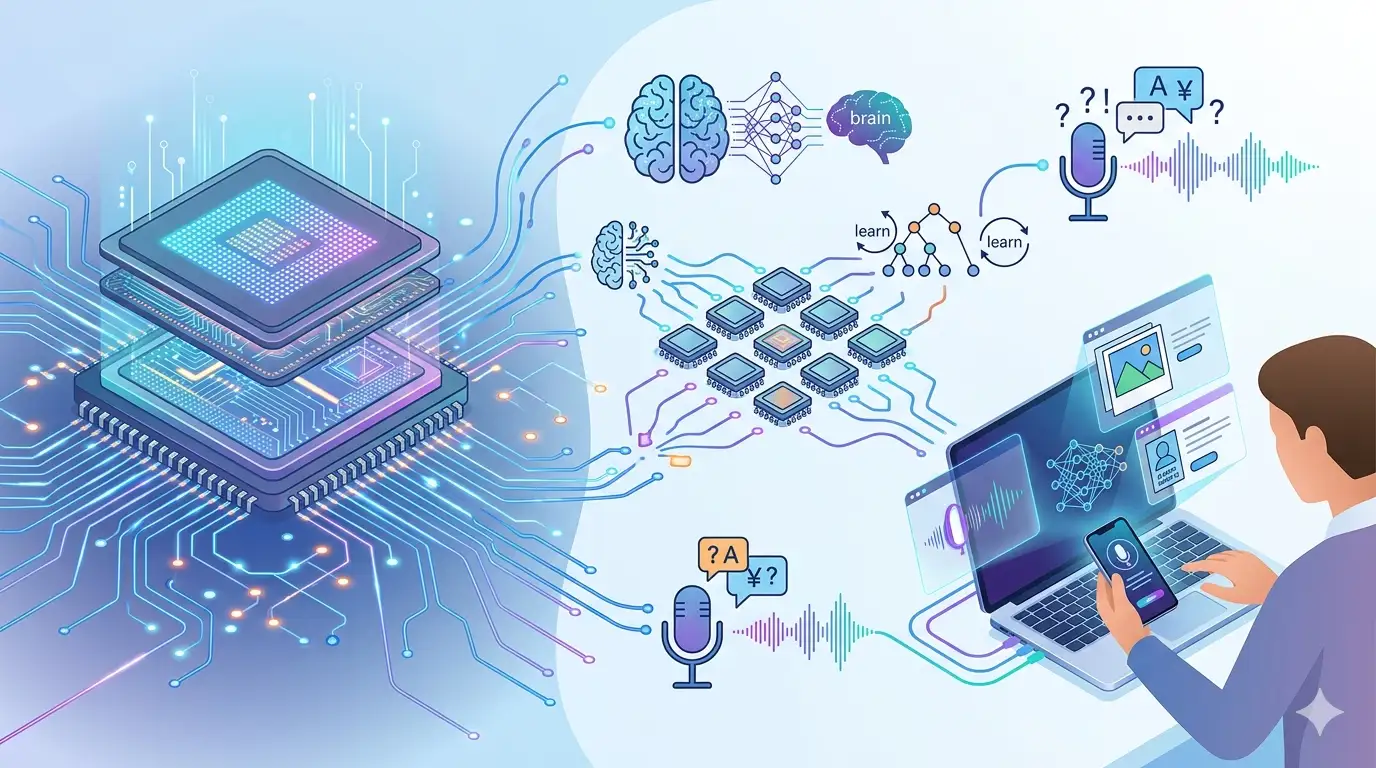
Fifth generation computers are machines built from the 1990s to the present day. What separates them from earlier generations is not just speed or size. It is intelligence. These systems are designed to learn, reason, and respond to natural human language in ways that earlier machines simply could not.
The core technologies powering them include artificial intelligence (AI), machine learning, natural language processing, parallel processing, and ultra-large-scale integration (ULSI). In simple terms, ULSI means cramming billions of transistors onto a single chip, which is how modern processors became so extraordinarily powerful.
Here is a thought that might surprise you: the laptop or phone you are using right now likely qualifies as a fifth generation device. The generation is not locked away in government labs. It is all around us.
List of Fifth Generation of Computer Examples
Here is a quick overview before we dig into the details:
1. IBM Watson
2. Deep Blue
3. Google DeepMind
4. Fujitsu K
5. Blue Gene (IBM)
6. ASCI Red
7. CRAY XC40
8. NEC SX-5
9. PARAM 10000
10. Intel Core i7 PCs
Each of these represents a different side of fifth generation computing, from chess-playing AI to India’s national supercomputing achievement. Let us take a closer look at each one.
Detailed Look at Each Fifth Generation Computer Example
IBM Watson
If you had to pick one machine that best represents what fifth generation computing stands for, IBM Watson would be a strong candidate. Developed by IBM with research beginning around 2007, Watson was built to understand natural human language, process enormous amounts of data, and make intelligent decisions based on what it learns.
Its moment in the spotlight came in 2011 when it competed on Jeopardy and defeated two of the show’s greatest human champions. The crowd went quiet. The hosts looked genuinely surprised. It was the kind of moment that makes you realize AI had crossed a threshold.
But Watson did not stop at game shows. Today it is actively used in healthcare to help doctors analyze patient data, in finance to spot patterns in markets, and in customer support to power intelligent chatbots. Watson learns continuously from new data, which means it gets smarter over time rather than staying frozen in what it already knows.
What makes Watson a textbook fifth generation machine is its combination of natural language processing, machine learning, and cloud computing working together as one system.
Deep Blue
Deep Blue holds a unique place in computing history. Built by IBM and completed in 1997, it was designed for one specific purpose: playing chess at the highest possible level. And it delivered.
In May 1997, Deep Blue defeated world chess champion Garry Kasparov in a six-game match. This was not just a computer winning a game. It was a machine demonstrating strategic thinking, long-term planning, and the ability to evaluate millions of possibilities in seconds. Deep Blue could analyze up to 200 million chess positions per second using custom VLSI chips and parallel computing architecture.
Kasparov reportedly said he sensed a kind of intelligence behind its moves that felt unsettlingly human at times. Whether or not that is literally true, it shows how much the win meant to people trying to understand the boundary between human and machine intelligence.
Google DeepMind
Founded in 2010 and later acquired by Google’s parent company Alphabet, DeepMind is one of the most ambitious AI research labs in the world. It is not a single computer in the traditional sense but rather an AI system and research platform that runs on fifth generation infrastructure.
DeepMind became globally famous through AlphaGo, its AI system that defeated world champions at the ancient board game Go. Go is notoriously difficult for computers because the number of possible moves is so vast that brute force calculation simply does not work. AlphaGo learned to play by studying thousands of human games and then by playing against itself, developing strategies that even expert human players had never considered.
Beyond board games, DeepMind is doing genuinely important work in healthcare, including using AI to detect eye diseases and predict protein structures through a program called AlphaFold. That last one is a big deal for medicine and biology in ways that will play out over decades.
Fujitsu K
Built by Fujitsu and the RIKEN research institute in Japan and completed in 2011, the Fujitsu K computer is one of the most powerful supercomputers ever constructed. At its peak it could perform 10 petaflops, which means 10 quadrillion calculations every single second.
To put that in perspective, if every person on Earth performed one calculation per second without stopping, it would take the entire human population over 1,000 years to match what the Fujitsu K can do in a single second.
It is built with over 80,000 SPARC64 processors all working in parallel, sharing tasks and computing together. Fujitsu K is used for weather forecasting, disaster prevention planning, medical research, and global climate modeling. In a world where accurate climate data can influence policy decisions that affect billions of people, the work this machine does carries real weight.
Blue Gene (IBM)
IBM developed the Blue Gene series of supercomputers in the early 2000s with a specific focus on scientific research, particularly in biology and physics. What made Blue Gene stand out was not just raw power but energy efficiency. It could perform extraordinary calculations while consuming far less electricity than comparable machines.
Blue Gene has been used for genome mapping, which involves analyzing the enormous amounts of data in human DNA to better understand diseases and develop treatments. It has also contributed to nuclear physics research and climate modeling.
There is something quietly remarkable about a machine that helps scientists understand the building blocks of human life. Blue Gene represents the kind of computing that works in the background of breakthroughs you might read about in a news headline without ever knowing what powered the research behind it.
ASCI Red
ASCI Red holds an important milestone in computing history. Introduced in 1996 by Intel for the United States Department of Energy, it was the first computer in the world to break the teraflop barrier, meaning it could perform one trillion calculations per second.
It was built with over 9,000 Intel Pentium Pro processors connected in a massively parallel architecture. ASCI Red was primarily used to simulate nuclear weapons tests after the US discontinued live nuclear testing, making it a critical tool for national security research.
As a milestone machine, ASCI Red proved that teraflop computing was achievable and set the stage for everything that followed in high-performance computing
CRAY XC40
Built by Cray Inc. in 2014, the CRAY XC40 is a modern supercomputer designed for large-scale scientific work and AI research. It uses a scalable parallel computing architecture that can be configured to handle hundreds of petaflops of processing power depending on the deployment.
Research institutions and government agencies use the CRAY XC40 for climate research, space modeling, and machine learning tasks that require sustained high-performance computing over long periods. Its energy-efficient design makes it practical for ongoing operations rather than just short bursts of power.
The CRAY XC40 represents a mature stage of fifth generation supercomputing where performance, efficiency, and practical usability have all advanced together.
NEC SX-5
Developed by NEC Corporation in 1998, the NEC SX-5 is a vector supercomputer known for extremely fast numerical calculations. It uses ultra-large-scale integration circuits and is designed to handle scientific and engineering workloads where precision and speed are equally important.
It has been deployed for weather forecasting, physics simulations, and aerospace modeling. Vector processing, which the SX-5 specializes in, is particularly well-suited for scientific calculations that involve long sequences of similar operations on large datasets. Think of analyzing atmospheric data from thousands of weather stations simultaneously.
PARAM 10000
PARAM 10000 deserves a moment of recognition as a source of national pride for India. Developed in 1998 by the Centre for Development of Advanced Computing (C-DAC), it marked India’s arrival as a serious player in high-performance computing at a time when such machines were dominated by American and Japanese institutions.
PARAM 10000 uses scalable parallel architecture and ULSI technology to process data at teraflop speeds. It has been used for scientific research, weather analysis, and industrial modeling both within India and in collaboration with international research teams.
It is a reminder that fifth generation computing is not the exclusive territory of any one country. Innovation in this space has always been a global story.
Intel Core i7 PCs
Here is where fifth generation computing comes home, literally.
Intel launched its Core i7 processor line in 2008 and it has powered hundreds of millions of personal computers and laptops since then. Multi-core design, hyper-threading, turbo boost technology, and integrated AI-capable features make these processors genuine fifth generation devices in the hands of everyday users.
When you are editing a video, playing a game, or running complex software on a modern laptop, there is a good chance a Core i7 or similar processor is doing the heavy lifting. The fifth generation is not just in supercomputing centers or AI research labs. It is on your desk, in your bag, and in your home.
Key Features That Define Fifth Generation of Computer Examples
Across all these examples, certain features appear consistently:
Artificial intelligence integration: Every fifth generation computer uses AI either as its core function or as a supporting capability.
Natural language processing: Many of these systems can understand, interpret, and respond to human language rather than requiring rigid programming commands.
Parallel processing: Instead of one processor handling tasks in sequence, multiple processors work simultaneously, dramatically increasing speed and efficiency.
Ultra-large-scale integration (ULSI): Billions of transistors on a single chip enable processing power that earlier generations could not have imagined.
Machine learning: These systems improve over time by learning from data rather than being manually updated with new rules.
How Fifth Generation Computers Are Different from Earlier Generations
To appreciate how significant fifth generation computers are, it helps to know where they came from.
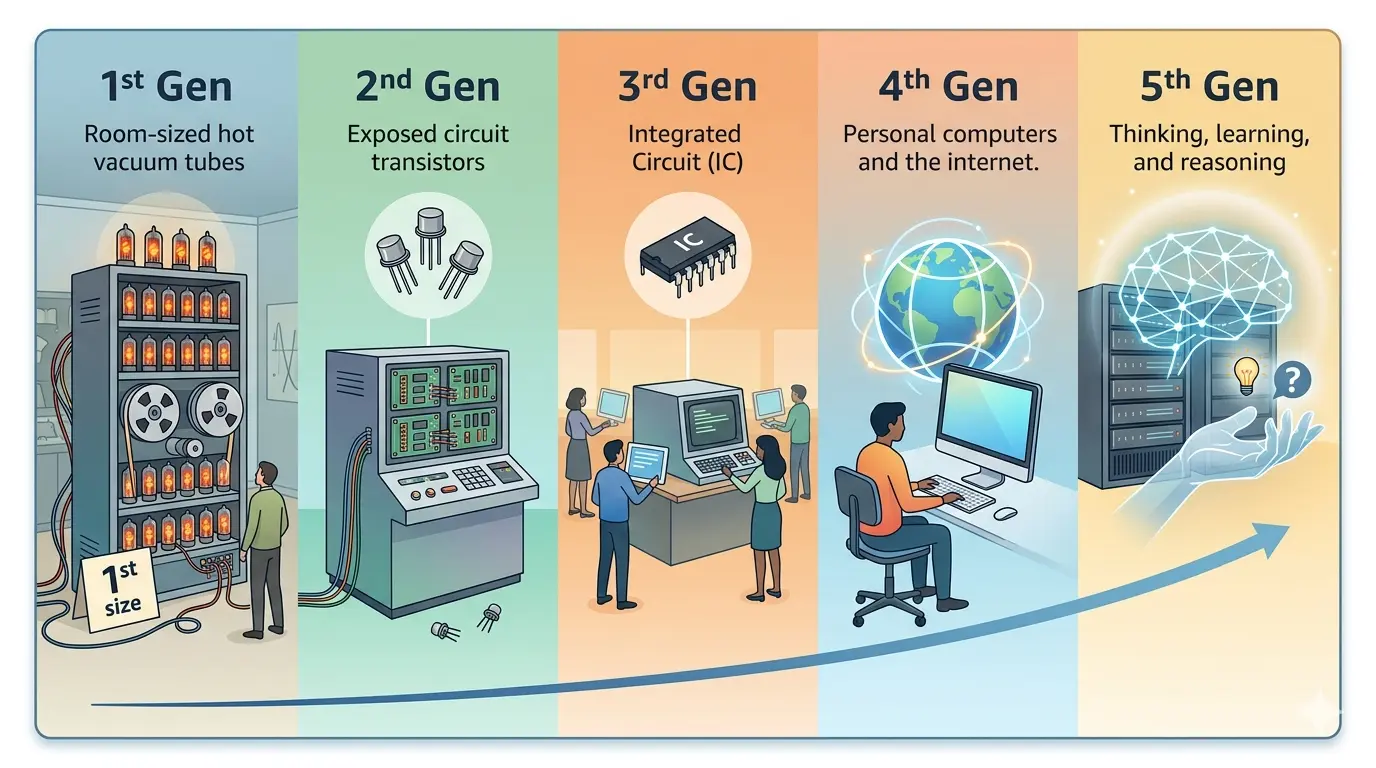
First generation computers (1940s-1950s) used vacuum tubes, filled entire rooms, and could only handle one task at a time. Second generation machines (late 1950s-1960s) replaced vacuum tubes with transistors, making them smaller and more reliable. Third generation computers (1960s-1970s) introduced integrated circuits and began to be used in businesses. Fourth generation computers (1970s-present) brought microprocessors, personal computers, and the internet era.
Fifth generation takes all of that progress and adds the ability to think, learn, and reason. The leap from fourth to fifth generation is not just about hardware improvements. It is about fundamentally changing what a computer can do.
Real-World Impact of Fifth Generation Computing
The examples in this article are not just impressive technical achievements. They are actively changing lives.
When a doctor uses an AI-assisted diagnostic tool to detect cancer at an earlier stage, a fifth generation system is often working quietly in the background. When meteorologists issue accurate storm warnings that save lives, supercomputers like Fujitsu K or CRAY XC40 are crunching the atmospheric data. When a researcher maps a gene linked to a hereditary disease, Blue Gene may have helped process the data.
And on a much more personal level, when you ask a smart assistant a question, get a product recommendation that actually makes sense, or use software that adapts to your habits over time, you are experiencing fifth generation computing in its most everyday form.
Are We Still in the Fifth Generation? What Comes Next?
This is a genuinely interesting question and one that researchers and computer scientists still debate.
Quantum computing is developing quickly and some argue it represents the beginning of a sixth generation. Quantum computers operate on entirely different principles, using quantum bits (qubits) that can exist in multiple states simultaneously rather than the binary ones and zeros of classical computing.
However, quantum computing is still largely experimental. Practical, large-scale quantum machines are not yet part of everyday computing. For now, we are still firmly in the fifth generation era, though the edges of that era are beginning to look blurry in the most exciting possible way.
Frequently Asked Questions
1. What are the best examples of fifth generation computers?
IBM Watson, Deep Blue, Google DeepMind, Fujitsu K, and Intel Core i7 PCs are among the most well-known and widely cited fifth generation of computer examples. Each represents a different application of fifth generation technology from AI research to personal computing.
2. When did fifth generation computers start?
The fifth generation of computers began in the early 1990s and continues to the present day. Key milestones include ASCI Red in 1996, Deep Blue’s chess victory in 1997, and the ongoing development of AI systems like Watson and DeepMind.
3. Is a smartphone a fifth generation computer?
In many ways, yes. Modern smartphones use multi-core processors, run AI-powered applications, and support machine learning features. While they are not classified as supercomputers, they share the foundational technologies that define fifth generation computing.
4. What technology do fifth gener fourth and fifth generation computers?
Fourth generation computers introduced microprocessors and made personal computing possible. Fifth generation computers added AI and machine learning, enabling machines to learn, adapt, and process natural language rather than simply executing fixed instructions.
Conclusion
Looking at these fifth generation of computer examples together, a clear picture emerges. These are not just faster versions of older machines. They are a fundamentally different kind of computing, one where machines can learn, reason, and in some ways, surprise us.
From Deep Blue’s historic chess match to IBM Watson’s healthcare applications, from India’s PARAM 10000 to the Core i7 processor on your desk, fifth generation computing is not a niche topic for academics. It is the engine running beneath modern life.
The next time you benefit from an accurate weather forecast, an early medical diagnosis, or a smart assistant that actually understands your question, you will know exactly what generation of computing made it possible.
If you found this helpful, consider exploring more about AI basics, supercomputer history, or how machine learning is changing industries you care about.