
Free online construction courses with certificates do exist, but “free” rarely means the same thing everywhere. Some providers give you the lessons and the certificate at no cost. Others let you study for free and charge for the paperwork.
This guide covers eight providers worth checking, what each one offers, and where the catches are. You’ll also learn how certificates differ from licenses, how to judge whether a certificate is credible, and how to use one on your résumé.
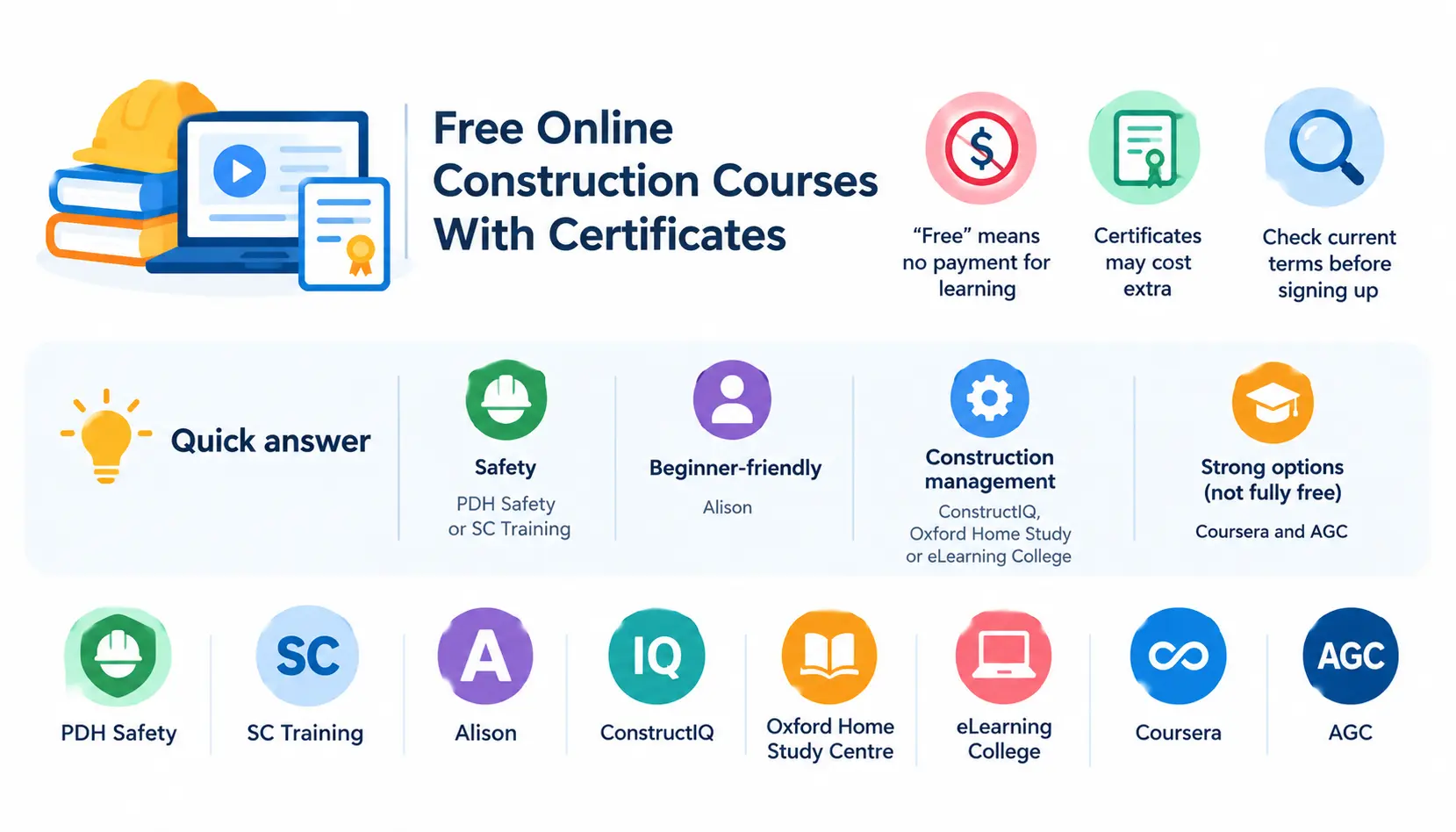
What “free” means here: a course counts as free if you can complete the learning without paying. I call out separately whether the certificate costs extra. Offers change often, so confirm current terms on each provider’s site before you sign up.
Quick answer: For safety topics, start with PDH Safety or SC Training. For beginner-friendly variety, try Alison. For construction management, look at ConstructIQ, Oxford Home Study Centre, or eLearning College. Coursera and AGC are strong, but they are not fully free.
Quick Comparison of Free Construction Courses
Last checked: September 2026. Terms change, so verify before enrolling.
| Provider | Best for | Subject | Self-paced | Certificate | Certificate cost |
| PDH Safety | Safety | Construction safety | Yes | Yes | Verify |
| Alison | Beginners | Broad construction | Yes | Verify per course | Verify |
| SC Training | Workplace safety | Construction induction | Yes | Yes | Check current terms |
| ConstructIQ | Management basics | Construction management | Yes | Yes | Verify |
| Oxford Home Study Centre | Introductory learning | Construction management | Yes | Optional | Paid |
| eLearning College | Structured study | Construction management | Yes | Optional | Paid |
| Coursera | University-backed learning | Construction management | Online | Yes | Generally paid |
| AGC | Working professionals | Management, BIM, Lean | Varies | Program-dependent | Varies |
Best Free Online Construction Courses With Certificates
1. PDH Safety: Free Construction Safety Courses
PDH Safety currently lists 16 free construction-safety courses. Topics include OSHA-related subjects, ergonomics, concrete and masonry, welding, and steel erection.
The courses are self-paced, so you can fit them around a job. Check each course page for its duration, certificate details, and whether CEUs apply. CEUs (continuing education units) matter mostly if you already hold a license or credential that requires them.
Best for: site workers, supervisors, and safety-minded beginners who want targeted topics rather than a broad overview.
Important OSHA disclaimer: An OSHA-related course is not the same as an official OSHA 10-hour or 30-hour card. Those cards come from OSHA-authorized trainers, and they usually cost money. A free safety course can build your knowledge, but don’t present it as an OSHA card.
2. Alison: Construction Courses
Alison has a large construction collection. It highlights courses such as Construction Safety and Health and Basics of Construction Project Management. You’ll also find electrical, plumbing, and carpentry courses.
That range makes Alison a good place to test whether construction is right for you. Certificate options vary by course, so check whether the certificate is free or paid before you invest time.
Best for: beginners exploring different parts of the industry.
3. SC Training: Free Construction Courses
SC Training describes several construction courses as free for up to 10 users, with certificates listed as available. Topics include construction induction, PPE, excavation and trenching, harnessing, and rigging.
The “up to 10 users” limit is the catch. It suits a small crew or a solo learner, but a larger company would need a paid plan. Read the current terms and confirm which courses are covered.
Best for: small teams and individuals who need workplace-safety basics.
4. ConstructIQ: Free Construction Management Courses
ConstructIQ describes its introductory construction-management course as free, and it includes a certificate of completion. Related topics include construction quality and project management, plus some practical resources.
An introductory course won’t make you a construction manager. It will give you the vocabulary and the big picture, which helps if you’re moving from the trades into office-based roles.
Best for: first-time learners of construction management.
5. Oxford Home Study Centre: Free Construction Management Courses
Oxford Home Study Centre offers self-paced courses in construction management and even machine learning in construction. Check each listing for level and duration.
The model matters here: course access is free, while optional CPD/QLS certificate products are paid. That’s a fair deal if you only want the knowledge. Budget for the certificate if you need proof.
Best for: self-directed learners who don’t need a certificate right away.
6. eLearning College: Construction Courses
eLearning College covers construction management, project management, and health and safety. Its current page says courses are free to study, but certificates and diplomas may be purchased separately.
The structure suits people who like a set path. As with Oxford, decide up front whether you’ll pay for the certificate.
Best for: learners who want a structured syllabus.
7. Coursera: Construction Courses
Coursera partners with universities and other providers, so the content can be strong. You can usually preview courses for free, and financial aid may be available for eligible programs.
However, Coursera states that its Construction Management Specialization is not fully free. That’s why it doesn’t qualify as a completely free certificate option. Treat it as a “try before you pay” route.
Best for: people who want university-backed content and can pay or qualify for aid.
8. AGC: Construction Education
The Associated General Contractors of America (AGC) offers live virtual training and national credentials, including CM-BIM and CM-Lean. Topics include supervisory training, BIM, and lean construction.
This is professional education, not a free-course platform. Pricing varies by program. It’s worth a look if you already work in construction and want a recognized credential.
Best for: working professionals aiming to move up.
Types of Free Construction Courses You Can Take Online
Construction covers a lot of ground. Knowing the categories helps you pick a course that fits your goal.
Construction management. These courses cover planning, scheduling, cost control, supervision, and project coordination. Read the Wikipedia overview of construction management for the wider context.
Construction safety. Expect PPE, fall protection, excavation, electrical hazards, fire safety, and hazard communication.
Construction project management. Here you’ll learn scope, budget, scheduling, contracts, and risk.
Construction estimating. This covers quantity takeoffs, cost estimation, bidding, and materials.
Site supervision. Topics include site organization, worker coordination, quality, safety, and documentation.
BIM and construction technology. Building information modeling (BIM) is a digital way to plan and coordinate a building. Courses cover BIM fundamentals, Revit, 3D modeling, and data-driven construction. See BIM on Wikipedia for a plain-language summary.
Skilled trades. Electrical, plumbing, carpentry, welding, and equipment operation appear here. Online lessons help with theory, but they can’t replace hands-on practice.
Are These Construction Courses Really Free?
Not always. Providers use four common models.
Completely free course and free certificate. This is the ideal. You learn and get proof without paying. It’s the rarest model, so read the fine print.
Free course and paid certificate. Oxford Home Study Centre and eLearning College follow this model. You study for free and pay only if you want the certificate.
Free preview and paid certificate. Coursera follows this model. You can sample lessons, but the full program and credential usually cost money, unless you qualify for financial aid.
Free training and CEUs. Some safety providers offer free training with continuing education credit. A CEU is a unit of continuing education, often defined as 10 contact hours. It shows you spent time learning. It is not a professional certification. Read more on CEUs at Wikipedia.
Certificate vs Certification: What’s the Difference?
These words sound alike, but employers treat them differently.
Certificate of completion. This shows you finished a course. It’s useful, but it usually doesn’t prove you passed a standardized exam.
Professional certification. This means you met an outside body’s standards, often through an exam and experience requirements. See professional certification.
License. A license is legal permission to do certain work in a region. You can’t replace one with a course certificate.
CEU or continuing education. These credits help licensed or certified people keep their status current.
OSHA training. OSHA’s outreach program issues 10-hour and 30-hour cards through authorized trainers. Learn more on the OSHA construction outreach page and the OSHA Wikipedia entry.
Apprenticeship or trade qualification. These combine paid on-the-job work with classroom learning. Wikipedia explains the apprenticeship model. Online courses can support this path but rarely replace it.
Do Free Online Construction Certificates Help With Jobs?
They can help, but they rarely decide a hiring outcome alone.
When They Can Help
- They show initiative, especially when you’re changing careers.
- They prove you’ve learned the basics.
- They strengthen a résumé that has little formal education in construction.
- They add to real experience you already have.
Picture a warehouse worker applying for a junior site-coordinator role. Two free courses in project management and safety won’t replace experience. They do tell the hiring manager that this person is serious.
When They Are Not Enough
- The job requires a license.
- The work is safety-critical and the employer demands specific training.
- The employer asks for named credentials.
- The role needs proven hands-on skill.
Some U.S. states and many employers require an official OSHA card for certain sites. Always check what your target employer expects.
How to Add a Certificate to Your Résumé
List these details:
- Course name
- Provider
- Completion date
- Credential type (say “certificate of completion” honestly)
- Skills you gained
You can also add it to your LinkedIn profile under licenses and certifications. Be accurate about what it is, since inflating a free certificate can backfire in an interview.
Best Free Construction Courses for Beginners
- Construction safety: PDH Safety or SC Training
- Construction management: ConstructIQ, Oxford Home Study Centre, or eLearning College
- Site supervision: Look for supervision modules within management courses, and check Alison’s catalog
- Project management: Alison’s Basics of Construction Project Management
- Skilled trades: Alison’s electrical, plumbing, and carpentry courses for theory
- Construction technology: AGC’s BIM programs, though not free, or free BIM introductions found via provider searches
Best Free Construction Courses by Career Goal
| Career goal | Recommended subject | What to learn |
| Construction manager | Construction management | Planning, cost, scheduling |
| Site supervisor | Site management | Supervision, safety |
| Safety professional | Construction safety | Hazards, compliance |
| Estimator | Estimating | Quantities, costs, bidding |
| Project coordinator | Project management | Scheduling, documentation |
| BIM professional | BIM | Modeling, coordination |
| Skilled tradesperson | Trade-specific training | Practical trade skills |
How to Choose the Right Free Construction Course
- Define your career goal. Know the job you want before you pick a course.
- Choose the right subject. Match the topic to that goal.
- Check the course level. Beginner, intermediate, or advanced? Don’t skip ahead.
- Review the syllabus. Make sure the lessons cover what you need.
- Check whether the certificate is actually free. Look for hidden fees.
- Verify accreditation or recognition claims. Terms like “accredited” are used loosely.
- Check duration and assessment. A quiz-based course carries more weight than a watch-only one.
- Check geographic and regulatory relevance. Standards differ by country and state.
- Compare practical value. Ask what you’ll be able to do afterward.
How to Verify Whether a Construction Certificate Is Credible
- Check who issues it. A known organization, university, or industry body carries more trust.
- Check accreditation claims. Look up the accrediting body independently.
- Check assessment requirements. Real testing adds credibility.
- Check whether practical competency is required. Many trades need demonstrated skill.
- Check employer or regulatory requirements. Ask the employer what they accept.
- Check whether it’s a certificate or a certification. They are not the same.
Forums can help here. Construction professionals in communities like r/ConstructionManagers often share what hiring managers actually value. Treat individual opinions as anecdotes, not rules.
Free Online Construction Courses vs Paid Courses
| Factor | Free course | Paid course |
| Cost | Low or no course fee | Tuition required |
| Flexibility | Usually high | Varies |
| Certificate | Varies | Usually included |
| Depth | Usually introductory | Can be advanced |
| Practical training | Limited | Varies |
| Professional recognition | Varies | Varies |
| Career value | Depends on the skills you gain | Depends on the credential |
How to Get a Certificate From a Free Construction Course
- Choose a course.
- Create an account.
- Review the completion requirements.
- Complete the lessons.
- Take any quizzes or assessments.
- Meet the completion criteria.
- Claim or download your certificate.
- Confirm what the certificate represents.
- Add it to your résumé or LinkedIn profile.
Common Mistakes When Choosing Free Construction Courses
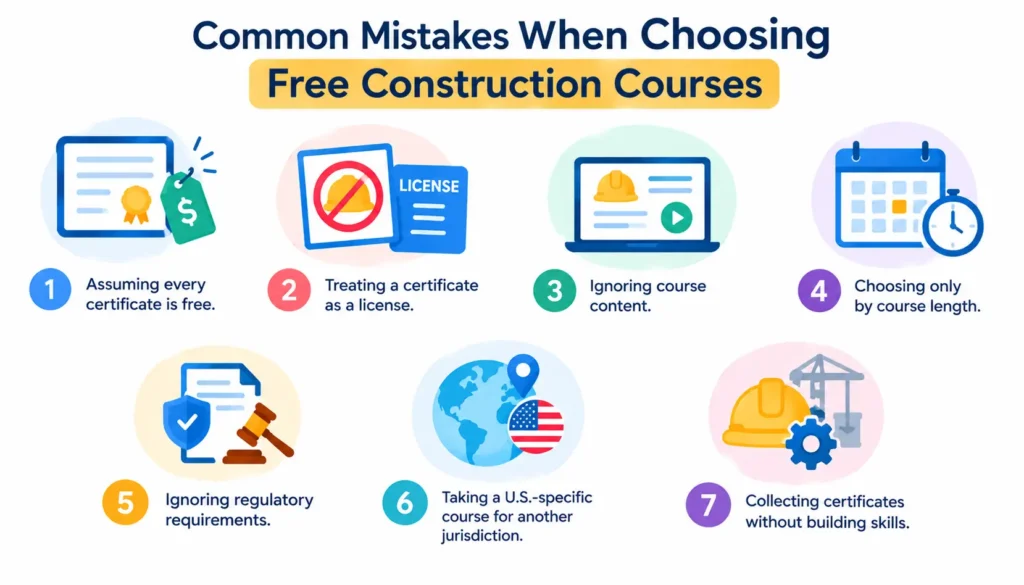
Assuming every certificate is free. Many aren’t. Check before you finish.
Treating a certificate as a license. A certificate doesn’t give you legal permission to work.
Ignoring course content. A polished certificate on a thin course helps no one.
Choosing only by course length. Short isn’t always shallow, and long isn’t always deep.
Ignoring regulatory requirements. Local rules decide what counts.
Taking a U.S.-specific course for another jurisdiction. OSHA content, for example, applies mainly to the United States.
Collecting certificates without building skills. Employers value what you can do on site.
FAQs About Free Online Construction Courses
1. What are the best free online construction courses with certificates?
PDH Safety, Alison, SC Training, and ConstructIQ offer free courses with certificates, though terms vary. Oxford Home Study Centre and eLearning College offer free study with paid certificates. Check each provider’s current terms first.
2. Where can I get a free construction certificate online?
Try PDH Safety, Alison, SC Training, or ConstructIQ. Confirm on the course page that the certificate itself is free.
3. Are free construction certificates really free?
Some are, and some aren’t. Providers like Oxford Home Study Centre and eLearning College charge for the certificate even when the course is free.
4. Can I get an OSHA construction certificate for free?
Usually not. Official OSHA 10- and 30-hour cards come from OSHA-authorized trainers and typically cost money. Free OSHA-related courses can teach useful skills, but they aren’t the official card.
5. Are online construction certificates recognized by employers?
It depends on the issuer and the employer. A certificate of completion shows learning, but many employers want licenses, official cards, or experience.
6. Can a free online construction course help me get a job?
It can support your application, especially for entry-level or career-change roles. It works best alongside experience and other credentials.
7. What construction course should a beginner take?
Start with construction safety or an introductory construction-management course. Alison and ConstructIQ are beginner-friendly options.
8. Can I study construction management online for free?
Yes, at an introductory level. ConstructIQ, Oxford Home Study Centre, and eLearning College offer free study, though certificates may cost extra.
9. Do free construction courses require exams?
Some include quizzes or final assessments, and others don’t. Check the course page.
10. Can I put a construction course certificate on my résumé?
Yes. List the course name, provider, completion date, and credential type, and describe it accurately.
11. Are free online construction courses valid internationally?
Not automatically. Standards, safety rules, and licensing differ by country, so check local requirements.
12. Do free construction certificates expire?
Some don’t, but safety training and continuing-education credits often have renewal expectations. Check the provider and any employer or regulator rules.
Conclusion
Free online construction courses with certificates can be a smart, low-risk way to build knowledge, test a new career, or support your résumé. Just remember that “free” often applies to the lessons, not the paperwork.
Pick a course that matches your goal, confirm the certificate terms, and check what employers and regulators in your area actually require. Then pair the learning with real site experience. That combination is what moves a career forward.