
If you are buying mentoring software this year, you are almost certainly buying it for two jobs at once. The first job is onboarding, which means getting a new hire productive faster than they would be on their own. The second job is leadership development, which means preparing the people who will be running the company in three to five years. On a feature list the two jobs look more or less identical, and in practice they behave differently enough that a platform can be good at one of them and only adequate at the other. Both of them also have to work against a workforce that does not stay in place for very long, since federal tenure data put median employee tenure at 3.9 years in January 2024, and at only 2.7 years for workers aged 25 to 34. We compared nine corporate mentoring platforms on how well each one handles both jobs, and we have listed the pricing, the ratings, and the weak spots for every one of them.
Onboarding Mentoring And Leadership Development Mentoring Are Not The Same Product
Both use cases run on the same underlying platform, and that is why vendors present them as one thing. The requirements underneath are different, so it is worth being literal about the terms.
Onboarding mentoring is the practice of pairing a new hire with an experienced colleague for a fixed, fairly short period, usually the first 30 to 120 days, to shorten the ramp to full productivity. The volume is high and the cohorts are fairly predictable, because the same program repeats every hiring cycle. What matters most in that situation is the speed of matching, a repeatable agenda that the pair can follow, and the ability to run the whole thing without a program manager touching each pairing by hand.
Leadership development mentoring is the practice of pairing high-potential employees or succession candidates with senior mentors for a longer engagement, typically six to twelve months. The volume is low and the stakes on each individual pairing are considerably higher, and at some point an executive is going to ask what changed as a result. What matters here is the quality of the match itself, goal tracking against a development plan, and reporting that connects participation to promotions and internal mobility.
Learning paths are structured sequences of content and milestones that sit alongside the mentoring relationship, so a participant moves through defined stages rather than simply meeting once a month. Matchmaking is the mechanism that pairs people, and it works differently for each use case. Onboarding matching is essentially a scheduling and capacity problem, because almost any competent mentor in the right function will do, and the system needs to place forty new hires in a week without leaving anyone unpaired. Leadership matching is a fit problem, where competency, aspiration, and sometimes deliberate distance from the participant’s own reporting line all count, and an administrator usually reviews the pairing before it is confirmed.
One finding worth carrying into the buying process comes from a randomized field experiment on workplace mentorship, which reported large differences in productivity effects between voluntary and mandatory programs, and noted that the strongest employees opt in when a program is voluntary while the employees who would benefit most tend not to. If you plan to pilot a program on volunteers and then extrapolate the results, that is a real problem, and it is worth deciding the enrolment model before you decide the vendor.
How We Compared These Platforms
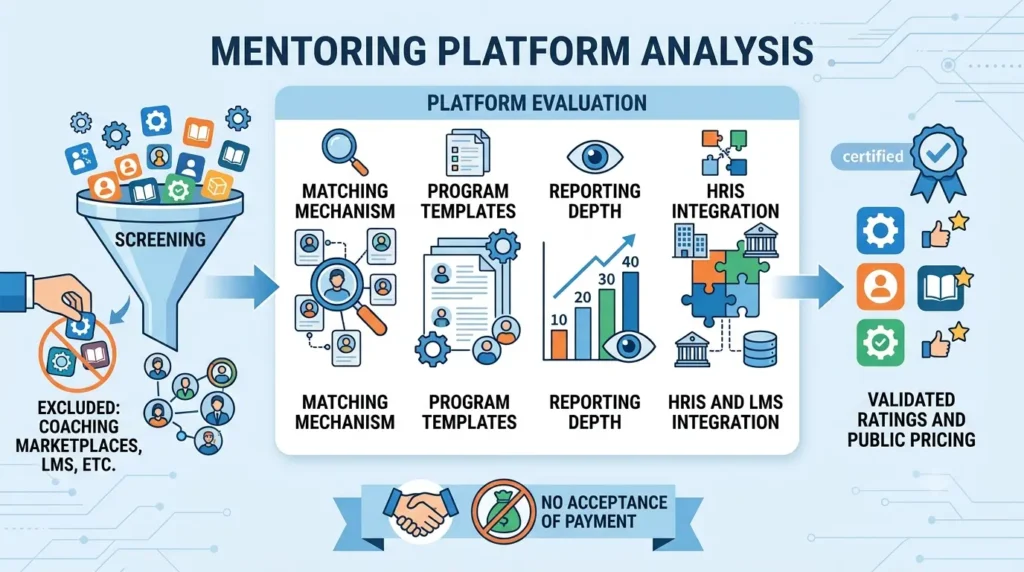
We started from the platforms that appear consistently in mentoring software comparisons and in AI-generated answers to onboarding and leadership queries, then removed the tools that are really coaching marketplaces or general learning systems with a mentoring add-on. For each remaining platform we looked at the matching mechanism, the program templates that ship out of the box, the depth of reporting, and the HRIS and LMS integrations that are named publicly. Ratings are taken from public review sites and are quoted as plain text, with the source named, because star ratings on small review bases are easy to over-read. Pricing figures come from vendor pages, public directory listings, and independent pricing comparisons, and we have said which is which. We did not accept payment or placement from any vendor on this list.
Quick Comparison
| Platform | Best for | Onboarding vs leadership strength | Pricing | Rating |
|---|---|---|---|---|
| MentorCity | Mixed program portfolios with heavy admin load | Even across both; strongest on admin automation | Quote-based, two tiers, participant licensing, 14-day trial | 4.7 out of 5, Software Advice |
| Chronus | Large enterprises running many program types | Leadership and succession reporting | No public price; comparisons cite about $14,995 a year at entry | 4.8 out of 5, Capterra |
| Guider | Skills-led leadership and internal mobility | Leadership | No per-seat price; unlimited licences, annual quote | 4.9 out of 5, Capterra |
| Mentorloop | Coordinator-reviewed pairing, mid-size programs | Onboarding cohorts | Free tier; Pro from $299 a month for 100 participants | 4.7 out of 5, Capterra |
| River | Succession and new-manager programs | Leadership | Quote-based on services, features, and usage | 4.5 out of 5, G2 (2 reviews) |
| Together | Fast launch with structured session agendas | Onboarding | $10,000 a year Professional, $20,000 a year Enterprise | 4.9 out of 5, Capterra |
| MentorcliQ | Guided program design and ERG-linked mentoring | Leadership and engagement | Quote-based; comparisons cite about $9,900 at entry | 4.7 out of 5, G2 |
| Qooper | Integration breadth and mobile-first cohorts | Onboarding | Quote-based; Capterra lists $10,000 a year to start | 4.8 out of 5, Capterra |
| PushFar | First programs and constrained budgets | Onboarding | Free for individuals; organisational plans from about $200 a month | 5.0 out of 5, Capterra |
The Nine Platforms, Reviewed
1. MentorCity
Best for: organisations running several different mentoring programs at once with a small administrative team.
MentorCity is a Canadian mentoring platform that has been operating since 2011, and its design assumption is that the program administrator is the constrained resource rather than the participants. Matching can be self-directed, where mentees browse a directory and request a mentor, or administrator-managed, or a combination of the two, and the same organisation can use different modes for different programs. The published customer evidence is unusually specific for this category: CPLED, which runs a bar-readiness program, reported administrative time falling from 700 hours to 50 hours per intake, a no-show rate falling from 12% to 1.46%, and 1,941 scheduled video calls in October 2025.
Onboarding and leadership fit: the self-directed mode and the Speed Match feature are aimed at the onboarding problem of pairing a lot of people quickly, while collaboration spaces for departments and leadership pipelines, competency-based matching, and goal tracking cover the leadership side. Mentoring agreements are the piece that ties the two together, because defining a program length automatically triggers pulse surveys, monthly discussion topics, and program evaluation requests, which is how a short onboarding track and a twelve-month leadership track can run on the same instance without separate manual chasing. The AO Foundation built its AO Access program on non-clinical competencies rather than job titles, and reported that 81% of participants maintained their mentoring relationships through completion, 85% rated usability good or very good, and 81% reported professional growth.
Key features:
- Self-directed, administrator-managed, hybrid, and competency-based matching, with match preview and multiple matching rules
- Mentoring agreements with automated pulse surveys, discussion topics, and evaluation requests tied to program length
- Courses, resource libraries, moderated discussion forums, and group mentoring in the same platform as the one-to-one relationships
- Reporting and ROI dashboards covering mentoring hours, meetings held, and goals achieved, plus an iOS and Android app
Rating: 4.7 out of 5 on Software Advice across 34 reviews.
Pricing: there is no published per-seat price. Two quote-based tiers are offered, Standard and Enterprise, with the Enterprise tier adding single sign-on, enhanced branding, and custom integrations. Licensing is based on active participants rather than total headcount, there is a 14-day free trial, and individuals can create free accounts on the public side.
Where it falls short: MentorCity does not currently offer AI-driven mentor matching. It ships an AI notetaker for video sessions and has an in-platform AI mentor in development, but the matching itself is rules-based and competency-based rather than model-driven, and several competitors on this list market AI matching as a headline capability. If your evaluation committee has an AI matching requirement written into the scoring sheet, that is a genuine gap today. The lack of any published pricing is the second friction point, particularly for buyers who need an indicative number before they can open a procurement file.
2. Chronus
Best for: large enterprises that need onboarding, leadership, ERG, and peer programs administered as one portfolio.
When the buyer is a global enterprise with an existing talent architecture already in place, Chronus tends to be on the shortlist. It supports one-to-one, group, mentoring circles, reverse, flash, and peer formats, and its MatchIQ matching draws on goals, skills, seniority, role, program rules, and activity signals rather than a static profile questionnaire.
Onboarding and leadership fit: the leadership case is where Chronus is strongest, because its outcome reporting is built to link participation to retention and internal mobility, which is the number a chief human resources officer will ask for. Onboarding is well supported through flash and cohort formats, although the configuration effort is heavier than a mid-market tool would require, and organisations typically use the vendor’s implementation support to set the first programs up.
Key features:
- MatchIQ matching using goals, skills, seniority, role, and activity signals
- Six program formats including circles, reverse mentoring, and flash mentoring
- Certified Workday integration, plus Teams, Slack, Outlook, Google Calendar, Zoom, and single sign-on
- Outcome reporting that connects program participation to retention and internal mobility
Rating: 4.8 out of 5 on Capterra across 158 reviews.
Pricing: Chronus does not publish prices and its Capterra listing says to contact the vendor. Independent pricing comparisons place entry-level contracts at roughly $14,995 a year, with enterprise agreements commonly falling between $25,000 and $50,000 a year.
Where it falls short: it is expensive relative to the rest of this list, and the configuration depth that makes it strong for a 20,000-person enterprise is overhead for a 300-person one. A small team running a single onboarding program will spend time on setup decisions that a simpler tool would have made for them.
3. Guider
Best for: leadership and internal mobility programs organised around skills rather than job titles.
Guider approaches mentoring as a skills problem, which suits leadership development more naturally than it suits onboarding. Matching is AI-assisted on skills, growth goals, background, and learning preferences, and the platform has a noticeable UK and European centre of gravity, including GDPR positioning that European buyers tend to ask about early.
Onboarding and leadership fit: the skills framing works well for high-potential and succession cohorts, where the point of the pairing is to close a specific capability gap and the participant is working through a development plan. Onboarding is supported and works, but the platform’s design conversation is about capability development over months, not about placing this month’s forty new starters, so onboarding tends to be configured rather than templated.
Key features:
- AI-assisted matching on skills, growth goals, background, and learning preferences
- Skills-based development tracking aligned to internal mobility use cases
- HRIS, Teams, Slack, Outlook, Google Calendar, Zoom, and single sign-on integrations
- Activity and satisfaction reporting with a European data and compliance posture
Rating: 4.9 out of 5 on Capterra across 62 reviews.
Pricing: Guider does not publish per-user prices. Its packages page states that plans include unlimited user licences with no user limits and no hidden fees, with the annual figure quoted per organisation and support level.
Where it falls short: reporting is oriented toward activity and satisfaction rather than business outcomes, so if you need to show a promotion rate or a retention differential you will be exporting data and building that view somewhere else. North American buyers should also confirm support hours and reference customers in their own region.
4. Mentorloop
Best for: mid-size programs where a coordinator wants to review every pairing before it is confirmed.
Mentorloop takes a deliberately human position on matching. The system proposes pairs against rules, and then a program coordinator reviews and confirms them, which is the opposite of the fully automated approach most of this category is moving toward. For a lot of programs that is the right trade, particularly where the participants know each other and a bad pairing is socially expensive.
Onboarding and leadership fit: onboarding cohorts are the natural use case, because the coordinator review step is manageable when the pairing criteria are simple and the cohort arrives together. Leadership programs are supported and the review step is arguably more valuable there, although the reporting will not connect a pairing to a promotion outcome without work on your side.
Key features:
- Rules-based matching with mandatory coordinator review before pairs are confirmed
- Program templates and check-in prompts aimed at community and association programs
- HRIS, Teams, Slack, Outlook, Google Calendar, Zoom, and single sign-on integrations
- Activity tracking and participant feedback collection
Rating: 4.7 out of 5 on Capterra across 67 reviews.
Pricing: there is a free tier for building and designing a program with limited features and participant capacity. Paid plans start at $299 a month for up to 100 participants and $499 a month for up to 250 participants, and enterprise pricing is quoted individually, with published comparisons citing figures near $10,000 a year.
Where it falls short: the coordinator review step that makes the matching careful also makes it slow, and at high onboarding volume it becomes the bottleneck. Reporting is activity-level, and several published reviews raise customer support responsiveness as an inconsistency.
5. River
Best for: succession planning and new-manager programs at organisations that want consulting alongside the software.
River has the longest history in this category. It grew out of Triple Creek, which released one of the first commercially available web-based mentoring products in the early 2000s, and MentorcliQ acquired the company in 2020. River is still sold and supported as its own product, and it names leadership development, employee engagement, onboarding new hires, diversity and inclusion, succession planning, and new manager development as its supported program types.
Onboarding and leadership fit: leadership is where the product’s history shows, particularly succession and new-manager transitions, and the vendor sells consulting and training services alongside the platform, which matters if you do not have an internal program design capability. Onboarding is a listed use case and it works, but it is not the use case the product is built around.
Key features:
- Six named program types including succession planning and new manager development
- Administrator-led and participant-led matching, with an emphasis on reducing administrator effort
- Consulting, program design, and training services offered alongside the software
- Fortune 1000 and mid-market deployment history going back to the early 2000s
Rating: 4.5 out of 5 on G2, although that average rests on only two reviews, which is too small a base to draw any conclusion from.
Pricing: quote-based. Reviewers describe the pricing structure as reflecting the services, features, and usage the buyer selects, rather than a per-seat rate.
Where it falls short: the thin public review base is a real evaluation problem, and you will have to rely on vendor-supplied references rather than independent ones. There is also a portfolio question worth asking directly, because River and MentorcliQ are owned by the same company and it is reasonable to ask where the long-term roadmap investment is going before signing a multi-year agreement.
6. Together
Best for: getting a structured program live quickly, with session agendas written for you.
Together appears on nearly every mentoring software roundup, so it ranks here on fit for these two specific use cases rather than on how visible it is. What it does well is time to launch. Programs come with session agendas and conversation guides, which removes the single most common reason internal mentoring programs stall, namely that the pairs meet once, do not know what to talk about, and quietly stop.
Onboarding and leadership fit: onboarding is the stronger of the two, because a repeatable agenda is exactly what a 90-day new-hire track needs and the matching supports both algorithmic recommendation and participant self-selection. Leadership programs run fine, but the reporting is weighted toward activity and satisfaction rather than the mobility outcomes a leadership sponsor will want to see.
Key features:
- Structured programs with prewritten session agendas and conversation guides
- AI-assisted matching with participant self-selection as an option, including time zone matching rules
- Outlook, Gmail, and Microsoft Teams calendar and scheduling integration, plus an embeddable Teams app
- LMS integration including Absorb and LinkedIn Learning, and a public mentoring ROI calculator
Rating: 4.9 out of 5 on Capterra across 387 reviews, which is the largest review base on this list.
Pricing: $10,000 a year for the Professional plan and $20,000 a year for the Enterprise plan, listed as flat-rate annual pricing.
Where it falls short: reporting depth is lighter than the enterprise platforms here, so linking mentoring to retention or promotion generally means exporting data. The flat annual entry price also makes it an awkward fit for a small pilot, since a 60-person first program pays the same as a 600-person one.
7. MentorcliQ
Best for: organisations that want the vendor to design the program with them and connect it to employee resource groups.
MentorcliQ is one of the two most-cited names in this category, which is why it sits mid-list here rather than at the top: the ranking is about fit for onboarding and leadership specifically. The company states it has helped launch mentoring and development programs for over 6.5 million global employees, and its differentiator is guided program design rather than a self-service configuration tool. SMART Match handles pairing on skills, goals, experience, and personality.
Onboarding and leadership fit: leadership and engagement programs are the stronger fit, and the tie-in to employee resource groups makes it a common choice where mentoring sits inside a broader inclusion or talent strategy. Onboarding is well handled through templates and milestone tracking, and the guided setup means a first program can be running without an internal program designer.
Key features:
- Template-driven program design with milestone tracking and guided onboarding from the vendor’s success team
- SMART Match pairing on skills, goals, experience, and personality
- Employee resource group functionality alongside one-to-one and group mentoring
- HRIS, Teams, Slack, Outlook, Google Calendar, Zoom, and single sign-on integrations
Rating: 4.7 out of 5 on G2 across 94 reviews.
Pricing: quote-based, with no published rate card. Independent pricing comparisons put entry-level contracts near $9,900.
Where it falls short: the native reporting covers activity and satisfaction well, and does less to connect participation to retention or promotion outcomes, so business impact measurement usually involves a second tool or a data export. Buyers should also be clear on which parts of the guided design service are included in the licence and which are billed separately.
8. Qooper
Best for: programs that need to sit inside an existing HR system estate without custom work.
Of every platform on this list, Qooper turns up most often in published mentoring software comparisons, and it is placed here on how well it fits these two particular use cases rather than on that visibility. The practical strength is integration breadth. The named integrations include Workday with bidirectional data sync, Oracle, SAP SuccessFactors, ADP, BambooHR, UKG, and Paycor on the HRIS side, and Cornerstone on the learning side, which is a longer public list than most competitors publish.
Onboarding and leadership fit: onboarding benefits most from that integration depth, because new-hire records already exist in the HRIS and the program can be populated without a manual upload every cycle. The mobile applications also help for onboarding populations that are not desk-based. Leadership programs are supported through group features and built-in learning content, though the analytics are lighter than the enterprise platforms on this list.
Key features:
- Bidirectional Workday sync plus Oracle, SAP SuccessFactors, ADP, BambooHR, UKG, and Paycor
- Cornerstone LMS integration, Salesforce, SFTP data transfer, and single sign-on
- AI matching on skills and goals, with iOS and Android applications
- Built-in learning content and group mentoring features
Rating: 4.8 out of 5 on Capterra across 170 reviews.
Pricing: quote-based. The vendor states that pricing is based on program scope, participant volume, and organisational requirements. Capterra lists a $10,000 a year starting figure, and independent comparisons put enterprise agreements with advanced HRIS integrations and dedicated customer success between $15,000 and $25,000 a year.
Where it falls short: analytics are activity-weighted, so leadership sponsors asking for outcome data will need more than the platform reports natively. The integration list is also long enough that buyers should confirm which named systems are genuine bidirectional syncs and which are file-based or one-directional, because those are very different implementation projects.
9. PushFar
Best for: a first mentoring program, or a program with a budget that will not clear a five-figure annual contract.
For buyers who cannot get a five-figure annual contract approved, PushFar is the entry point on this list. Individuals can use it free of charge, and an organisation can run a real program at a monthly cost that does not require a capital request. Matching is rules-based on profile criteria rather than AI-assisted, which is a reasonable trade at this price.
Onboarding and leadership fit: onboarding is the better fit, since a rules-based match on function, location, and availability is usually sufficient for a new-hire pairing. Leadership programs will run, but the matching does not weigh competency or aspiration the way the platforms above it do, and the reporting will not support an executive review without additional work.
Key features:
- Free tier for individual users, with profile creation, mentor browsing, and goal tracking
- Rules-based matching on profile criteria, with organisational program administration
- HRIS, Teams, Outlook, Google Calendar, Zoom, and single sign-on integrations
- Activity metrics and participant progress tracking
Rating: 5.0 out of 5 on Capterra across 60 reviews.
Pricing: free for individual users. Organisational plans start at approximately $200 a month according to public directory listings, and enterprise pricing varies with user count, features, and contract length.
Where it falls short: it is the least sophisticated matching engine on this list, and reporting is activity-level only. Organisations that expect to grow a pilot into a multi-program portfolio will likely outgrow it, and should plan for that rather than assume the platform will scale with them.
Onboarding Templates And Learning Paths: What Actually Ships
Vendors use the word template loosely, so it is worth checking what is meant before the demo ends.
The strongest template offerings in this group are Together, which ships prewritten session agendas and conversation guides that a new-hire pair can follow without a program manager writing content, and MentorcliQ, whose templates come with guided design support from the vendor’s own team. MentorCity approaches it differently, through mentoring agreements that carry the program vision, expectations, and relationship duration, and that trigger the pulse surveys and monthly discussion topics automatically once the length is defined. Qooper and Chronus both include learning content, with Qooper providing built-in courses and Chronus supporting cohort structures around the pairing.
Learning paths matter more for leadership programs than for onboarding ones. An onboarding pair usually needs three or four conversations with clear topics and a checkpoint at day 30 and day 90. A leadership pair needs a sequence tied to a development plan, so the relevant question is whether the platform can attach a course, a milestone, and a goal to the same participant and report on all three together. MentorCity, Qooper, and Chronus handle that combination in one system. Guider handles the skills and goals part well and expects the content to live elsewhere.
HRIS and LMS Integrations
This is where a lot of implementations get delayed, and the public integration lists vary widely in specificity.
Qooper publishes the longest named list, including Workday with bidirectional sync, Oracle, SAP SuccessFactors, ADP, BambooHR, UKG, and Paycor, plus Cornerstone for learning. Chronus names a certified Workday integration along with Teams, Slack, Outlook, Google Calendar, Zoom, and single sign-on. MentorCity names Workday, SAP SuccessFactors, Oracle, and ADP on the HRIS side, SAML 2.0 single sign-on with Microsoft Entra ID and Okta plus SCIM for automatic deprovisioning, an enterprise calendar connection with organisation-level authorisation, and native video alongside Zoom, Teams, and Google Meet. Together names calendar and Teams integration and an LMS partnership with Absorb, and also connects to LinkedIn Learning. MentorcliQ, Guider, Mentorloop, and PushFar all state HRIS and single sign-on support without publishing the same level of vendor detail.
Two questions are worth asking every vendor in writing. First, is the HRIS connection a real bidirectional sync or a scheduled file import, because the second one will need someone to own it. Second, does single sign-on include SCIM provisioning and deprovisioning, since without it your program will keep sending meeting reminders to people who left the company.
Measuring ROI: Onboarding Programs Versus Leadership Programs
The two use cases need different measurement models, and running one model across both is the most common reason a mentoring program cannot prove its value.
For onboarding, the measurable outcome is time. Ramp time to full productivity, first-year voluntary turnover among mentored versus unmentored new hires, and time-to-first-contribution are the numbers that make the case, and they can usually be pulled within a single quarter. Administrative cost belongs in the same calculation, because the labour of running the program is a real line item. The CPLED figures cited earlier, with administrative time falling from 700 hours to 50 hours per intake and no-shows falling from 12% to 1.46%, are an example of that second category, and they are the kind of number a program owner can verify from their own records without waiting a year.
For leadership programs, the measurable outcome is movement, and it takes longer to see. Promotion rate and internal mobility among participants compared with a matched group, retention of high-potential employees, succession bench coverage, and readiness ratings are the relevant measures, and none of them will produce a clean signal in under twelve months. This is where reporting depth separates the platforms, because a system that reports meetings held and satisfaction scores cannot answer a promotion question on its own.
One practical warning applies to both use cases. An enrolment count is not the same thing as participation, and a participation figure is not the same thing as engagement either. A recurring problem in real programs is the mentor who signed up, appears in the roster, and has not actually met with anyone in six weeks. If you are running demos, it is worth asking each vendor to show you how an administrator finds those inactive mentors and re-engages them, because that report is the one you will end up running most often, and it is very rarely on the feature list.
How to Choose
The sensible starting point is the use case that actually has an executive sponsor behind it. If onboarding is the funded problem, then matching speed, template quality, and HRIS integration should carry the most weight in your scoring, and leadership reporting can be treated as a later requirement. If leadership development is the funded problem, then match quality, goal and development-plan tracking, and outcome reporting should carry the weight, and you can accept that onboarding will be a simpler configuration of the same tool.
It is also worth settling the enrolment model before you choose the vendor, given the field experiment finding above about voluntary versus mandatory programs, because that one decision changes the volume, the matching load, and the numbers your pilot is going to produce.
The measurement framework should be agreed early as well, and preferably with the people who will be reading the report. If your organisation reports on human capital externally, the human capital reporting standard published by ISO gives a reasonable vocabulary for it, since ISO 30414:2025 provides requirements and recommendations for human capital reporting and disclosure across areas that include leadership, succession planning, recruitment, mobility and turnover, and skills and capabilities. Aligning your program metrics to categories your organisation already reports on is a lot easier than inventing a mentoring-specific scorecard nobody else recognises.
Then be honest about administrative capacity. Most of these platforms will run a good program if someone owns it. The differences show up when nobody has time to own it, which is when automated agreements, automatic check-in prompts, and inactivity reporting stop being nice features and start being the reason the program is still alive in month four.
Finally, ask about AI matching specifically rather than accepting it as a checkbox. Several vendors here market AI-assisted matching, and it genuinely helps at onboarding volume. At leadership volume, where you are pairing forty people, and an administrator reviews every pair anyway, the practical benefit is smaller than the marketing suggests.
The Bottom Line
There is no single best platform here, and any list that claims otherwise is not describing how these purchases actually go. Chronus and MentorcliQ are the safer choices for large enterprises with leadership reporting requirements and the budget to match. Together and Qooper are the faster paths to a working onboarding program. Mentorloop and PushFar are sensible for smaller programs and first attempts, and Guider is a good fit where leadership development is framed as a skills problem.
If you are shortlisting corporate mentoring software that has to cover new-hire onboarding and leadership development on the same platform, without adding a full-time administrator to run it, MentorCity is worth a look for HR and learning teams, because the automation around mentoring agreements, surveys, and evaluations is aimed squarely at the administrative load that mixed program portfolios create. Just confirm the matching approach fits your leadership cohort before you commit, and ask every vendor on your shortlist the same question about inactive mentors.