
Digital marketing students can learn funnels, segmentation, analytics, and copywriting in class, yet still struggle when asked to build a real prospect list or explain why a campaign failed. B2B lead generation brings several marketing skills together at once: research, targeting, data quality, messaging, testing, and measurement. A carefully designed project lets students practice that full workflow. Instead of memorizing isolated concepts, they learn how one decision—such as choosing the wrong buyer role or using poor contact data—affects everything that follows.
Why B2B Lead Generation Is Best Learned Through Practice
B2B lead generation is a chain of decisions, not a single tactic. Students need to translate a broad market into an ideal customer profile, decide which companies fit it, identify relevant people inside those companies, and determine how to approach them. Those choices require judgment that is difficult to develop through lectures alone.
Projects also make marketing trade-offs visible. A large list may look productive but perform badly if the contacts are irrelevant. Highly personalized messages may take longer to create but reveal which information actually matters to a buyer. Campaign analysis then forces students to connect results with their original assumptions. This is why hands-on assignments, internships, and simulated campaigns can complement classroom learning: students see how audience research, execution, and business outcomes influence one another.
Start With a Realistic B2B Project
A useful project begins with a believable business scenario. A student team might represent a SaaS startup selling scheduling software to small clinics, a web development agency serving local manufacturers, or a recruitment platform targeting technology companies.
Before searching for leads, students should write a one-page targeting brief. It should define the offer, target industry, geography, company size, common business problem, and likely buyer roles. For example, a web agency could target UK manufacturers with 20–200 employees and focus on marketing managers or commercial directors at companies with outdated websites.
The goal is not to collect as many names as possible. Every target should fit a reasoned hypothesis. Practical programs such as Excendra’s digital marketing internship can also show how real campaigns, performance tracking, and portfolio projects fit into broader marketing training.
Build and Validate a Prospect List
Next, students can research companies through company websites, professional networks, industry directories, search engines, and prospecting platforms. They should record information in a structured sheet or CRM-style table: company name, website, industry, location, company size, contact name, job title, source, email status, segment, and notes.
This is also where students can learn how professional tools fit into the workflow. A platform such as Snov.io can be used as an educational example for finding business contacts, verifying email addresses, organizing prospects, and preparing outreach. The important lesson is not the brand itself but the process: data must be relevant, traceable, and clean enough to support responsible campaign decisions.
Verification matters because invalid addresses distort campaign results and create avoidable delivery problems. Role relevance matters just as much. A valid email for someone with no influence over the purchase is still a weak lead.
Students should also segment the list before writing outreach. Useful segments might include industry, company size, buyer role, pain point, or trigger event. A list of 60 carefully selected prospects split into three meaningful groups will usually teach more than a random database of thousands.
Turn Prospect Research Into an Outreach Experiment
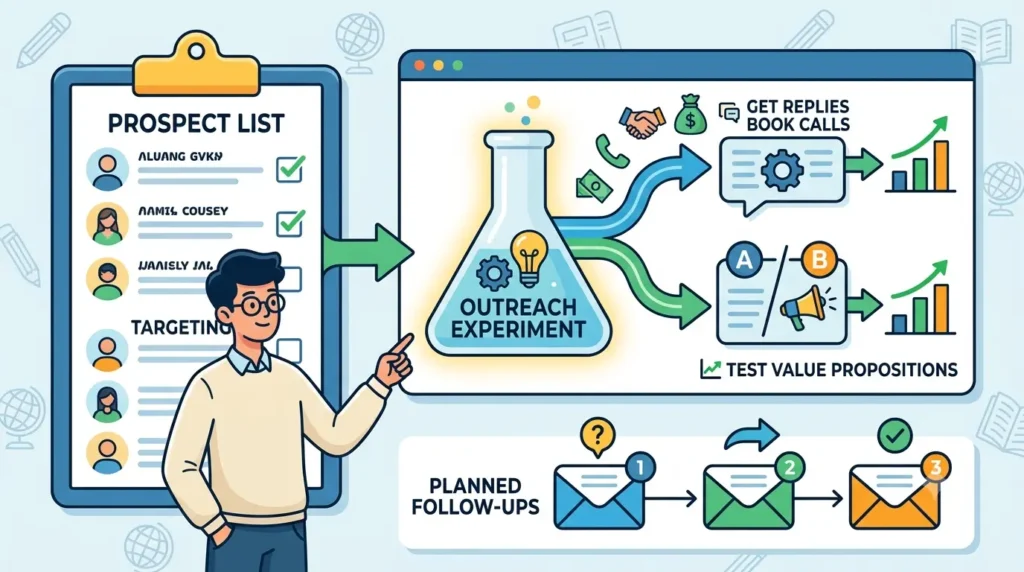
Once the list is ready, students can design a small experiment with a clear objective. The goal might be to generate replies from operations managers, book discovery calls for a mock agency, or test whether one value proposition resonates more strongly than another.
Messages should be short and tied to the recipient’s context. Students can create two or three variants that change one major element at a time, such as the opening line, problem framing, proof point, or call to action. If every part changes at once, it becomes harder to explain why one version performed differently.
Follow-ups should be planned rather than improvised. One might add a useful observation, another might restate the relevance differently, and the final message might close the loop politely.
The exercise does not require mass outreach. An instructor can approve a small real campaign, provide a closed list of volunteers, or run the entire sequence as a simulation. The learning objective is to understand targeting, message design, sequencing, and testing—not to maximize sending volume.
Measure Results Like a Real Marketing Team
A project becomes more valuable when students define metrics before launch. They can track valid contact rate, bounce rate, reply rate, positive reply rate, meetings or conversions, and performance by segment or message variation.
Each metric should answer a question. A low valid-contact rate may point to weak data collection. A high bounce rate may suggest verification or sourcing problems. A low reply rate can indicate poor targeting, weak relevance, or unclear messaging. If one segment responds better than another, students should ask what distinguishes that group rather than simply celebrating the number.
They should also avoid treating any single metric as proof that a campaign worked. Replies are useful, but positive replies or qualified conversations are closer to the business objective.
After reviewing results, students should propose the next iteration: narrow the ICP, remove weak lead sources, change the buyer role, rewrite the offer, or test a different message. Poor performance is still useful if it produces a defensible learning decision.
Create a Portfolio Project From the Results
The finished project can become evidence of practical ability for internships and entry-level roles. A short case study should document:
- Business scenario
- Campaign objective
- Ideal customer profile
- Prospecting methodology
- Tools used
- Segmentation strategy
- Outreach approach
- Metrics tracked
- Results or clearly labeled simulated results
- Lessons learned
- Changes proposed for the next campaign
The strongest portfolio projects explain reasoning, not just outcomes. A student who can justify why a segment was chosen, identify where the data was weak, and explain what they would test next demonstrates useful marketing judgment. Career-preparation resources such as Excendra’s career counselling and interview preparation program can also help students think about presenting project experience in resumes, case studies, and interviews.
Skills Students Gain From a Real-World Lead Generation Project
A well-designed lead generation project develops more than prospecting ability. Students practice market research while defining the ICP, lead qualification while evaluating companies and contacts, and data management while building a structured prospect database. They use marketing technology, write concise business copy, create experiments, analyze campaign data, and learn how marketing activity connects with sales conversations.
They also gain communication discipline. B2B outreach requires students to explain value from the buyer’s perspective rather than describe a product at length. Campaign analysis teaches them to separate assumptions from evidence and improve decisions instead of defending an unsuccessful first attempt.
For digital marketing students, that combination is especially valuable. Real-world projects turn terms such as segmentation, lead qualification, personalization, and conversion into decisions with consequences. By working through the complete B2B lead generation cycle, students move beyond knowing marketing vocabulary and begin understanding how customer acquisition actually works.