
If you’ve ever tried to learn a new language and hit a wall of strange grammar rules, unfamiliar sounds, or an alphabet that looks nothing like your own, you’ve probably wondered: what’s actually the most difficult language in the world?
The honest answer is that it depends on your native language, your goals, and how you learn best. But some languages are objectively harder than others for most learners, based on grammar complexity, writing systems, pronunciation, and how much classroom time it takes to reach fluency.
This guide ranks the 20 hardest languages in the world using a clear scoring system, backed by frameworks like the U.S. Foreign Service Institute (FSI) language categories. You’ll also learn what makes a language hard, how difficulty shifts depending on your native tongue, and how to learn a tough language faster.
Most rankings you’ll find online are opinion-based lists with no real methodology behind them. This one is different. Instead of guessing, we compare languages across five measurable factors: grammar, script, pronunciation, vocabulary, and required study hours- and cross-reference that against decades of FSI research on how long it actually takes learners to reach proficiency. The result is a ranking you can trust, whether you’re picking a language for a career move, a study abroad program, or personal curiosity.
Is There a Single Most Difficult Language in the World?
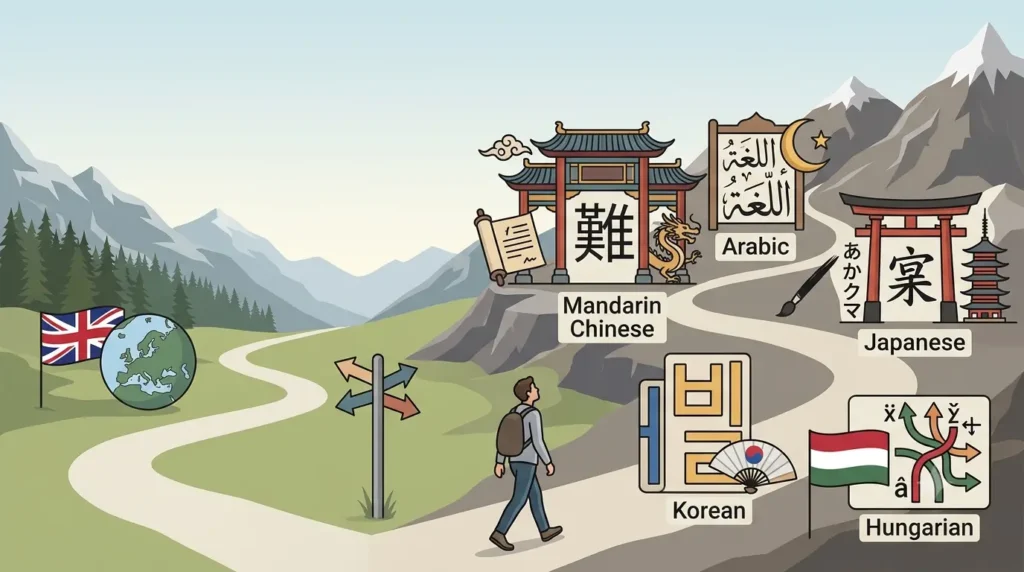
No single language is universally “the hardest.” Difficulty is relative to what you already speak. Mandarin is brutal for English speakers but far easier for someone who grew up speaking Cantonese or Vietnamese, since they share tonal systems and vocabulary roots.
That said, when linguists and language schools compare grammar complexity, writing systems, and required study hours across languages, a consistent group keeps showing up at the top: Mandarin Chinese, Arabic, Japanese, Korean, and Hungarian. These languages combine multiple difficulty factors at once: new scripts, complex grammar, and unfamiliar sounds, which is why they take the longest to master.
What Makes a Language Difficult to Learn?
Six factors drive most of the difficulty in language learning:
- Grammar complexity: languages with noun cases, gendered nouns, or irregular verb systems (like Russian or Hungarian) demand more memorization and mental math while speaking.
- Pronunciation: tonal languages (Mandarin, Vietnamese, Thai) and languages with sounds absent in English (Arabic’s guttural consonants) are hard to produce and hear correctly.
- Writing system: logographic scripts (Chinese characters), non-Latin alphabets (Cyrillic, Arabic script), or multiple writing systems used together (Japanese) slow down reading fluency.
- Vocabulary: languages with few cognates to your native language mean almost every word must be learned from scratch.
- Sentence structure: word order that differs from your native language (like Japanese’s subject-object-verb, or SOV, structure) requires you to reprogram how you build sentences.
- Similarly to your native language, this is the single biggest factor. A French speaker learning Italian has a huge head start, since both languages share Latin roots, similar sentence structure, and thousands of overlapping words. That same French speaker learning Mandarin starts from zero on every front: no shared vocabulary, no shared grammar logic, and no shared writing system.
Most difficult languages combine three or more of these factors at once. Mandarin, for example, stacks tonal pronunciation on top of a logographic writing system and grammar that works very differently from English. That combination, not any single factor alone, is what pushes a language to the top of a difficulty ranking.
How We Ranked the World’s Hardest Languages
Difficulty Factors and Methodology
We scored each language from 1 (easiest) to 10 (hardest) across five categories: grammar, script, pronunciation, vocabulary, and required learning hours. Scores were then averaged into an overall difficulty rating.
Data Sources
Our rankings draw on the FSI’s language category system, which measures classroom hours required for English-speaking diplomats to reach professional fluency, along with general linguistic research on morphology (word structure) and syntax (sentence structure) from sources like the Linguistic Society of America.
It’s worth noting that FSI data was built for English-speaking government employees, not casual learners. Your actual timeline will vary based on how much time you dedicate weekly, whether you live in a country where the language is spoken, and how many related languages you already know. Treat the hour estimates in this guide as a useful benchmark for relative difficulty, not a guaranteed timeline for your own learning journey.
Top 20 Most Difficult Languages in the World (2026 Ranking)
Here’s a snapshot of where each language struggles most, followed by a quick reference table.
- Mandarin Chinese (Score: 9.5), Tonal pronunciation and thousands of logographic characters make this consistently ranked as the hardest language for English speakers. FSI Category IV, ~2,200 hours.
- Arabic (9.3): A new script written right-to-left, guttural sounds, and root-based word patterns make vocabulary building slow. FSI Category IV, ~2,200 hours.
- Japanese (9.2): Three writing systems used simultaneously (hiragana, katakana, kanji), plus layered honorifics that change based on social status. FSI Category IV, ~2,200 hours.
- Korean (8.5): The Hangul alphabet is logical and learnable fast, but sentence structure and honorific speech levels are genuinely difficult. FSI Category IV.
- Hungarian (8.3): Around 18 grammatical cases and an unfamiliar word structure make this one of Europe’s hardest languages.
- Finnish (8.2): Fifteen noun cases and complex vowel harmony rules challenge even experienced learners.
- Russian (7.8): Six cases, a new Cyrillic alphabet, and a complex verb aspect system. For learners exploring Russian vocabulary and names, a russian female name generator can also be a useful resource. FSI Category III.
- Polish (7.7): Consonant clusters that are difficult to pronounce, plus seven grammatical cases.
- Icelandic (7.6): Preserves Old Norse grammar with heavy inflection and limited learning resources.
- Navajo (7.9): A complex verb system where a single verb can encode what takes a full sentence in English.
- Georgian (7.5): A unique alphabet and complex consonant clusters with no European equivalents, plus a verb system that encodes who is doing an action and who it’s being done to within a single word.
- Thai (7.4): Five tones and a script with no spaces between words, which makes reading comprehension especially slow for beginners.
- Vietnamese (7.3): Six tones and a Latin-based script with unfamiliar diacritics, meaning the alphabet looks familiar, but the pronunciation rules are not.
- Basque (7.2): A language isolate unrelated to any other on Earth, meaning learners have zero cognates or grammar shortcuts to lean on.
- Estonian (7.0): Fourteen noun cases with an agglutinative structure similar to Finnish, where suffixes stack to convey grammatical meaning.
- Czech (6.9): Seven cases and challenging consonant clusters, including tongue-twisting words with almost no vowels.
- Turkish (6.8): Agglutinative grammar where suffixes stack onto root words to build entire phrases, a structure very different from English sentence patterns.
- Mongolian (6.7): Vowel harmony rules and, in some regions, a traditional vertical script alongside the modern Cyrillic alphabet.
- Tibetan (6.6): A script where spelling often doesn’t match modern pronunciation, similar to how English spelling has drifted from how words actually sound.
- Cantonese (6.5): Six to nine tones depending on classification, more than Mandarin, making it one of the hardest tonal systems to master by ear.
Difficulty Comparison Table
| Language | Grammar | Pronunciation | Writing System | Learning Hours | Difficulty Score |
|---|---|---|---|---|---|
| Mandarin Chinese | High | Very High | Logographic | ~2,200 | 9.5 |
| Arabic | High | High | Abjad script | ~2,200 | 9.3 |
| Japanese | High | Medium | 3 systems | ~2,200 | 9.2 |
| Korean | Medium | Medium | Hangul (alphabet) | ~2,200 | 8.5 |
| Hungarian | Very High | Medium | Latin | ~1,100 | 8.3 |
| Finnish | Very High | Medium | Latin | ~1,100 | 8.2 |
| Russian | High | Medium | Cyrillic | ~1,100 | 7.8 |
| Navajo | Very High | Medium | Latin | N/A | 7.9 |
Which Language Has…
1. The hardest grammar? Hungarian and Navajo, due to extensive case systems and verb complexity.
2. The hardest writing system? Mandarin Chinese, since fluent reading requires recognizing 3,000+ characters.
3. The hardest pronunciation? Cantonese and Mandarin, because of tonal accuracy requirements.
4. The longest learning time? Mandarin, Arabic, Japanese, and Korean all sit in FSI Category IV at roughly 2,200 classroom hours.
The most complex vocabulary? Arabic, due to root-based word families that shift meaning with small changes.
Hardest Languages by Native Language
Difficulty isn’t fixed; it shifts based on what you already speak.
- For English speakers: Mandarin, Arabic, Japanese, and Korean top the list, per FSI data.
- For Hindi speakers: Languages with unfamiliar scripts and no Sanskrit-derived vocabulary, like Korean or Finnish, tend to be hardest, while Urdu and Arabic are comparatively easier due to shared linguistic history.
- For Spanish speakers: Tonal and non-Latin-script languages (Mandarin, Japanese, Russian) are far harder than Romance languages like Italian or Portuguese.
- For Arabic speakers: Non-tonal European languages with heavy case systems, like Finnish or Hungarian, present the steepest learning curve.
FSI Language Categories Explained
The FSI groups languages by how long they typically take English speakers to learn:
| Category | Hours Required | Example Languages |
|---|---|---|
| I | 600–750 | Spanish, French, Italian |
| II | 900 | German, Indonesian |
| III | 1,100 | Russian, Hindi, Finnish |
| IV | 1,100 | Hungarian, Vietnamese, Thai |
| V | 2,200 | Mandarin, Arabic, Japanese, Korean |
Hardest Language vs. Hardest Writing System

These aren’t always the same language. Mandarin has the hardest writing system by character count, but Hungarian’s grammar is arguably harder than Mandarin’s, even though Hungarian uses the familiar Latin alphabet. Overall difficulty depends on which factors matter most to you as a learner.
Which Difficult Language Should You Learn?
- Career: Mandarin and Arabic open doors in international business, diplomacy, and government roles, since both are in high demand and short supply among fluent non-native professionals.
- Business: Japanese and Korean are valuable given strong trade ties with major economies in manufacturing, tech, and entertainment. Fluency signals long-term commitment to employers and business partners in these markets.
- Travel: Thai and Vietnamese offer huge cultural payoff for the effort invested; locals tend to respond warmly to even basic attempts, and both countries have growing expat and digital nomad communities that make immersion easier.
- Immigration: Choose based on your destination country’s official language and available support communities. Government-run language integration programs, common in countries like Germany and Finland, can meaningfully lower the barrier to fluency.
- Academic research: Icelandic and Georgian appeal to linguists studying preserved grammatical structures, since both languages retain features that have disappeared from most modern European languages.
Whatever you choose, match the language to a goal you’ll actually stay motivated by. Difficulty rankings measure objective complexity, not how enjoyable or useful a language will be for your specific life.
Tips for Learning Difficult Languages Faster
- Immersion: surround yourself with the language through media, travel, or conversation partners. Switching your phone’s system language or watching shows without subtitles trains your ear even outside dedicated study time.
- Spaced repetition: use tools like Anki to review vocabulary right before you’re about to forget it. This single habit is why many self-taught learners retain more vocabulary than classroom students who only review once a week.
- Shadowing: repeat native speaker audio in real time, matching rhythm and intonation, not just individual sounds. This builds pronunciation muscle memory faster than reading a phonetics guide.
- AI language learning tools apps using speech recognition, and even a simple phonetic spelling generator can catch pronunciation errors a textbook can’t, giving instant feedback on tone accuracy in languages like Mandarin or Vietnamese
- Speaking practice: prioritize speaking early rather than waiting until you feel “ready.” Learners who start speaking in week one, even badly, tend to overtake learners who spend months only studying grammar rules.
A realistic learner example: someone studying Japanese might spend six months on hiragana and katakana before tackling kanji, then layer in grammar and honorifics gradually rather than all at once. Learners who try to master everything simultaneously often burn out within the first few months; pacing matters as much as method.
Best Resources for Learning Difficult Languages
| Category | Recommended Tools |
|---|---|
| Apps | Duolingo, Babbel, Memrise |
| Structured Courses | Pimsleur, Rosetta Stone |
| Vocabulary/SRS | Anki |
| Conversation Practice | HelloTalk |
| Community Discussion | Reddit language-learning communities (e.g., r/languagelearning) |
Common Myths About Difficult Languages
- “Some languages are impossible for adults to learn.” False; adults can reach fluency in any language with consistent practice, though children often achieve native-like pronunciation more easily because their brains are still highly adaptable to new sound systems. Adult learners actually have an advantage in grammar comprehension, since they can consciously study rules rather than absorbing them purely by exposure.
- “Difficult languages have the most words.” Not necessarily true. Vocabulary size doesn’t always correlate with grammatical complexity. English has one of the largest vocabularies in the world due to centuries of borrowing from other languages, yet it isn’t considered among the hardest to learn.
- “You need a special talent to learn Mandarin or Arabic.” Motivation and consistent study time matter more than innate talent. Polyglots aren’t necessarily more gifted; they’ve usually just developed efficient study habits and stayed consistent longer than the average learner.
- “You have to move to the country to become fluent.” Immersion helps, but it isn’t required. With today’s language apps, online tutors, and streaming content, learners can build near-immersive environments from home.
Frequently Asked Questions
1. What is the hardest language in the world?
There’s no single answer, but Mandarin Chinese, Arabic, Japanese, and Korean consistently rank hardest for English speakers based on FSI learning-hour data.
2.Is Chinese harder than Japanese?
Mandarin has a steeper pronunciation curve due to tones, while Japanese has more complex grammar and honorific systems. Both sit in the same FSI difficulty category.
3. Which language has the hardest grammar?
Hungarian and Navajo are frequently cited due to extensive case and verb systems.
4. Which language takes the longest to learn?
Mandarin, Arabic, Japanese, and Korean each require roughly 2,200 classroom hours per FSI estimates.
5. Is English one of the hardest languages?
English has relatively simple grammar but notoriously inconsistent spelling and pronunciation rules, making it moderately difficult for non-native speakers.
6. Does your native language affect learning difficulty?
Yes, shared vocabulary, grammar patterns, and writing systems with your native language significantly reduce learning time.
7. Why is Hungarian difficult?
Hungarian isn’t related to most European languages and uses around 18 grammatical cases, requiring learners to memorize different word endings depending on a noun’s role in a sentence.
8. Why is Finnish considered hard?
Finnish combines 15 noun cases with vowel harmony rules, meaning vowels within a word must match in a specific pattern, a concept with no equivalent in English.
9. Can adults learn difficult languages?
Yes. Adult learners can reach fluency in any language given consistent practice, structured study, and regular speaking opportunities. Age affects accent acquisition more than overall comprehension ability.
10. How many years does it take to learn Mandarin?
At roughly 2,200 classroom hours (FSI estimate), studying part-time might take 4–6 years, while intensive full-time study or immersion can shorten that to 1–2 years.
11. What is the easiest difficult language to learn?
Korean is often considered the most approachable of the top-tier hardest languages, largely because Hangul is a logical, learnable alphabet rather than a character-based system.
Final Verdict
There is no single “hardest language in the world”; difficulty depends on your starting point, your goals, and how the language is structured compared to what you already know. That said, Mandarin Chinese, Arabic, Japanese, and Korean consistently top objective rankings due to their combination of unfamiliar scripts, complex grammar, and challenging pronunciation.
If you’re choosing your next language, don’t just pick the “hardest” one for bragging rights. Pick the one that aligns with your goals, career, travel, or personal curiosity, and commit to consistent, immersive practice.
Every language on this list has been learned to fluency by thousands of non-native speakers before you, using the same tools now available to you: spaced repetition apps, native speaker communities, and structured study frameworks. Difficulty fades with the right strategy, consistent effort, and enough time. The hardest language in the world is simply the one you give up on; the rest just take patience.