
Most B2B buyers do a lot before they ever speak to sales.
They compare a few vendors. They read a case study and forget the company name. They skim a pricing page. They forward a webinar link to someone internally. Then they vanish for a few days and come back through a different channel.
For sales and marketing teams, that can be frustrating. There is interest, but it rarely arrives with a big label saying, “This account is ready.” More often, it shows up as a handful of small actions that may or may not mean something.
A click is not a buying committee. A download is not a deal. A webinar attendee is not automatically ready for an account executive.
But those actions are still clues. When a tech company learns how to read them, qualify them, and act at the right moment, the quality of its sales meetings usually improves. In practice, turning buyer interest into qualified sales meetings is less about chasing every signal and more about knowing which ones deserve attention.
Here are nine practical ways to turn scattered buyer activity into better conversations.
1. Decide What a Good Meeting Looks Like Before You Try to Book More
This sounds obvious. It is also where many teams quietly go wrong.
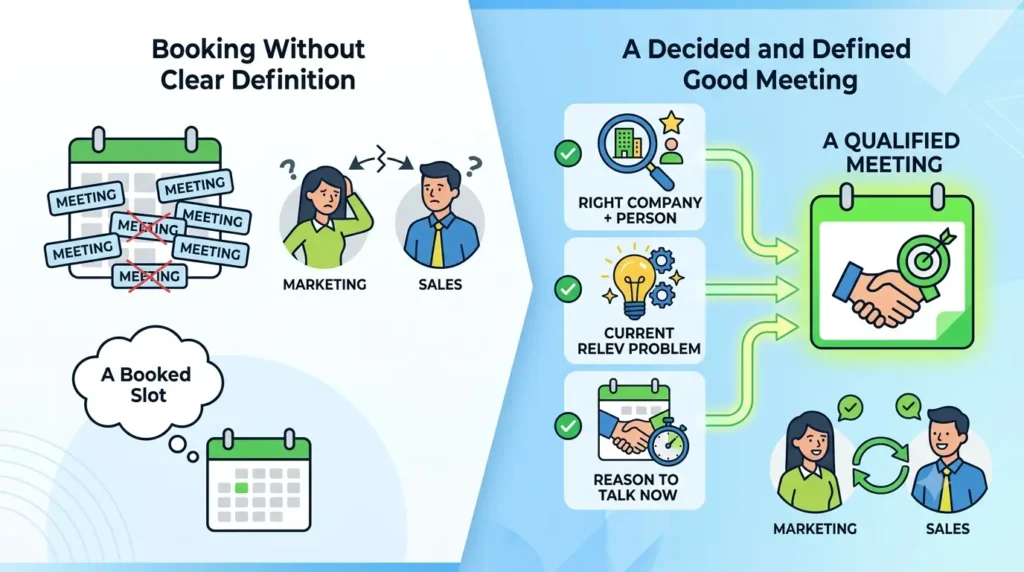
They run the campaign, route leads to SDRs, report the meeting number, and only later realize sales and marketing were using different definitions of success. Sales says the meetings are weak. Marketing says sales is picky. SDRs say they booked what the brief asked for.
No one is completely wrong.
A good meeting needs more than a slot on someone’s calendar. It should involve the right company, the right person, and a reason to talk now.
For a cybersecurity vendor, that might be an IT, security, or compliance leader dealing with audit pressure, risk, or threat detection gaps. For a SaaS operations platform, it might be a RevOps or operations leader tired of manual routing and slow handoffs.
The definition should be simple enough that the whole team can remember it. Something like:
“A qualified meeting is a conversation with a relevant stakeholder at a target account who has a current problem we can credibly help solve.”
It is not fancy. That is the point. Fancy definitions tend to die in slide decks.
2. Stop Treating Every Form Fill Like a Buying Signal
Someone can download your guide and still have no plan to buy.
They might be gathering links for a manager. They might be new to the topic. They might be writing an internal report. They might be a competitor. It happens.
That does not make the lead useless. It just means the action needs context.
A single content download is usually light interest. A pricing page visit from a target account is stronger. Two or three people from the same company looking at pricing, integrations, and customer stories in the same week is stronger again.
The pattern matters.
One blog visit is worth noticing. A return visit to integration docs, followed by a pricing page view and a webinar registration from the same company, is worth investigating.
The mistake is treating both situations the same way. For many B2B teams, turning buyer interest into qualified sales meetings starts by resisting the urge to call every engagement signal “hot.”
Good teams ask: is this person just learning, or is this account starting to behave like a buyer?
3. Look at the Company, Not Just the Contact
A lead can look good until you zoom out.
Maybe the person has the right title, but the company is too small. Maybe the company is a great fit, but the person engaging is too junior. Maybe the account looks interesting, but there is no clear pain point connected to what you sell.
That is why account context matters.
At the account level, look at company size, industry, location, growth stage, revenue range, and whether the business fits your ideal customer profile. For some tech companies, the tools a company already uses matter too. A sales automation platform may care about CRM. A cybersecurity vendor may care about cloud setup, compliance pressure, or security maturity.
Then look at the person. Their role, seniority, department, and likely influence all matter.
The best opportunities usually happen when account fit and persona fit overlap. A good-fit account with a junior researcher may need nurturing. A senior buyer at a poor-fit company may still go nowhere. A relevant stakeholder at a strong-fit account showing timely activity is different. That is usually worth fast attention.
4. Follow Up While the Buyer Still Remembers Why They Cared
Buyers often research in short bursts.
They have a budget meeting coming up. Or a tool renewal. Or a process problem that has become annoying enough to fix. For a few days, they care. Then another priority takes over.
If your follow-up comes too late, the context is gone.
That does not mean every site visit needs an immediate demo pitch. Nobody likes that. But stronger signals should trigger faster, more relevant follow-up.
A weak message sounds like this:
“I saw you downloaded our guide. Do you want to book a call?”
A better one:
“Teams looking into this usually ask about rollout time, internal ownership, and how it fits with their current systems. Happy to compare what implementation typically looks like.”
Still sales outreach. Just less lazy.
5. Use AI for the Messy Middle, Not as a Magic Button
AI can help, but only if the process underneath it is sane.
The useful part is not that AI can write another email. Most buyers already get plenty of emails that sound fine and say nothing.
The real value is pattern recognition. A lot of tech companies have signals spread across CRM records, website analytics, webinar platforms, ad campaigns, sales notes, email engagement, and third-party intent tools. Someone has to connect those dots.
AI can help summarize account activity, spot unusual behavior, suggest next steps, draft role-specific outreach, and route leads to the right person.
But it needs to explain itself.
A vague “hot account” label is not very useful. A better summary would say:
“Two operations contacts from this account viewed pricing and integration pages this week. One also attended last month’s webinar on workflow automation. Suggested angle: implementation effort and process efficiency.”
Now the SDR has context. The account executive has a reason to care. The follow-up can be specific.
This is where turning buyer interest into qualified sales meetings becomes a practical operating problem, not just a marketing slogan. The team needs a way to validate signals, prioritize the right accounts, and act while the buyer’s interest is still fresh.
6. Make the Message Fit the Buyer’s Stage
A lot of outreach asks for too much too soon.
If someone is just learning about a problem, they may not want a demo. If someone is comparing vendors, they may want proof. If someone is checking pricing and implementation details, they may be closer to a serious conversation.
The stage matters.
Early-stage buyers need clarity. Send them useful education, not pressure.
Mid-stage buyers need comparison. Give them use cases, customer stories, and practical reasons to choose one approach over another.
Late-stage buyers need confidence. They care about pricing, rollout, integrations, security, procurement, and whether the solution will survive contact with their internal reality.
A person who just read an introductory blog post probably does not need a hard meeting request. A person who came back to your pricing page after reading two case studies might.
Same company. Different moment. Different message.
7. Personalize Based on the Problem Each Role Cares About
Personalization is not “Hi Sarah.”
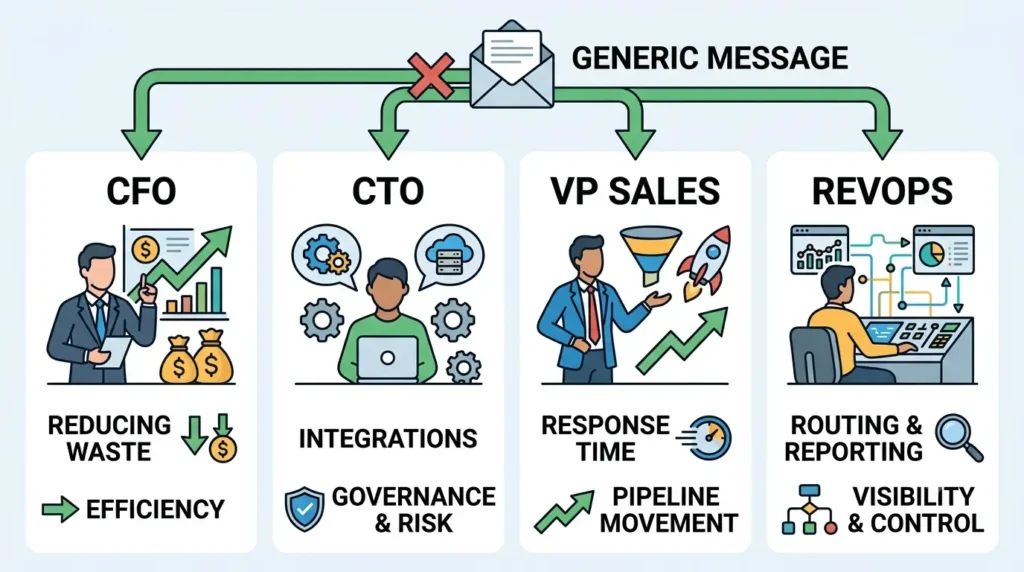
A CFO, CTO, VP of Sales, and RevOps leader can all research the same technology for completely different reasons.
Take workflow automation. A CFO may care about reducing waste. A CTO may worry about integrations and governance. A VP of Sales may care about response time and pipeline movement. RevOps may be thinking about routing rules, reporting, and handoff problems.
If all of them receive the same generic email, the campaign misses the point.
The message should connect the signal to the role.
For a CFO, talk about efficiency. For a CTO, talk about systems and risk. For sales leadership, talk about speed and missed opportunities. For RevOps, talk about visibility and control.
It does not mean every message has to be written from scratch. It does mean the outreach should sound like you know why that person would care.
That role-level context is often what separates generic lead follow-up from turning buyer interest into qualified sales meetings that sales teams actually want to take.
8. Do Not Celebrate the Meeting Until It Actually Happens
A booked meeting can still fall apart.
The prospect may not show up. They may forget why they accepted. They may join with the wrong expectations. The sales rep may have no context. The call may technically happen and still go nowhere.
So yes, booking matters. Attendance and preparation matter just as much.
Small details help:
- Use a specific calendar title.
- Add a short agenda.
- Confirm the meeting before it happens.
- Make rescheduling easy.
- Give the rep notes on what triggered the conversation.
- Remind the buyer what they will get from the call.
“Intro Call” is easy to ignore.
“Discussion: Reducing Manual Lead Routing After Webinar Engagement” gives the meeting a purpose.
That one detail will not fix a bad process, but it helps.
9. Measure Where Interest Gets Lost
Meetings booked is an easy number to report. It is not always the most honest one.
A campaign can book plenty of meetings and still disappoint if people do not attend, sales rejects the conversations, or none of them turn into opportunities.
Look at the path instead:
- Target account shows activity
- Signal is reviewed
- Account and contact are qualified
- Outreach starts
- Meeting is booked
- Meeting is attended
- Sales accepts the meeting
- Opportunity is created
- Pipeline is influenced
Once you see the full path, the weak spots are harder to ignore.
If lots of accounts show activity but few meetings are booked, the problem may be messaging or speed. If meetings are booked but people do not attend, the reminder process may be weak. If sales rejects the meetings, qualification probably needs tightening. If meetings happen but do not become opportunities, the campaign may be attracting the wrong pain.
The point is not to build a giant dashboard. It is to find where good interest leaks out of the system.
Conclusion: Better Meetings Come From Better Judgment
Buyer interest is not the same as sales readiness.
A download, website visit, webinar registration, or pricing page view might be a clue. It might be noise. It might be the first sign of a real buying process. The work is knowing the difference.
Tech companies that do this well are not just chasing more leads. They qualify accounts more carefully, respond while the moment is still fresh, tailor the message to the buyer’s role and stage, and pay attention to what happens after the meeting is booked.
In the end, turning buyer interest into qualified sales meetings comes down to judgment: knowing which signals matter, which buyers are worth pursuing, and when a conversation is likely to move the pipeline forward.