
If you are thinking about spending two years and a lot of money on an MBA the thing you might be wondering is what you will make after you finish. That is a question and the real answer is it depends on the school you go to, the area you focus on, the city you work in and the industry you end up in. This guide looks at MBA salaries in India using placement data from IIMs, ISB and other top business schools so you can have realistic ideas instead of listening to stories from a cousin’s friend who said they got 40 lakhs.
I have collected numbers from placement reports, industry salary surveys and hiring trends to give you a picture that is based on real facts instead of what people say on campus. Let’s look at the details.
What Is the Average MBA Salary in India?
National Average Salary
Across India, the average MBA salary typically falls between ₹8 lakh and ₹12 lakh per annum for graduates from a mix of tier-1, tier-2, and tier-3 B-schools. This is a blended number; it includes the modest packages from lesser-known colleges as well as the eye-catching ones from top-tier institutes, so the “average” hides a lot of variation.
If you narrow the lens to only the premier institutes IIMs, ISB, XLRI, and similar schools the average jumps sharply. For instance, IIM Ahmedabad’s Class of 2025 batch reported <cite index=”4-1″>an average package of 35.50 LPA with a highest package of 1.10 crore per annum</cite>, while <cite index=”1-1″>IIM Bangalore saw its average salary rise from Rs 35.31 LPA in 2023 to Rs 35.92 LPA in 2024</cite>. So the “average MBA salary” question really has two honest answers: one for the top 20 B-schools, and a much more modest one for the remaining few thousand MBA colleges in the country.
Salary Range
A more useful way to think about it is as a range:
- Tier-3 colleges: ₹3–6 LPA
- Tier-2 colleges: ₹6–10 LPA
- Tier-1 colleges (non-IIM, like SPJIMR, FMS, NMIMS): ₹12–20 LPA
- IIMs and ISB: ₹20–36 LPA on average, with top offers well above ₹1 crore
This spread is exactly why the college you choose matters so much more in India than in many other countries brand pedigree still drives a large chunk of starting pay here.
Highest Salary Packages
The headline numbers you see in newspapers are usually the outliers, not the norm. IIM Bangalore, for example, reported international offers touching extraordinary figures, and across the IIM system, <cite index=”6-1″>the maximum domestic salary recorded in 2025 was around Rs 1.15 crore per annum</cite>, with <cite index=”6-1″>the highest international placement offer at IIM Ahmedabad reaching roughly $212,347, or about Rs 1.76 crore</cite>. These packages typically go to a small number of students hired into niche roles in global consulting, quant finance, or specialized tech so treat them as inspiration, not expectation.
MBA Salary by Experience
Experience changes your MBA salary trajectory more than almost any other factor, including which college you attended. A fresher and a professional with ten years of managerial experience are, frankly, playing different games in the job market.
1. Freshers
Fresh MBA graduates who have just finished their studies and don’t have any work experience usually get a salary that ranges from six lakh rupees per year to fifteen lakh rupees per year. The exact amount depends on the college’s reputation and the area of study. Students who come from the IIMs often get higher salaries than this range.. For the average business school graduate the first job is more about creating a good history and gaining experience than getting the highest possible salary.
2. Mid-Level Professionals
With three to seven years of experience after getting an MBA salaries usually range from fifteen lakh per annum to thirty lakh per annum. This is the time when specialization, knowing your field well and having a few achievements on your resume become more important than the name of the school you went to.
3. Senior Professionals
When you have 8 to 15 years of experience people in jobs like Head of Marketing or Finance Controller or Senior Program Manager usually make around ₹30 LPA to ₹60 LPA. At this point the people you know know about your field. What you have achieved as a leader are more important than which MBA batch you were in.
4. Leadership Roles
CXO positions and Vice President roles are usually achieved after 15 or more years of experience. These roles can pay anywhere from ₹70 LPA to crores every year. This is especially true in fields like consulting, private equity or big companies. By this point the MBA degree is something from the past. What matters now is the impact on the business and having control over profits and losses.
MBA Salary by Specialization
Your specialization shapes both your starting salary and your long-term earning ceiling. Here’s how the major streams generally compare.
1. Finance
Finance is a field that pays well especially if you are working in investment banking, private equity or corporate finance after doing your MBA. When people who are new to the field, known as freshers start out they usually make around ₹8–18 LPA.. If they get jobs at the best companies in banking and financial services they can make a lot more money. Finance jobs like these are really sought after because they pay well.
2. Marketing
People who do an MBA in Marketing are always needed in companies that make things like food and drinks, online shopping sites and technology for consumers. When they start working they usually get paid between ₹7 and ₹15, per year. If they get a job managing a brand at a good company that makes food and drinks they can get paid even more.
3. Human Resources
People who work in Human Resources usually start with a salary that’s a little less than what people in finance or marketing get. They typically get around ₹6–12 LPA.. The thing is, Human Resources has become really important to companies now. This is because companies are putting money into things like finding the right people, keeping them happy and making sure the organization is set up in a good way. Human Resources is really important for this.
4. Operations
Operations management MBAs, people who study how businesses run their operations, those who focus on manufacturing or how products get from factories to stores usually start with a salary of seven to 14 lakh rupees, per year. More companies are looking for these kinds of people because they want to make sure their businesses run smoothly and save money.
5. Business Analytics
The field of analytics is really taking off. People from information technology and other industries like e-commerce and banking are showing a lot of interest in it.
When you first start working in analytics you can earn a salary that’s somewhere between ₹8 and ₹18 LPA.
If you are good with things like SQL and Python and know how to use visualization tools then you can get paid more than other analytics professionals.
6. International Business
International business specialists do their job where trade and global operations meet. They get paid around ₹7–14 LPA when they start. International business specialists usually work for companies that do a lot of export and import companies with offices in many countries and firms that give advice to other companies on international business.
7. Healthcare Management
Healthcare management MBAs are a small field but they are getting more popular. People who do healthcare management MBAs usually start with a salary of around ₹6–12 LPA. They work with hospital chains, pharma companies and health-tech startups which’s really interesting. Healthcare management MBAs have a lot of opportunities. They are working with hospital chains and pharma companies and health-tech startups.
8. Supply Chain Management
India’s manufacturing and e-commerce sectors are growing fast. Because of this people who are good at managing supply chains are really needed. When you start working in this field you can expect to get a salary of around ₹7 to ₹15 LPA.. If you have a lot of experience and work with big companies that make things or handle logistics the supply chain leaders can earn a lot more money. Supply chain specialists are very important in India now. MBA Salary by Industry
The industry you join shapes not just your starting pay but your salary growth curve for years to come.
1. Consulting
Consulting is the paying job for new MBA graduates from good business schools. Companies like McKinsey, BCG and Bain usually give the salary to these students.. This job is also very tough. People who work in consulting have to work for a time and travel a lot. Consulting is a demanding job. Companies like McKinsey, BCG and Bain expect a lot from the people who work for them. They have to work hours and travel a lot for consulting.
2. IT
Information Technology and technology companies hire Masters of Business Administration for product management, strategy and operations roles. The salaries for Masters of Business Administration are very good for people who have a background in engineering and also have a Masters of Business Administration. This combination of engineering and Masters of Business Administration is something that Indian technology companies think is very important.
3. Banking & Finance
Banking and financial services offer strong pay, especially in areas like investment banking, treasury, and risk management. Public sector banks tend to pay less than private banks and NBFCs at the entry level, though they offer more job stability.
4. FMCG
FMCG companies are known for structured, high-quality management trainee programs (like HUL’s famous one) that pay well and groom future business leaders. Starting salaries are solid, and the sector has a reputation for producing strong general managers.
5. Manufacturing
Manufacturing has traditionally paid less than consulting or finance at entry level, but it offers steady growth and strong operational exposure, particularly for supply chain and operations specialists.
6. Healthcare
Healthcare management is a growing but still maturing sector in India. Pay is moderate compared to finance or consulting, but demand is rising as hospital chains and health-tech firms professionalize their management.
7. E-commerce
E-commerce companies pay competitively for MBAs, especially in categories like product management, category management, and growth roles, though compensation structures often include a significant variable or ESOP component.
8. Startups
Startup salaries vary enormously; a well-funded startup might match or beat corporate pay, while an early-stage one may offer a lower cash salary in exchange for equity. It’s a higher-risk, potentially higher-reward path, and worth considering only if you understand the trade-off.
MBA Salary by Job Role
Marketing Manager
Marketing Managers in India usually get a salary between ₹10 and ₹25 per year. This amount can vary a lot depending on the size of the company and the type of industry they are in. For example Marketing Managers who work for companies that make food and other daily use items or for companies that make consumer technology products often get paid more than others.
Financial Analyst
Financial Analysts generally earn ₹6–15 LPA at the mid-level, rising significantly with specialization in areas like equity research or M&A.
Product Manager
People who work as Product Managers in the tech and e-commerce fields usually get paid a lot. They often start with a salary of around ₹15–30 LPA at companies. Senior Product Managers can earn more money than that. Product Managers are really well paid compared to jobs that people with an MBA can get.
Business Analyst
Business Analysts typically start around ₹8–16 LPA, with consulting and analytics-heavy roles at the higher end of that range.
HR Manager
HR Managers usually earn ₹8–18 LPA, with compensation rising meaningfully as they move into HR Business Partner or leadership roles.
Operations Manager
Operations Managers typically earn ₹8–18 LPA, with manufacturing, logistics, and e-commerce being major employers.
Consultant
Consultants at top firms are among the highest earners at the entry level, often starting well above ₹20 LPA, though the number varies widely between boutique and Tier-1 global firms.
Project Manager
Project Managers, particularly in IT and infrastructure, typically earn ₹10–22 LPA, with certifications like PMP adding to earning potential.
MBA Salary by City
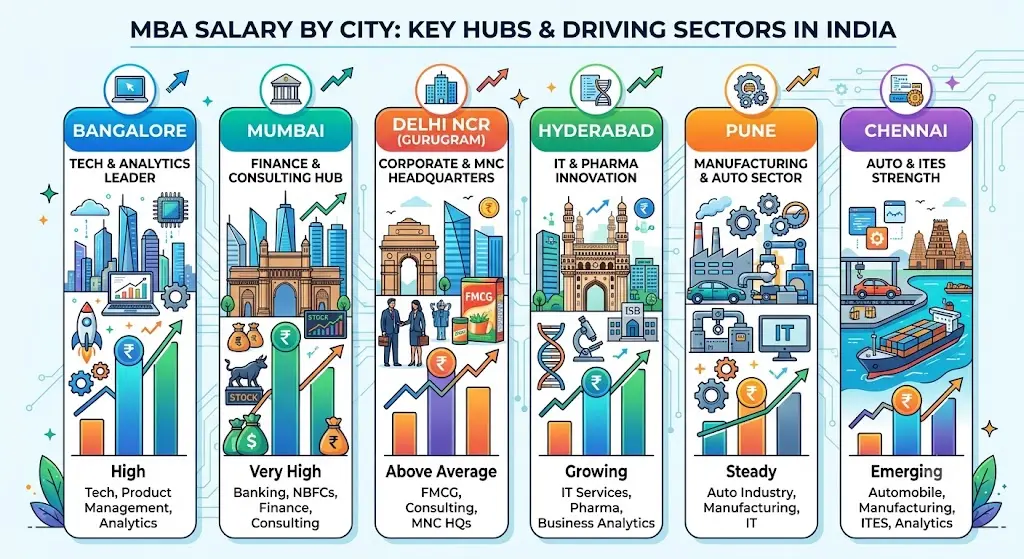
Location has a real, measurable effect on MBA pay in India, largely because it tracks where the highest-paying industries are concentrated.
Bangalore
Bangalore leads for MBA salaries in tech, product management, and analytics roles, thanks to its concentration of IT and startup headquarters.
Mumbai
Mumbai offers the strongest pay for finance, banking, and consulting roles, as India’s financial capital and home to most major banks and NBFCs.
Delhi NCR
Delhi NCR offers a broad mix of consulting, FMCG, and corporate roles, with Gurugram in particular emerging as a major hub for MNC headquarters.
Hyderabad
Hyderabad has grown rapidly as a hub for IT, pharma, and business analytics, helped along by ISB’s presence and a strong tech ecosystem.
Pune
Pune offers solid opportunities in manufacturing, IT, and auto sector management roles, generally at slightly lower pay scales than Mumbai or Bangalore.
Chennai
Chennai is strong in manufacturing, auto, and IT-enabled services, with a steadily growing analytics and banking presence.
MBA Salary by College
1. IIMs
The IIMs remain the gold standard for MBA salaries in India. Recent placement data shows <cite index=”5-1″>IIM Ahmedabad’s average CTC at around Rs 35 LPA with the highest international package touching roughly Rs 1.15 crore</cite>, while <cite index=”1-1″>IIM Calcutta’s average salary held steady at around Rs 35.07 LPA</cite>. Not every IIM commands these numbers, though newer IIMs report considerably more modest averages; <cite index=”1-1″>IIM Nagpur, for example, reported an average salary of Rs 18.07 LPA in 2025</cite>. Across the top five IIMs combined, <cite index=”2-1″>the average salary in 2025 was around Rs 32 lakh per annum, with the highest offer reaching an extraordinary Rs 1.54 crore</cite>.
2. ISB
ISB Hyderabad’s one-year MBA program has consistently delivered strong outcomes, with average packages showing a clear upward trend: <cite index=”11-1″>class of 2021 averaged Rs 27.13 LPA, rising to Rs 32.76 LPA in 2022, Rs 33.25 LPA in 2023, and Rs 34.21 LPA in 2024</cite>. For the Class of 2025, <cite index=”12-1″>the average package was estimated in the Rs 30–35 LPA range, with the highest offer reaching Rs 66 LPA</cite>.
3. XLRI
XLRI Jamshedpur remains a top choice for HR and business management, with consistently strong placement outcomes, though like several peer institutes it saw a dip in average salaries during the tougher 2024 hiring season along with other B-schools.
4. SPJIMR
SPJIMR Mumbai is known for its strong general management program and healthy placement record, typically placing it just behind the top IIMs in terms of average compensation.
5. FMS
FMS Delhi is famous for offering one of the best ROI stories in Indian management education — its fees are a fraction of most private B-schools, while its placement outcomes rival many IIMs.
6. Other Leading B-Schools
Schools like MDI Gurgaon, IIFT, NMIMS Mumbai, and IIM-adjacent newer campuses round out the list of institutes that consistently deliver strong, if not top-tier, placement packages.
Factors Affecting MBA Salary
1. College Reputation
Brand pedigree remains a strong signal to recruiters in India, particularly at the entry level, before you have real work history to show for yourself.
2. Experience
Prior work experience before the MBA, and cumulative experience after it, is one of the single biggest levers on your salary trajectory.
3. Skills
Hard skills especially in analytics, finance modeling, or digital marketing increasingly separate high earners from the rest, regardless of college.
4. Industry
Some industries simply pay more than others for equivalent seniority; consulting and finance sit at the top, manufacturing and healthcare are typically more moderate.
5. Company Size
Large, well-funded companies and MNCs tend to pay more than small or family-run businesses, though the latter can offer faster growth and broader exposure.
6. Location
As covered above, city matters a role in Mumbai or Bangalore usually pays more than the same role in a smaller city, though cost of living should factor into your comparison.
7. Certifications
Certifications like CFA, PMP, or specialized analytics credentials can meaningfully boost pay, especially in finance and project management roles.
CTC vs In-Hand Salary
This is where a lot of freshers get an unpleasant surprise. The “package” you’re offered on paper (CTC, or Cost to Company) is almost always higher than what actually lands in your bank account each month.
1. Salary Components
CTC typically includes your basic pay, allowances, provident fund contributions, gratuity, insurance, and any performance-linked pay all bundled into one number that looks impressive but isn’t what you take home.
2. Variable Pay
Many companies, especially in consulting and product roles, structure 10–20% of the CTC as variable pay tied to performance, meaning your actual payout can differ from the headline number.
3. Bonuses
Joining bonuses and annual performance bonuses are often included in the “highest package” figures you see reported by B-schools, which is part of why those numbers look so much bigger than typical in-hand pay.
4. ESOPs
At startups, Employee Stock Options (ESOPs) are sometimes bundled into the total compensation figure, even though they carry real risk and typically vest over several years rather than paying out immediately.
As a rough rule of thumb, expect your in-hand, take-home salary to be roughly 60–75% of your quoted CTC, depending on how the package is structured.
MBA ROI Analysis
Tuition Cost
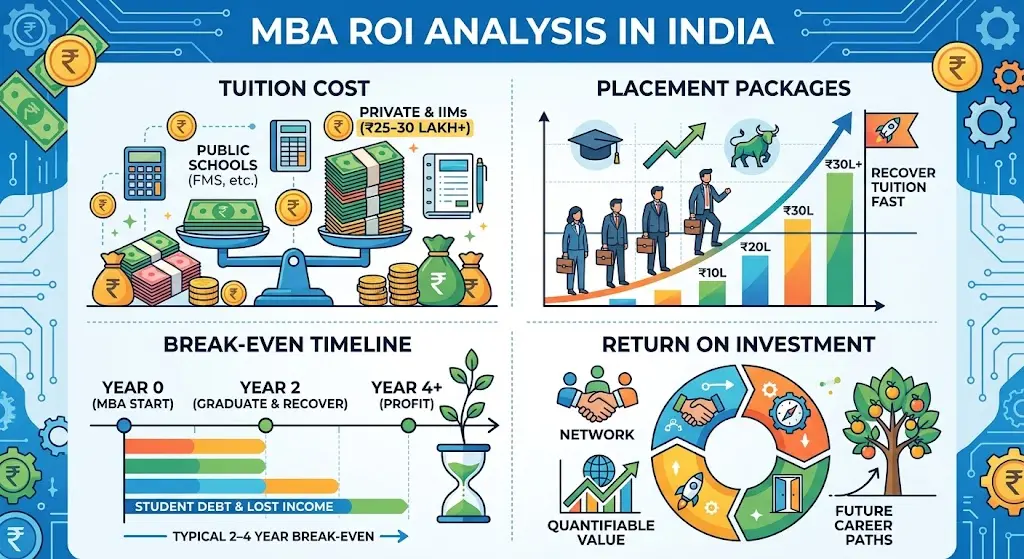
MBA fees in India range enormously from a few lakh rupees at public institutes like FMS Delhi to ₹25–30 lakh at top private schools and IIMs.
Placement Packages
As covered above, average placement packages at top institutes now regularly cross ₹30 LPA, meaning many students can recover their tuition cost within the first year or two of employment.
Break-even Timeline
For most students at reputed B-schools, the typical break-even period the time it takes for post-MBA earnings to offset the total cost of the degree, including lost income during the program is roughly 2–4 years.
Return on Investment
Beyond the raw numbers, an MBA’s ROI also includes intangible benefits: a stronger professional network, sharper business fundamentals, and access to career paths that would otherwise be hard to break into. These are harder to quantify but genuinely matter over a 10–15 year career.
MBA Salary Growth Timeline
1. First Year
In your first year post-MBA, expect to be in learning mode salary growth is usually modest as you settle into your role and prove yourself.
2. Three Years
By year three, many professionals see a meaningful jump, often 30–50% above their starting salary, especially if they’ve switched companies once.
3. Five Years
By year five, professionals who’ve built a strong track record and possibly moved into a managerial role can see their salary roughly double from their starting point.
4. Ten Years
By the ten-year mark, many MBA graduates have moved into senior management, and total compensation can be three to five times their starting salary, particularly for those who’ve taken on P&L responsibility.
MBA in India vs MBA Abroad
1. Cost Comparison
An MBA in India, even at a top IIM, generally costs a fraction of a comparable program in the US or Europe, where total costs (tuition plus living expenses) can easily cross ₹1–1.5 crore.
2. Salary Comparison
MBA graduates abroad, particularly from top US schools, often command higher absolute salaries, but the cost of living and taxes abroad also eat into that advantage significantly.
3. Career Opportunities
An MBA abroad can open doors to global roles and international relocation more easily, while an MBA in India tends to build stronger local networks and domain knowledge for the Indian market.
4. ROI
When you account for the dramatically lower cost of Indian programs relative to their placement outcomes, many top Indian B-schools IIM Ahmedabad, ISB, and FMS Delhi among them — actually offer a better financial ROI than many mid-tier international programs, even though the absolute pay abroad may be higher.
How to Increase Your MBA Salary
1. Choose the Right Specialization
Picking a specialization aligned with high-growth sectors like business analytics or finance can meaningfully improve your starting salary and long-term ceiling.
2. Gain Industry Certifications
Layering certifications like CFA, FRM, or specialized analytics courses on top of your MBA signals depth to recruiters and often justifies a higher offer.
3. Develop High-Demand Skills
Skills like data analysis, digital marketing, and financial modeling are increasingly valued across every specialization, not just the ones traditionally associated with them.
4. Build Professional Networks
A strong professional network through alumni groups, LinkedIn, and industry events often surfaces better opportunities than job boards ever will.
5. Negotiate Salary Effectively
Many candidates leave money on the table simply by not negotiating. Research market rates for your role and city, and be prepared to make a reasoned case rather than just asking for more.
Frequently Asked Questions
1. Is an MBA worth it in India?
For most candidates who get into a reputed institute, yes the placement data shows strong average salaries and healthy ROI, especially when tuition costs are compared against post-MBA earnings. That said, an MBA from a poorly ranked college with weak placements is a much harder case to justify financially.
2. Which MBA specialization pays the highest?
Finance and consulting-oriented specializations tend to offer the highest starting salaries, though business analytics has closed the gap significantly in recent years as demand for data-driven decision-making has grown.
3. What is the salary after MBA?
It depends heavily on your college and specialization, but a realistic range for freshers is ₹6–20 LPA, with graduates from top IIMs and ISB often exceeding this on average.
4. What is the highest MBA package?
Recent top-tier placements have touched packages of over ₹1 crore per annum, including international offers, though these go to a small number of students, not the typical graduate.
5. Which MBA college has the best placements?
IIM Ahmedabad, IIM Bangalore, IIM Calcutta, and ISB Hyderabad consistently rank among the strongest for both average and highest placement packages in India.
6. Does work experience increase salary?
Yes, significantly. Prior work experience before an MBA, and continued experience after it, is one of the strongest predictors of long-term salary growth.
7. What is the average salary after an Executive MBA?
Executive MBA graduates, who typically already have 5–10+ years of work experience, often see salaries in the ₹20–40 LPA range post-program, though this varies widely based on prior seniority.
8. Is online MBA valuable?
Online MBAs can add value, particularly for working professionals looking to formalize their skills, but they generally don’t command the same salary premium as a full-time residential MBA from a reputed institute, largely due to weaker campus placement support.
Conclusion
The MBA salary in India isn’t a single number; it’s a range shaped by your college, your specialization, your city, and how many years you’ve put into your career after graduation. Top-tier institutes like the IIMs and ISB continue to post strong average packages, often in the ₹30–36 LPA range, while the broader market average across all B-schools sits much lower, closer to ₹8–12 LPA.
If you’re planning your MBA journey, go in with realistic expectations: research the specific placement reports of the colleges you’re considering, rather than relying on headline “highest package” figures that apply to a handful of students. Think about specialization and industry fit as seriously as you think about college ranking, since both shape your earning trajectory for years to come.
Ultimately, an MBA is a long-term investment in your career, not just a one-time salary bump. Choose your college and specialization with your 10-year career in mind, not just your first job offer, and the numbers tend to work out favorably over time.