
For decades, CCTV served one primary purpose: recording what happened. Cameras captured activity, security teams watched selected screens, and footage was reviewed after theft, trespassing, workplace incidents, or other problems occurred. That model still has value, but it is increasingly difficult to manage across large, modern facilities.
The shift toward intelligent surveillance is already accelerating. The global AI video surveillance market was valued at approximately $7.2 billion in 2025 and is projected to reach $33.8 billion by 2033. Cloud platforms accounted for 62.6% of the market in 2025, while commercial organizations represented 37.8% of revenue. The broader video analytics market is also expected to grow rapidly as businesses look for faster ways to turn large volumes of camera footage into useful information.
These numbers reflect a fundamental change in what businesses expect from cameras. Organizations no longer want systems that simply collect recordings. They increasingly need cameras and software that can interpret activity, locate important events quickly, and help teams respond while an incident is still developing.
AI video surveillance is therefore becoming both a security technology and an operational tool.
Why Legacy CCTV Creates Operational Friction
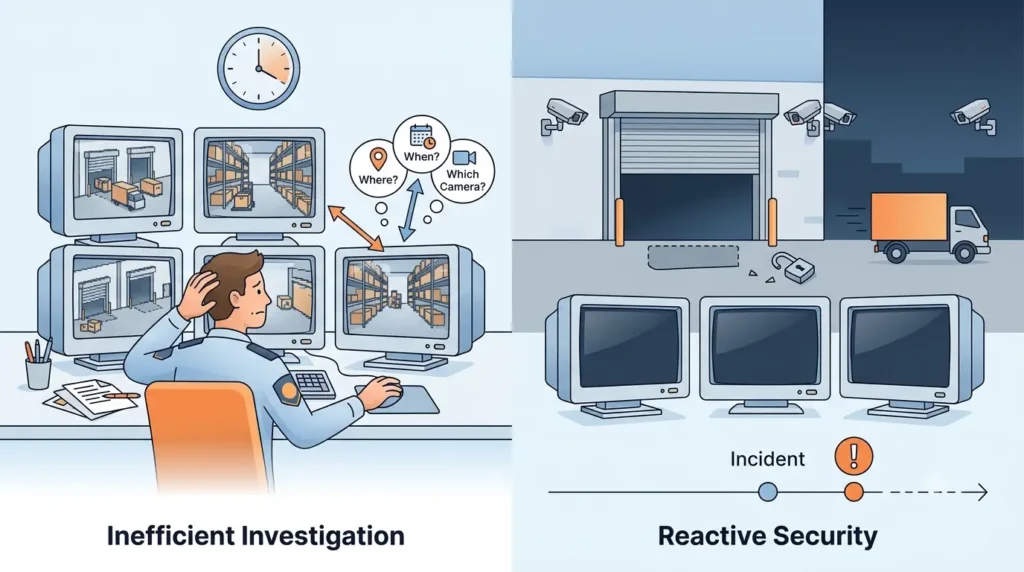
Traditional CCTV systems were designed around continuous recording and human observation. When an incident occurs, someone often needs to determine which camera captured it, identify the approximate time, and manually scrub through recordings.
That process becomes increasingly inefficient as camera networks grow.
Imagine a distribution center with 150 cameras investigating a missing shipment. Managers may know that a particular vehicle entered the loading area sometime between noon and 4 p.m., but finding the exact interaction can require reviewing footage from several cameras.
The same problem occurs in offices, retailers, factories, parking facilities, and warehouses.
Legacy systems can also create blind spots because human monitoring does not scale easily. Even when multiple screens are displayed in a control room, operators cannot realistically interpret every activity happening across every camera simultaneously.
The result is a security environment that is often reactive. Video becomes most useful after something has already gone wrong.
AI Changes Cameras From Recorders Into Detection Systems
Computer vision changes this model by allowing software to analyze what cameras are seeing.
Instead of treating every video frame equally, AI systems can identify objects, people, vehicles, movement patterns, and specific events. Depending on the platform and configuration, teams can use analytics for perimeter monitoring, intrusion detection, vehicle identification, safety events, occupancy analysis, and other business requirements.
This creates a more manageable monitoring environment.
Rather than expecting a security employee to continuously watch dozens of feeds, the system can surface events that meet predefined criteria. Staff members can then focus their attention on situations that actually require judgment or intervention.
The technology does not remove people from physical security. It changes where their time is spent. Instead of searching through hours of routine recordings, employees can dedicate more time to evaluating unusual activity, coordinating responses, assisting visitors, and investigating higher-priority events.
Natural-Language Search Makes Investigations Faster
One of the largest operational differences between traditional CCTV and modern AI surveillance is how teams search recorded video.
Conventional systems generally require investigators to work with cameras, timestamps, and timelines. AI-powered platforms can make footage searchable based on what actually appears within the video.
For example, a facility manager investigating missing equipment might search for a person carrying a box, a red vehicle near a loading dock, or activity around a restricted doorway instead of manually checking recordings from multiple cameras.
Modern businesses are also improving surveillance efficiency by adopting intelligent ai video analytics platforms that reduce dependence on manual footage review. For example, platforms like Coram use AI-powered video search to help security teams search footage using natural-language descriptions of people, vehicles, or activities. Teams can also create custom detections for specific situations and receive alerts when matching activity appears on connected cameras, helping organizations investigate incidents faster and focus attention on events that may require a response.
This type of search capability makes surveillance footage more practical for everyday operations. Video stops being a large archive that employees visit only after serious incidents and becomes information that can be queried when operational questions arise.
Real-Time Alerts Reduce Dependence on Constant Monitoring
AI also changes when security teams receive information.
Traditional CCTV may capture an unauthorized person entering a restricted area, but someone still needs to notice the event. If nobody is watching the relevant camera, the recording may not be discovered until later.
AI systems can analyze activity continuously and generate alerts when predefined conditions occur.
That could include someone entering a restricted location, a vehicle appearing in a sensitive area, unusual movement near a perimeter, or another event important to the organization.
This changes the security team’s role from watching everything to responding to events that have already been prioritized by the system.
Reducing the time between detection and awareness can be particularly important for facilities containing inventory, machinery, sensitive records, IT infrastructure, or restricted spaces.
Video Intelligence Can Improve Facility Management
The value of AI cameras extends beyond theft prevention.
Businesses already generate large amounts of visual information about how their facilities operate. Traditionally, most of that information disappears into video archives without being analyzed.
Computer vision can make portions of this data useful for operational decision-making.
A warehouse might examine movement around loading areas to identify recurring congestion. A retailer could understand when entrances or specific areas become busiest. A manufacturing facility could investigate whether activity near equipment coincides with repeated safety incidents.
Corporate facilities may also use video to understand how parking areas, entrances, reception spaces, and shared environments are being used.
These insights can help facility managers identify inefficient workflows, investigate recurring incidents, improve traffic patterns, and make better decisions about staffing or space usage.
This does not mean every business should analyze everything a camera captures. Privacy policies, access controls, retention periods, and appropriate use of analytics remain important. The goal should be to extract useful operational signals without creating unnecessary surveillance.
Modernization Does Not Always Require Replacing Every Camera
One reason businesses delay surveillance upgrades is the assumption that adopting AI means replacing an entire camera network.
That is not always necessary.
Some modern video platforms can connect with existing IP cameras and introduce new analytics, search, cloud management, and alerting capabilities through upgraded software and processing infrastructure.
This can make phased modernization more practical for organizations with large existing deployments.
A company could begin with higher-risk locations such as entrances, server rooms, warehouses, loading docks, parking facilities, or restricted areas before expanding intelligent monitoring elsewhere.
Businesses should therefore evaluate more than image resolution when considering an upgrade. Search speed, alerting capabilities, centralized management, integration options, retention requirements, cybersecurity protections, and compatibility with existing cameras can all affect the long-term value of a surveillance system.
From Passive Recording to Operational Intelligence
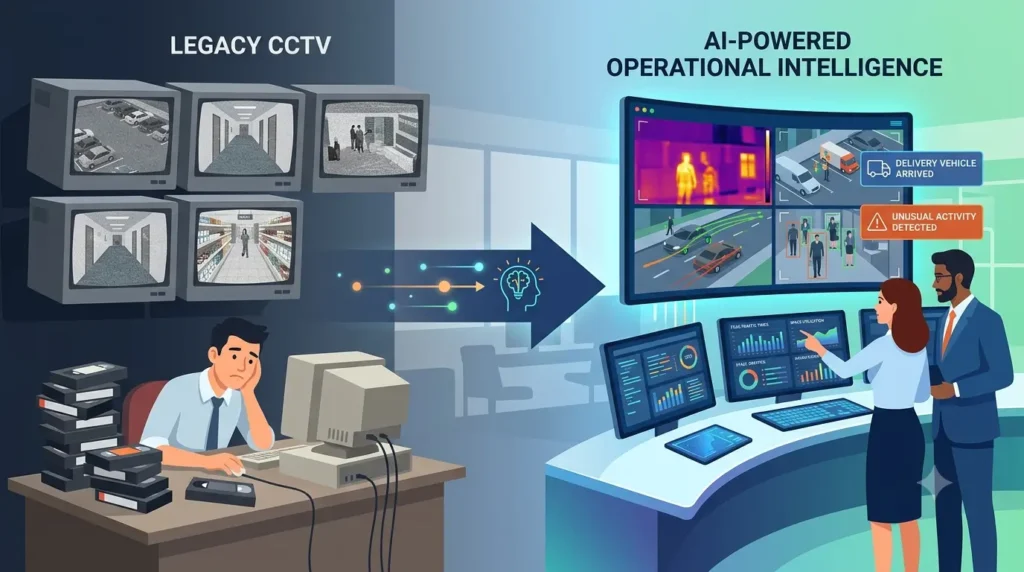
Legacy CCTV will not disappear overnight. Many existing cameras continue to provide perfectly usable video.
What is changing is the intelligence surrounding those cameras.
AI gives businesses the ability to search footage more efficiently, automate portions of monitoring, identify relevant events, and respond to problems faster. It can also help operations teams understand patterns that would otherwise remain buried inside thousands of hours of recordings.
For business leaders, that means surveillance technology is becoming less about collecting footage and more about extracting timely intelligence from it.
FAQs
What is AI video surveillance?
AI video surveillance combines security cameras with computer vision and machine learning technologies that can analyze video, recognize certain objects or events, and help automate monitoring and investigation tasks.
How is AI surveillance different from traditional CCTV?
Traditional CCTV primarily records footage for live viewing or later review. AI surveillance adds capabilities such as intelligent search, automated event detection, analytics, and real-time alerts.
Can businesses use AI with existing security cameras?
In many cases, yes. Some modern video platforms can integrate with existing IP cameras, allowing businesses to introduce AI capabilities without replacing every camera in their facilities.
Can AI completely replace security personnel?
No. AI is better viewed as an efficiency tool. It can help detect and prioritize events, but people remain responsible for interpreting situations, making decisions, communicating with others, and managing responses.
Why is natural-language video search useful?
Natural-language search allows users to describe what they are looking for instead of manually reviewing timelines. This can reduce investigation time, particularly across facilities with many cameras and long retention periods.
Conclusion
The transition from legacy CCTV to AI-powered video surveillance represents more than a camera upgrade. It changes the role video plays inside the business.
Instead of relying primarily on passive recording and manual investigation, organizations can use computer vision to identify important events, search footage more efficiently, improve response times, and uncover operational insights.
As facilities become more connected and camera networks continue to grow, businesses that modernize the intelligence behind their existing surveillance infrastructure can gain greater value from the video they are already collecting.