
The digital world has created employment for millions, but the constant evolution and major scenarios have also created hybrid and remote work opportunities. This digital transformation, along with other needs, has resulted in the creation of huge amounts of data that only cloud storage can accommodate. Cloud storage is being pursued by all types of organizations, from small to mid-size and large, because it offers regular data backup and recovery options and even fits the pockets of different budgets and needs.
If you are new in the industry and looking for a storage option for your business, cloud storage is the best, and there is no debate about it. However, we are not focusing on its benefits and features, but will discuss a rather important thing: how to choose one. The most common names you must have come across when looking for cloud storage are Google Drive or OneDrive, and they are often the preferred ones, but there are more options with added benefits.
You must make a decision not by how familiar you are with a few names, but what your business needs are and how one can fulfill them. Let’s help you with 4 important key considerations when choosing a cloud storage for your business.
Security
Security will always be the foremost concern for any business for obvious reasons, and you will have to treat it the same when choosing a cloud storage. There are several ways through which you can ensure that the cloud storage offers robust protection against common cyber-attacks, such as end-to-end encryption, password protection, multi-factor authentication, and compliance with standards including PCI DSS, HIPAA, and GDPR. This also becomes necessary to evaluate because, as per some renowned forums, almost 50% of online businesses are at risk of cyberattacks.
Also, ensure that the secure cloud storage offers reporting and governance features such as external sharing alerts so when someone outside your workspace accesses your storage, like a client, you know the permission settings to control access on whoever can access the storage and data. Not evaluating security features can be the most damaging step for your organization.
Integration with Other Software and Apps
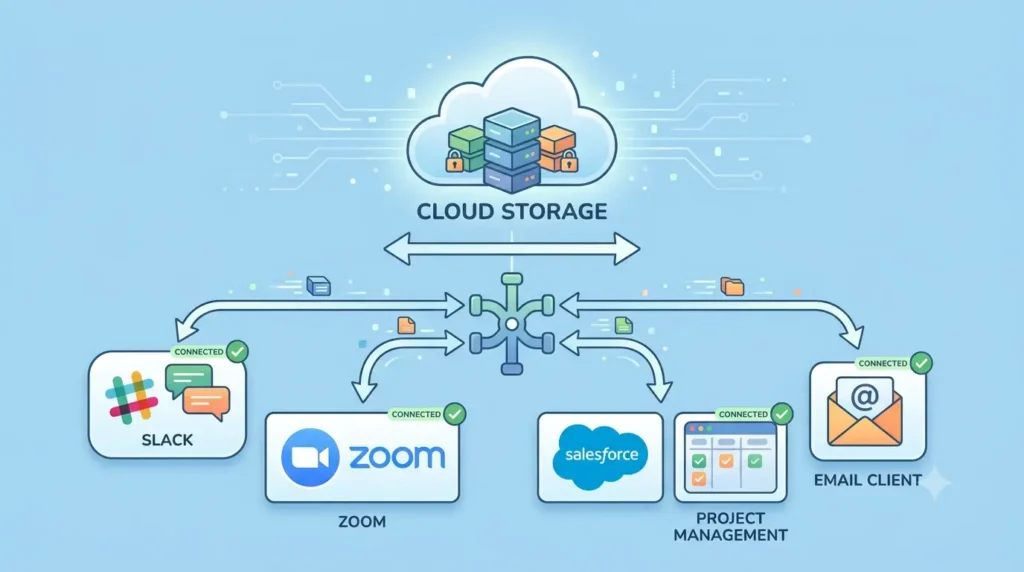
A business can’t run on a single software and app, but will rely on multiple, and they will also need to access some of your stored data for better productivity. Depending on this, the next key consideration for choosing a cloud storage should be integration with other software and apps that you use on a regular basis to operate your business. Some leading and renowned cloud storage does offer this feature, such as OneDrive and Google Drive, and it should be the same for the cloud storage you are choosing outside these popular choices.
Assuming that you and your team are already using some software for better productivity like Zoom, Slack, or Salesforce, check if the cloud storage offers extensions that can easily be integrated with these. A cloud storage working individually serves no purpose other than storing data, which can be done in other ways too because fetching data by different applications and software is a daily need.
Data Recovery
Loss of data can become the endpoint for many organizations because it is not accumulated in a day or two but is a result of years. Data safety is indeed one of the foremost concerns, but the worst scenarios can occur even with the safest practice. As cloud storage keeps your connected with your system and storage 24*7 by hosting it on the internet, it also increases the chances of specific kinds of attacks like an employee losing the device with access to the storage, deleting files accidentally, or someone from your organization sharing it.
All these will have less impact on your business if the cloud storage you have chosen offers data backup and recovery. Most storage does offer restoring files in case you accidentally lose them from previous sessions, but this is not the same for other scenarios. A cloud storage provider that regularly creates backups and can restore data from the last 30 days should be considered, and some even offer to recover data for 180 days.
Accessibility

The reason why businesses also opt for cloud storage other than security and data recovery is accessibility, which increases the productivity of your business. Since the data is stored online, it is always available to be accessed whenever there is a need, ensuring that your employees can work despite their locations. It should also offer mobile and desktop app availability so employees can have access to information without always switching devices in a controlled and secure environment, even when they are not online.
The cloud storage should also help with collaboration among teams and employees by allowing them real-time file sharing and co-editing options, and for this, opt for a solution that offers syncing and integration with existing systems. Also, keep in mind that when it comes to accessibility, different cloud storage offers different features; some can connect even when users are offline, while some need regular internet connectivity.
Other than these important key considerations, there is also a broader list that can determine the right cloud storage for your business, such as:
- Cost
- Storage needs
- After-purchase support and assistance
- Scalability and flexibility
- User recommendation
Final Words
Cloud storage has become the most standard choice when it comes to storage because it can accommodate vast data in its system and makes it available for users all the time. Though people think of common names as their options, there are more options with better features and functionalities. Whatever cloud storage you choose, ensure you evaluate its features based on key considerations that we have discussed here.
Since your business relies mainly on data, ensuring its safety against common threats and risks should be your major concern, but it should also comply with your business needs. Instead of restricting your access, it should offer better features and integration with the rest of the apps and software you use.