

AI tools such as ChatGPT, Perplexity, Gemini and Google’s AI Overviews now answer buyer questions directly, often naming a shortlist of businesses with no click to a website at all. Answer Engine Optimisation (AEO) and Generative Engine Optimisation (GEO) are the skills built around getting a business named accurately inside those answers. Both are young enough that a new marketer can still get ahead of the field.
Key takeaways
- AI answers now skip the click. Buyers ask an AI tool and get a named shortlist, not a page of blue links.
- AEO and GEO are genuinely new skills. Most digital marketing courses have not caught up yet.
- They build on SEO, not instead of it. A page still needs to be crawlable and indexed before it can be cited.
- Employers are starting to ask for it. Agencies are already building dedicated teams around this work.
- The field is young enough to learn fast. Standards are still forming, so an early mover has real room to specialise.
What Are AEO and GEO, and Why Should a Beginner Care?
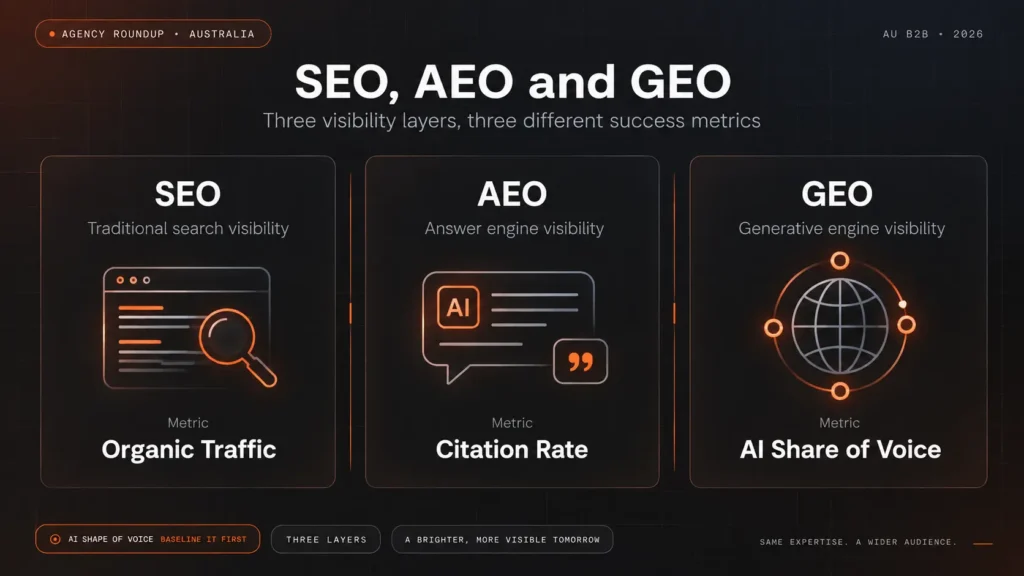
Answer Engine Optimisation is the practice of making content easy for an AI system to find, understand and use inside a generated answer. Generative Engine Optimisation covers the same goal across fuller AI-generated responses, comparisons and recommendations. Both sit alongside SEO rather than instead of it, and both ask a different question.
SEO asks whether a page ranks. AEO and GEO ask whether a business gets named, cited or recommended when an AI tool answers a buyer’s question. For someone starting a digital marketing career, this matters because most training still teaches SEO fundamentals and stops there, while the industry is already hiring for the newer skill set.
How Do AEO and GEO Differ from the SEO You Already Know?
The three disciplines overlap heavily but measure different things. The table below gives a quick comparison.
| Area | SEO | AEO | GEO |
| Goal | Rank in search results | Get cited in a direct AI answer | Get represented accurately in a generated response |
| Main metric | Rankings and clicks | Citation frequency | Mentions, accuracy, AI share of voice |
| Core skill | Keyword and technical optimisation | Structured, answer-first content | Topical authority and evidence |
| Where it shows up | Google search results page | ChatGPT, Perplexity, AI Overviews | Broader AI-generated comparisons and summaries |
What Skills Actually Sit Behind This Work?
Four skills come up again and again in AEO and GEO roles.
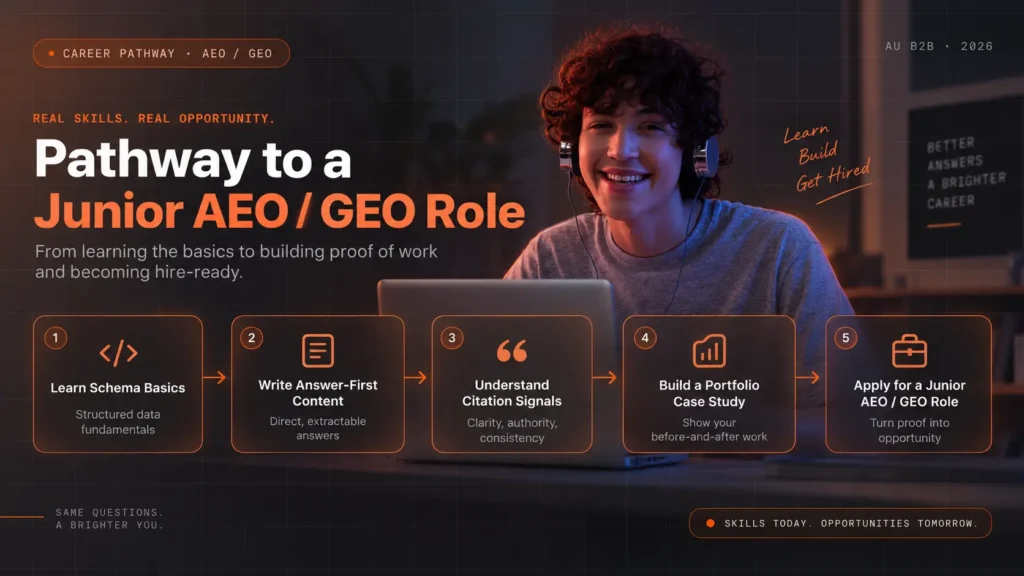
- Structured data and schema markup. Basic schema, such as FAQ and Article markup, gives an AI system a clean, unambiguous version of a page’s content to read.
- Answer-first writing. Content that states the answer in the first few sentences, then explains it, matches how people phrase questions to AI tools.
- Topical authority and citation signals. Original examples, data and expert commentary give an AI system a reason to cite a page rather than a generic competitor.
- Measuring AI share of voice. A newer metric: how often a brand is mentioned across a set of AI-generated answers, tracked over time rather than judged from a single screenshot.
Where Are These Skills Already Being Put to Work?
This is not a hypothetical skill set. Specialist agencies such as Intelligent Resourcing are building teams and services entirely around AEO and GEO, a sign of how quickly the field is professionalising. Roles now exist for people who can audit a site’s AI visibility, write answer-first content and report on citation data, work that barely existed as a job description two years ago.
For someone building a portfolio, this is a useful context. The skill set is specific enough to demonstrate, and rare enough that a well-documented project genuinely stands out to an employer.
Getting a Feel for the Industry Landscape
Before specialising, it helps to see how the industry is already structured. Providers position themselves differently depending on whether they lead with technical audits, content programmes or measurement dashboards, and a learner can pick up a lot from studying that variation.
It’s worth looking at how these services are packaged and sold: compare the best AEO providers across Australia to see the range of offerings a new professional might work alongside, or eventually aim to join.
How to Start Learning AEO and GEO
Whether you’re building these skills through a structured programme such as Excendra or piecing it together independently, the same starting points apply.
- Learn basic schema markup. Start with FAQ and Article schema on a real page, then check how it renders with a structured data testing tool.
- Practise answer-first writing. Rewrite an existing page so the direct answer sits in the first two sentences, then compare it against the original.
- Pick one real site to audit. Check whether its key pages are crawlable, indexed, and answer a clear question early.
- Run a simple AI-citation test. Ask ChatGPT or Perplexity a handful of relevant questions and record whether the site is named.
- Turn it into a portfolio case study. Document the before and after, including any citation change, so the work is demonstrable to an employer.
FAQs on AEO and GEO Skills for New Digital Marketers
Do I need to learn SEO first?
Yes. AEO and GEO both depend on a page being crawlable and indexed, so SEO fundamentals still come first.
Is AEO or GEO a full-time job yet?
Increasingly. Some agencies now run dedicated AEO and GEO teams, though many practitioners still combine it with broader digital marketing work.
What’s the fastest way to prove this skill to an employer?
A documented before-and-after case study on a real site, including any citation or mention change, demonstrates the skill more directly than a certificate alone.
Will AI answers replace search entirely?
Not yet. Search results and AI-generated answers currently sit side by side, so both skill sets stay relevant for now.