
Firebase is a powerful platform developed by Google that simplifies the process of building modern web and mobile applications. It provides a wide range of tools such as real-time databases, authentication, hosting, and analytics, allowing developers to focus more on user experience rather than backend infrastructure.
As part of broader technical interview questions preparation, Firebase has become an important topic for developers. Many companies expect candidates to understand its core services, architecture, and real-world applications.
In this guide, we cover the most important firebase interview questions to help both freshers and experienced professionals prepare effectively and boost their confidence for interviews.
What is Firebase?
Firebase is a cloud-based app development platform by Google that provides backend services such as databases, authentication, hosting, and analytics to help developers build and scale applications quickly.
Key Features of Firebase
- Realtime Database that syncs data instantly across users
- Cloud Firestore for scalable and structured NoSQL storage
- Authentication for secure user login
- Hosting for fast and secure web deployment
Why Do Companies Use Firebase?
Companies use Firebase because it reduces development time, scales automatically, and offers built-in tools for analytics, performance monitoring, and user engagement in one unified platform.
Firebase Features Overview
| Feature | Description |
| Cloud Firestore | Scalable NoSQL database with structured data storage |
| Realtime Database | Real-time JSON-based database |
| Authentication | Secure user login system |
| Firebase Cloud Messaging | Push notifications across platforms |
| Crashlytics | Real-time crash reporting tool |
| Hosting | Fast and secure web hosting |
| Cloud Functions | Serverless backend logic |
| Analytics | User behavior tracking and insights |
Firebase Interview Questions for Freshers
Q1. What is Firebase?
Firebase is a Backend-as-a-Service platform that provides developers with tools to build applications without managing servers. It includes services like databases, authentication, and hosting.
For example, instead of writing backend APIs, developers can directly use Firebase Firestore to store and retrieve data, making development faster.
Q2. What are the advantages of Firebase?
Firebase reduces development time by offering ready-to-use backend services. It supports real-time updates, automatic scaling, and seamless integration with Google tools.
For example, a startup can quickly launch an app without hiring a backend team, saving both time and cost.
Q3. What is Firebase Authentication?
Firebase Authentication is a service that allows users to securely sign in using email, phone, or third-party providers like Google.
For example, users can log in to an app using their Google account without creating a new password.
Q4. What is Cloud Firestore?
Cloud Firestore is a scalable NoSQL database that stores data in documents and collections.
For example, in a blog app, each post can be stored as a document, making it easy to retrieve and update.
Q5. What is Firebase Cloud Messaging (FCM)?
FCM is a service that sends push notifications to users across devices.
For example, a shopping app can notify users about discounts or order updates.
Q6. What is Firebase Realtime Database?
It is a cloud-hosted database that syncs data in real time across all clients.
For example, chat messages appear instantly for all users without refreshing.
Q7. What is Firebase Hosting?
Firebase Hosting allows developers to deploy web apps quickly with fast loading speeds.
For example, a portfolio website can be hosted globally using Firebase.
Q8. What is Firebase Crashlytics?
Crashlytics helps track and fix app crashes with detailed reports.
For example, it identifies the exact issue causing app failure.
Q9. What is Firebase Analytics?
Firebase Analytics tracks user behavior and app performance.
For example, it shows which features users interact with the most.
Q10. Is Firebase free?
Firebase offers a free tier with limited usage and paid plans for scaling.
For example, small apps can run completely on the free plan initially.
Intermediate Firebase Interview Questions
Q11. What is the difference between Firestore and Realtime Database?
Realtime Database stores data as a JSON tree, while Firestore uses a document-based structure.
Firestore supports better scalability, advanced queries, and indexing, making it suitable for complex applications.
Q12. How does Firebase handle offline data?
Firebase caches data locally when offline and syncs it when connectivity is restored.
For example, users can continue using an app even without internet.
Q13. What are Firebase security rules?
Security rules control access to data based on authentication and conditions.
For example, users can only access their own data in an app.
Q14. How does indexing work in Firestore?
Firestore uses indexes to speed up queries.
For complex queries, developers need to create composite indexes to improve performance.
Q15. How do you implement authentication in Firebase?
You integrate Firebase SDK and enable sign-in methods.
For example, adding Google login takes just a few steps using Firebase console.
Advanced Firebase Interview Questions
Q16. How do you scale Firebase applications?
Firebase scales automatically using Google Cloud infrastructure.
However, developers must optimize database structure and queries to handle large traffic efficiently.
Q17. What are the limitations of Firebase?
Firebase has limitations such as vendor lock-in and limited complex query support.
It may not be ideal for highly customized backend logic.
Q18. How can you optimize Firebase costs?
Optimize by reducing unnecessary reads and writes, using efficient queries, and caching data.
For example, avoid repeated database calls for the same data.
Q19. Firebase vs AWS Amplify
Firebase is easier to use and ideal for quick development, while AWS Amplify offers more flexibility and control.
Firebase is better for startups, whereas AWS suits enterprise-level applications.
Q20. How do you secure large-scale Firebase apps?
Use strict security rules, authentication, and data validation.
For example, role-based access ensures only authorized users can access data.
Scenario-Based Firebase Interview Questions
Q21. How would you build a chat application using Firebase?
Use Realtime Database or Firestore to store messages.
Attach listeners to update messages in real time. Use authentication for user identity and FCM for notifications.
Q22. How to optimize Firestore queries?
Use indexing, limit query size, and structure data efficiently.
For example, avoid deeply nested data structures.
Q23. How to handle high traffic in Firebase?
Use efficient queries, caching, and Cloud Functions.
For example, reduce unnecessary reads to improve performance.
Q24. How to debug Firebase performance issues?
Use Firebase Performance Monitoring and logs.
Identify slow queries and optimize them.
Additional Intermediate Firebase Interview Questions
Q25. How does Firebase handle real-time synchronization?
Firebase uses WebSockets to maintain an active connection between client and server. Whenever data changes, updates are pushed instantly to all connected clients.
For example, in a collaborative app, changes made by one user are immediately visible to others without refreshing the page.
Q26. What are collections and documents in Firestore?
Firestore organizes data into collections and documents. A collection contains multiple documents, and each document holds key-value pairs.
For example, a “users” collection can contain documents for each user, storing their profile data.
Q27. What is the role of Firebase SDK?
Firebase SDK allows applications to interact with Firebase services easily. It provides pre-built functions for authentication, database operations, and analytics.
For example, developers can fetch data from Firestore using simple SDK methods instead of writing backend APIs.
Q28. What is Firebase Remote Config?
Remote Config allows developers to change app behavior without releasing updates. It is commonly used for feature toggles and A/B testing.
For example, you can enable a new feature for only 10 percent of users to test performance.
Q29. What is Firebase App Distribution?
Firebase App Distribution helps distribute pre-release versions of apps to testers. It simplifies beta testing and feedback collection.
For example, developers can share APK files with testers directly through Firebase.
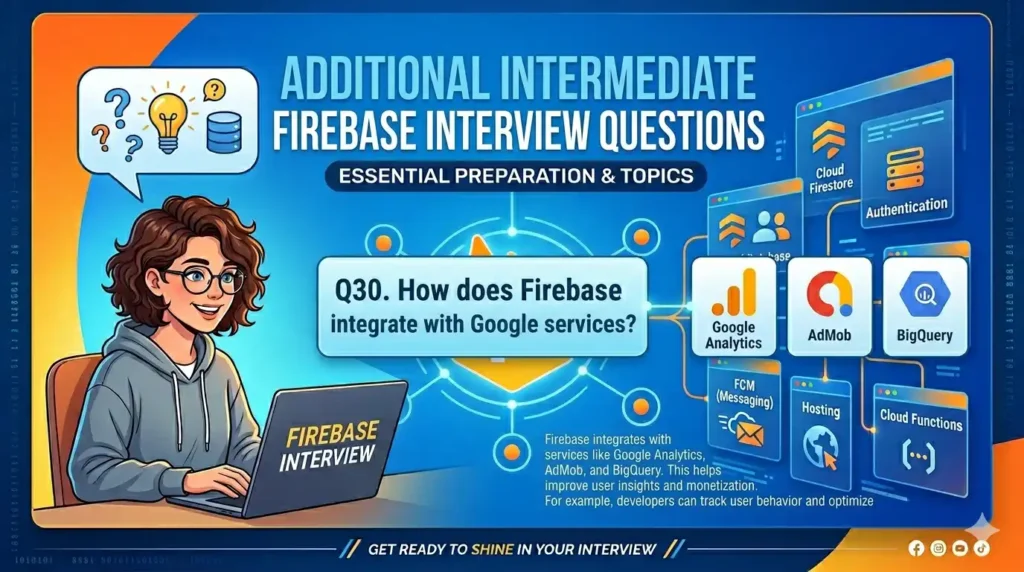
Q30. How does Firebase integrate with Google services?
Firebase integrates with services like Google Analytics, AdMob, and BigQuery. This helps improve user insights and monetization.
For example, developers can track user behavior and optimize ads using these integrations.
Additional Advanced Firebase Interview Questions
Q31. How do you design a scalable Firestore database?
To design a scalable Firestore database, you should structure data into collections and avoid deep nesting. Use indexing and optimize queries to reduce read operations.
For example, splitting large datasets into smaller collections improves performance.
Q32. What is data denormalization in Firebase?
Denormalization involves duplicating data to improve read performance. Since Firebase is NoSQL, joins are not supported.
For example, storing user names along with posts avoids multiple queries.
Q33. How do you manage large datasets in Firebase?
Use pagination, indexing, and efficient queries. Avoid fetching unnecessary data.
For example, load only 10 records at a time instead of the entire dataset.
Q34. What are Firebase quotas and limits?
Firebase has limits on reads, writes, storage, and concurrent connections. Exceeding these can impact performance or cost.
For example, excessive reads can increase billing in production apps.
Q35. How does Firebase ensure data consistency?
Firebase uses real-time syncing and conflict resolution mechanisms. Updates are applied in order and synced across clients.
For example, simultaneous edits are handled using last-write-wins strategy.
Q36. What is vendor lock-in in Firebase?
Vendor lock-in means your app becomes dependent on Firebase services, making migration difficult.
For example, switching from Firebase to another backend may require major code changes.
Additional Scenario-Based Questions
Q37. How would you design a notification system using Firebase?
Use Firebase Cloud Messaging to send notifications and Cloud Functions to trigger them based on events.
For example, send a notification when a user receives a new message.
Q38. How would you migrate from Realtime Database to Firestore?
Export data, restructure it into collections and documents, and update queries accordingly.
For example, convert JSON tree data into structured documents.
Q39. How do you handle authentication in a multi-role application?
Use Firebase Authentication and define roles using custom claims. Apply security rules based on roles.
For example, admins get full access while users have limited permissions.
Q40. How would you reduce Firebase billing costs in a production app?
Optimize database reads, use caching, and avoid unnecessary queries.
For example, store frequently accessed data locally to reduce reads.
Q41. How do you implement file uploads in Firebase?
Use Firebase Storage to upload and store files securely.
For example, users can upload profile pictures stored in cloud storage.
FAQ
Is Firebase good for backend development?
Yes, Firebase is excellent for backend development, especially for small to medium-scale applications. It eliminates the need for server management and provides ready-to-use services like databases and authentication.
Is Firebase easy to learn?
Firebase is relatively easy to learn compared to traditional backend technologies. Its documentation and SDKs make it beginner-friendly.
What companies use Firebase?
Many startups and large companies use Firebase for app development, analytics, and user engagement.
Is Firebase free?
Firebase offers a free tier, but pricing depends on usage for larger applications.
Conclusion
Preparing Firebase interview questions thoroughly can significantly improve your chances of success in technical interviews. Whether you are a fresher or an experienced developer, understanding core concepts, real-world scenarios, and best practices is essential.
Focus on consistent practice and explore a wide range of firebase interview questions for freshers and experienced professionals to build confidence and crack your next interview successfully.