
Over the last few years, AI has become an inseparable part of the learning process. Whether it’s for research purposes or to gain a better understanding of complex concepts, more and more students turn to AI assistants for help. While the majority of educational establishments accept that the use of AI is inevitable, very few provide actual frameworks on how to properly do this. Let’s take a closer look at different ways AI technology can be implemented in the learning process, so both teachers and students can effectively use it in their everyday work.
How AI Writing Assistants Are Revolutionizing Learning in Education
The majority of education systems aren’t built to provide their students with 24-hour support, which means that students with different abilities may not get the necessary help they need to understand the subject.
An AI assistant can help students at any time of the day, becoming a study buddy with a variety of useful features. It’s like having all the necessary materials gathered in one place – an electronic library, records of lessons, knowledge quizzes, and all kinds of educational resources.
What’s even more important, this type of help is highly interactive for students of all age groups and doesn’t rely solely on their own ability to focus on the task, which can quickly get boring. In the end, students can grasp complex ideas faster and check what they’ve already learned using AI and its feedback.
Moreover, writing coherently and concisely is a skill that most students acquire along the way. The use of software such as the JustDone platform can be very helpful in the process of reviewing an article or an essay that’s already written. In many cases, students still end up with bulky writing that needs to be edited even if they didn’t use any AI tools in the process. Getting help from tools like JustDone can help them analyze their work and improve their writing considerably using humanization features.
The Benefits of AI Writing Tools for Students and Teachers
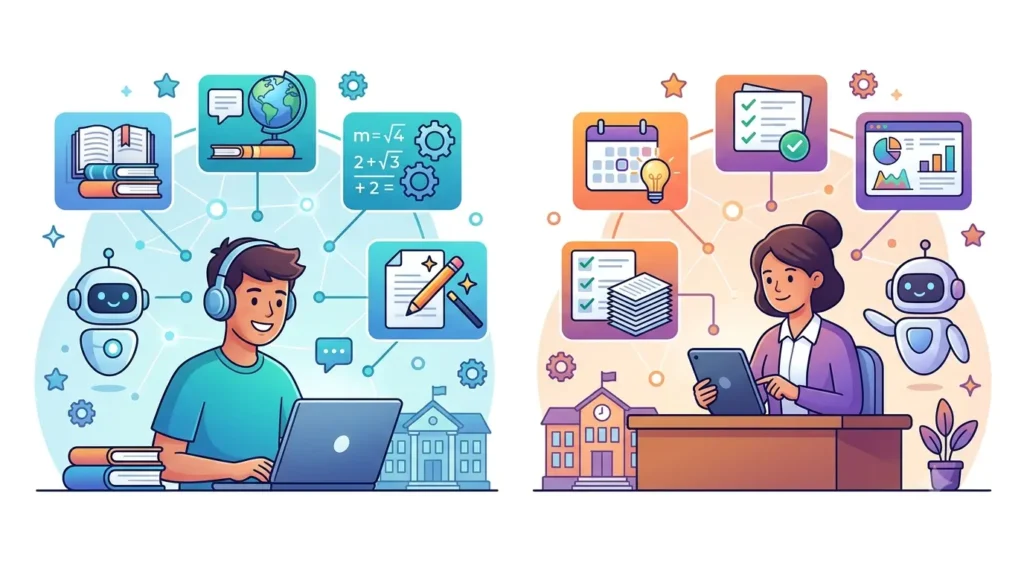
If we look at the statistics provided by the Pew Research Center, we can understand just how much modern students rely on AI chatbots both in their studies and personal lives. Let’s look at the numbers:
- 57% of the respondents used AI tools to search for information.
- 54% used AI to get help with their schoolwork.
- 42% used it to get summaries of books, videos, and articles.
- 47% used AI to pass the time doing something fun and entertaining.
That being said, only 1 out of 10 students admitted that they do the majority of their homework with AI’s help. This means that despite the general fear of teenagers using too much AI in their studies, the actual numbers are different, and the ways students use these tools also differ, depending on various factors.
So, what are students using AI chatbots for when studying? Here are a few examples:
- 48% admit they’re using AI to research different topics because it’s easier that way.
- 43% use AI to solve math problems.
- 35% admitted they turn to AI tools to edit something they wrote.
This shows us that most students use AI for research and problem-solving. Of course, they use artificial intelligence for writing as well, but it’s not as widespread as we thought.
Personalized Learning and Immediate Feedback
These statistics give teachers an idea of the ways students use AI during their study process so that they can utilize it more effectively, recognizing that it is actually a helpful tool in the learning process. At times, teachers do not consider different levels of learning speed among diverse groups of students and treat them equally despite the differences. This causes some students to fall behind and miss the needed support.
While AI assistants would never replace the in-class learning process, students might use artificial intelligence to solve various issues. When the teacher is not available, AI can give feedback on the student’s writing, along with some ideas on how to improve it.
Of course, one can’t blindly trust AI and treat everything that it generates at face value. Teachers should always verify the content generated by AI tools. Meanwhile, students need to be aware of the initial assignment criteria and the conformity between the commentary generated by AI and these criteria. Finally, the credible sources should also be checked.
Improving Writing and Research Skills
AI tools have one important function that can greatly improve students’ writing skills – it makes the whole writing process more transparent. By doing activities such as brainstorming the topic and title of the essay, doing research, and revising the final text, students will have a better understanding of the whole process. They will also learn about all the writing stages they need to go through to produce the best result.
At any step of this process, they can get help from the AI assistant, particularly if the students want to know why some paragraph is not clear or how they can avoid repetition. By analyzing the written content using AI tools such as the JustDone platform, students can greatly improve their overall writing capabilities, finding areas where they’re lacking.
The main point here is not to follow the system blindly – each revision needs to be properly weighed and analyzed. It’s always best to combine such AI-powered supervision with in-class writing activities to teach the students proper ways of writing in real time. Due to the fact that students most certainly will still be using AI one way or another, it’s crucial for educators to teach them the right ways to do it.
Practical Tips for Using AI Writing Assistants Effectively
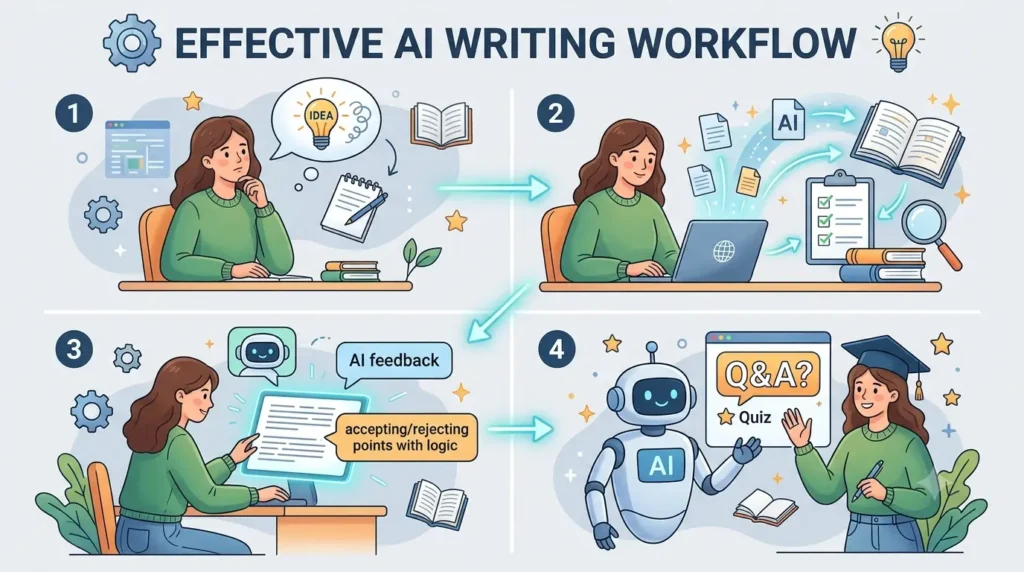
Simply relying on generated answers will never garner good results, be it for a teacher or a student. One should develop a certain workflow that is customized according to the writing needs for a certain subject. But if we talk in general, here are a few tips that can help you approach AI assistants in a more effective way:
- When you get a new task, think it over first. You can use AI later after you’ve noted down some of your original thoughts. This way, you will make sure your work is original.
- Fact-checking is important. Whether it’s a broad or narrow topic, you should always check what AI has provided you with. Visit the corresponding resources and do the research yourself. This way, you’ll ensure your writing is truly authentic.
- Revise your work in a smart way. Use the AI assistant for feedback and then present arguments for why you accept the remarks or reject them.
One of the easiest and most effective ways to use an AI chatbot is asking it to be your tutor. This little role-playing game transforms a regular chatbot into an actual teacher who would prompt you to think for yourself, rather than provide you with ready answers.
For instance, you have already written the essay and now wish to test your knowledge. In this case, the AI system will be able to ask you certain questions and then analyze your answers. You can also ask AI to create a special quiz for you to make things more interactive.
Conclusion
In this day and age, both students and teachers turn to AI tools for solving various tasks. Educational institutions recognize that while AI tools aren’t 100% reliable, they can still provide valuable help to students who experience issues with their learning process. Not only is AI there for students 24/7, but it can also give customized advice and coherent feedback on the finished writing.
In the end, it’s not about fully relying on AI tools to complete the tasks, but about getting help at various stages of the learning or writing process. Thus, students can get help with new ideas, creating drafts, and revisions of their articles and essays even before they get the teachers to check them.
FAQ
1. What’s an AI writing assistant in digital learning?
It is an artificial intelligence tool that makes use of prompts to generate different kinds of material for students. Before any writing begins, it can also assist them in coming up with ideas, drafting their text, creating an outline, explaining complex topics, and revising the already-written text.
2. Can AI writing tools replace teachers?
No, AI-powered chatbots and assistants can never replace teachers, as they can’t give personal guidance, and the information they provide still needs to be fact-checked. That being said, AI tools are still handy as they can provide immediate feedback and give explanations 24/7 when teachers are unavailable to students in need of help.
3. How can students use AI responsibly?
To begin with, it is necessary for all students to strictly adhere to the policies of their educational establishment related to AI. In case there are no policies that define how to deal with AI, one should always consult his/her tutor. Generally speaking, while working with AI, one should check all information provided by such tools and make sure they understand the subject matter well enough on their own.
4. Are AI detection tools always accurate?
No, AI detection tools aren’t 100% accurate. Some texts written by students may be flagged as machine-generated due to specific speech patterns they use or a more formal style of writing. The results of AI detection should be carefully used alongside the whole bulk of the student’s work, including their drafts, provided source materials, citations, and other evidence that backs up their work.
5. What is the biggest benefit of AI in digital education?
Of course, no artificial intelligence tool is perfect; however, it could offer prompt help for those who need it. This may include extra explanation of material covered in class, personalized exercises according to the level of one’s knowledge, or even writing help.