
Free online learning has quietly become one of the biggest shifts in how people build careers. You don’t need a university acceptance letter or a five-figure tuition bill to learn data analysis, project management, or digital marketing anymore. A laptop and a few hours a week are often enough to get started.
But here’s the catch that trips up a lot of learners: a free course and a free certificate are not always the same thing. Plenty of platforms let you watch every lecture for free, then ask for payment the moment you want a certificate to show for it. Knowing the difference before you enroll saves you time, money, and frustration.
This guide is built around free online courses with certificates that are actually free, not “free to start, pay to finish.” We’ll walk through the best options by career goal, by subject, by provider, and by platform, then cover how to tell a valuable certificate from a resume filler, and how to actually use what you earn.
What Are Free Online Courses With Certificates?
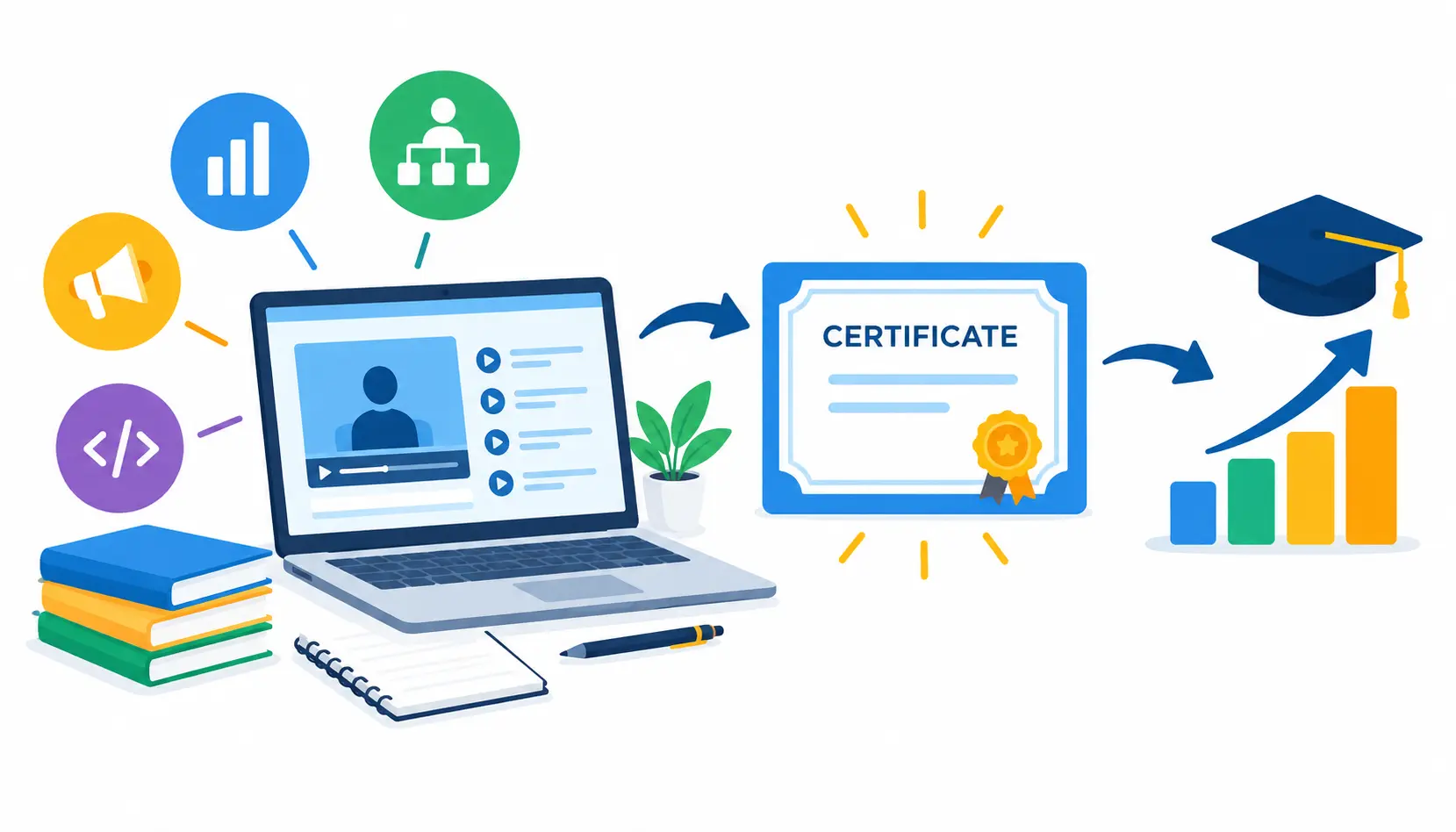
A free online course with a certificate is a course you can complete without paying tuition, and that issues you a document or digital credential once you finish. That sounds simple, but the details matter a lot once you start comparing providers.
What “Free” Actually Means
“Free” can mean a few different things depending on the platform. Sometimes it means the entire course, including the certificate, costs nothing. Other times it means you can watch the lessons for free but need to pay, or qualify for financial aid, to unlock the graded work and the certificate.
On Coursera, for example, you can often “audit” a course for free, which gives you the videos and readings but not the certificate. To get the certificate without paying, you typically need to apply for Coursera’s financial aid program, which can grant free access to the full course and credential if approved. Read the enrollment page carefully before you assume a course is free end to end.
Free Course vs Free Certificate
This is the single most common point of confusion in this space. A course being free tells you nothing about whether the certificate is free. Some providers, like Google’s Skillshop and Digital Garage programs, give you both the learning and the certificate at no cost. Others, like many Coursera Professional Certificates, separate the two.
Before you invest your time, check the certificate page specifically, not just the enrollment page. Look for the words “audit,” “free trial,” or “financial aid,” which are all signals that the certificate isn’t automatically included.
Certificate vs Certification vs Digital Badge
These three terms get used interchangeably, but they aren’t the same thing:
- A certificate of completion simply confirms you finished a course. It doesn’t test mastery in a rigorous way.
- A certification usually involves an exam or a more formal assessment process, often tied to a professional body or vendor (think AWS or Cisco certifications).
- A digital badge is a smaller, skill-specific credential, often issued for finishing a short module. Badges are increasingly used by companies like Google and Microsoft to recognize narrower skills.
None of these is automatically “better.” What matters is whether the issuing organization is respected in your target industry.
Are Free Online Certificates Legitimate?
Yes, generally, as long as they come from a recognized institution or company. A certificate from Harvard, Google, IBM, or a properly accredited university carries real weight because the issuer’s reputation backs it. A certificate from an obscure site with no verification process carries very little.
Legitimacy isn’t about the price tag. It’s about who is willing to put their name on your credential, and whether an employer can verify it if they choose to.
Best Free Online Courses With Certificates
Here’s a quick comparison of well-known, genuinely free options across popular categories. Duration and certificate terms can change, so always confirm details on the provider’s page before enrolling.
| Course | Provider | Subject | Level | Duration | Certificate | Best For |
| CS50: Introduction to Computer Science | Harvard (via edX) | Computer Science | Beginner | ~10-20 hrs/week, 12 weeks | Free audit; verified certificate paid | Career changers into tech |
| Google Digital Garage: Fundamentals of Digital Marketing | Marketing | Beginner | ~40 hours | Free | Job seekers, small business owners | |
| Google Ads / Analytics Certifications | Google Skillshop | Marketing/Analytics | Beginner-Intermediate | A few hours per exam | Free | Marketers, freelancers |
| Responsive Web Design | freeCodeCamp | Web Development | Beginner | Self-paced | Free | Aspiring developers |
| IBM SkillsBuild Courses | IBM | Tech, AI, Business | Beginner-Intermediate | Varies | Free | Students, career starters |
| CS50’s Introduction to AI | Harvard (via edX) | Artificial Intelligence | Intermediate | ~10 hrs/week | Free audit; paid certificate | Developers exploring AI |
| Google AI Essentials | AI Literacy | Beginner | ~9-10 hours | Free (via promotional access, terms vary) | Non-technical professionals | |
| Cisco Introduction to Cybersecurity | Cisco Networking Academy | Cybersecurity | Beginner | ~6 hours | Free | Students, IT beginners |
Rather than listing courses in a random order, it helps more to think about what you’re trying to achieve. That’s how the rest of this guide is organized.
Best Free Online Courses for Career Development
Your situation shapes which course is actually worth your time. A recent graduate and a mid-career professional need very different things from a “free certificate.”
Best for Job Seekers
If you’re actively applying for jobs, prioritize short, recognizable credentials over long academic courses. Google’s Skillshop certifications, IBM SkillsBuild courses, and Cisco’s introductory cybersecurity course are all quick to finish and instantly recognizable to hiring managers in relevant fields.
Best for Career Changers
Career changers benefit more from structured, multi-course programs that build a portfolio, not just a single badge. Look at freeCodeCamp’s full curriculum for web development or IBM’s data and AI learning paths on SkillsBuild, both let you build real projects you can show, not just a certificate you can list.
Best for Students
Students often get the best deal in this space. University-run platforms like edX and OpenLearn (from the UK’s Open University) let students audit rigorous, real university courses for free, and many student-focused platforms offer discounted or waived certificate fees.
Best for Working Professionals
If you’re employed and learning on the side, time efficiency matters most. Short, focused courses, like a single Google Analytics certification or a LinkedIn Learning module your employer already has access to, fit better than long semester-style programs.
Best for Beginners
Total beginners should start with something structured and low-stakes. Google Digital Garage and Cisco’s introductory courses are built for people with no prior background, and neither assumes you already know industry jargon.
Best Free Technology Courses With Certificates
Technology is where free certificates are most abundant, largely because tech companies use free learning as a recruiting and ecosystem-building tool.
IT and Computer Science
Harvard’s CS50 remains the most widely recommended free introduction to computer science, and it’s genuinely rigorous rather than a marketing exercise. Google’s IT Support learning content and Cisco Networking Academy also offer solid, free foundational material.
Programming
freeCodeCamp is the standout here, a nonprofit that offers a full, free curriculum in web development, JavaScript, Python, and more, along with free certifications for each section you complete. Its community is active on platforms like r/freecodecamp on Reddit, where learners regularly share study plans and job outcomes.
Data Analytics
IBM SkillsBuild and Google’s Skillshop-adjacent data content are strong free starting points. For a deeper program, Google’s Data Analytics Professional Certificate on Coursera can be audited free, with the certificate available through financial aid if you qualify.
Artificial Intelligence and Machine Learning
Google’s AI Essentials course and Harvard’s CS50 AI course (via edX) are two of the most credible free entry points into AI right now. Hugging Face also offers free, community-driven courses on machine learning and natural language processing aimed at practitioners who want hands-on experience rather than theory alone.
Cybersecurity
Cisco Networking Academy’s Introduction to Cybersecurity is one of the most respected free starting points in this field, and IBM SkillsBuild offers complementary free content on security fundamentals.
Cloud Computing
AWS Skill Builder offers free digital training and badges across its cloud fundamentals content, though formal AWS certification exams carry separate fees. Microsoft Learn offers a similarly structured free path into Azure fundamentals.
Web Development
freeCodeCamp again leads here, alongside Google’s web development learning paths. Both are hands-on, project-based, and free from start to finish.
Class Central, an independent course aggregator, tracks hundreds of free courses and credentials across these exact categories and regularly publishes updated counts, it’s worth bookmarking if you want to see what’s currently available before committing to one provider.
Best Free Business Courses With Certificates
Business Management
Several universities offer free-to-audit management courses through edX and OpenLearn, covering fundamentals like organizational behavior and strategy.
Project Management
Google’s Project Management content and free introductory material from PMI-adjacent sources are good starting points before committing to a paid certification like the PMP.
Finance
Free finance fundamentals courses from university platforms cover budgeting, corporate finance basics, and financial literacy, useful groundwork before a paid, credentialed finance certification.
Entrepreneurship
Many business schools offer free-to-audit entrepreneurship courses through edX, often taught by the same faculty who teach the paid MBA versions.
Leadership
Short leadership modules are common on LinkedIn Learning (often free through library or employer access) and on OpenLearn.
Best Free Digital Marketing Courses With Certificates
SEO
Semrush Academy offers free SEO courses with certificates, covering keyword research, technical SEO, and content strategy, taught by working practitioners rather than generic instructors.
Content Marketing
HubSpot Academy’s Content Marketing course is free and includes a certificate, and it’s one of the more widely recognized marketing credentials among hiring managers.
Social Media Marketing
Meta offers free social media marketing courses through its Blueprint program, covering both organic and paid strategy on its platforms.
Google Ads
Google Skillshop’s Ads certifications (Search, Display, Video, and more) are completely free and are the industry-standard credential for PPC roles.
Analytics
Google Analytics certification through Skillshop is free and widely requested in marketing and e-commerce job postings.
Email Marketing
HubSpot Academy also offers a free email marketing course and certificate, useful for anyone moving into lifecycle or CRM marketing roles.
Class Central currently identifies hundreds of free digital marketing certificates and badges across these providers, which reflects just how competitive this space has become among companies trying to build brand loyalty through education.
Best Free Courses for Communication and Soft Skills
Communication
Short, free communication skills courses are available on OpenLearn and through university extension programs, often focused on workplace writing and public speaking.
Leadership
Beyond the business-focused options above, several free leadership modules focus specifically on team management and feedback delivery, practical skills for new managers.
Negotiation
A handful of university-backed free courses on negotiation fundamentals are available to audit through edX, drawing on real case studies from business school curricula.
Time Management
Short, free time management and productivity courses are common on OpenLearn and similar platforms, usually structured as a few hours of self-paced content.
Workplace Skills
General workplace readiness courses, covering things like professional email etiquette and meeting management, are often bundled into IT Support or business fundamentals programs.
Best Universities Offering Free Online Courses With Certificates
Harvard
Harvard’s CS50 is the flagship example: free to audit through edX, with a wide range of spinoff courses in AI, cybersecurity, and web programming.
Stanford
Stanford offers select free-to-audit courses through edX and its own online learning initiatives, particularly in computer science and machine learning.
MIT
MIT OpenCourseWare has offered free course materials for decades, though it’s worth noting that OpenCourseWare traditionally provides materials rather than formal certificates, check current offerings for which courses now include a credential option.
Yale
Yale offers free-to-audit courses on platforms like Coursera, including well-known courses in psychology and well-being.
Open University
The UK’s Open University runs OpenLearn, which offers genuinely free short courses with free statements of participation, making it one of the more consistently free university platforms.
Other Universities to Consider
The University of Michigan, University of Pennsylvania, and University of Edinburgh all regularly offer free-to-audit courses through major platforms, each with their own certificate terms.
It’s worth repeating the core caveat here: free course access and free certification are not necessarily the same thing, even when a prestigious university is involved. Always check the certificate terms separately from the enrollment terms.
Best Platforms for Free Online Courses With Certificates
Class Central
Class Central is an independent course discovery platform (not a course provider itself) that aggregates and reviews free and paid courses from Coursera, edX, and hundreds of other sites. It’s genuinely useful for finding what’s currently free before you commit elsewhere. See its Wikipedia entry for background on the platform.
Udemy
Udemy hosts a mix of free and paid courses from independent instructors. Free Udemy courses typically include a certificate of completion, but because instructor quality varies widely, it’s worth checking reviews before enrolling.
Coursera
Coursera partners with universities and companies to offer both free-to-audit courses and paid Professional Certificates. Financial aid is the main path to a free certificate on courses that would otherwise require payment.
edX
edX (now part of 2U) offers free audit access to thousands of university courses, with verified certificates available for a fee. It’s one of the best platforms for genuinely academic, free content.
OpenLearn
OpenLearn, run by the Open University, is one of the few platforms where both the course and the completion statement are free by default, without an audit-versus-paid split.
FutureLearn
FutureLearn offers free courses from UK and international universities, typically with free access for a limited time window and paid upgrade options for permanent access and certificates.
Saylor Academy
Saylor Academy is a nonprofit that offers genuinely free courses with free certificates, aimed at learners who might not otherwise have access to higher education resources.
Other Specialized Platforms
Platforms like Hugging Face (for AI/ML), Semrush Academy (for SEO), and HubSpot Academy (for marketing) specialize in one subject area and tend to offer free, high-quality, industry-specific certificates.
Free Online Courses From Major Technology Companies
Google runs several free learning programs, including Skillshop (Ads, Analytics), Digital Garage (marketing fundamentals), and AI Essentials. Its paid Google Career Certificates on Coursera are a separate, more advanced program that isn’t free by default, though financial aid can make them accessible at no cost.
Microsoft
Microsoft Learn offers free, self-paced modules across Azure, Microsoft 365, and Power Platform, many with free digital badges upon completion.
IBM
IBM SkillsBuild provides free courses and certificates in technology, data, and business skills, aimed particularly at students and career starters.
Amazon Web Services
AWS Skill Builder offers free digital training content and badges, with paid options for formal certification exams and deeper hands-on labs.
Cisco
Cisco Networking Academy offers free courses in networking and cybersecurity fundamentals, widely used in secondary and higher education settings.
Meta
Meta’s Blueprint program offers free courses and certifications in social media marketing and advertising on its platforms.
Other Technology Providers
Companies like Salesforce (Trailhead) and Hugging Face also offer free, skill-specific certifications that are increasingly recognized in their respective niches.
How to Choose the Right Free Online Course
Start With Your Career Goal
Work backward from the job or skill you actually want. A course is only useful if it moves you closer to a specific outcome, not just because it’s free and available.
Choose a Skill, Not Just a Certificate
The certificate is a byproduct, not the goal. Focus on courses that teach something you can demonstrate in an interview or a portfolio, not just something you can list.
Check the Provider
A certificate is only as credible as the organization behind it. Search the provider’s name alongside terms like “reviews” or “recognized by employers” before committing significant time.
Verify That the Certificate Is Actually Free
Re-check this at the enrollment stage, not just from a blog post like this one. Platforms change their pricing and audit policies fairly often.
Check Course Difficulty
Read a handful of learner reviews on the course page or on a community like Reddit before starting, so you know whether the difficulty matches your current level.
Check Time Commitment
Be honest about how many hours a week you can realistically commit, and pick a course length that matches, a 40-hour course finished slowly is better than a 100-hour course abandoned halfway.
Look for Assessments and Projects
Courses that include real assignments or projects teach more, and give you something concrete to show employers, unlike courses that only require watching videos.
Consider Employer Recognition
Before investing serious time, search job postings in your target field on LinkedIn to see whether the certificate you’re considering actually appears as a listed qualification.
How to Tell Whether a Free Certificate Is Worth It
Use this simple scoring framework before you commit your time to any course:
| Factor | What to Check |
| Provider reputation | Who issues it, a known company, university, or nonprofit? |
| Verification | Can an employer verify the certificate online? |
| Assessment | Does the course actually test your knowledge, or just track video views? |
| Relevance | Does it match the skills listed in your target job postings? |
| Practical work | Does the course include projects or hands-on exercises? |
| Recognition | Is the provider known and respected in your specific industry? |
If a certificate scores well across most of these, it’s worth your time. If it fails on provider reputation and verification, treat it as personal learning rather than resume material.
Are Free Online Certificates Worth It?
When They Are Valuable
Free certificates are valuable when they come from a recognizable provider, fill a real skill gap on your resume, and are paired with evidence you actually applied the skill, a project, a portfolio piece, or a work example.
When They Have Limited Value
They have limited value when they’re from an unknown provider, involve no real assessment, or when you’re collecting them faster than you can apply what they teach. A resume with ten unrelated certificates often reads as less focused than one with two relevant ones.
How to Combine Certificates With Projects
Pair every certificate with something tangible. If you complete a data analytics course, build a small dashboard with real data. If you complete a marketing certificate, run a mock campaign or audit a real (even personal) website. This is what actually convinces hiring managers.
How Many Certificates Do You Actually Need?
There’s no fixed number, but quality beats quantity every time. Two or three relevant, well-chosen certificates paired with real project work will do more for your career than a long, unfocused list. The goal should be skill evidence, not certificate collecting.
How to Put Free Online Courses on Your Resume
Where to List Certificates
Create a dedicated “Certifications” or “Professional Development” section, separate from your work experience and education. This keeps your resume scannable for recruiters and applicant tracking systems.
What Information to Include
List the certificate name, the issuing organization, and the completion date. If the certificate is verifiable online, you can optionally include a short note like “verifiable” rather than a full link, which keeps the resume clean.
Resume Example
Certifications Google Analytics Certification | Google Skillshop | 2026 Responsive Web Design Certification | freeCodeCamp | 2025
Should You Put Free Courses on LinkedIn?
Yes, especially relevant ones. LinkedIn’s Licenses & Certifications section is designed exactly for this, and recruiters actively search LinkedIn by skill and certification.
How to Add Free Certificates to LinkedIn
Add the Certificate Under Licenses & Certifications
Go to your LinkedIn profile, select “Add profile section,” then “Licenses & Certifications,” and fill in the details from your certificate.
Include the Issuing Organization
LinkedIn often auto-suggests the correct organization page as you type, which helps your certificate display the provider’s logo, a small detail that adds credibility at a glance.
Add a Verification Link
If your certificate includes a public verification URL (common with Coursera and edX), add it to the credential ID or URL field so anyone viewing your profile can confirm it’s real.
Match Certificates to Your Career Goal
Only add certificates relevant to the roles you’re targeting. A cluttered certifications section can dilute your profile rather than strengthen it.
Free Course vs Paid Course: Which Should You Choose?
| Factor | Free Course | Paid Course |
| Cost | Usually $0 | Varies, often $30-$100+ per certificate |
| Flexibility | Often high, self-paced | Varies by provider |
| Instructor support | Limited in many cases | Often greater, with mentorship or forums |
| Certificate | Depends on provider | Often included by default |
| Career value | Depends on provider and course | Depends on provider and course |
| Practical projects | Varies | Varies |
The honest answer is that price alone doesn’t determine value. A free Google or Harvard course can outperform a mediocre paid course from an unknown instructor. Evaluate the provider and content quality first, and treat the price tag as a secondary factor.
How to Avoid Fake or Low-Value Online Certificates
Check Who Issues the Certificate
If you can’t find the issuing organization through a basic search, treat the certificate with caution.
Look for Verification
Legitimate certificates from major platforms usually include a public verification link or a unique credential ID.
Avoid Unclear Accreditation Claims
Be skeptical of any course that vaguely claims to be “accredited” without naming the accrediting body. Real accreditation is specific and checkable.
Check Whether the Course Has Real Assessments
If a course only requires you to click “next” through videos with no quiz, project, or exam, the resulting certificate carries very little weight.
Be Careful With “Guaranteed Job” Claims
No legitimate course can guarantee employment. Treat any provider making this claim as a red flag, regardless of how polished their marketing looks.
How to Get the Most Career Value From a Free Course
Complete the Course
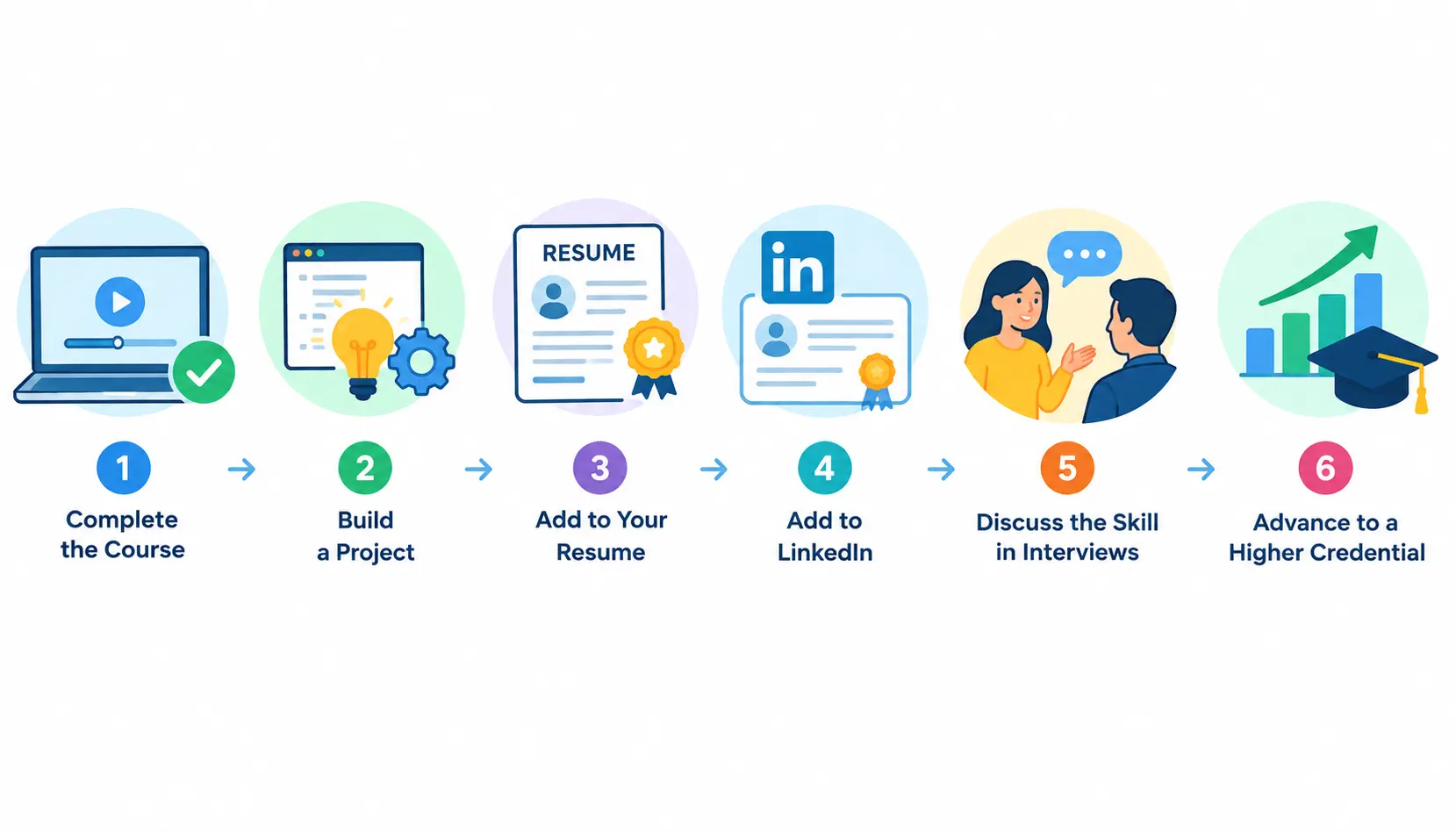
Half-finished courses don’t help your resume. Choose a course length that matches your actual schedule so you’re realistically able to finish it.
Build a Project
Turn what you learned into something concrete, a small app, a marketing plan, a spreadsheet analysis. This is often more persuasive to employers than the certificate itself.
Add the Certificate to Your Resume
Place it in a dedicated certifications section, as covered above, and keep the listing concise and current.
Add It to LinkedIn
Add it to your Licenses & Certifications section with a verification link if one is available.
Discuss the Skill in Interviews
Be ready to talk specifically about what you built or learned, not just recite the course title. Interviewers usually probe past the certificate to see if the skill is real.
Continue With a More Advanced Credential if Needed
If a free course reveals real interest and aptitude in a field, it’s often a smart next step to pursue a more advanced or paid certification once you’ve confirmed the direction is right for you. Communities like r/GetEmployed on Reddit can be a useful, if informal, place to see what actually worked for other career changers.
Frequently Asked Questions
1. Which online courses are free with certificates?
Strong options include Google’s Skillshop certifications (Ads, Analytics), HubSpot Academy’s marketing courses, freeCodeCamp’s programming certifications, Cisco’s Introduction to Cybersecurity, and Saylor Academy’s full course catalog. Each of these offers both the course and the certificate at no cost.
2. Can I get an online certificate completely free?
Yes. Providers like Google Skillshop, HubSpot Academy, freeCodeCamp, and Saylor Academy offer certificates with no cost at any stage. Other platforms, like Coursera, may require financial aid approval to unlock a free certificate on courses that otherwise charge for one.
3. Are free online certificates recognized by employers?
It depends on the issuer. Certificates from recognized companies (Google, IBM, Microsoft) and universities (Harvard, Yale, Open University) are generally recognized, especially when paired with demonstrated skills. Certificates from unknown or unverifiable sources carry little weight.
4. What is the best free online course for getting a job?
It depends on your target field, but Google’s Skillshop certifications for marketing roles, freeCodeCamp for developer roles, and Cisco’s cybersecurity fundamentals course are consistently among the most job-relevant free options.
5. Does Udemy give free certificates?
Yes, free Udemy courses typically include a certificate of completion, though instructor quality and employer recognition vary far more widely than on platforms like Coursera or edX.
6. Does Coursera offer free certificates?
Some Coursera courses are free with a certificate by default. Many others require either a paid subscription or an approved financial aid application to unlock the certificate, even though the course content itself can be audited for free.
7. Which Google courses offer free certificates?
Google Skillshop (Ads and Analytics), Google Digital Garage, and Google AI Essentials are among the Google programs that offer free certificates directly. Google Career Certificates on Coursera are a separate, paid program, though financial aid can make them accessible at no cost.
8. Are free online courses worth putting on a resume?
Yes, when they’re relevant to your target role and from a credible provider. Pair them with a project or practical example for the strongest resume impact.
9. What is the difference between a certificate and certification?
A certificate usually confirms course completion, while a certification typically involves a formal assessment or exam and is often tied to a professional or vendor body. Certifications generally carry more weight in technical and vendor-specific fields.
10. How can I verify an online certificate?
Most reputable platforms provide a unique credential ID or a public verification link that can be checked online. If a certificate has no way to be verified, treat it as informal learning rather than a formal credential.
Conclusion
Once you finish a course, don’t stop at the certificate. Build something with what you learned, add it to your resume and LinkedIn profile the right way, and be ready to talk about it in real detail. That’s what turns a free course into an actual career asset.
Free online courses with certificates can genuinely move your career forward, but only if you choose carefully. Start with your goal, not the certificate. Pick providers you’d recognize even without this guide, Google, Harvard, IBM, freeCodeCamp, Cisco, and always double-check whether the certificate itself is free before you invest your time.