
If you have just finished grade and you are interested in healthcare but do not want to spend six years trying to get a medical seat, paramedical courses after twelfth grade might be exactly what you are looking for. These programs teach you to work with doctors as a lab technician, radiographer, physiotherapist, optometrist or dialysis technician. You can do all this in under three years.
This guide will tell you everything you need to know about courses after twelfth grade. You will learn what paramedical courses actually are, who can apply for them, which paramedical courses pay the best and what the future of courses will be like over the next ten years. You can think of this guide as a conversation with a career counselor, where they talk to you about courses in a straightforward way, without trying to convince you to do something.
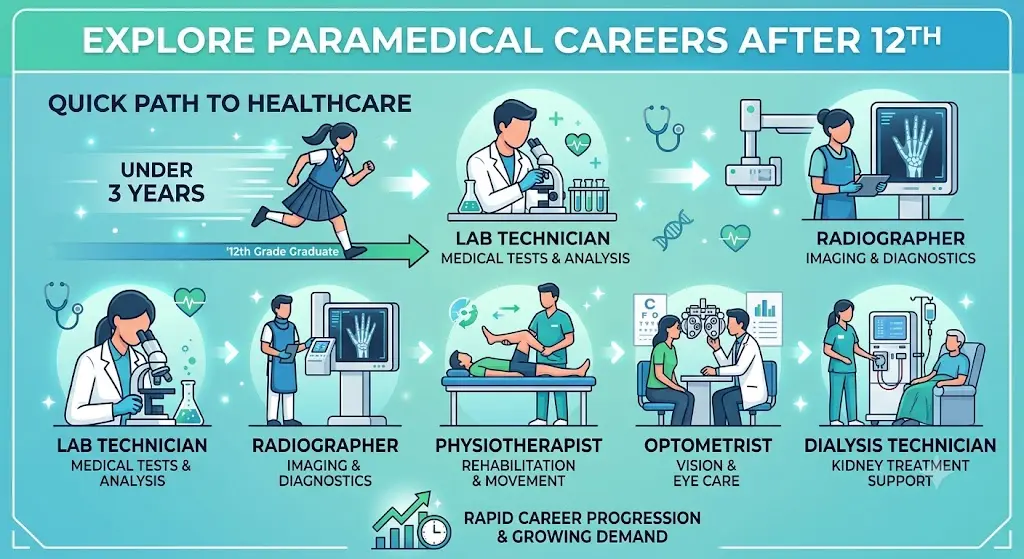
What Are Paramedical Courses?
Definition
Paramedical courses are programs that teach students how to help doctors and other medical professionals. These paramedical courses can be a diploma or a degree. They show students how to do things like run tests in a lab, use machines that take pictures of the inside of our bodies, help with surgery or assist patients who are trying to get better after being hurt.
Paramedical courses are not the same as being a doctor. When you take a course you become really good at one specific job in a hospital. You do not become a doctor, like someone who studies MBBS. Hospitals need people who have taken courses to work properly. They really need paramedical courses graduates to fill these roles.
Importance in Healthcare
No hospital works on doctors alone. A surgeon needs an OT technician in the room. A physician needs a lab report before prescribing treatment. A stroke patient needs a physiotherapist to walk again.
Paramedical staff are the connective tissue of a functioning hospital quietly essential, rarely in the spotlight, but impossible to do without.
Difference Between Medical, Nursing, Pharmacy, and Paramedical
It’s easy to lump these together, so here’s the quick distinction:
- Medical (MBBS/BDS): Diagnoses illness and prescribes treatment. Longest and most competitive path.
- Nursing (B.Sc Nursing): Provides direct, continuous patient care medication, monitoring, comfort.
- Pharmacy (B.Pharm): Focuses on drugs, how they’re made, dispensed, and how they interact.
- Paramedical: Operates equipment, runs diagnostic tests, or assists in specific procedures (imaging, lab work, OT support, rehabilitation).
Each role is part of the same care team, just with a different job description. The Wikipedia entry on allied health professions gives a useful global overview of how these roles are classified.
Why Choose a Paramedical Course After 12th?
1. Benefits
The biggest draw of degrees is speed. Paramedical degrees take three to four years to complete and diplomas in degrees can be completed in one to two years. That means you are earning money years before your friends who are studying to be doctors, that is MBBS-track friends, even finish their internship for medical college.
Fees for degrees are also much lower than fees for medical college and many of these paramedical courses accept students who have studied Arts and students who have studied Commerce too, not just students who have studied Biology.
2. Career Demand
India’s healthcare system is getting bigger all the time. We are seeing more places where people can go to get diagnosed and treated. This includes hospitals that can do lots of different things and special units that help people with kidney problems. These places are opening up in cities in India every year. The thing is, all of these healthcare places need people who know what they are doing to run them. India’s healthcare system needs trained technicians to make everything work. India’s healthcare system is. It needs these trained technicians to keep operating all the new diagnostic centers and hospitals and dialysis units.
3. Job Stability
Healthcare is not usually the kind of field that has a lot of layoffs like you see in tech or retail. People always need tests and treatment no matter what is happening with the economy. This means that jobs in healthcare like the people who help doctors are pretty safe. People will always need healthcare so jobs in this field are generally secure. Healthcare jobs, such as these roles, are not usually at risk.
4. Global Opportunities
There are some countries that really like to hire people from India who are trained in medical fields. The UK, Australia, Canada and some Gulf nations are examples of these countries. They often hire radiographers from India and also lab technologists and physiotherapists from India. Usually people from India have to take a licensing exam or go through a bridging program to work in these countries. If you have a paramedical degree from India it can be a great way to get a job in another country. A paramedical degree can really be your ticket to working.
Eligibility Criteria for Paramedical Courses
1. PCB Students
Students with Physics, Chemistry, and Biology have the widest range of options pretty much every course on this list is open to them, including B.Sc MLT, Radiology, Physiotherapy, and Optometry.
2. PCM Students
Physics, Chemistry, Maths students can still enter many paramedical fields, especially technology-heavy ones like Radiology & Imaging Technology, Dialysis Technology, and OT Technology, since some institutes accept PCM in place of PCB.
3. Arts Students
Arts students aren’t shut out entirely. Courses like Diploma in Medical Record Technology, Hospital Administration-linked diplomas, and some Emergency Medical Technology programs accept Arts backgrounds, though options are narrower.
4. Commerce Students
Commerce students face similar limits to Arts students but can still pursue diploma-level paramedical courses and administrative-adjacent programs, particularly in hospital management support roles.
5. Minimum Marks Required
Most colleges ask for at least 45–50% in 12th grade (40–45% for reserved categories), with PCB or PCM as applicable. Always check the specific institute’s cutoff, since it varies by state and college type.
Top Paramedical Courses After 12th
1. B.Sc Medical Laboratory Technology (MLT)
Trains you to run blood tests, biopsies, and pathology reports. One of the most in-demand paramedical courses because every hospital and diagnostic chain needs lab technologists.
2. B.Sc Radiology & Imaging Technology
Covers X-ray, CT, MRI, and ultrasound machine operation. Pays well because imaging equipment is expensive and skilled operators are hard to find.
3. B.Sc Operation Theatre Technology
Prepares students to assist surgeons directly sterilizing instruments, managing OT equipment, and supporting the surgical team during procedures.
4. B.Sc Dialysis Technology
A narrow but high-demand specialization, given the rising number of kidney disease and dialysis patients in India.
5. B.Sc Optometry
Focuses on eye care vision testing, prescribing corrective lenses, and detecting early signs of eye disease. Strong demand from optical retail chains as well as hospitals.
6. Bachelor of Physiotherapy (BPT)
A 4.5-year program (including internship) that trains students in movement rehabilitation after injury, surgery, or stroke. One of the more respected and independently practicable paramedical degrees.
7. B.Sc Emergency Medical Technology
Trains first responders and ambulance/ER staff to stabilize patients before a doctor takes over a growing field as emergency ambulance services expand across India.
8. B.Sc Cardiac Care Technology
Specializes in ECG, cardiac monitoring, and assisting in cath labs and cardiac ICUs closely tied to India’s rising cardiac care demand.
9. B.Sc Respiratory Therapy
Focuses on ventilator management and lung function testing, a field that saw sharp demand growth during the COVID-19 pandemic and has stayed relevant since.
10. B.Sc Anesthesia Technology
Trains technicians to assist anesthesiologists before and during surgery, monitoring vital signs and managing anesthesia equipment.
11. Diploma in Medical Laboratory Technology (DMLT)
A shorter, 2-year alternative to B.Sc MLT faster entry into the workforce, though with a slightly lower salary ceiling.
12. Diploma in Radiology
A 1–2 year diploma covering the basics of X-ray and imaging operation, ideal for students wanting quicker job entry over a full degree.
13. Diploma in OT Technology
Covers the essentials of operation theatre assistance in a shorter format than the B.Sc equivalent.
14. Diploma in Dialysis Technology
A compact program focused specifically on operating dialysis machines and supporting nephrology patients.
Best Paramedical Courses by Stream
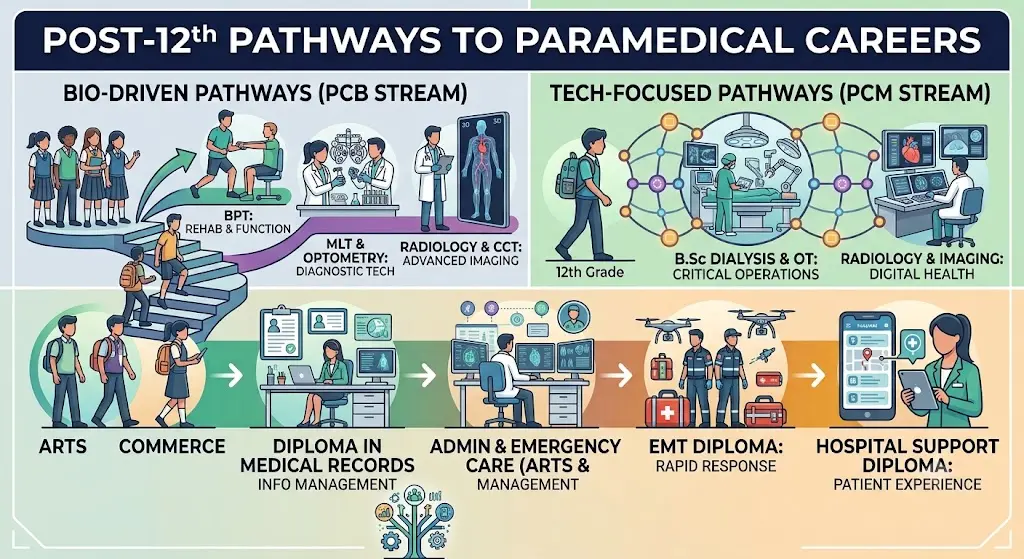
1. PCB
BPT, B.Sc MLT, B.Sc Radiology, B.Sc Optometry, and B.Sc Cardiac Care Technology are generally the strongest fits, since these lean heavily on Biology fundamentals.
2. PCM
B.Sc Radiology & Imaging Technology, B.Sc Dialysis Technology, and B.Sc OT Technology work well, as they lean more on physics and technical operation than biology.
3. Arts
Diploma in Medical Record Technology and some Emergency Medical Technology diplomas are realistic options, though the field is narrower.
4. Commerce
Diploma-level hospital support courses and Emergency Medical Technology diplomas are the more accessible entry points.
Comparison Table of the Best Paramedical Courses
| Course | Duration | Fees (Approx., India) | Avg. Starting Salary | Difficulty | Job Demand |
| B.Sc MLT | 3 years | ₹1–3 lakh total | ₹2–4 LPA | Moderate | Very High |
| B.Sc Radiology & Imaging | 3 years | ₹1.5–4 lakh total | ₹2.5–5 LPA | Moderate–High | High |
| BPT (Physiotherapy) | 4.5 years | ₹2–6 lakh total | ₹2.5–5 LPA | High | High |
| B.Sc OT Technology | 3 years | ₹1.5–3.5 lakh total | ₹2–4 LPA | Moderate | High |
| B.Sc Optometry | 3–4 years | ₹1.5–4 lakh total | ₹2–4.5 LPA | Moderate | High |
| B.Sc Dialysis Technology | 3 years | ₹1.5–3 lakh total | ₹2.5–4.5 LPA | Moderate | Growing Fast |
| DMLT (Diploma) | 2 years | ₹50k–1.5 lakh total | ₹1.8–3 LPA | Low–Moderate | High |
Figures are approximate industry ranges and vary widely by city, college, and employer. Treat them as a starting reference, not a guarantee.
Best career path overall: if you want the highest ceiling and don’t mind the longer duration, BPT and B.Sc Radiology tend to offer the best long-term growth. If you want to start earning sooner, DMLT or a diploma-level course gets you into the workforce fastest.
Degree vs Diploma Paramedical Courses
A degree (B.Sc) takes longer but generally opens doors to supervisory roles, higher pay ceilings, and further postgraduate study (M.Sc). A diploma gets you working faster and costs less upfront, but the growth ceiling is usually lower without further upskilling.
A practical way to decide: if you’re financially comfortable waiting 3–4 years and want long-term career growth, go for the degree. If you need to start earning within 1–2 years, a diploma with a plan to upgrade later is a reasonable middle path.
Admission Process
1. Entrance Exams
Some states and private universities conduct their own paramedical entrance exams, while others admit directly based on 12th marks. There’s no single national paramedical entrance exam in India, so always check the specific state or university’s process.
2. Merit-Based Admission
Most government paramedical colleges admit students based on 12th-grade percentage, sometimes combined with a state-level counseling process similar to medical college admissions.
3. Required Documents
Typically you’ll need your 12th mark sheet, transfer certificate, migration certificate, category certificate (if applicable), Aadhaar card, and passport-size photographs. Keep both originals and photocopies ready during counseling.
Top Government and Private Colleges for Paramedical Courses
Government medical colleges and AIIMS-affiliated paramedical institutes generally offer the lowest fees and strong clinical exposure, but seats are limited and competition is high. Private paramedical colleges and universities offer more seats and often better infrastructure, at a higher fee.
Rather than chasing a “best college” list that goes outdated quickly, check for three things before enrolling anywhere: NAAC/university affiliation, hospital tie-ups for clinical training, and placement track record from actual alumni a quick search on LinkedIn for alumni of a college is often more revealing than the college’s own brochure.
Course Fees and Education Costs
Paramedical course fees in India generally range from ₹50,000 for a basic diploma to ₹6 lakh for a full B.Sc or BPT degree at a private institute, spread across the full duration. Government colleges are typically at the lower end of this range, sometimes significantly cheaper.
Additional costs to budget for include hostel/accommodation, uniforms, lab equipment, and internship-related expenses, which can add 20–30% on top of tuition.
Highest Paying Paramedical Careers
1. Salary by Course
Among paramedical fields, Radiology & Imaging Technology, Dialysis Technology, and Cardiac Care Technology tend to sit at the higher end of starting salaries, largely because they involve expensive, specialized equipment that fewer people are trained to operate.
2. Salary by Experience
Entry-level paramedical salaries in India typically start around ₹2–3 lakh per year. With 5+ years of experience and specialization, this can rise to ₹5–8 lakh per year, and senior technologists or department heads in private hospitals can earn more.
3. Salary by Sector
Private hospitals and diagnostic chains generally pay more than government hospitals at entry level, but government roles offer stronger job security, structured pay scales, and pension benefits over the long run.
4. Salary in India vs Abroad
Paramedical professionals working abroa particularly radiographers, physiotherapists, and lab technologists in the UK, Gulf countries, or Australia often earn several times their Indian starting salary, though this usually requires additional licensing exams and sometimes a bridging course in that country.
Career Opportunities After Paramedical Courses
1. Hospitals
The most common employer in every department from radiology to the OT to the ICU relies on paramedical staff.
2. Diagnostic Labs
Chains like pathology and imaging labs hire heavily for MLT and radiology graduates, often with structured shift-based roles.
3. Emergency Services
Ambulance services, trauma centers, and disaster response teams increasingly hire trained Emergency Medical Technicians.
4. Rehabilitation Centers
Physiotherapy and occupational therapy graduates find strong demand in rehab centers, sports clinics, and old-age care facilities.
5. Research Organizations
Lab technologists and cardiac/respiratory technicians are also hired by pharmaceutical companies and clinical research organizations for trial-related diagnostic work.
6. Government Sector
Government hospitals, primary health centers, and public health missions regularly recruit paramedical staff through state-level exams.
7. Private Sector
Private hospital chains and corporate diagnostic labs tend to offer faster growth and performance-linked pay, though with less job security than government roles.
8. International Careers
With the right licensing, paramedical professionals, especially physiotherapists, radiographers, and lab technologists can work in the UK, Canada, Australia, and the Middle East. Professional communities on LinkedIn and forums like Reddit’s r/healthcare are good places to hear real experiences from people who’ve made this move.
Future Scope of Paramedical Careers (2026–2035)
1. AI in Healthcare
AI tools are increasingly used to flag abnormalities in scans and lab results faster, but this is changing the paramedical role rather than replacing it with technicians who understand how to work alongside these tools will be more valuable, not less.
2. Digital Diagnostics
The shift toward digital pathology and cloud-based reporting means paramedical staff increasingly need basic digital literacy alongside their clinical skills.
3. Medical Imaging
Demand for radiographers is expected to keep growing as imaging becomes a bigger part of routine diagnosis, not just emergency care.
4. Telemedicine
As telemedicine grows, paramedical staff at local clinics increasingly act as the “hands” for a remote doctor running tests and procedures locally while a specialist consults from elsewhere.
5. Aging Population and Demand
India’s aging population is expected to drive sustained demand for dialysis technicians, physiotherapists, and cardiac care specialists over the next decade, since these are the fields most tied to age-related conditions.
Skills Required to Succeed in Paramedical Careers
Beyond the technical training, the professionals who do well in this field tend to share a few habits: attention to detail (a misread lab value can change a diagnosis), the ability to stay calm under pressure, physical stamina for long shifts, clear communication with patients who are often anxious, and a willingness to keep learning as equipment and protocols evolve.
How to Choose the Right Paramedical Course
Based on Interest
If you enjoy precision, lab work, and quiet technical tasks, MLT or Radiology suits you better than a physically active role like Physiotherapy or Emergency Medical Technology.
Based on Salary
If salary ceiling matters most, Radiology, Dialysis Technology, and Physiotherapy tend to offer the strongest long-term earning potential.
Based on Placement
Check a college’s actual placement record with recent graduates before choosing — a course name means little if the college has weak hospital tie-ups for internships.
Based on Future Demand
Fields tied to aging-related conditions dialysis, cardiac care, physiotherapy are likely to see the steadiest long-term demand growth in India.
Common Mistakes Students Should Avoid
A few mistakes come up again and again: choosing a course based only on its name sounding impressive, ignoring a college’s hospital affiliation and internship quality, not checking whether the course and college are recognized by the relevant state paramedical council, and assuming every paramedical course leads to the same salary and demand they genuinely don’t.
Scholarships and Financial Aid Options
Many state governments run scholarship schemes for paramedical students from economically weaker sections and reserved categories, usually applied for through the National Scholarship Portal. Some private colleges also offer merit-based fee waivers, and education loans from nationalized banks are commonly available for paramedical degrees, similar to other professional courses.
FAQs
Q1. Which paramedical course has the highest salary after 12th?
Radiology & Imaging Technology and Dialysis Technology tend to offer some of the higher starting salaries among paramedical courses, though actual pay varies by employer and city.
Q2. Can Arts or Commerce students take paramedical courses?
Yes, though options are narrower than for PCB/PCM students. Diploma-level courses like Emergency Medical Technology or Medical Record Technology are more commonly open to Arts and Commerce backgrounds.
Q3. Is a paramedical degree better than a diploma?
A degree generally offers a higher salary ceiling and more career growth, while a diploma gets you into the workforce faster and at lower cost. The right choice depends on your timeline and budget.
Q4. Do paramedical courses require NEET?
No, most paramedical courses do not require NEET. Admission is typically based on 12th-grade marks or a college/state-specific entrance exam.
Q5. Can I work abroad after a paramedical course in India?
Yes, many paramedical fields, especially physiotherapy, radiography, and lab technology offer international opportunities, though you’ll usually need to clear that country’s licensing exam first.
Q6. Are paramedical courses after 12th good for a stable career?
Yes. Healthcare demand remains relatively steady regardless of the broader economy, which makes paramedical careers a comparatively stable long-term choice.
Conclusion
Paramedical courses after 12th offer a genuinely practical route into healthcare shorter than an MBBS, more affordable, and open to students from multiple academic streams, not just Biology. The key is matching the right course to your interests, budget, and long-term goals, rather than picking the first name you hear.
Whether you choose B.Sc MLT, Radiology, Physiotherapy, or a faster diploma route, the field rewards people who take their training seriously and keep building skills after graduation. Do your research on specific colleges, talk to current students where you can LinkedIn and Reddit threads from working professionals are a good starting point and choose the paramedical course that fits where you actually want your career to go.