
Every year, lakhs of students finish class 12 and start hunting for a management course that doesn’t need an engineering or medical background. That’s usually when the question “what is the full form of BBA?” shows up in their search history. This guide answers that question in full and walks through everything else you’ll want to know before you commit three years and a chunk of your family’s savings to this degree.
We’ll cover the meaning, eligibility, subjects, specializations, salary expectations, and whether BBA is still worth it in 2026, when AI and automation are reshaping entry-level business roles.
BBA Full Form in Education
What Does BBA Stand For?
The full form of BBA is Bachelor of Business Administration. It’s an undergraduate degree that introduces students to the core functions of running a business management, marketing, finance, human resources, and operations usually before they’ve held a single full-time job.
Meaning of Bachelor of Business Administration
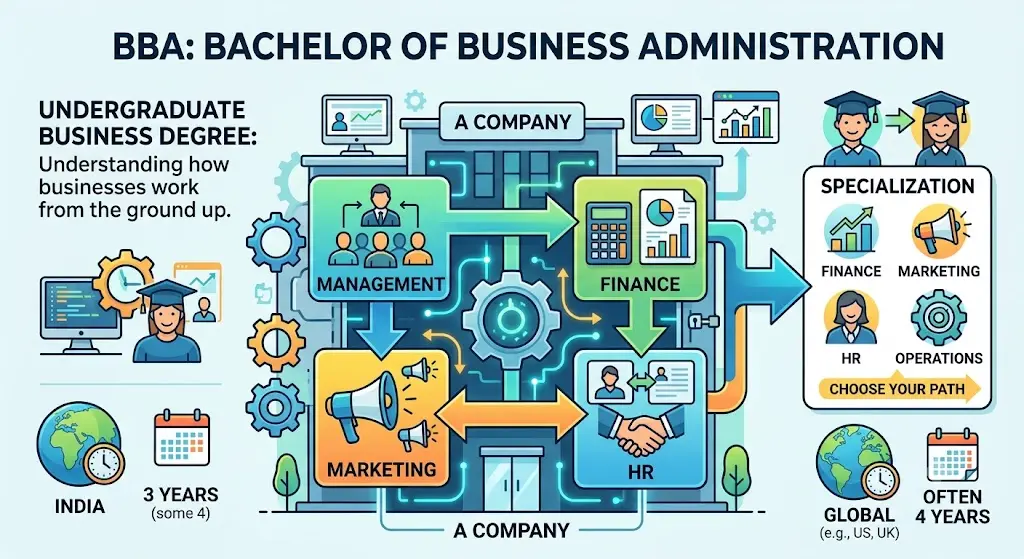
A Bachelor of Business Administration is a first-level college degree built around one goal: teaching you how businesses actually work, from the ground up. <cite index=”1-1″>It’s an undergraduate degree in business administration, designed to give students a broad knowledge of the functional aspects of a company and how those functions connect with each other, while also allowing them to specialize in one area.</cite>
In India, the course typically runs for three years, though some universities under the new National Education Policy now offer a four-year version with research or honors options. Globally in the US, UK, and parts of Europe a BBA is often a four-year program, closer in structure to a general business bachelor’s degree.
Full form of BBA: Bachelor of Business Administration. It’s a 3-year undergraduate degree (4 years in many countries outside India) that covers management, finance, marketing, HR, and business operations, and is usually taken right after class 12.
What Is a BBA Course?
1. Course Overview
Think of a BBA as a trailer for the world of business before you commit to the full feature film of an MBA or a corporate career. You get a taste of every department: how marketing teams plan a campaign, how finance teams read a balance sheet, how HR handles hiring, and how operations keep supply chains moving.
Most programs mix classroom theory with case studies, group projects, and at least one internship. <cite index=”1-1″>Many BBA programs incorporate training and practical experience in the form of case projects, presentations, internships, industrial visits, and interaction with established industry experts</cite>, which is exactly the kind of exposure a fresh graduate needs before stepping into a real workplace.
2. Why Choose BBA?
Students usually pick BBA for one of three reasons. First, they know they want a business career but aren’t sure which specific function marketing, finance, HR suits them yet, and BBA lets them explore before choosing. Second, they plan to do an MBA later and want a head start on business fundamentals. Third, they want to start working sooner than a typical undergraduate + postgraduate route would allow.
If you’re the kind of student who enjoys leading group projects, negotiating, or figuring out why a product succeeded or failed, this course tends to feel natural rather than forced.
3. Key Skills You Learn
A good BBA program builds skills that don’t show up on a mark sheet but matter a lot in interviews: communication, teamwork, basic financial literacy, problem-solving, and comfort with public speaking. <cite index=”1-1″>The degree also develops a student’s practical, managerial, and communication skills, along with business decision-making capabilities that prepare them for managing a business entity.</cite> You’ll also pick up early data skills reading spreadsheets, interpreting charts, and making a case with numbers instead of just opinions.
BBA Course Highlights
| Particular | Details |
| Full Form | Bachelor of Business Administration |
| Duration | 3 years (India); 4 years in many other countries |
| Eligibility | Class 12 pass in any stream, usually with 50% or above |
| Admission | Merit-based or entrance exam-based |
| Average Fees | ₹1 lakh to ₹10+ lakh (varies widely by college) |
| Course Mode | Full-time, distance, and online |
| Common Entrance Exams | CUET, NPAT, SET, IPMAT, UGAT |
1. Duration
In India, a regular Bachelor of Business Administration takes three years. This is split across six semesters. Some universities that offer the four-year National Education Policy aligned structure give you a choice. You can exit after three years with a Bachelor of Business Administration or you can continue for a year.
If you do this you get an honors degree with a research component. Bachelor of Business Administration programs are pretty common. The National Education Policy aligned structure is a thing. It gives you options. You can get a Bachelor of Business Administration in three years. You can get an honors degree in four years.
2. Eligibility
You need to have passed class 12 from a recognized board. This class 12 exam can be from any stream, such as commerce or science or arts.
Most colleges want you to have a minimum of 45 to 50 percent aggregate marks in class 12.. Class 12 marks required by top colleges are usually higher than that.
3. Admission Process
Getting into college can happen in one of two ways. You can get in because of how you did in class 12 or you can take a special exam. After the exam there is usually a group discussion and a personal interview.
The thing is, it is up to the college to decide which way they want to do it. The good colleges almost always make people take the entrance exam to see who is a good fit. The college is looking at the entrance exam to figure out who to let in. This is how they filter out the people who are applying.
4. Average Fees
Fees swing wildly depending on the type of institution. A state government college might charge under ₹1 lakh for the full course, while a well-known private university can charge anywhere from ₹3 lakh to over ₹10 lakh. It’s worth checking placement records against fees before assuming a costlier college automatically means a better return.
5. Course Mode
You can pursue BBA full-time on campus, through distance education, or fully online via UGC-approved platforms. Full-time remains the most valued option for campus placements, but online BBA has become a legitimate path for working students or those managing other commitments.
6. Entrance Exams
Some universities use tests to see who gets in rather than just looking at the grades people got. These tests are either used by the country or just, by that particular university. Universities use these tests of just making a list of people who did well. Universities do this because they want to use university entrance tests.
BBA Eligibility Criteria
1. Commerce Students
Students who study Commerce usually find that doing a Bachelor of Business Administration is the next step. This is because they already know a lot about things, like accountancy and business studies and economics which are also taught in the Bachelor of Business Administration course. It is not necessary to have studied Commerce but it does give you a bit of an advantage.
2. Science Students
Science students are just as eligible as anyone and they often have better skills when it comes to analyzing things and working with numbers, which is really helpful when you are studying things, like business statistics and business analytics. If a science student decides to get a business degree they do not lose anything from their science background.
3. Arts Students
Arts students, particularly those from psychology, sociology, or economics backgrounds, tend to do well in HR and marketing specializations, where understanding human behavior matters as much as numbers.
4. Minimum Marks Required
Most universities want students to have at least 45 to 50 percent marks when they finish class 12. There are some exceptions for people who come under categories and these exceptions are based on what the government says. You should always look at the information that the college provides because this percentage is not the same in the country.
BBA Admission Process
1. Merit-Based Admission
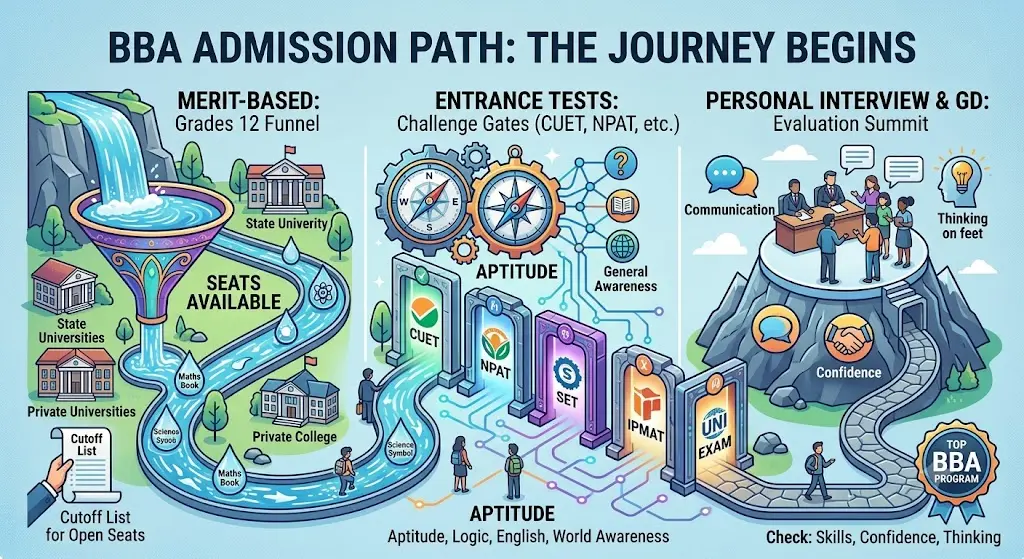
When it comes to getting into college some schools use a system called merit-based admission. In this system colleges look at the grades people got in class 12. That is how they decide who gets in. They make a list of the people they want. This list is called a cutoff list. This is how a lot of state universities and private colleges work, the ones that have a lot of open seats.
2. Entrance-Based Admission
Entrance based admission to a university requires that you clear a test, such as CUET or NPAT or SET or IPMAT or the university’s own exam before they will even think about you.
These tests are used to check how good you are at things, like aptitude and logical reasoning and English comprehension and general awareness of the world.
3. Personal Interview & GD
Top colleges add a personal interview and group discussion round after the written test. This step checks for communication skills, confidence, and how you think on your feet — qualities that matter a lot in business roles but are hard to measure through a written exam alone.
BBA Entrance Exams
Here are the entrance exams most commonly linked to BBA admissions in India:
- CUET (Common University Entrance Test): used by central and several state universities
- NPAT (NMIMS Programs After Twelfth): for NMIMS and its affiliated campuses
- SET (Symbiosis Entrance Test): for Symbiosis-affiliated colleges
- IPMAT (Integrated Program in Management Aptitude Test): mainly for IIM’s five-year integrated programs, which some students use as an alternative route into management education
- UGAT (Under Graduate Aptitude Test): conducted by AIMA for several private universities
- Other university-specific exams: many private universities run their own entrance tests
BBA Course Duration and Semester Structure
The standard Indian BBA spans six semesters over three years, with two semesters per academic year. Each semester typically mixes core subjects, electives, and at least one practical or project component. By the final year, most programs shift focus toward a chosen specialization and often include a mandatory internship or capstone project.
BBA Subjects and Syllabus
First Year
The first year builds the base: principles of management, business communication, financial accounting, business economics, business mathematics, and organizational behavior. Nothing here is specialized yet the goal is to get everyone speaking the same business language.
Second Year
The second year adds depth: marketing management, human resource management, business law, cost accounting, and business statistics. Some programs introduce entrepreneurship and e-commerce here too.
Third Year
The third year is where specialization kicks in, along with strategic management, international business, and a research project or internship. This is also when placement preparation typically ramps up.
Popular BBA Specializations
- Marketing: consumer behavior, branding, digital campaigns
- Finance: corporate finance, investment analysis, financial markets
- Human Resources: recruitment, training, labor law, organizational development
- Business Analytics: data-driven decision-making, dashboards, forecasting
- International Business: global trade, cross-border strategy, export-import management
- Digital Marketing: SEO, social media, performance marketing
- Entrepreneurship: startup planning, venture funding, business model design
- Operations: process management, quality control, logistics
- Supply Chain Management: procurement, inventory, distribution networks
- Healthcare Management: hospital administration, healthcare policy, medical business operations
Skills You Develop During BBA
By graduation, most BBA students can read a basic financial statement, build a presentation that makes an argument (not just lists facts), lead a small team through a project, and hold their own in a debate about a business case. These aren’t flashy skills, but they’re the ones recruiters actually test for in interviews often through group discussions or case-study rounds rather than written exams.
Career Opportunities After BBA
1. Private Sector Jobs
Private companies hire BBA graduates for jobs such as management trainee and marketing executive. They also hire BBA graduates for roles like HR associate and business development executive. Some BBA graduates even get hired as financial analysts.
Big companies from banking sectors hire BBA graduates. BBA graduates also get jobs in FMCG and IT services companies. Consulting firms are also among the companies that hire BBA graduates at the entry level.
2. Government Jobs
BBA graduates can also take part in government exams, banking exams, like IBPS and SBI PO, SSC exams and state-level PSU recruitment drives. This is because most of these exams only require a bachelor’s degree in any subject. It is not the path that most people take. BBA graduates can definitely do it. BBA graduates have this option because the main thing that these exams require is a bachelor’s degree.
3. Startup Opportunities
Startups often value BBA graduates for their generalist skill set, someone comfortable wearing multiple hats across marketing, operations, and basic finance in a small team. If you’re drawn to fast-paced, less structured environments, this route can offer faster responsibility than a large corporation.
4. Higher Education Options
People usually do an MBA next. This really helps with getting a better job and making more money. Some people choose to do a masters degree in an area like finance or analytics or supply chain. Others go for certificates like the CFA or the CA or certificates in digital marketing to get really good at something. An MBA is a way to move up in a company and an MBA can be very helpful, for people who want to make more money.
BBA Salary in India
1. Fresher Salary
A fresh BBA graduate in India typically starts anywhere between ₹2.5 lakh and ₹6 lakh per annum, depending on the college, specialization, and city. Graduates from top-tier institutes with strong placement cells can command salaries at the higher end or above this range.
2. Salary by Specialization
Finance and business analytics specializations tend to command a premium over general management or HR roles at the entry level, simply because analytical and technical skills are scarcer. Marketing and digital marketing roles vary hugely based on whether you land at a large brand or a smaller agency.
3. Salary by Industry
Consulting, banking, and IT services generally pay more at entry level than retail or traditional manufacturing. Startups can pay less in fixed salary but sometimes offer equity or faster growth in responsibility.
4. Salary After MBA
An MBA after BBA typically pushes salaries up significantly, often doubling or more, especially from a well-ranked B-school because it adds specialized expertise and, in many cases, better recruiter access through campus placements.
Read More: MBA Salary in India
Top Recruiters for BBA Graduates
Common recruiters across sectors include Deloitte, EY, KPMG, ICICI Bank, HDFC Bank, HUL, ITC, Amazon, Flipkart, Byju’s-style edtech firms, and a long tail of regional businesses and startups. The exact list depends heavily on which college you attend and its placement partnerships.
Top Colleges Offering BBA
Well-regarded BBA programs in India include Shaheed Sukhdev College of Business Studies (Delhi University), Christ University (Bangalore), Symbiosis Centre for Management Studies (Pune), NMIMS (Mumbai), and various IIMs’ integrated five-year programs for students straight out of class 12. Rankings shift year to year, so it’s worth checking current placement data and faculty profiles before shortlisting, rather than relying on reputation alone.
BBA vs Other Business Degrees
1. BBA vs BCom
BCom focuses more heavily on accounting, taxation, and commerce fundamentals, while BBA leans toward management, leadership, and cross-functional business skills. If you want to become a chartered accountant, BCom is the more natural fit; if you want a generalist management track, BBA suits better.
2. BBA vs BMS
BMS (Bachelor of Management Studies) is quite similar to BBA in content but is typically offered by Mumbai University-affiliated colleges with a fixed structure. The core skill set taught overlaps significantly with BBA.
3. BBA vs BBM
BBM (Bachelor of Business Management) is essentially a regional variant of BBA, common in universities in Karnataka and parts of South India. The curriculum and career outcomes are broadly comparable.
4. BBA vs BS Business Administration
A BS (Bachelor of Science) in Business Administration, more common abroad, usually has a heavier quantitative and analytical component compared to a standard BBA, which leans more toward general management and communication skills.
Online BBA vs Regular BBA
A regular, on-campus BBA gives you access to campus placements, internships, networking, and hands-on group projects advantages that are hard to fully replicate online. An online BBA works well for students who are working part-time, managing family responsibilities, or based somewhere without access to a good local college, but you’ll need to build your own network and internship opportunities more actively. Always confirm the online program is UGC-recognized before enrolling, since not all online degrees carry equal weight with employers.
Is BBA Worth It in 2026?
This depends far more on the college and your own effort than on the degree name itself. A BBA from a college with strong placements, active industry tie-ups, and good faculty can genuinely open doors both directly into jobs and into a strong MBA later. A BBA from a college with weak infrastructure and no placement support, on the other hand, can leave you with a degree but little practical advantage over other bachelor’s holders.
Online discussions on forums like Reddit reflect this split opinion clearly; outcomes vary enormously by institution and how proactively a student builds internships and skills alongside the coursework. The honest answer: BBA is worth it if you choose the right college and treat it as a launchpad rather than a guaranteed ticket to a good job.
Certifications That Add Value During BBA
Pairing your BBA with certifications can meaningfully strengthen your resume. Popular options include Google Digital Marketing certifications, Microsoft Excel and Power BI courses, HubSpot’s free marketing and sales certifications, basic Python or SQL courses for analytics-inclined students, and CFA Level 1 for those leaning toward finance. None of these are mandatory, but they signal initiative to recruiters, something that matters a lot when your degree alone looks similar to thousands of other applicants.
AI and the Future of Business Careers
AI tools are already changing entry-level business work automating routine data entry, generating first drafts of reports, and speeding up market research. This doesn’t eliminate BBA-related careers, but it does shift what’s valued: employers increasingly want graduates who can direct AI tools intelligently, interpret their output critically, and focus their own time on judgment calls, negotiation, strategy, relationship-building that tools can’t replicate. Students who treat AI literacy as part of their business education, not a separate skill, will likely have an edge in the coming years.
Common Mistakes Students Make Before Choosing BBA
A few patterns show up again and again among students who regret their BBA choice. Picking a college purely because it’s affordable, without checking placement records, is one. Choosing BBA “because I didn’t know what else to do” rather than out of genuine interest is another. It often leads to disengagement halfway through. Ignoring internships and treating the degree as classroom-only is a third mistake, since real recruiters weigh practical exposure heavily. Finally, some students skip researching whether a specialization actually matches current job market demand, and end up with skills that are harder to place.
Frequently Asked Questions
1. What is the full form of BBA?
BBA stands for Bachelor of Business Administration.
2. Is BBA a 3-year or 4-year course?
In India, it’s typically a 3-year course. In many other countries, it’s a 4-year undergraduate program.
3. Can science students do BBA?
Yes. BBA is open to students from commerce, science, and arts backgrounds alike.
4. Is BBA better than BCom?
Neither is objectively better; BBA suits students aiming for general management roles, while BCom suits those aiming for accounting, taxation, or CA-related careers.
5. What is the average salary after BBA?
Fresh BBA graduates in India typically earn between ₹2.5 lakh and ₹6 lakh per annum, depending on college, specialization, and location.
6. Should I do an MBA after BBA?
It’s a common and often valuable path, especially for students aiming at leadership roles, since an MBA usually leads to a significant salary jump and broader career options.
7. Which entrance exams are needed for BBA?
Common exams include CUET, NPAT, SET, IPMAT, and UGAT, though many colleges also admit students purely on class 12 merit.
Conclusion
Now that you know what BBA Bachelor of Business Administration means and what it is about, the big question is if BBA Bachelor of Business Administration is right for you. BBA Bachelor of Business Administration is a course that many people know about and it can be a great start for a career in business or a way to get ready for an MBA.
You just have to pick a college and make sure you do internships and learn new skills while you are studying for a BBA Bachelor of Business Administration. Think of BBA Bachelor of Business Administration as the beginning of your journey, not the end. If you do this, a BBA Bachelor of Business Administration can really help you get ready for 2026 and the years after that.