
If you have ever made a database table and seen the information repeated in ten different rows you have already seen functional dependency in action. You just did not know what it was called at the time. Functional dependency is one of those database concepts that sounds complicated when you read about it in a book. It shows up in almost every real database you will ever make.
This guide will explain what functional dependency really means, the types of functional dependency you will come across, how it helps with normalization and how to do the math that is involved like attribute closure, Armstrong’s Axioms and canonical cover without getting confused.
As we go through this guide we will use examples that you can relate to, such as student records, employee tables and orders instead of using letters, like A, B and C. We will use functional dependency examples that are easy to understand so you can see how functional dependency works in real life.
What Is Functional Dependency in DBMS?
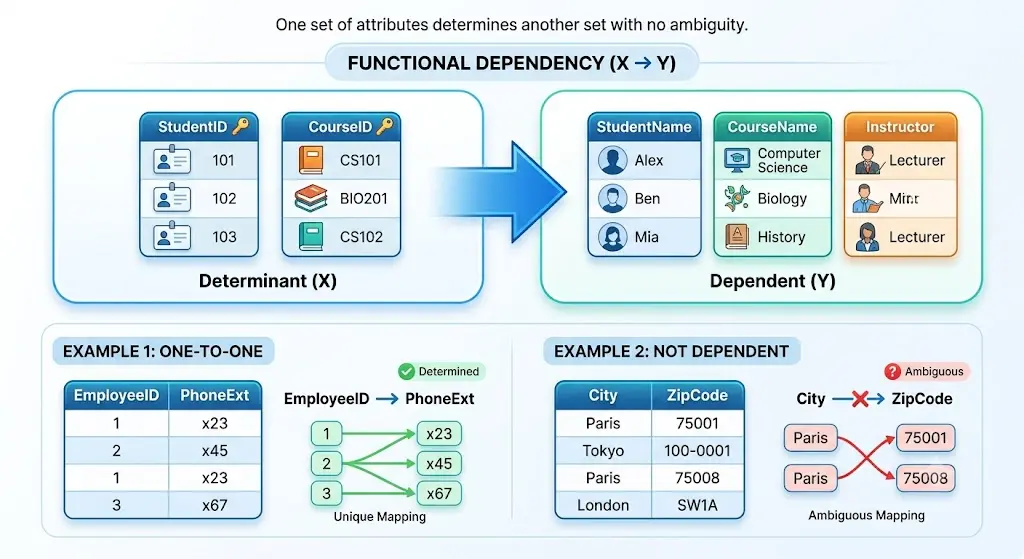
A functional dependency (FD) is a relationship between two sets of attributes in a table, where the value of one attribute (or set of attributes) determines the value of another. If you know the first, you can always figure out the second with no ambiguity, no guessing.
It’s written as X → Y, read as “X determines Y.” Here, X is called the determinant, and Y is the dependent. For example, in a student table, StudentID → StudentName means that once you know the student ID, the name is fixed every row with that ID will have the same name.
Why Functional Dependency Matters
Functional dependency is the backbone of good database design. This is the rule that tells you whether your table structure is logically sound or whether it is quietly storing redundant data.
Without understanding dependencies you cannot really do normalization properly. You might end up with tables where updating one piece of data in the dependencies means you have to hunt down and fix five other rows too, which is a classic update anomaly, in the functional dependencies. Recognizing dependencies early saves you from that mess later when you are working with functional dependencies.
Real-Life Analogy
Think about a drivers license number. If you know a person’s drivers license number you can always find out their name, date of birth and address because this information is tied to that drivers license number.
If you only know a person’s name you cannot always find their drivers license number because a person’s name is not unique.
That is what functional dependency is like, in our life: a drivers license number always gives you a certain set of information but knowing a person’s name does not always give you their drivers license number.
Basic Terminology You Should Know
Before diving deeper, let’s get comfortable with the vocabulary. These terms come up constantly in FD discussions, and mixing them up is one of the most common beginner mistakes.
1. Attributes
An attribute is a column in a table. For example it can be StudentID, Name or Email. The StudentID attribute holds one piece of data about a student. The Name attribute holds one piece of data about a student. The Email attribute holds one piece of data about a student. Each StudentID attribute and each Name attribute and each Email attribute holds one piece of data, about a student.
2. Relations
In other words when we talk about Database Management Systems, a relation is really just a table. This table is a collection of rows that all have the columns. The idea of a relation actually comes from a part of math called algebra, which is what relational databases are based on. Relational databases use this concept of a relation to organize and manage data in a way that makes sense.
3. Tuples
A tuple is one row in a table that has all the information about something.For example if you have a table of Students with 500 students in it then it has 500 tuples.
Each tuple has all the details about one student.So in this case the Students table has 500 tuples, one, for each student.
Keys
Keys are attributes (or combinations of attributes) used to uniquely identify tuples. There are several types, and functional dependency is really the theory that explains why keys work the way they do.
- Primary Key: The chosen attribute (or set of attributes) that uniquely identifies each row in a table, and cannot be null.
- Candidate Key: Any attribute or minimal set of attributes that could serve as the primary key. A table can have multiple candidate keys, but only one becomes the primary key.
- Super Key: Any set of attributes that uniquely identifies a tuple, even if it includes extra, unnecessary attributes. Every candidate key is a super key, but not every super key is minimal enough to be a candidate key.
- Alternate Key: A candidate key that wasn’t chosen as the primary key. If Email and StudentID can both uniquely identify a student, and you pick StudentID as primary, then Email becomes an alternate key.
- Composite Key: A key made up of two or more attributes that together uniquely identify a row, even though neither attribute alone can do it.
How Functional Dependency Works
1. Basic Syntax
The standard notation is X → Y, meaning X functionally determines Y. X can be a single attribute or a set of attributes, and so can Y. If X → Y and X → Z, you can also write it compactly as X → YZ.
2. Simple Example
Consider EmployeeID → Salary. This means every employee ID maps to exactly one salary value. Two different rows can’t have the same employee ID but different salaries that would break the dependency.
3. Database Table Example
| RollNo | Name | Department | HOD |
| 101 | Aisha | CSE | Dr. Rao |
| 102 | Rahul | ECE | Dr. Iyer |
| 103 | Meera | CSE | Dr. Rao |
Here, RollNo → Name (each roll number has one name) and Department → HOD (each department has one head of department). Notice that RollNo does not determine HOD directly, it works through the Department. That’s actually a preview of transitive dependency, which we’ll cover shortly.
Types of Functional Dependency
This is the section most students and developers search for, so let’s go through each type carefully, with examples for every one.
1. Trivial Functional Dependency
A dependency X → Y is trivial if Y is a subset of X. In other words, it’s stating something obvious. For example, {StudentID, Name} → StudentID is trivial because StudentID is already part of the left-hand side.
2. Non-Trivial Functional Dependency
X → Y is non-trivial if Y is not a subset of X. This is the useful, informative kind of dependency like StudentID → Name, where Name isn’t part of StudentID at all.
3. Completely Non-Trivial Dependency
This is a stricter version: X → Y is completely non-trivial if X and Y share no attributes at all (their intersection is empty). For example, RollNo → Name where the two sets don’t overlap even partially.
4. Full Functional Dependency
An attribute Y is fully functionally dependent on X if it depends on the entire X, not just part of it and this only becomes relevant when X is a composite key. For example, if {StudentID, CourseID} → Grade, and Grade genuinely needs both attributes to be determined (not just one), that’s full functional dependency.
5. Partial Dependency
Partial dependency happens when a non-key attribute depends on only part of a composite primary key, not the whole thing. Say the key is {StudentID, CourseID}, but StudentName depends only on StudentID. That’s a partial dependency, and it’s exactly what Second Normal Form (2NF) is designed to eliminate.
6. Transitive Dependency
A transitive dependency exists when a non-key attribute depends on another non-key attribute, rather than directly on the primary key. In our earlier table, RollNo → Department and Department → HOD together imply RollNo → HOD — but that link is indirect, going through Department. This transitive chain is what the Third Normal Form (3NF) removes.
7. Multivalued Dependency
A multivalued dependency (written X →→ Y) occurs when one attribute determines a set of values for another attribute, independently of any other attributes in the table. Classic example: an employee can have multiple skills and multiple phone numbers, and these two lists are unrelated to each other. This is the concept behind Fourth Normal Form (4NF).
8. Join Dependency
A join dependency is a more general condition where a table can be broken into multiple smaller tables and then correctly reconstructed by joining them back together, with no loss or extra data. It’s the theoretical basis for Fifth Normal Form (5NF), and it’s mostly relevant for very complex, multi-relationship schemas.
Functional Dependency Examples
Real examples make this concept click faster than any formal definition. Here are four scenarios you’ll recognize from actual systems.
1. Student Database
In a university’s student table, StudentID → {Name, DOB, Email} is a solid FD — each ID maps to one fixed identity. But Name → StudentID would be false, since names repeat across students.
2. Employee Database
EmployeeID → {Name, Department, ManagerID} typically holds true. However, Department → ManagerID might also hold if each department has exactly one manager this is worth documenting because it hints at a transitive dependency waiting to be normalized out.
3. University Database
{CourseID, Semester} → Instructor is common. A course might be taught by different instructors in different semesters, so you need both attributes together to pin down who’s teaching it.
4. E-commerce Database
OrderID → {CustomerID, OrderDate, TotalAmount} holds for a typical orders table. But ProductID → Price is trickier in real systems, since prices change over time which is exactly why serious e-commerce schemas store price at the time of order in a separate order-items table, rather than assuming a static FD.
Attribute Closure Explained
The closure of an attribute set X, written X⁺, is the complete set of all attributes that can be functionally determined from X, given a set of functional dependencies. It’s a core tool for testing candidate keys and checking if a particular FD is implied by others.
Algorithm
- Start with result = X.
- Repeat: for every FD A → B in your FD set, if A is a subset of result, add B to result.
- Stop when no more attributes can be added.
- The final result is X⁺.
Worked Example
Suppose you have FDs: A → B, B → C, and C → D. To find A⁺:
- Start: {A}
- A → B applies, so add B: {A, B}
- B → C applies, so add C: {A, B, C}
- C → D applies, so add D: {A, B, C, D}
So A⁺ = {A, B, C, D}, meaning A alone determines every other attribute making A a candidate key for this relation.
Armstrong’s Axioms
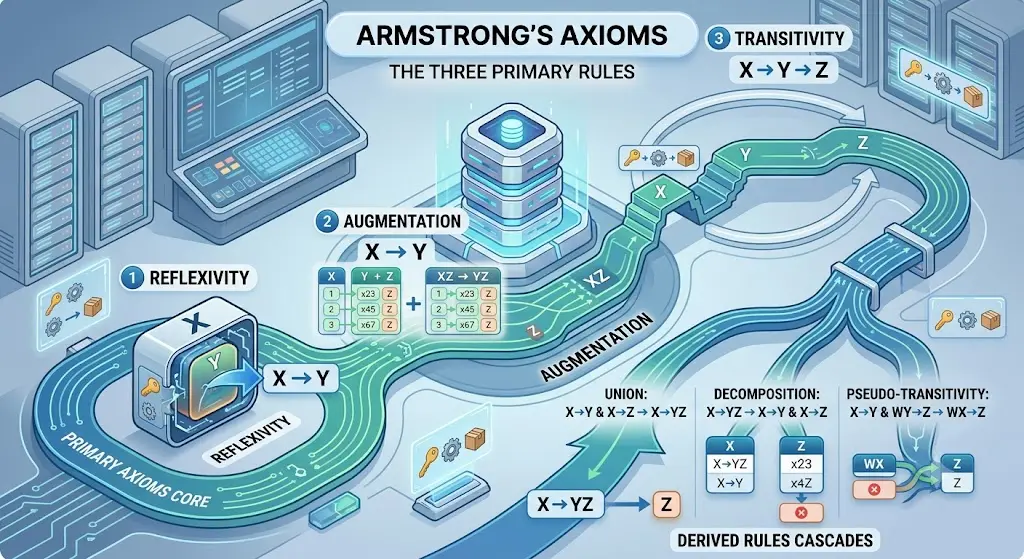
Armstrong’s Axioms are a set of inference rules, formalized by William Armstrong in 1974, that let you derive all the functional dependencies logically implied by a given set. They’re proven to be both sound and complete, meaning they generate exactly the correct set of dependencies no more, no less.
1. Reflexivity
If Y is a subset of X, then X → Y. This is the trivial-dependency rule in formal terms it always holds true.
2. Augmentation
If X → Y holds, then XZ → YZ also holds for any attribute set Z. In other words, adding the same extra attributes to both sides of a dependency doesn’t break it.
3. Transitivity
If X → Y and Y → Z, then X → Z. This is the rule that formally explains transitive dependency, which we saw earlier with RollNo → Department → HOD.
4. Derived Rules
From these three axioms, you can derive several handy shortcuts: Union (X→Y and X→Z implies X→YZ), Decomposition (X→YZ implies X→Y and X→Z), and Pseudo-transitivity (X→Y and WY→Z implies WX→Z). These aren’t strictly necessary; they follow from the basic three but they save time in exam problems and real schema analysis.
Functional Dependency and Database Normalization
Normalization is the whole reason functional dependency theory exists in practice. Each normal form removes a specific category of dependency-related redundancy.
1. First Normal Form
1NF requires that every attribute holds only atomic (indivisible) values, no lists or repeating groups crammed into a single cell. A “Phone Numbers” column storing “9876543210, 9123456789” in one field violates 1NF.
2. Second Normal Form
2NF requires the table to be in 1NF and have no partial dependencies meaning every non-key attribute must depend on the whole primary key, not just part of it. This matters only for tables with composite keys.
3. Third Normal Form
3NF requires 2NF, plus no transitive dependencies; non-key attributes can’t depend on other non-key attributes. This is usually where most well-designed production tables land.
4. BCNF
Boyce-Codd Normal Form is a stricter version of 3NF: for every non-trivial dependency X → Y, X must be a super key. It handles some rare edge cases 3NF misses, typically involving overlapping candidate keys.
5. Dependency Preservation
When you decompose a table into smaller tables during normalization, dependency preservation means all the original functional dependencies can still be verified without needing to join tables back together. Losing dependency preservation makes it harder to enforce data integrity through constraints alone.
6. Lossless Decomposition
A lossless-join decomposition guarantees that when you join the decomposed tables back together, you get exactly the original data, no extra phantom rows, nothing missing. This is checked by verifying that the common attribute between two decomposed tables is a candidate key in at least one of them.
Canonical Cover (Minimal Cover)
A canonical cover (or minimal cover) is the smallest, most simplified set of functional dependencies that’s still logically equivalent to your original set — no redundant dependencies, no redundant attributes on either side.
Algorithm
- Break every FD so the right-hand side has only a single attribute.
- Remove any extraneous (unnecessary) attributes from the left-hand side of each FD.
- Remove any FD that’s entirely redundant implied by the others.
Solved Example
Given FDs: A → BC, B → C, A → B, AB → C.
- Step 1 (split RHS): A → B, A → C, B → C, A → B, AB → C
- Step 2 (remove extraneous LHS attributes): In AB → C, since B → C already exists, A is extraneous — AB → C simplifies to B → C, which is a duplicate.
- Step 3 (remove redundant FDs): A → C is redundant because A → B and B → C already imply it (via transitivity). Duplicate A → B is removed too.
Canonical cover: A → B, B → C. Clean, minimal, and logically equivalent to the original messy set.
Functional Dependency vs Other Database Concepts
1. Primary Key vs Functional Dependency
A primary key is a part of the information that helps us tell each row apart. The primary key is what makes each row unique. The reason the primary key works is because of something called dependency. This is an idea that explains why the primary key is so important. The primary key is the thing that has all the other information connected to it. This means the primary key includes every piece of information in the table, which is really important for the primary key to work properly with the primary key.
2. Foreign Key vs Functional Dependency
A foreign key links two tables by referencing another table’s primary key, enforcing referential integrity across relations. Functional dependency, by contrast, describes relationships within a single table’s attributes.
3. Unique Key vs Functional Dependency
A unique key enforces that no two rows share the same value in that column, allowing one null. It’s a constraint you implement in SQL; functional dependency is the design-level concept that tells you a column deserves that constraint in the first place.
4. Candidate Key vs Functional Dependency
A candidate key is any minimal attribute set whose closure equals all attributes in the relation so candidate keys are essentially discovered by applying functional dependency and attribute closure analysis to your schema.
SQL Examples of Functional Dependency
1. Creating Sample Tables
CREATE TABLE Students (
StudentID INT PRIMARY KEY,
Name VARCHAR(100),
Department VARCHAR(50),
HOD VARCHAR(100)
);
This table, as designed, actually violates 3NF Department → HOD is a transitive dependency hiding inside it.
2. Identifying Dependencies
Running a simple query can reveal broken assumptions about your dependencies:
SELECT Department, COUNT(DISTINCT HOD) AS hod_count
FROM Students
GROUP BY Department
HAVING COUNT(DISTINCT HOD) > 1;
If this returns any rows, it means your assumed FD Department → HOD doesn’t actually hold in the real data a useful sanity check before you normalize based on an assumption.
3. Normalization Example
To fix the transitive dependency, split the table:
CREATE TABLE Departments (
Department VARCHAR(50) PRIMARY KEY,
HOD VARCHAR(100)
);
CREATE TABLE Students (
StudentID INT PRIMARY KEY,
Name VARCHAR(100),
Department VARCHAR(50),
FOREIGN KEY (Department) REFERENCES Departments(Department)
);
Now HOD is stored once per department instead of repeating across every student row — a direct, practical payoff of understanding functional dependency.
Common Mistakes
- Confusing correlation with dependency. Just because two columns often match in your sample data doesn’t mean a true functional dependency exists, check the rule against edge cases, not just the rows you happen to see.
- Assuming a dependency is permanent. Real-world facts change (managers get reassigned, prices update), so an FD that held yesterday might not hold tomorrow. Model for change, especially with time-sensitive attributes like price or status.
- Skipping attribute closure before picking keys. Guessing at candidate keys without computing closure often leads to missed partial or transitive dependencies that surface later as data bugs.
- Over-normalizing everything to BCNF. Sometimes a controlled amount of denormalization is a deliberate performance trade-off, not a design flaw know the rule well enough to break it on purpose.
- Forgetting composite keys when checking partial dependency. Partial dependency only applies to tables with composite primary keys checking for it on a single-column key wastes time.
Interview Questions and Answers
Q1: What is functional dependency in DBMS?
It’s a constraint where one attribute (or attribute set) uniquely determines another. If you know X, you always know Y.
Q2: What’s the difference between full and partial functional dependency?
Full dependency means Y depends on the entire composite key X; partial dependency means Y depends on only part of that composite key.
Q3: How is functional dependency related to normalization?
Each normal form (1NF through 5NF) is defined in terms of eliminating a specific type of problematic dependency partial, transitive, multivalued, or join dependency.
Q4: What is attribute closure used for?
It’s used to determine whether a given attribute set is a candidate key, and to check if a specific FD is logically implied by a given set of FDs.
Q5: State Armstrong’s Axioms.
Reflexivity, Augmentation, and Transitivity three inference rules proven sound and complete for deriving all implied functional dependencies.
Q6: What’s a transitive dependency, and why does 3NF care about it?
It’s when a non-key attribute depends on another non-key attribute rather than the primary key directly. 3NF removes it because it causes update anomalies. Changing one fact requires updating many rows.
Q7: Can a table have more than one functional dependency?
Yes, absolutely most real tables have several FDs operating simultaneously, and part of good design is mapping all of them out before normalizing.
Practice Problems
Easy Questions
- Given EmployeeID → {Name, Salary}, is this dependency trivial or non-trivial? (Answer: non-trivial, since Name and Salary aren’t subsets of EmployeeID.)
- Identify the determinant and dependent in ISBN → BookTitle.
Intermediate Questions
- A table has a composite key {OrderID, ProductID}, and ProductName depends only on ProductID. What type of dependency is this, and which normal form fixes it?
- Given FDs A → B and B → C, compute A⁺.
Advanced Questions
- Given R(A, B, C, D) with FDs {A → B, B → C, C → D, D → A}, find all candidate keys.
- Compute the canonical cover for: X → YZ, Y → Z, X → Y.
Best Practices for Database Design
Map out your functional dependencies on paper (or a whiteboard) before you write a single CREATE TABLE statement; it’s far cheaper to fix a dependency diagram than a live production schema. Always validate assumed FDs against real sample data rather than trusting your mental model of the business rules, since actual data often breaks assumptions in surprising ways.
Aim for 3NF as a solid default for transactional systems, and only push to BCNF when you have overlapping candidate keys that genuinely need it. Keep an eye on multivalued dependencies whenever a single entity has multiple independent one-to-many relationships; that’s your signal to consider 4NF. Finally, document your key dependencies in your schema comments or data dictionary; future developers (including future you) will thank you.
Frequently Asked Questions
1. What is functional dependency in a database with an example?
Functional dependency is when one attribute determines another for instance, StudentID → Name means each student ID always maps to exactly one name.
2. What is the difference between functional dependency and multivalued dependency?
Functional dependency maps one determinant to a single value of the dependent; multivalued dependency maps one determinant to a set of independent values, like an employee having multiple skills.
3. Why is functional dependency important in normalization?
So when we talk about forms they are really defined by the kind of redundant dependencies they get rid of. To do normalization right we need to figure out the dependencies first. We have to know what the functional dependencies are before we can normalize the data correctly. Normal forms are about removing redundant dependencies and functional dependencies are a key part of that.
4. What is the difference between partial and transitive dependency?
Partial dependency involves part of a composite key not determining the full set of non-key attributes; transitive dependency involves a non-key attribute determining another non-key attribute.
5. What is attribute closure in DBMS?
It’s the complete set of attributes that can be derived from a given attribute (or attribute set) using the known functional dependencies.
6. What are Armstrong’s Axioms used for?
They’re the formal inference rules used to derive all functional dependencies logically implied by a base set foundational for computing closures and canonical covers.
7. Is a primary key always a determinant?
Yes, by definition, a primary key must functionally determine every other attribute in its table.
8. Can two attributes be mutually dependent on each other?
Yes, this is possible and it’s called an equivalence: if X → Y and Y → X both hold, X and Y are considered equivalent determinants of each other.
9. What is the difference between candidate key and super key?
A super key is a set of attributes that can identify a row in a database.It has all the attributes to uniquely identify a row even if some are extra.A candidate key is also a key but it has only the necessary attributes, no extra ones.It is a super key.
10. How do you find candidate keys using functional dependency?
Compute the closure of different attribute combinations; any minimal set whose closure equals all attributes in the relation is a candidate key.
11. What is canonical cover, and why do we need it?
It’s the smallest equivalent set of functional dependencies, stripped of redundancy; it makes normalization and dependency-checking far simpler and faster.
12. What is the difference between BCNF and 3NF?
3NF allows a rare exception where a non-key attribute determines part of a candidate key; BCNF closes that loophole by requiring every determinant to be a super key.
13. Does every relation need to be in BCNF?
No, BCNF sometimes isn’t achievable without losing dependency preservation, so many real-world systems settle for 3NF instead as a practical trade-off.
14. What is a trivial functional dependency?
It’s a dependency where the right-hand side is already a subset of the left-hand side technically true, but not informative.
15. How does functional dependency affect database performance?
Well-identified FDs lead to properly normalized tables, which reduce redundancy and update anomalies though over-normalization can sometimes require more joins, which is its own performance trade-off.
Conclusion
Functional dependency is a fundamental DBMS concept that helps organize data efficiently and reduce redundancy. It forms the foundation of good database design and ensures data remains accurate and consistent.
Understanding functional dependency also makes normalization much easier. Concepts like partial dependency, transitive dependency, and attribute closure help you build well-structured databases that are easier to maintain and scale.
Whether you’re preparing for exams, technical interviews, or real-world database projects, mastering functional dependency will strengthen your DBMS knowledge and improve your database design skills.