For e-commerce brands, shipping cost inflation doesn’t just eat into the profitability of a single order, it also complicates decisions about promotions, free-shipping thresholds, and how aggressively to compete on price.
Most businesses respond to a new FedEx rate increase or updated UPS rate card by looking straight at headline transportation costs. That’s a reasonable first instinct.
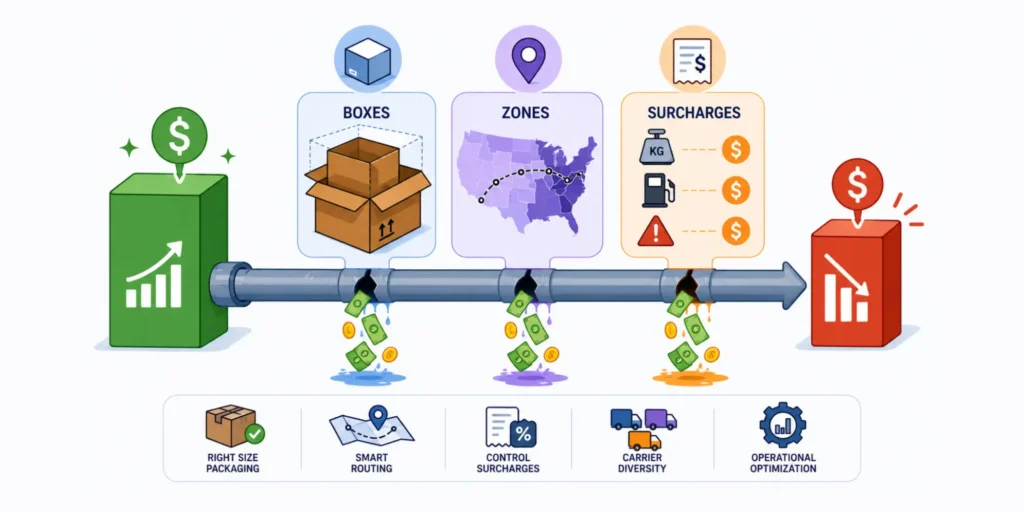
But it usually misses where the real money leaks out: excess packaging, dimensional weight exposure, inefficient routing, and a growing list of surcharges. None of these show up as one dramatic line item. They add up quietly, across thousands of shipments a month.
2026 is likely to make this worse. New rate adjustments and expanded delivery-area surcharges mean small inefficiencies compound faster than they used to.
So real margin protection can’t just be a carrier-negotiation exercise. It requires understanding how your shipments actually behave, where they go, how they’re packed, and which patterns are quietly costing you money. This piece walks through package profiling, DIM weight management, zone exposure, delivery-area surcharge control, carrier diversification, and the cross-functional planning that keeps margins intact.
What Changed in 2026 and Why Brands Should Care Now
The 2026 carrier changes aren’t just about higher rates. They reflect an industry getting more granular about how it prices shipments — and more aggressive about recovering costs it used to just absorb.
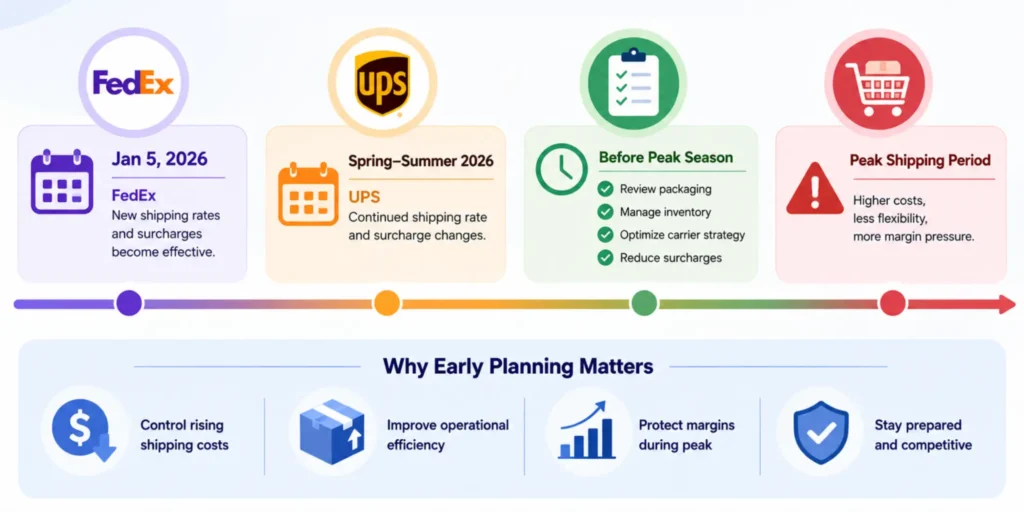
FedEx’s 2026 rate and surcharge changes took effect January 5. UPS has been rolling out its own rate and surcharge adjustments through spring and summer 2026. Together, they add up to more than a routine annual increase.
- Shipping Costs Extend Beyond Base Rates
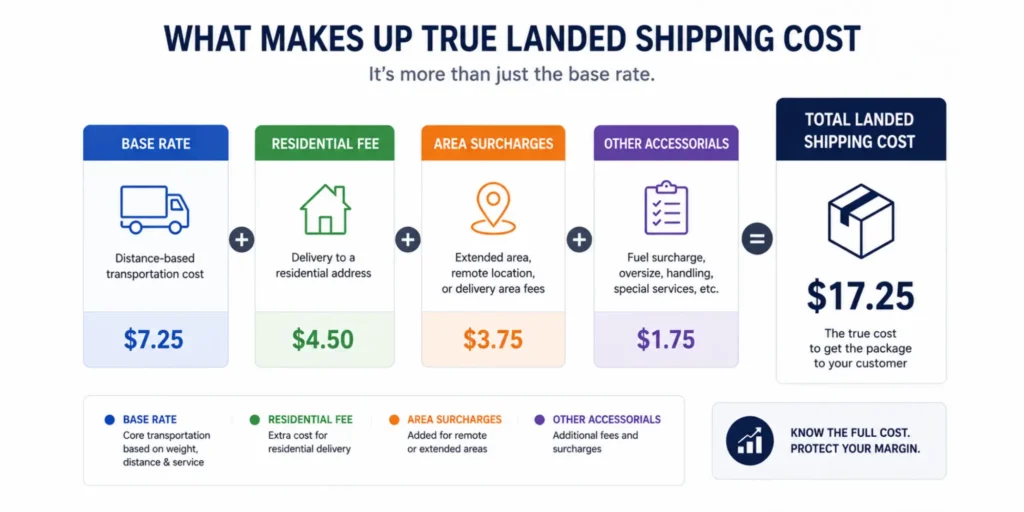
Many e-commerce companies underestimate how much of the increase sits outside the base transportation charge. A growing share of the pressure comes from accessorials:
- Residential delivery fees
- Oversized-package fees
- Fuel surcharges
- Recurring surcharges that spike during peak season
- Home Delivery Demand Is Driving Higher Operational Costs
Home delivery is a big part of why FedEx and UPS keep finding new ways to recover cost. More than 80% of parcel volume in many e-commerce categories already goes to residential addresses.
That volume isn’t shrinking. So this cost pressure probably isn’t temporary either.
- Growing Parcel Volumes Continue to Increase Transportation Costs
Pitney Bowes has reported that U.S. parcel volume has passed 21 billion pieces a year, with no sign of slowing. Industry data suggests overall e-commerce transportation costs keep rising alongside it.
At that kind of scale, even a small per-shipment rate bump turns into a real hit to margin.
- Proactive Shipping Audits Protect Margins Before Peak Season
The real shift in thinking isn’t “how much did carriers raise rates.” It’s “how unpredictable has our cost-per-order become.”
That distinction matters because once peak season hits, the flexibility to fix things disappears. Waiting until the holiday surge to notice a problem means losing the window to:
- Redesign packaging
- Rebalance inventory across fulfillment nodes
- Reduce exposure to surcharges
- Renegotiate carrier allocation
Margin protection has to start well before volume peaks, not during it.
Start With a Package Profile Audit Before Looking at Carrier Rates
Before renegotiating with FedEx or UPS, it helps to actually know how your shipments behave today.
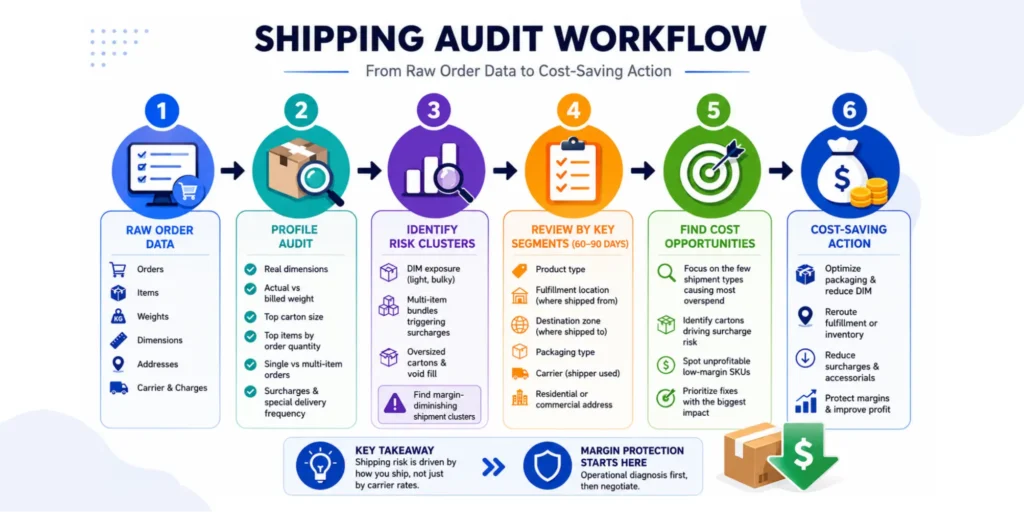
A package profile audit looks at how products are packed, billed, and shipped in practice — not on paper. It’s common for brands to sign carrier agreements without a clear picture of which shipment characteristics are driving cost.
A useful audit should dig into:
- Real package dimensions
- Actual weight versus billed weight
- Most common carton sizes
- Highest-volume SKUs by order count
- Single-item versus multi-item orders
- Shipping patterns by product category
- Frequency of surcharges and special delivery fees
The goal is to find what you might call “margin-diminishing shipment clusters” — recurring patterns where shipping cost is disproportionate to the value of what’s inside the box.
Lightweight but bulky products often get hit with DIM pricing even though they barely register on a scale. Bundled items can unintentionally cross weight thresholds that trigger higher surcharges. Oversized cartons packed with void fill can quietly inflate billed weight across thousands of shipments a month.
It’s worth pulling 60–90 days of shipment data and breaking it down by:
- Product type
- Fulfillment location
- Destination zone
- Packaging type
- Carrier used
- Residential versus commercial delivery address
Most brands that go through this exercise find a small number of shipment types account for a disproportionate share of their shipping spend. One company might discover that three carton sizes are driving most of its delivery-area surcharge exposure. Another might find certain low-margin SKUs are actually unprofitable once surcharges are allocated properly.
This is why the operational diagnosis has to come before the carrier negotiation, not after. Carrier pricing matters, but how you pack and ship is what actually determines your exposure to rising fees, accessorials, and rate increases.
Review Zone Exposure: Distance Quietly Multiplies Cost
One of the most important drivers of e-commerce pricing inflation is the shipping zones, Shipping zones are one of the most overlooked drivers of cost inflation.
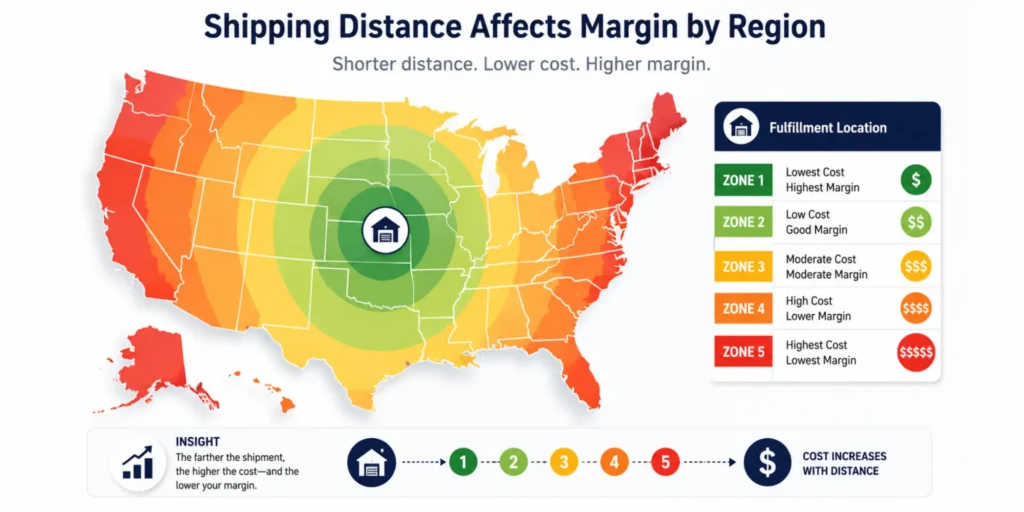
A zone reflects the distance between where a package ships from and where it’s delivered. The farther it travels, the more it costs to move.
That sounds obvious. But plenty of e-commerce brands still haven’t looked closely at how much of their volume falls into the costlier zones.
“Zone creep” tends to happen when a company fulfills a wide geography from a single node. As demand grows in far-flung areas, average shipping distance creeps up, and so does cost.
Worth evaluating:
- What percentage of shipments fall into each zone
- Revenue generated by zone
- Total shipping cost by zone
- Order volume from ZIP codes outside your optimal service area
- Which regions carry the most delivery-area surcharge exposure
The nuance here is that an order can be profitable when it ships locally and unprofitable when it ships cross-country at a much higher rate. Some ways to manage this:
- Redistributing inventory across regions
- Rethinking warehouse allocation
- Adding regional carriers for certain lanes
- Adjusting free-shipping thresholds by region
- Reducing long-haul parcel volume
Peak-season surcharges and tighter carrier capacity make all of this worse if it’s left unaddressed. Margin protection, in other words, is as much a geographic fulfillment question as an operational one.
Tackle DIM Weight Before It Silently Resets Your Cost Structure
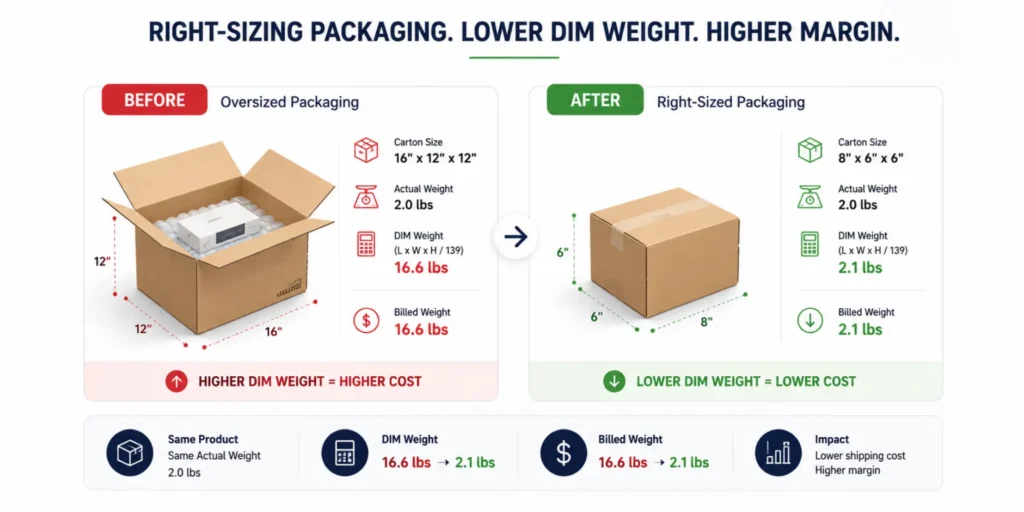
Dimensional weight, DIM weight, remains one of the least understood cost drivers in e-commerce shipping.
Carriers don’t always bill by scale weight. Past a certain size threshold, they bill by volume instead.
That means a genuinely lightweight package can still carry a high billed cost, simply because of the space it takes up in a truck or plane.
Brands routinely underestimate how much DIM pricing cuts into margin, especially as FedEx and UPS rates climb. Common culprits: oversized boxes for small items, excess void fill, inconsistent packing logic, and picking processes that don’t account for box size at all.
Auditing shipments where billed weight is meaningfully higher than actual weight is often the fastest way to find hidden, recurring overspend. Reduction strategies typically include:
- Right-sizing boxes
- Cutting unnecessary void fill
- Standardizing box sizes
- Improving picking and packing workflows
- Redesigning product sets with packaging in mind
- Getting merchandising and packaging teams talking to each other
Even a modest reduction — say, a pound of billed weight per unit across a high-volume SKU category — can add up to real savings once it’s multiplied across a year of shipments. In many cases, that kind of operational fix outperforms whatever savings a brand might negotiate directly with a carrier.
DIM optimization tends to be one of the fastest wins available, because the savings repeat with every future shipment rather than depending on the next contract renewal.
More mature operations increasingly treat packaging engineering as a profit lever rather than just a warehouse task. That usually means merchandising, fulfillment, and finance need to be in the same conversation.
Product photography plays a role here too. Brands that standardize their catalog, including using a background remover tool for consistent product shots, often find it easier to plan packaging consistently across product variants.
Bottom line: ignore DIM exposure long enough, and it quietly resets your cost structure a little more every month.
Don’t Ignore Residential Fees and Delivery Area Surcharges
Residential delivery cost is one of the fastest-growing risks to margin for DTC and hybrid retailers.
On a single order, a residential fee or delivery-area surcharge barely registers. Multiply it across thousands of monthly shipments, though, and it becomes real operational leakage.
DTC brands should know:
- What share of shipments are residential
- Which ZIP codes trigger surcharges most often
- Which low-AOV orders carry disproportionate surcharge costs
- Which regions see outsized surcharge exposure
One common mistake: lumping delivery-area surcharges into a general “shipping expense” bucket. That hides exactly what’s driving the decline in margin.
Options worth considering:
- Adding one or more regional carriers
- Tightening address validation
- Smarter order-routing logic
- Adjusting free-shipping policy
- Charging more for longer-distance delivery
Managing surcharges isn’t purely a logistics problem. It touches merchandising, pricing, customer acquisition economics, and forecasting too.
Brands that get ahead of delivery-zone surcharge risk tend to hold onto margin better than those simply absorbing whatever FedEx or UPS announces next.
Reevaluate Carrier Mix Instead of Sending Every Parcel the Same Way
Most e-commerce brands still route the bulk of their volume through a single national carrier. As FedEx and UPS rates keep shifting, that single-carrier approach increasingly limits flexibility.
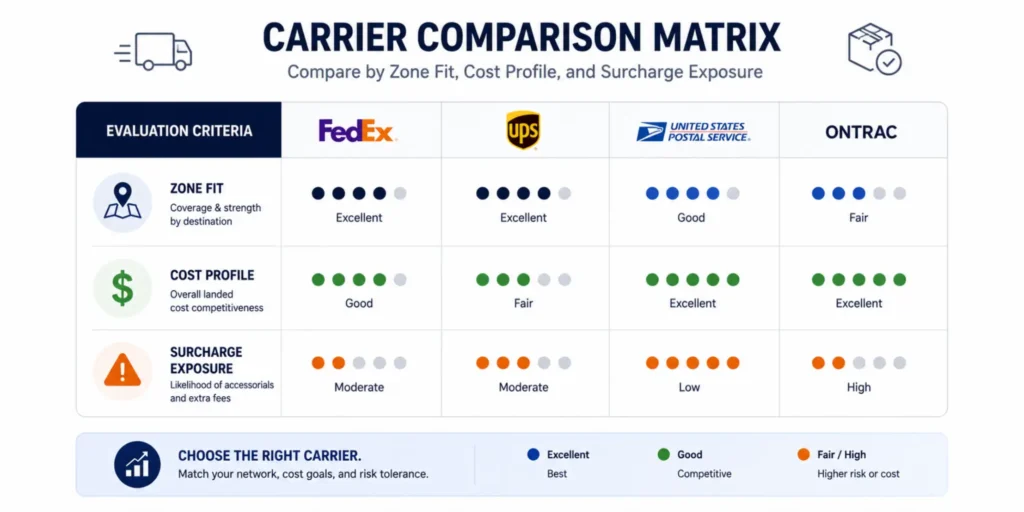
A diversified carrier mix is itself a margin-protection strategy. Different carriers perform differently depending on shipment profile, destination zone, service level, and surcharge structure.
A balanced mix typically includes:
- A national carrier for broad coverage
- Regional carriers for specific zones
- Postal-based options for low-priority shipments
- A budget option for cost-sensitive customers
It helps to score carriers on:
- Cost per parcel
- Delivery success rate
- Damage and claims rate
- Surcharge frequency
- Residential delivery fees
- Peak-season flexibility
As UPS continues adjusting pricing and service through 2026, it’s worth revisiting these numbers periodically rather than treating a rate card as fixed.
Rather than switching carriers wholesale, it usually makes more sense to test gradual changes, reallocating certain regions or shipment categories, so margin improves without disrupting the customer experience.
The strongest operators increasingly treat carrier allocation as something to adjust continuously, not a decision made once a year.
Build a Pre-Peak Margin Protection Plan Across Ops, Finance, and CX
None of this works without cross-functional ownership.
Shipping optimization too often stays siloed inside logistics, even though the costs ripple into finance, customer experience, merchandising, and growth. Brands that protect margin well tend to run a recurring review, ideally well before the holiday rush, that looks specifically at shipment-level cost drivers.
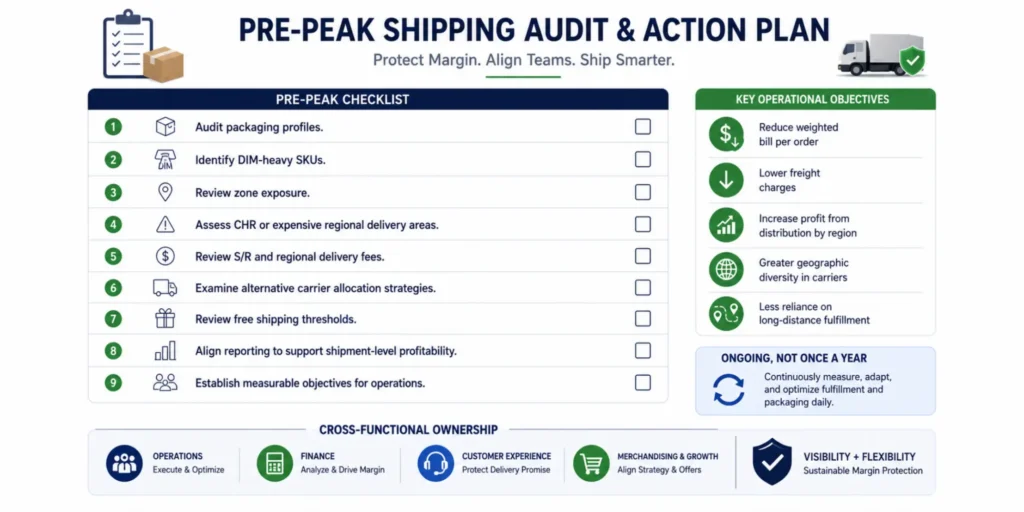
A reasonable pre-peak checklist:
- Audit packaging profiles
- Flag DIM-heavy SKUs
- Review zone exposure
- Identify high-cost regional delivery patterns
- Review residential and regional delivery fees
- Reassess carrier allocation
- Revisit free-shipping thresholds
- Align reporting around shipment-level profitability
Useful targets to track:
- Lower weighted cost per order
- Reduced freight expense
- Better regional distribution profitability
- More carrier diversity
- Less reliance on long-distance fulfillment
Treat this as an ongoing process, not an annual one. Shipping economics shift too often for a once-a-year review to hold up.
The brands that do best keep measuring performance through peak season itself, adjusting both carrier allocation and packaging as they go. Margin protection, in the end, comes down to two things: operational flexibility and shipment visibility.
Conclusion: Margin Protection Comes From Better Shipping Decisions, Not Wishful Forecasting
E-commerce brands can’t control what FedEx or UPS charges. They can control how exposed they are to it.
The brands that come out ahead in 2026 will be the ones that tighten package discipline, reduce DIM inefficiency, watch their zone exposure, manage delivery-area surcharge risk, and diversify how they allocate carriers, deliberately, not reactively.
For a long time, shipping was treated as an unavoidable cost of doing business rather than something that directly shapes revenue and customer experience. That’s changing.
Brands that get ahead of it before peak season tend to end up with lower operational waste, more resilience under pressure, and margins that hold up well after the rush fades.
Now’s a reasonable time to run a full shipping audit, before today’s small inefficiencies turn into next year’s permanent profit loss.