
Almost every company is now using AI somewhere. Marketing teams draft copy with it. Support teams automate replies. Finance teams forecast with it. Yet many of these companies still struggle to turn all that activity into real business change.
The reason is rarely the technology. In my experience, AI transformation is a problem of governance. The models work. What breaks is the layer around them: who owns the decisions, who checks the outputs, which data is allowed, and who answers when something goes wrong.
This guide explains why governance is the missing link between AI adoption and AI transformation. You will learn the main challenges and risks, the frameworks worth knowing, a nine-step plan to put governance in place, and the metrics that show whether it is working.
What Does It Mean That AI Transformation Is a Problem of Governance?
AI transformation is a problem of governance means that the main obstacle to lasting AI success is not algorithms or computing power. It is the lack of clear ownership, rules, oversight, and accountability for how AI is chosen, built, used, and monitored across the organization.
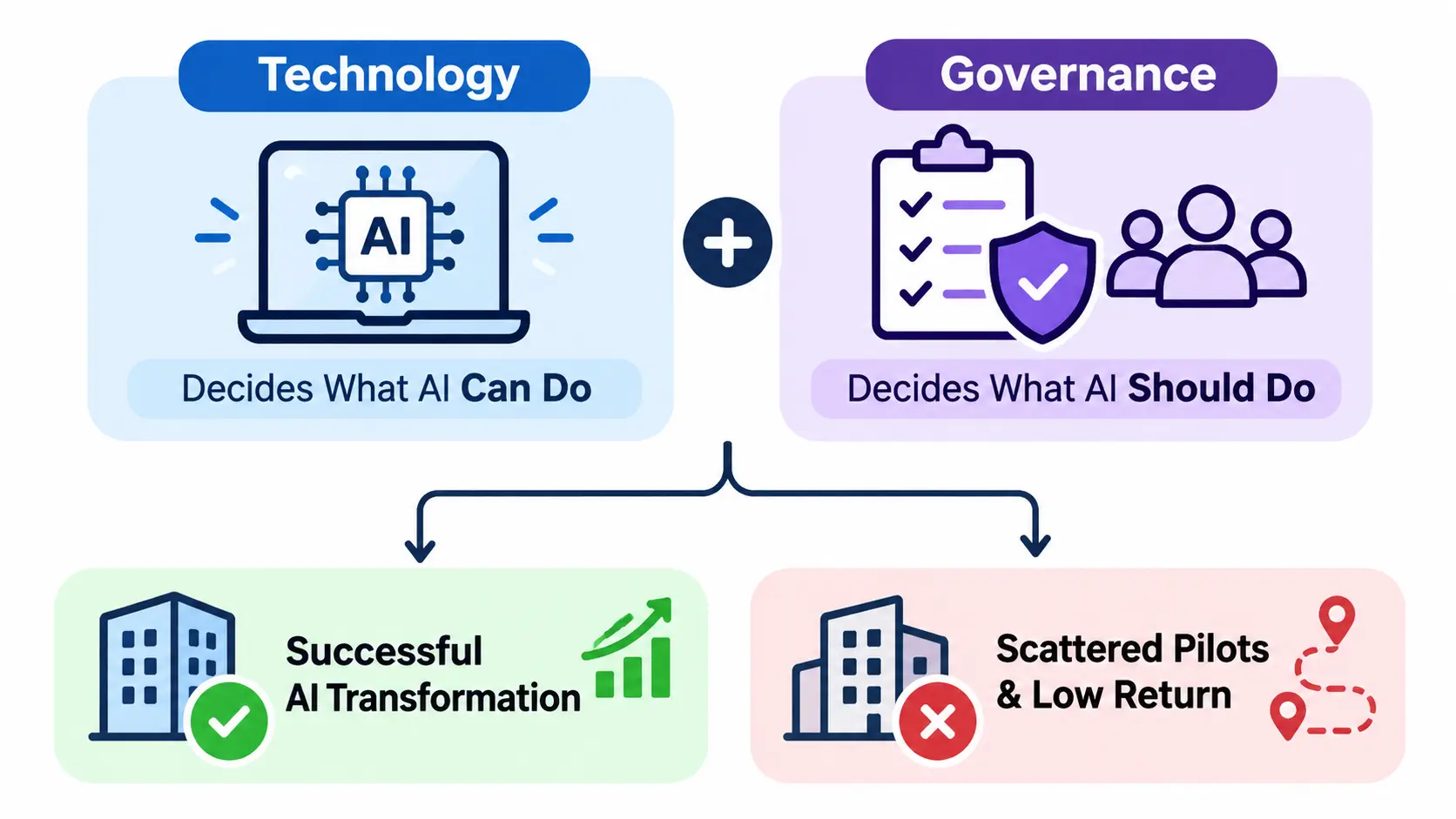
Put simply, technology decides what AI can do. Governance decides what AI should do, who approves it, and who is responsible for the result.
Two companies can buy the same AI tool. One scales it safely across the business. The other ends up with scattered pilots, nervous legal teams, and no clear return. The difference is almost always governance.
Understanding AI Transformation vs. AI Adoption vs. AI Governance
These three terms are often mixed up, so it helps to separate them.
- AI adoption means using AI tools. A team signs up for a chatbot or a prediction tool.
- AI transformation means AI changes how the organization works, makes decisions, and creates value, in a way that lasts.
- AI governance is the set of roles, policies, processes, and controls that guide AI use so it is safe, lawful, fair, and useful.
Adoption is easy. Anyone with a credit card can do it. Transformation needs adoption plus governance. Without governance, adoption stays a collection of experiments.
Why Technology Alone Cannot Deliver Successful AI Transformation
A model can be accurate in a test and still fail in the real world. Why? Because real work involves people, messy data, legal duties, and judgment calls.
Take a lending model that predicts risk well. Someone still has to decide which customers it applies to, who reviews unusual cases, how customers can challenge a decision, and what happens when the model’s accuracy slips. None of that is solved by better code.
Technology answers “can we?” Governance answers “should we, who decides, and what if it goes wrong?”
The Relationship Between Leadership, Accountability, and AI Governance
Governance only works when leaders back it. Accountability has to sit with named people, not with “the AI team” or “the vendor.”
Strong leadership does three things. It sets the direction for how AI supports business goals. It assigns clear decision rights. And it makes sure risk and compliance voices are heard before launch, not after an incident.
When leaders treat governance as a brake on innovation, teams work around it. When leaders treat it as the guardrail that lets them go faster, teams use it.
Why AI Transformation Fails Without Proper Governance
When AI projects stall, the post-mortem rarely blames the model. It usually points to one or more of the six gaps below.
Lack of Clear AI Ownership and Accountability
Ask “who owns this AI system?” in many companies and you get four different answers. IT says it owns the platform. The business says it owns the use case. Security owns the risk. Legal owns the contract.
This creates real problems:
- Unclear decision-making authority. Nobody knows who can approve a new use case or stop a risky one.
- Confusion between IT, legal, security, and business teams. Each assumes another team is handling the hard questions.
- No dedicated governance leadership. Without a named lead or committee, issues drift.
When no one owns the outcome, no one fixes the problem.
Fragmented AI Adoption Across Departments
In many organizations, each department picks its own tools. Sales trials one assistant. HR uses another. Operations builds a custom model.
The result looks like this:
- Isolated AI experiments that never connect to a wider strategy.
- Duplicate AI investments, with several teams paying for similar tools.
- No enterprise-wide coordination, so lessons learned in one team never reach another.
Fragmentation also hides risk. You cannot govern what you cannot see.
Poor Data Governance and Data Quality
AI is only as reliable as the data behind it. Weak data governance shows up in three ways:
- Inaccurate or incomplete training data, which leads to poor or biased outputs.
- Sensitive data exposure, such as staff pasting customer details into public AI tools.
- Weak data access controls, which let the wrong people or systems reach the wrong information.
Most AI incidents I have seen trace back to data decisions made long before the model was built.
Insufficient Human Oversight
AI can sound confident while being wrong. If nobody checks, errors flow straight into customer messages, reports, and decisions.
Common gaps include:
- Overreliance on automated decisions, especially when teams are busy.
- Inadequate human review, where reviewers lack time or context.
- Unclear escalation procedures, so staff do not know what to do when an output looks wrong.
Lack of AI Risk Assessment and Monitoring
Many teams test a model once, launch it, and move on. But AI systems change in practice.
- Unidentified operational risks. Nobody asked what happens if the system fails or is misused.
- Model drift. A model’s accuracy can decline over time as real-world data changes.
- Unmonitored AI-generated outputs. Nobody samples results to see whether quality is holding.
Weak Leadership and Organizational Change Management
AI changes jobs, workflows, and expectations. If that change is not managed, people resist it or quietly work around it.
- Lack of executive sponsorship. Without a sponsor, projects lose budget and priority.
- Employee resistance. Staff fear job loss or distrust the tools.
- Insufficient AI literacy and training. People do not know what the tools can and cannot do.
Major AI Governance Challenges Facing Modern Organizations
Even well-run companies face real difficulty here. These are the challenges that come up most often.
Ethical AI and Algorithmic Bias
Bias happens when an AI system treats groups of people unfairly, often because its training data reflects past inequalities. A hiring model trained on historic hiring decisions can repeat old patterns.
Governance helps by requiring bias testing before launch, defining what “fair” means for each use case, and reviewing results regularly.
Data Privacy and Security Risks
AI systems often process personal, financial, or confidential data. Privacy laws such as the GDPR in Europe place strict duties on how that data is collected, used, and stored.
AI also adds new security risks. Examples include data leaking through prompts, manipulated inputs, and insecure connections between AI tools and company systems.
Regulatory Compliance and Legal Uncertainty
AI rules are changing quickly and differ by country and sector. The EU has passed a dedicated law, while other regions rely on existing privacy, consumer, and anti-discrimination rules, plus new guidance.
The practical answer is to build a flexible governance process that can absorb new requirements, rather than reacting law by law.
AI Transparency and Explainability
Transparency means being open about where and how AI is used. Explainability means being able to describe, in plain terms, why a system produced a given result.
This matters most when AI affects people’s lives, such as credit, hiring, or care decisions. If you cannot explain a decision, you cannot defend it.
Third-Party AI Vendor Management
Most companies buy AI rather than build it. That moves risk outside your walls but does not remove your responsibility.
You need to ask vendors where data goes, whether it is used to train their models, what security controls exist, and how they handle incidents. Contracts should reflect those answers.
Shadow AI and Unauthorized AI Tools
Shadow AI is when employees use AI tools that the company has not approved. They usually mean well. They want to work faster.
But the risk is real: confidential documents pasted into public tools, unvetted outputs used in client work, and no audit trail. Banning tools rarely works. Offering approved alternatives and clear rules works better.
Governance of Generative AI and Autonomous AI Agents
Generative AI can produce text, code, and images that look right but contain errors. AI agents go further. They can take actions, such as sending emails, changing records, or triggering payments.
That raises the stakes. Agents need clear limits on what they can access, which actions need human approval, and how their activity is logged.
What Happens When Businesses Implement AI Without Proper Governance?
The costs show up in several places. Not all of them appear at once, which is why they are easy to underestimate.
Financial Losses and Failed AI Investments
Ungoverned projects often overspend, overlap, or never reach production. Money goes into pilots that nobody can scale because ownership, data, and approval paths were never settled.
Compliance Violations and Legal Consequences
Using personal data without a proper basis, or deploying AI in a regulated area without required checks, can lead to fines, investigations, and lawsuits. Regulators generally expect organizations to show they exercised control, not just that they meant well.
Biased or Unreliable Business Decisions
If biased or low-quality outputs feed into pricing, hiring, or credit decisions, the business makes worse decisions at scale. And the errors can be hard to spot because the outputs look professional.
Data Breaches and Cybersecurity Incidents
Poor access controls and unvetted tools widen the attack surface. A single employee sharing sensitive files with an unapproved AI service can create a reportable incident.
Reduced Customer Trust and Brand Reputation
Customers forgive mistakes more easily than they forgive carelessness. If your AI gives harmful advice or mishandles personal data, trust is slow to rebuild.
Failed AI Pilots and Unsuccessful Enterprise Scaling
A pilot can succeed with a small, motivated team. Scaling it needs shared standards, approvals, and monitoring. Without governance, pilots stay pilots.
A practical example (illustrative). Imagine a retailer builds an AI tool that predicts which products will sell out. In testing, it is accurate. Then it launches. The merchandising team trusts it fully. The supply team does not trust it at all. Nobody is assigned to review its forecasts, and no one has authority to override it during a supplier delay.
Stock-outs rise, teams blame each other, and the tool is shelved. The model worked. The organization around it did not. That gap is a governance gap.
Key Principles of an Effective AI Governance Framework
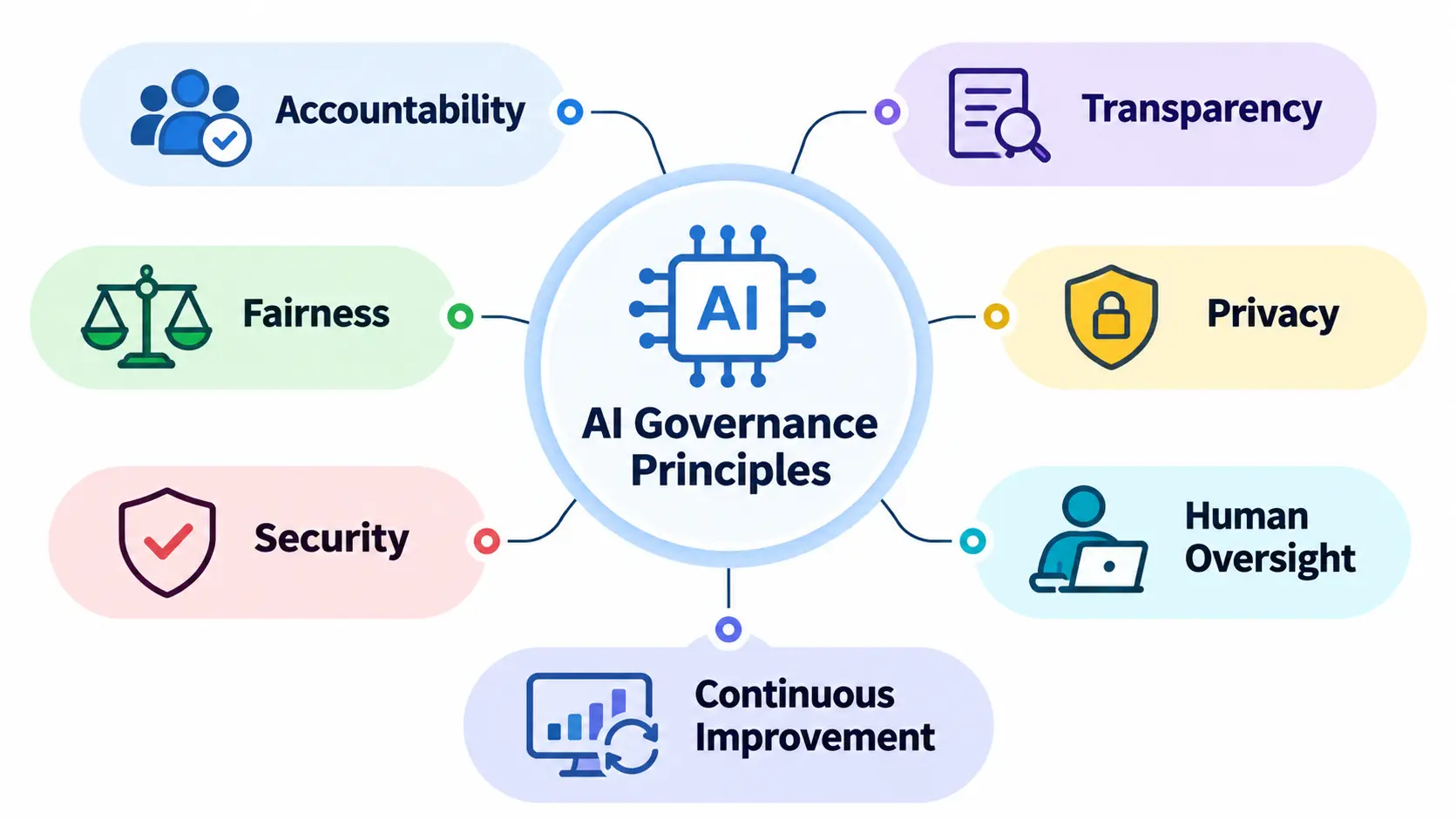
An AI governance framework is a structured set of principles, policies, and processes that guide how AI is used. Most good frameworks rest on the same seven principles. Think of them as the foundation, not a checklist to tick once.
Accountability and Clear Ownership
Every AI system should have a named owner who is responsible for its purpose, performance, and risks. Ownership should be written down, not assumed.
Transparency and Explainability
People affected by AI should know it is being used, and the organization should be able to explain how important outputs were produced. Keep documentation simple and current.
Fairness and Ethical AI Development
Test for unfair outcomes before launch and after. Decide in advance what level of difference between groups is acceptable, and who signs off.
Privacy and Data Protection
Collect only the data you need, protect it, and be clear about how it is used. Make sure AI use matches the promises you made to customers and employees.
Security and Reliability
AI systems need the same protection as any critical system, plus attention to AI-specific threats such as prompt manipulation and data leakage. They should also perform consistently under real conditions.
Human Oversight and Decision Control
Humans should stay in charge of important decisions. The higher the impact on people, the stronger the human review should be.
Continuous Monitoring and Improvement
AI is not a “launch and forget” product. Track performance, review incidents, and update controls as the system, data, and rules change.
How these principles show up in daily work. Principles only matter when they change behavior. Accountability becomes an owner field in your AI inventory. Transparency becomes a short documentation template. Human oversight becomes an approval step before AI-written messages go to customers. Monitoring becomes a monthly review in someone’s calendar.
If a principle does not change a policy or a routine, it is a slogan.
Major AI Governance Frameworks and Standards Businesses Should Know
You do not need to invent governance from scratch. Several respected frameworks and laws exist. Here is what each one does, in plain English.
NIST AI Risk Management Framework
The NIST AI Risk Management Framework (AI RMF) was published by the U.S. National Institute of Standards and Technology in January 2023. It is voluntary and designed to help organizations manage AI risks across the AI lifecycle. It is built around four functions:
- GOVERN: Build a culture and structure for managing AI risk, including policies, roles, and accountability. This function runs through all the others.
- MAP: Understand the context of each AI system, including its purpose, users, and potential impacts.
- MEASURE: Assess and track risks using tests, metrics, and evaluations.
- MANAGE: Prioritize risks and act on them, with plans for response and improvement.
It is popular because it is flexible and practical, and it works for organizations of any size.
ISO/IEC 42001 AI Management System
ISO/IEC 42001, published in late 2023, is an international standard for an AI management system. It follows the same style as other ISO management standards, so companies that already use ISO 27001 for security will find it familiar. Organizations can be audited against it and certified.
It focuses on:
- Organizational AI policies that set direction and objectives.
- Risk management across AI systems, including impact assessment.
- Management responsibilities, so leaders are accountable for the system.
- Continuous improvement, through monitoring, audits, and corrective action.
EU AI Act and Its Risk-Based Regulatory Approach
The EU AI Act is the European Union’s law on AI. Unlike the frameworks above, it is legally binding. It sorts AI systems by risk level and sets stricter duties for higher risk.
- Prohibited AI practices: A small set of uses judged to carry unacceptable risk are banned.
- High-risk AI systems: Systems used in sensitive areas, such as employment or access to essential services, face strict requirements for risk management, data quality, documentation, and human oversight.
- Transparency obligations: Some systems, such as chatbots and certain AI-generated content, must make clear that AI is involved.
- Compliance responsibilities: Both providers and organizations that deploy AI have duties. Penalties for serious breaches can be substantial.
The Act is being phased in, and timelines and details have been under discussion, so check current official guidance before planning around specific dates. It can also apply to companies outside the EU if their AI is used within it.
OECD AI Principles for Trustworthy AI
The OECD AI Principles were first adopted in 2019 and later updated. They were among the first intergovernmental AI standards and have influenced many national policies. They are not legally binding. Their core ideas include:
- Human rights and fairness: AI should respect human rights and democratic values.
- Transparency: People should be able to understand when and how AI is used.
- Robustness and security: AI should be safe and reliable throughout its life.
- Accountability: Those who build and run AI should answer for how it behaves.
NIST vs. ISO 42001 vs. EU AI Act vs. OECD: Key Differences
Here is how the four compare at a glance.
| NIST AI RMF | ISO/IEC 42001 | EU AI Act | OECD AI Principles | |
| Main purpose | Help manage AI risk | Set up and run an AI management system | Regulate AI based on risk | Guide trustworthy AI policy |
| Scope | Any organization, any AI lifecycle stage | Organization-wide management system | AI systems placed on or used in the EU market | Governments and organizations, high-level |
| Typical use | Risk practices and internal playbooks | Formal certification and audit readiness | Legal compliance | Shaping values and policy |
| Status | Voluntary | Voluntary (certifiable) | Legal requirement | Voluntary |
Many organizations combine them: NIST for risk practices, ISO 42001 for the management system, and the EU AI Act where the law applies.
How to Build and Implement an Effective AI Governance Strategy
This is the practical core of the article. Follow these nine steps in order. Each one lists who should lead it and what you should have at the end.
Step 1: Audit Existing AI Systems and Business Processes
Lead: CIO or head of IT, with business unit leaders. Deliverable: An AI inventory.
Start by finding out what you already have. Most companies discover more AI than they expected.
- Identify all AI tools and models, including those built in-house, bought, and embedded in other software. Organizations looking to strengthen their understanding of AI models and machine learning can also explore AI and machine learning training to build practical technical knowledge.
- Review current AI use cases and what data each one touches.
- Identify unauthorized AI use. A short, non-punitive staff survey works well.
- Evaluate your current governance maturity, even informally.
Step 2: Establish an AI Governance Committee
Lead: An executive sponsor. Deliverable: A charter with members, scope, and decision rights.
A small cross-functional group beats a large one. Keep it focused on decisions, not discussion.
- Assign executive leadership so the group has authority.
- Include IT, legal, security, HR, and business representatives.
- Define what the committee can approve, reject, or escalate.
Step 3: Develop an Organization-Wide AI Governance Policy
Lead: Legal and compliance, with the committee. Deliverable: A written AI policy.
Keep it short enough that people will read it.
- Define acceptable AI use, with clear examples of what is allowed and not allowed.
- Set data handling rules, such as which data must never enter public tools.
- Set approval and escalation procedures for new use cases and incidents.
- Document accountability, so every AI system has a named owner.
Step 4: Create an AI Risk Classification System
Lead: Risk and compliance, with security. Deliverable: A risk tiering model and control requirements.
Not every AI use needs the same scrutiny. A tool that summarizes internal meeting notes is not the same as one that screens job applicants.
- Classify applications by risk, for example low, medium, and high.
- Identify potential impacts on customers, employees, and the business.
- Set controls for each tier. Higher risk means more testing, documentation, and human review.
Step 5: Define AI Roles and Responsibilities
Lead: Governance committee. Deliverable: A RACI matrix.
The roles below are typical. Adjust them to your structure.
- Chief Information Officer (CIO): technology strategy and systems oversight.
- Chief Technology Officer (CTO): technical architecture and build standards.
- Chief Information Security Officer (CISO): security controls and incident response.
- Legal and compliance teams: regulatory review and contracts.
- Data scientists and AI engineers: model development, testing, and documentation.
- Business department leaders: use-case outcomes and day-to-day oversight.
Here is a sample RACI matrix. R = Responsible, A = Accountable, C = Consulted, I = Informed.
| Activity | CIO | CTO | CISO | Legal/Compliance | AI Engineers | Business Leader |
| Maintain AI inventory | A | C | C | I | R | R |
| Approve new AI use case | C | C | C | C | I | A |
| Risk classification | I | C | C | A | R | C |
| Security review | I | C | A | C | R | I |
| Vendor assessment | C | C | R | A | I | C |
| Model monitoring | I | A | C | I | R | C |
| Incident response | C | C | A | R | R | I |
| Staff training | I | I | C | R | I | A |
This is a starting point. Some companies place final approval authority with the committee instead. The key is that every row has exactly one “A.”
Step 6: Implement Human Oversight and Approval Controls
Lead: Business leaders, with compliance. Deliverable: Oversight rules by risk tier.
- Define when a human must approve an AI output or decision.
- Establish escalation paths, including who to contact and how fast.
- Set boundaries for autonomous AI. For example, an agent may draft a refund but not issue one above a set amount.
Step 7: Secure AI Systems and Manage Third-Party Vendors
Lead: CISO, with procurement and legal. Deliverable: Vendor assessment checklist and access controls.
- Evaluate AI vendors on security, data use, and incident handling.
- Review data handling practices, especially whether your data is used to train their models.
- Apply least-privilege access so AI tools see only what they need.
- Monitor external AI integrations and review them regularly.
Step 8: Train Employees on Responsible AI Usage
Lead: HR, with the governance committee. Deliverable: Training program and acceptable-use acknowledgment.
- Run AI literacy programs that explain what AI can and cannot do. Professionals can further develop their knowledge of AI productivity tools, automation, and responsible usage through AI tools and agentic AI training.
- Share acceptable-use rules with real examples from your own workflows.
- Cover data privacy basics.
- Teach responsible practices, such as checking outputs before using them.
Short, role-specific sessions work better than one long annual course.
Step 9: Monitor, Audit, and Continuously Improve AI Systems
Lead: CTO and risk team. Deliverable: Monitoring dashboards, audit reports, and policy updates.
- Monitor AI performance against agreed targets.
- Track model drift.
- Review security incidents and near-misses.
- Run periodic governance audits.
- Update policies as technology and regulations change.
Governance is never finished. Plan for a review cycle from day one.
Practical AI Governance Example: Moving From an AI Pilot to Enterprise Transformation
This is a hypothetical case study, written to illustrate the ideas above. It does not describe a real company.
The Initial AI Adoption Problem
A mid-sized company rolls out AI-powered customer support. Within months, several departments are using AI to answer customer questions. Early results look promising: response times fall.
Governance Problems Identified
An internal review finds four problems:
- Different departments use different AI tools.
- Customer data is shared with those tools without consistent controls.
- AI-generated responses go out without review.
- Nobody owns final decisions when the AI gets something wrong.
Governance Improvements Implemented
The company responds with a focused set of changes:
- A central AI governance committee with a named executive sponsor.
- An approved AI vendor list.
- Clear customer data access policies.
- Human review for sensitive responses, such as refunds, complaints, and legal questions.
- Ongoing monitoring of output quality.
Expected Business Outcomes
If the changes are applied well, the company should see:
- Better accountability when issues arise.
- Improved data protection.
- More consistent AI use across teams.
- Lower operational risk.
- A more controlled path to scaling AI across the business.
Notice what did not change: the AI technology itself. The improvement came from governance.
How to Measure AI Governance Success: Essential KPIs and Metrics
If you cannot measure governance, it slips down the priority list. Choose a small set of metrics and review them on a regular schedule.
AI Adoption and Usage Metrics
These show where AI is actually used and whether approved tools are replacing shadow AI. Examples: active users of approved tools, and the number of approved versus unapproved tools detected.
AI Risk and Compliance Metrics
These show whether controls are being followed. Examples: policy compliance rate, share of systems with a completed risk assessment, and incident resolution time.
AI Model Performance and Reliability Metrics
These show whether systems still work as intended. Examples: accuracy against a baseline, error rates, and model drift rate.
Employee AI Literacy Metrics
These show whether people understand responsible use. Examples: training completion and short knowledge checks.
AI Governance Maturity Metrics
These show how your overall program is developing. Examples: inventory coverage, and progress against a maturity model you choose.
| KPI | What it measures |
| AI policy compliance rate | Adherence to organizational policies |
| AI inventory coverage | Percentage of identified AI systems |
| Risk assessment coverage | Percentage of AI systems assessed |
| Incident resolution time | Time taken to resolve AI incidents |
| Human review coverage | Percentage of decisions requiring human review that receive it |
| Model drift rate | Changes in model performance |
| Employee AI literacy | Workforce understanding of responsible AI |
| AI business ROI | Business value generated through AI |
Targets should reflect your organization’s risk profile and starting baseline. A hospital and a marketing agency will not set the same numbers, and neither should copy a generic benchmark.
AI Governance Best Practices for Different Industries
The principles are the same everywhere, but the stakes and the rules differ by sector. Here is how they play out in five industries.
AI Governance in Healthcare
- Applications: Diagnostic support, medical imaging, scheduling, clinical note drafting.
- Risks: Patient safety, privacy of health records, and bias across patient groups.
- Controls: Clinical validation before use, strict data access controls, and compliance with health privacy laws.
- Human oversight: A qualified clinician makes or confirms every clinical decision.
AI Governance in Financial Services
- Applications: Credit scoring, fraud detection, trading, customer service.
- Risks: Unfair lending, unexplainable decisions, and regulatory breaches.
- Controls: Independent model validation, bias testing, documentation, and audit trails.
- Human oversight: Human review for adverse or disputed decisions, with a clear way for customers to appeal.
AI Governance in Education
- Applications: Tutoring, grading support, plagiarism detection, student support.
- Risks: Student privacy, unfair assessment, and overreliance on tools that make mistakes.
- Controls: Clear rules on student data, transparency about AI use, and extra care with tools used with minors.
- Human oversight: Teachers make final decisions on grades and student outcomes.
AI Governance in Manufacturing
- Applications: Predictive maintenance, quality inspection, supply chain planning, robotics.
- Risks: Safety incidents, production downtime, and weak security in connected equipment.
- Controls: Testing in safe environments, security for operational systems, and monitoring for drift as conditions change.
- Human oversight: Engineers and safety leads approve changes that affect people or equipment.
AI Governance in Retail and eCommerce
- Applications: Recommendations, dynamic pricing, demand forecasting, chat support.
- Risks: Unfair or confusing pricing, misuse of customer data, and misleading AI-generated content.
- Controls: Consent and data minimization, pricing guardrails, and review of AI-written product claims.
- Human oversight: Staff review pricing rules and handle complaints that AI cannot resolve.
The Future of AI Transformation: Why Governance Will Become More Important
AI is becoming more capable and more independent. That makes governance more important, not less.
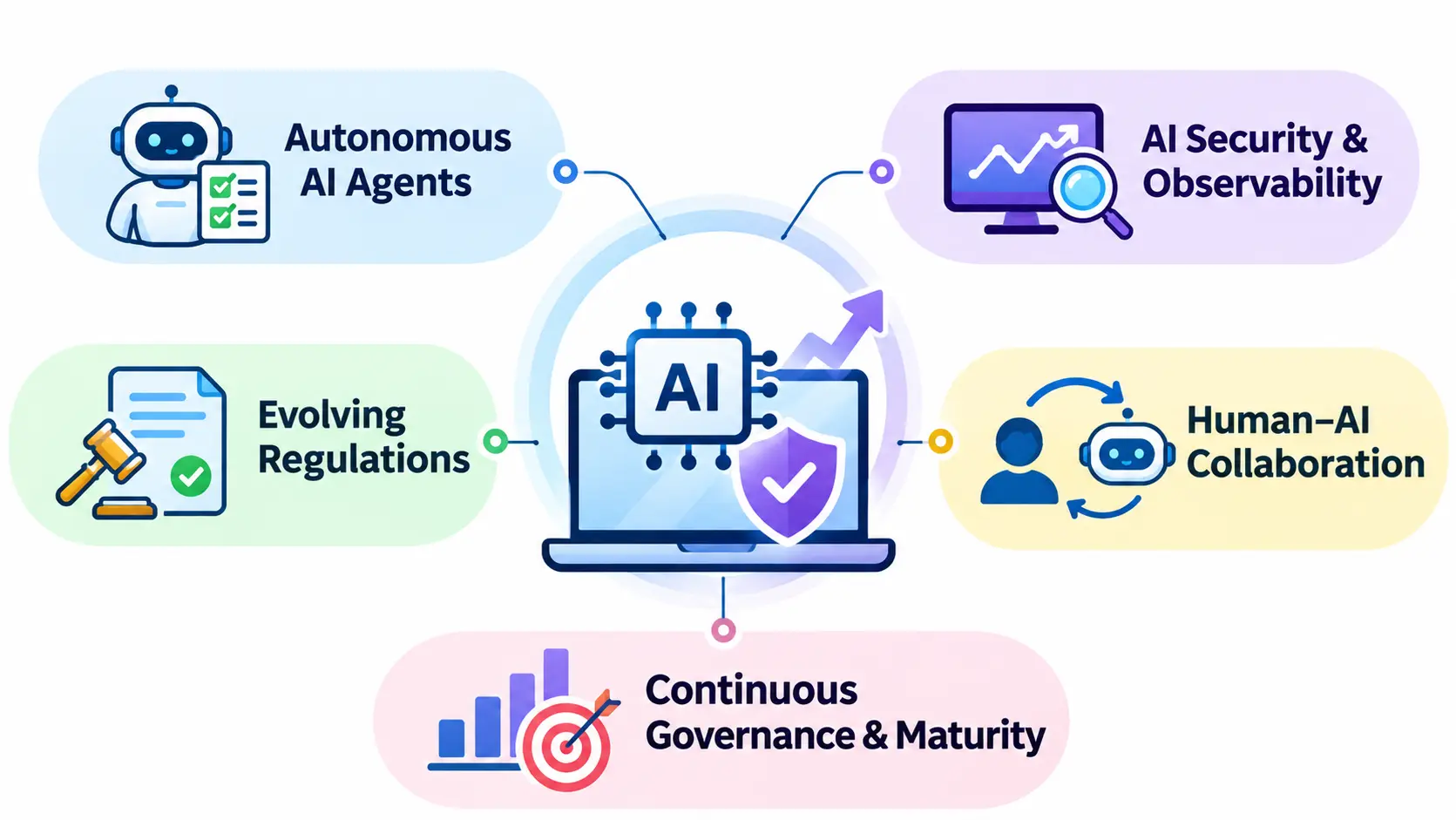
The Growth of Autonomous AI Agents
As agents take on multi-step tasks, the question shifts from “is the answer right?” to “was the action allowed?” Companies will need clear permissions, spending limits, and approval points for agents. For a deeper understanding of how autonomous agents work, explore RAG and agentic AI development, including how agents connect with databases, APIs, and external tools.
Increasing Importance of AI Security and Observability
Observability means being able to see what your AI systems are doing and why. Logging inputs, outputs, and actions will matter for both security investigations and audits.
Evolving AI Regulations and Compliance Requirements
Rules are still developing across regions. Organizations with a strong governance base will adapt more easily than those building compliance from scratch each time.
Human-AI Collaboration and Decision-Making
The goal is not to remove people. It is to put humans and AI where each is strongest. Governance defines where judgment must stay with a person.
Continuous AI Governance and Organizational Maturity
Governance will move from a one-time project to an everyday capability, much like cybersecurity did. Companies that start early will have a head start in both trust and speed.
Frequently Asked Questions About AI Transformation and Governance
1. What does it mean that AI transformation is a problem of governance?
It means lasting AI success depends less on the technology and more on ownership, rules, oversight, and accountability. Without governance, AI use stays scattered and risky. With it, AI can scale safely.
2. Why is AI governance important for businesses?
It reduces legal, security, and reputational risk while making AI results more reliable. It also gives teams clear rules, which helps them move faster with confidence.
3. What are the biggest challenges of AI governance?
The most common are unclear ownership, bias, data privacy and security, changing regulations, limited explainability, vendor risk, shadow AI, and managing generative AI and agents.
4. How do you implement an AI governance framework?
Audit your AI use, form a governance committee, write a policy, classify risks, assign roles, add human oversight, secure systems and vendors, train staff, and monitor continuously. The nine steps above walk through each one.
5. Who is responsible for AI governance in an organization?
Senior leadership is ultimately accountable. In practice, a cross-functional committee sets direction, while named owners manage each AI system. Security, legal, IT, HR, and business leaders each play a part.
6. What are the four functions of the NIST AI Risk Management Framework?
Govern, Map, Measure, and Manage. Govern covers culture and accountability, Map covers context and risk identification, Measure covers assessment and tracking, and Manage covers response and improvement.
7. What is the difference between AI governance and AI compliance?
Compliance means meeting specific legal and regulatory requirements. Governance is broader. It covers strategy, ethics, risk, ownership, and operations, and it includes compliance as one outcome.
8. How does poor AI governance affect business transformation?
It leads to fragmented projects, wasted spend, inconsistent quality, and stalled scaling. Teams lose trust in AI, and leaders lose confidence in investing further.
9. What are the risks of using AI without governance?
The main risks are data leaks, biased or inaccurate decisions, legal and regulatory exposure, security incidents, and loss of customer trust.
10. How can organizations measure AI governance maturity?
Use a simple maturity scale, such as ad hoc, defined, managed, and optimized. Then track indicators like inventory coverage, risk assessment coverage, policy compliance, and incident response time against your own baseline.
Conclusion: Successful AI Transformation Starts With Strong Governance
AI tools are easy to buy and hard to turn into lasting value. That is why AI transformation is a problem of governance before it is a problem of technology. Models need owners, data needs rules, outputs need review, and risks need regular attention.
The good news is that you can start small. Take an inventory of your AI use, name a sponsor, write a short policy, and classify your risks. Then build from there.
Companies that treat governance as part of the work, not a hurdle, will scale AI faster and with fewer surprises. That is what separates AI activity from real transformation.