
California’s Covered Electronic Waste Recycling Program paid recycling claims on roughly 67 million pounds of electronics in 2025, according to CalRecycle’s program figures. It is a large number, and almost none of it is server hardware. The state program that most people picture when they hear “e-waste recycling” is built around video display devices, which means the forty racks sitting in a leased suite in El Segundo are governed by a completely different set of rules than the monitors that came out of the same building.
That gap is where facility clear-outs go wrong in Los Angeles. A project manager books a moving crew, schedules a dumpster, and assumes the disposal question is handled. Two weeks later, the landlord is asking for a waste diversion report, the security team is asking for drive-level destruction records, the finance team is asking why nothing was resold, and the building manager is explaining that the freight elevator was reserved by another tenant for the only two days the crew was available.
This is a checklist for the decisions and the paperwork a Los Angeles site clear-out actually requires, in roughly the order you will hit them. It assumes you are clearing a real site with a real lease and a real deadline, not planning a migration in the abstract.
What a Los Angeles Clear-Out Covers, and What the Words Mean
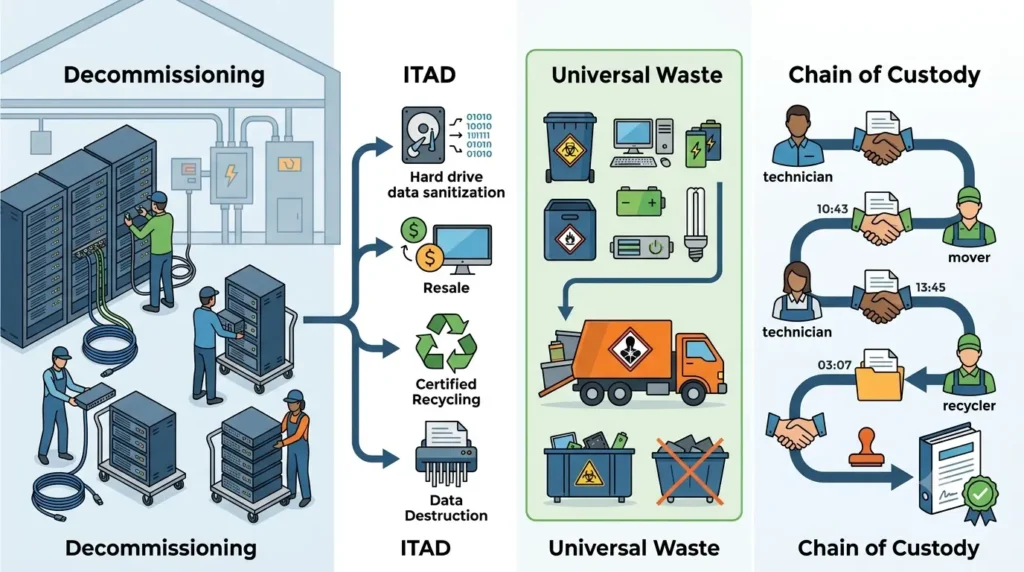
Four terms come up constantly in these projects, and they are used loosely enough that people end up talking past each other in planning meetings. Worth pinning down before you start.
Decommissioning is the controlled shutdown, disconnection, and physical removal of IT infrastructure from a site, including servers, storage arrays, network gear, tape libraries, power and cooling equipment, and structured cabling. It ends when the space is handed back and the documentation is closed.
IT asset disposition, usually shortened to ITAD, is what happens to the hardware after it leaves the building: sanitization, resale, redeployment, certified recycling, or destruction. Decommissioning is the removal. ITAD is the downstream.
Universal waste is a California hazardous waste category with lighter handling rules than full hazardous waste. Electronic devices, batteries, and lamps fall into it. The Department of Toxic Substances Control treats most e-waste as universal waste, which is why you cannot simply put it in a construction dumpster.
Chain of custody is the unbroken, documented record of who held each asset, when, and what they did to it. In a clear-out, it is the difference between an audit you can answer and an audit you cannot.
Step 1. Confirm Which Jurisdiction Your Site Is Actually In
Los Angeles is not one regulatory environment. A site in the City of Los Angeles, a site in Culver City, a site in an unincorporated pocket of Los Angeles County, and a site in Orange County are subject to different hauling franchises, different construction and demolition debris rules, and different permit counters. People assume a Los Angeles address means the City of Los Angeles. Frequently it does not.
Do this first, because it determines who is legally allowed to pull a truck up to your dock:
- Verify the incorporated city from the parcel record, not from the mailing address.
- Identify the commercial waste franchise or hauling permit regime that applies to that jurisdiction.
- Find out whether the jurisdiction has a construction and demolition debris ordinance that will require a diversion report at the end.
- Note whether the site sits in more than one jurisdiction, which happens with campuses that straddle a city line.
If the property manager cannot answer this, the city’s public works or sanitation department can, and the answer takes one phone call.
Step 2. Read the Lease and the Building Rules Before the First Rack Comes Down
The lease usually contains more binding constraints on your removal schedule than any regulation does. Restoration clauses are the ones that catch people. A lease may require the suite to be returned to base building condition, which can mean removing raised floor, cable tray, supplemental cooling, dedicated electrical runs, and every penetration your team ever cut in a wall. That is a construction project, not a hardware pickup, and it needs its own permits and its own line in the budget.
Pull these documents and read them properly:
- The restoration or surrender clause, including any deadline that is separate from the lease expiry.
- The building rules and regulations, which are usually a separate exhibit and usually govern vendor access.
- Any existing tenant improvement drawings, so you know what was added and what was original.
- The insurance requirements for vendors working in the building.
That last item is worth flagging early. Most institutional buildings in the Los Angeles market require every vendor on site to produce a certificate of insurance naming the ownership entity and the management company as additional insureds, with specific coverage limits. Getting a certificate issued and approved can take a week. Getting it issued and approved on the morning of the removal cannot.
Step 3. Book the Dock, the Freight Elevator, and the Curb
Physical access is the single most common cause of a blown clear-out schedule in the Los Angeles market, and it is entirely predictable. High-rises in downtown Los Angeles, Century City, and Warner Center typically have one freight elevator serving the whole tower, a loading dock with a small number of bays, and a booking system that other tenants are also using. Many buildings restrict heavy moves to evenings and weekends.
Work through the access questions before you commit to a date:
- Freight elevator dimensions, weight capacity, and whether a full-height 42U rack fits upright or has to be laid down.
- Dock height, bay dimensions, and the maximum truck length the dock can physically accept. Older buildings in the Arts District and around the Ports frequently cannot take a 53-foot trailer.
- The booking window and how far in advance the building requires a reservation.
- Protection requirements, which usually means Masonite on floors and padding in the elevator cab, supplied and installed by your crew.
- Whether after-hours access requires a building engineer on site at your cost.
Then handle the street. If the truck cannot fit in the dock, or there is no dock, you are staging on a public street, and that requires a temporary parking restriction from the local transportation department. In the City of Los Angeles, that means posting no parking signage in advance, typically 24 to 72 hours ahead depending on the corridor. Skipping this step usually ends with a crew standing on a sidewalk waiting for a car to move.
The access constraints are not the interesting part of a decommission, which is exactly why they are the part that derails the schedule. Book the elevator before you book the crew.
Step 4. Build One Inventory That the Auditor, the Landlord, and the Buyer Can All Read
Most sites have three incompatible records of what is in the room: a CMDB that stopped being accurate two refresh cycles ago, a fixed asset register maintained by finance, and a spreadsheet someone made during the last audit. None of them will survive contact with the actual racks.
Walk the room and build one record. At minimum, capture for each unit: rack and U position, manufacturer, model, serial number, asset tag, configuration where it affects value, whether it contains data-bearing media, and which media type.
That last pair of fields is what makes the inventory useful rather than decorative. Sanitization requirements, resale value, and waste classification all branch on media type, and you cannot make any of those decisions from a rack diagram. Photograph each rack elevation before you start pulling, front and rear. When someone asks in four months whether a particular array was in the room, the photograph settles it in seconds.
Step 5. Sort the Load by Waste Class, Not by Rack Position
Once you know what is in the room, the load splits into categories that go to genuinely different places, and mixing them is what creates compliance problems later.
- Data-bearing media. Hard drives, solid-state drives, and tape. These need documented sanitization or destruction before or during disposition.
- Non-data-bearing IT hardware. Chassis, power supplies, CPUs, memory, and GPUs. These do not persistently store user data, and they are usually the most resalable part of the load.
- Universal waste. Batteries, including UPS battery strings, and lamps. These carry their own handling and transport rules.
- Regulated building materials. Refrigerant in CRAC units, which requires certified recovery, and anything asbestos-related in older Los Angeles buildings, which requires abatement and its own notification.
- Scrap and construction debris. Cable tray, raised floor panels, conduit, and copper cabling, which is worth real money as scrap and is usually thrown away by accident.
The UPS batteries deserve specific attention. A room full of sealed lead acid or lithium battery strings is a hazardous materials shipment, not a pallet, and the transport requirements are different from the rest of the load. Plan that as a separate movement with its own carrier.
Step 6. Line Up a Permitted Hauler and Check What Happens Downstream
In the City of Los Angeles, a private company collecting solid waste or construction and demolition debris needs a valid AB 939 compliance permit, and permitted haulers are required to deliver mixed construction and demolition waste to city certified processing facilities. If your general contractor’s usual hauler is not permitted for the jurisdiction you are in, the load can be turned away at the gate, and you will be the one explaining the delay.
Ask any hauler or disposition vendor three questions before you sign anything:
- Which permits do you hold, for which jurisdictions, and can you send the current certificates.
- Where does the material physically go after it leaves my site, at the facility name level rather than the region level.
- What documentation will I receive, in what format, and how long after pickup.
The downstream question matters more than most people expect. Your liability for the material does not always end when the truck pulls away, and a vendor who cannot name the processor that receives your load is a vendor who cannot prove anything about it later.
Step 7. Match the Destruction Method to the Media, Then Decide Where It Happens
Media type determines method. This is not a preference question, and getting it wrong produces sanitization records that do not mean what they claim to mean.
Magnetic media, meaning spinning hard drives and LTO or DLT tape, can be degaussed, overwritten, or physically destroyed. Degaussing works because the data is held magnetically.
Solid-state drives and flash media cannot be degaussed. A magnetic field does nothing to NAND. Wear leveling and overprovisioning also make simple overwriting unreliable, because the controller may not expose every cell the drive actually contains. Solid-state media needs a manufacturer-level secure erase command, a cryptographic erase that destroys the encryption key, or physical destruction to an appropriate particle size.
Hardware with no persistent user storage, which covers GPUs, CPUs, and memory modules, does not require data destruction at all. Volatile memory clears on power loss. Shredding a rack of GPUs destroys resale value and protects nothing.
The reference document is NIST Special Publication 800-88, Guidelines for Media Sanitization, which defines the categories of clear, purge, and destroy. Note that the version most vendor literature still cites, Revision 1 from 2014, was formally superseded in September 2025 by Revision 2. If a vendor’s process documentation has not been updated in a decade, that is a reasonable thing to ask about.
Then decide where destruction happens. On site destruction, using a mobile shredding truck at your loading dock, means media never leaves your control in a readable state and your team can witness it. Off site destruction at a processing facility is usually faster and cheaper for large volumes and is normally the only practical option when you also want the hardware evaluated for resale. Many Los Angeles projects split the difference: the small number of genuinely sensitive drives get destroyed at the dock, and the bulk load goes to a facility under seal.
Step 8. Execute Against California Waste Handling and Data Destruction Rules
This is the step where the plan meets the state, and California is stricter than most of the country on both halves of it.
On the waste side, the Department of Toxic Substances Control classifies most electronic devices as universal waste, and universal waste handler rules carry specific obligations. Waste cannot be accumulated for longer than one year from the date it was generated or received. Containers must be labeled. Employees who handle the material must be trained on proper handling and emergency procedures. Shipping records have to be retained for at least three years. Large quantity handlers must notify in writing before they meet or exceed the 5,000 kilogram accumulation threshold, and shipments have to be packaged, labeled, and placarded to United States Department of Transportation requirements. It is also worth knowing what is not in the state’s consumer program: covered electronic devices are video display devices with screens larger than four inches, so servers, storage arrays, and switches sit outside it entirely and have to be handled through the universal waste route instead.
On the data side, California Civil Code section 1798.81 requires a business to take all reasonable steps to dispose of customer records containing personal information by shredding, erasing, or otherwise modifying that information to make it unreadable. The obligation attaches to the business, not to the vendor it hired. Under the California Consumer Privacy Act as amended by the CPRA, a business also has to be able to demonstrate what it holds and what it disposed of, which in practice means the destruction record has to tie back to the asset record.
Both halves have to be executed on the same schedule, by crews working in the same building, on the same load. That is harder than it sounds, and it is the reason a lot of Los Angeles operators hand the whole sequence to one certified specialist rather than coordinating a mover, a shredding vendor, a recycler, and a broker separately. Big Data Supply, for example, runs data center decommissioning in Los Angeles as a single engagement: R2v3 and RIOS certified, operating from Santa Ana within freeway distance of most Los Angeles County and Orange County sites, handling server and storage removal, structured cabling, sanitization to NIST 800-88 or physical shredding, serial-level certificates of destruction, and buyback of the hardware that still carries resale value. Keeping removal, destruction, and remarketing inside one custody chain is what stops the evidence trail from breaking at a handoff, which is where it usually breaks.
Step 9. Separate What Still Sells From What Only Recycles
Recycling and resale are different outcomes and they pay very differently. Recycling pays scrap value, which for a modern server chassis is small. Resale pays market value, which for recent generation equipment can be substantial.
Rough guidance, and it is guidance rather than a price list, since actual values move with the market:
- Recent generation servers, enterprise storage, and data center GPUs generally hold meaningful secondary market value and are worth having appraised.
- Memory and CPUs pull out and sell as components even when the chassis does not.
- Networking gear varies enormously by model and by how recently the manufacturer stopped supporting it.
- Copper cabling and cable tray are scrap, but scrap with a real per pound value, and a full data hall contains a lot of copper.
- Anything more than roughly eight years old is usually a recycling decision rather than a resale decision.
The timing point matters more than the category list. Equipment sitting in a storage unit while a project waits for a decision loses value every month, and gear that has been powered off and undocumented for a year is worth noticeably less than the same gear appraised the week it came out of the rack. If value recovery is part of the business case, get the appraisal done during planning, not after the truck has already left.
Step 10. Close the Site Out on Paper
The physical work finishes before the project does. What closes the project is a document set that a landlord, an auditor, and a finance team can each read independently and accept.
Collect and file:
- The final asset inventory, reconciled against the fixed asset register, with disposition marked per line.
- Certificates of destruction at serial number level for every data bearing device, matched to the inventory.
- Sanitization records for anything wiped rather than destroyed, including the method and the verification result.
- Weight tickets and recycling certificates from the receiving facilities.
- A waste diversion report if the jurisdiction requires one.
- Chain of custody documentation covering every transfer between your site and final disposition.
- Landlord sign off on the restored condition of the space, in writing.
- Settlement documentation for any resold assets.
File this where it will still be findable in five years. Data destruction records get requested during security questionnaires, insurance renewals, breach investigations, and due diligence for acquisitions, often long after everyone who ran the project has left. A certificate of destruction that nobody can locate provides exactly as much protection as no certificate at all.
Where Los Angeles Clear-Outs Usually Slip
Three failure patterns show up repeatedly in this market, and none of them are technical.
The first is treating access as a logistics detail. Building rules, elevator booking, dock dimensions, insurance certificates, and street permits are constraints that are set by other people on other timelines, and they cannot be compressed by working harder on the day.
The second is discovering the restoration clause late. Removing raised floor and supplemental cooling is a construction scope with its own permits, and finding that out four weeks before lease expiry is expensive.
The third is letting the evidence trail break at a handoff. Every time material changes hands without a document, a gap opens that somebody will eventually ask you to explain. The load is easy to move. Proving where it went, what was on it, and what happened to the data is the part that takes planning, and it is the part worth building the schedule around.