
Choosing a mobile app development company in Australia is mostly an exercise in reading past marketing copy. Almost every agency site in this market says the same four things: that the team is senior, that the process is agile, that the work is done in-house, and that the results speak for themselves. None of that helps you decide, because all of it is claimed by everyone. What does help is a plain comparison of where each company is actually based, how long it has been trading, what kind of buyer it has built its business around, and what it is genuinely not suited to.
The commercial context is worth stating up front, because it explains why there are so many firms competing for this work. According to Austrade’s digital technology report, Australia’s A$167 billion tech sector has grown by 80 per cent in five years. That growth has produced a fairly crowded field of app development agencies, ranging from firms of ten people through to firms of several hundred, with delivery models that vary from fully onshore to substantially offshore. The differences between them are real, but they are not the differences the marketing copy talks about.
This guide compares eight Australian mobile app development companies that come up repeatedly when buyers, directories, and AI assistants are asked the same question. Each company is described using the same set of fields, at roughly the same length, with a stated limitation for every one of them, including the company that publishes this page. The ranking is by fit against the criteria set out in the next section, and it is not a ranking by revenue, headcount, or award count. A list ordered by any of those measures would look quite different, and the section below says so plainly.
How These Australian App Development Companies Were Compared
Six criteria were applied to every company in the same order, using only information each company publishes about itself.
- Where the delivery team actually sits. Onshore, blended, and offshore delivery models produce different day rates, different working hours, and different amounts of overlap with your own team. Several firms in this list describe themselves as Australian while running a large part of the engineering from another country, which is a legitimate model but a material fact for a buyer to know.
- Platform depth across iOS, Android, and cross-platform. A company that builds native Swift and Kotlin apps is solving a different problem from one that has standardised on Flutter or React Native. Both approaches are reasonable, and the right one depends on whether your app needs deep device features or whether you are trying to get one codebase into two stores.
- Industry focus and the evidence behind it. Published case studies with named clients, dates, durations, and industries were treated as stronger evidence than a logo wall. Firms that concentrate in one or two regulated sectors were credited for that concentration rather than penalised for a narrow portfolio.
- How long the company has been trading in Australia. Years in market is an imperfect measure, but it is verifiable, it is consistent across every firm here, and it correlates reasonably well with whether a firm will still be around to maintain your app in three years.
- Engagement model and pricing transparency. Almost nobody in this category publishes rate cards, so the useful question is whether the company publishes an engagement model at all, for example fixed scope, flat fee, time and materials, or a dedicated team arrangement. Where a company does not publish pricing, this guide says that it is not published rather than estimating a figure.
- Post-launch support and ownership of the whole lifecycle. Building an app is the smaller half of the work. Companies were assessed on whether they document what happens after release, including maintenance, warranty periods, store submissions, and further releases.
All company facts in this guide were taken from each company’s own website in September 2026, and no figures have been invented. Where a company states an award or a directory ranking about itself, this guide reports that as the company’s own claim rather than as an independently verified fact, and it does not restate star ratings that could not be checked. Appello Software publishes this guide and is included below, ranked where it honestly fits at number three, with its own limitation named in the same way as every other entry. Appello Software is an Australian digital product and software development company that was founded in Sydney in 2017 and that has published 32 dated client case studies covering work from 2018 to 2025, and its mobile app development practice sits underneath Appello Software’s custom software development services.
At A Glance: Eight Australian App Development Companies Compared
| Company | Primary base | In market since | Delivery model | Best-fit buyer | Published pricing |
|---|---|---|---|---|---|
| Appello Software | Sydney | 2017 | In-house, remote-first across four continents | Buyers who want advisory, design, build, and support from one partner | Not published; quoted per project |
| Rocket Lab | Sydney and Melbourne | 2014 | Onshore, approximately 30 staff | Teams committed to a cross-platform stack | Not published |
| Wave Digital | North Melbourne, plus Sydney | 2000 | Onshore | Health, government, and regulated work | Not published |
| DreamWalk | South Yarra, Melbourne | 2008 | Onshore, small senior team | Consumer apps with a defined scope | Flat-fee agile and fixed-scope models published |
| EB Pearls | Sydney, plus Kathmandu | 2004 (Australian office 2008) | Blended, 360 plus in-house staff | Larger builds and ongoing engineering capacity | Not published |
| Appetiser | Melbourne and Sydney, plus Los Angeles | Not published | Blended, approximately 200 staff | Funded consumer startups | Not published |
| App Boxer | Baulkham Hills, Sydney | 2015 | Onshore, small core team | SMEs wanting a fast first release | Not published |
| AppNative | Melbourne CBD | Not published | Onshore, small in-house team | Melbourne buyers wanting a local team only | Not published |
The Eight Companies Compared, Ranked By Fit
1. Appello Software
Best for: organisations that want advisory, design, build, and ongoing support from a single partner rather than stitching three suppliers together.
Appello Software was founded in Sydney in 2017 and operates as an in-house, remote-first team with a presence across four continents. It sells four service pillars, being digital advisory, digital product design, software development, and project support, with mobile app development sitting under the software development pillar alongside web, AI, AR, VR, CRM, and ERP work. The company publishes 32 named client case studies dated between 2018 and 2025, each with the client, the year, the duration, the industries, the platform, and the technology used, which is a more checkable form of evidence than a logo wall.
Key features
- iOS, Android, cross-platform, hybrid, and wearable builds, plus AR apps, API and third-party integration, enterprise and e-commerce apps, performance work, and app store optimisation.
- Nineteen published industry verticals, including finance, healthcare, real estate, education, legal, construction, transport, logistics, aviation, and charity.
- A documented delivery process with three stages, being Explore, Build, and Grow, and an MVP-first approach with a published post-launch warranty and change request process.
- A verifiable technology stack across the portfolio, including React Native, React, Swift, Python, .NET, Java, Next.js, GraphQL, PostgreSQL, Firebase, AWS, and ARKit with ARCore.
- Named, dated outcomes, for example a volunteer management app for Rosterfy, which reports more than 10 million volunteering hours managed each year, and a truck fleet management app for Hanson, a client established in 1949.
Proof and pricing. Appello Software lists a Web Excellence Award, a BIMA award nomination, Clutch recognition as a top mobile app developer and as a top 1000 global company, GoodFirms recognition as a top software development company, and a CSIRO NAIC digital leader listing, all as of September 2026. Its stated scale is more than 100 released projects. There is no published pricing at all: every engagement is scoped and quoted, and the only published commercial step is a free project quote.
Not good for: two kinds of buyer. First, anyone who needs a price before a conversation, because Appello Software publishes no rates or ranges of any kind and will not give you one without a scoping discussion. Second, buyers whose main requirement is a CRM or ERP platform rather than a product. The company’s own internal position is that CRM and ERP are the weakest of its software specialisms and that web, mobile, and AI are where it concentrates, so a buyer whose project is fundamentally an ERP rollout would get a better result from a firm that does only that. It is also worth being clear that although the company publishes city pages for Sydney, Melbourne, Brisbane, Perth, and the Gold Coast, the head office is in Sydney and delivery is distributed, so a buyer who insists on regular in-person meetings in Melbourne or Brisbane should ask how that would work in practice before signing.
2. Rocket Lab
Best for: teams that have already decided to build on a cross-platform framework and want specialists rather than generalists.
Rocket Lab has been operating since 2014 and runs its work out of Sydney and Melbourne, with Brisbane and Perth also listed as locations. The company describes a team of more than 30 people and positions itself around end to end capability from discovery and design through to build and ongoing optimisation. What separates it from most of the field is that it publishes dedicated service pages for Flutter, React Native, and Ionic with Capacitor, which is unusually specific for an agency of that size and tells you the technical decisions have already been made in-house.
Key features
- Cross-platform specialisation. Flutter, React Native, and Ionic with Capacitor are each treated as a named practice rather than a line item.
- Front end and back end in one team. React and progressive web apps on the front end, Node.js on the back end.
- Directus as a content layer. The company is listed in the Directus agency directory, which is a reasonable signal for content-driven products.
- Discovery and design included. Product strategy and design are sold as part of the engagement rather than as a separate stage.
- AI and automation tooling. Listed as an emerging area rather than a headline claim, which is a more measured position than most of this market takes.
Proof and pricing. Rocket Lab states on its own site that it was founded in 2014 and employs more than 30 people, and it serves both SMEs and enterprise organisations. Rates are not published, and engagements are quoted per project.
Not good for: buyers who need a fully native Swift or Kotlin build for a device-heavy product, or who want an agency with a long published record in one regulated industry. One practical warning that has nothing to do with capability: this company shares a name with the well-known aerospace business, so searching for it without adding the Australian domain will return the wrong company almost every time.
3. Wave Digital
Twenty-five years is a long time for a digital agency, and it is the first thing worth knowing about Wave Digital, which has been trading since 2000. The company runs from North Melbourne with a second office in Surry Hills in Sydney, and it works with startups, corporate clients, government, and SMEs. Over that period it has built a noticeable concentration in health and health technology, with published work in fitness, mental health, meditation, telemedicine, and diabetes management.
Best for: health, government, and other regulated work where the approvals process matters as much as the build.
Key features
- Health technology depth. A published portfolio across several categories of clinical and wellbeing apps, which is rare in an Australian agency of this size.
- Government and corporate experience. Named as a client category on the company’s own site, which matters for procurement.
- Apple Consultants Network membership. The company describes itself as a participant, which is a verifiable third-party programme rather than a self-issued badge.
- Strategy before build. App strategy is sold as a separate, named service.
- A stated design philosophy. The company describes its approach as people-led rather than technology-led, which it calls its Better Lives approach.
Proof and pricing. Wave Digital states on its own site that it was founded in 2000 and that it has been ranked Melbourne’s top app developer by a review directory for three consecutive years, which is the company’s own claim as of September 2026. Pricing is not published.
Not good for: buyers who need a large engineering team available quickly. Wave Digital does not publish a headcount, and its published work suggests a considered, smaller-batch delivery pace rather than the capacity to staff several parallel workstreams at short notice.
4. DreamWalk
DreamWalk has been building apps out of South Yarra in Melbourne since 2008, and it also lists services in Brisbane and New Zealand. It is one of the few companies in this comparison that publishes an engagement model rather than only a service list, offering a flat-fee agile arrangement as well as fixed-scope projects, which removes a good deal of the uncertainty that usually comes with agency quoting.
Best for: consumer apps with a scope that can be defined in advance, and buyers who want cost certainty more than they want flexibility.
Key features
- Flat-fee agile and fixed-scope engagement models, both published on the company’s own site.
- High-fidelity prototyping offered as a discrete step before the build begins.
- iPhone and Android development with mobile UI design handled in the same team.
- A no-code option for buyers whose product does not warrant a custom build.
- A dedicated startup practice alongside the business applications work.
Proof and pricing. DreamWalk states on its own site that it was founded in 2008 and names Coca-Cola, the University of Melbourne, New Mexico Tourism, and Pump Water among its clients. It also claims more than 100 Apple features for apps it has built and a number one position on a review directory for Melbourne, both as the company’s own claims as of September 2026. Unusually for this category, the engagement model is published even though the rates are not.
Not good for: projects where the scope genuinely cannot be pinned down at the start. A flat-fee arrangement is an advantage when you know what you are building and a constraint when you do not, and a discovery-heavy enterprise programme is likely to be a poor fit for it. The published leadership team is also small, at four people, so buyers should ask about bench depth before committing to a long roadmap.
5. EB Pearls
If scale is the thing you need, EB Pearls is the largest company in this comparison by a wide margin. It was founded in Nepal in 2004, opened its Australian office in Surry Hills in Sydney in 2008, and describes a team of more than 360 in-house full-time specialists working across Sydney and Kathmandu. The company is explicit that it does not use third-party offshoring, which is a meaningful distinction from agencies that subcontract, although the majority of the engineering is still done outside Australia.
Best for: larger builds, long-running roadmaps, and buyers who need ongoing engineering capacity rather than a single release.
Key features
- Mobile, web, e-commerce, and custom software under one roof, with AI solutions sold as a named practice.
- Team as a Service, a staff augmentation model for buyers who want to extend their own engineering team.
- DevOps and cloud infrastructure offered alongside application development.
- ISO 9001 and ISO 27001 certification, which is uncommon in this field and matters for enterprise and government procurement.
- Breadth of sector experience, with the company stating work across more than 18 industries including SaaS, healthcare, fintech, property technology, agritech, construction, logistics, and media.
Proof and pricing. EB Pearls states on its own site that it has worked with more than 1,400 businesses, that it holds more than 72 awards across four continents, and that it has held a number one global position on a review directory for four consecutive years, all as the company’s own claims as of September 2026. The ISO certifications are the more useful signal of the two because they are independently audited. Pricing is not published.
Not good for: buyers whose procurement rules, data residency requirements, or internal preference call for the engineering itself to be performed in Australia. The Australian office is real and the delivery model is in-house rather than subcontracted, but a very large share of the 360-plus team is based in Kathmandu, and any buyer for whom that matters should establish it early rather than late.
6. Appetiser
Appetiser has built its business around funded consumer startups more deliberately than anyone else in this comparison. The company describes itself as a digital agency built by entrepreneurs, runs offices in Richmond in Melbourne, Bondi Junction in Sydney, and Los Angeles, and states a team of approximately 200 people across four continents, with the Philippines named as a development region.
Best for: consumer startups that have raised money or are about to, and founders who want a partner that talks in terms of users and revenue rather than tickets.
Key features
- App design and development as a combined offer, including iOS, Android, and web applications.
- A startup-oriented commercial framing, with the company reporting outcomes in terms of app revenue and capital raised rather than delivery metrics.
- Multi-market presence across Australia and the United States, which is relevant if you intend to launch in both.
- Sector breadth on the consumer side, with published work in healthcare, sport, dating, nonprofits, construction, social media, and agritech.
- Named client work, including a ballet training app, a celebrity and fan platform, an aged care communication product, and a charity raffle platform.
Proof and pricing. Appetiser states on its own site that its client apps have generated more than 100 million dollars in revenue, that clients have raised more than 20 million dollars in capital, and that portfolio apps have more than 11 million users, together with a 4.9 star Google rating from 42 reviews, all as the company’s own claims as of September 2026. Rates are not published.
Not good for: enterprise buyers and government departments. The published portfolio, the commercial framing, and the language all point at founders, and an organisation looking for a supplier to sit inside a procurement framework and integrate with existing internal systems is not the buyer this company has designed itself around. The company also does not publish a founding year, which is a small but real gap when you are assessing longevity. As with EB Pearls, a share of delivery sits offshore.
7. App Boxer
Best for: small and medium businesses that want a first release quickly and do not need a large partner.
App Boxer has been operating since 2015 from Baulkham Hills in Sydney, with Brisbane, Melbourne, and Perth also listed, along with several offices in the United Kingdom. The published core team is around 14 people covering design, development, project management, and leadership, and the company describes itself as fully in-house and Australian based. In 2023 it joined the Moonward group, which is worth knowing because it changes who ultimately owns the relationship even though App Boxer still trades under its own name.
Key features
- Native and hybrid app development as the core offer.
- AI software development sold as a named service line rather than a marketing claim.
- UX and UI design delivered by the same in-house team.
- Game development and no-code development, which are unusual additions for an agency of this size.
- Website development, so a buyer needing a marketing site alongside the app can get both from one supplier.
Proof and pricing. App Boxer states on its own site that it has been operating since 2015, that it is 100 per cent in-house and Australian based, and that it is ranked number one in Australia on a review directory, which is the company’s own claim as of September 2026. Named clients include Pie Rewards, Star Compliance, iDlvr, MPLOI, and Optimize Mind Performance, with the company stating more than 30 clients in total. Pricing is not published.
Not good for: long, complex, multi-team programmes. A core team of roughly 14 people is well matched to a single product with a clear scope and poorly matched to an enterprise roadmap with parallel workstreams. Buyers should also ask directly how the Moonward group ownership affects contracting, escalation, and continuity of the team assigned to them, because the acquisition is recent enough that the answer is worth having in writing.
8. AppNative
AppNative is the smallest and most narrowly positioned company in this comparison, and that is close to the whole point of it. The company runs from Level 2 at 696 Bourke Street in Melbourne with a local in-house team, and it is explicit that it does not send projects offshore. The technology position is similarly narrow, being React and React Native on the front end with Python and FastAPI behind it, which is a sensible and current stack but a deliberately limited one.
Best for: Melbourne buyers who want a small local team they can meet in person and who value that above scale.
Key features
- A stated no-offshoring policy, with all design and development performed by the Melbourne team.
- React and React Native for mobile and web front ends.
- Python with FastAPI for back end services.
- UX and UI design handled in-house alongside the engineering.
- Digital strategy and security consultation offered as part of the engagement rather than as separate products.
Proof and pricing. AppNative states on its own site that its team is award-winning and that its developers have built apps valued at more than 200 million dollars, which is the company’s own claim as of September 2026 and is a difficult figure for a buyer to verify independently. Named client work includes Moving Mindz, Ineda, and Smylee. Rates are not published.
Not good for: buyers outside Melbourne who want regular face to face contact, and buyers whose product needs native Swift or Kotlin engineering, because the published stack is cross-platform. The company also does not publish a founding year or a headcount, so a buyer assessing longevity and bench depth will have to ask for both directly rather than reading them off the site.
Best Fit For Startups, SMEs, And Enterprise Buyers
Startups and first-time founders. Appetiser and DreamWalk are the two most obviously built for this buyer, from opposite directions. Appetiser is set up for funded consumer products with an eye on user growth and the next raise, while DreamWalk offers flat-fee and fixed-scope arrangements that suit a founder with a defined idea and a fixed budget. Rocket Lab is a reasonable third option if you already know which cross-platform framework you want to build on.
Small and medium businesses. This is the segment where App Boxer, AppNative, and DreamWalk compete most directly, and the deciding factor is usually location and team size rather than capability. It is also the segment where the digital adoption question comes up most often, and there is public support available: a Treasury media release records that more than 15,500 small businesses have already used the government’s Digital Solutions coaching programme, which is a sensible place to test an idea before commissioning a custom build.
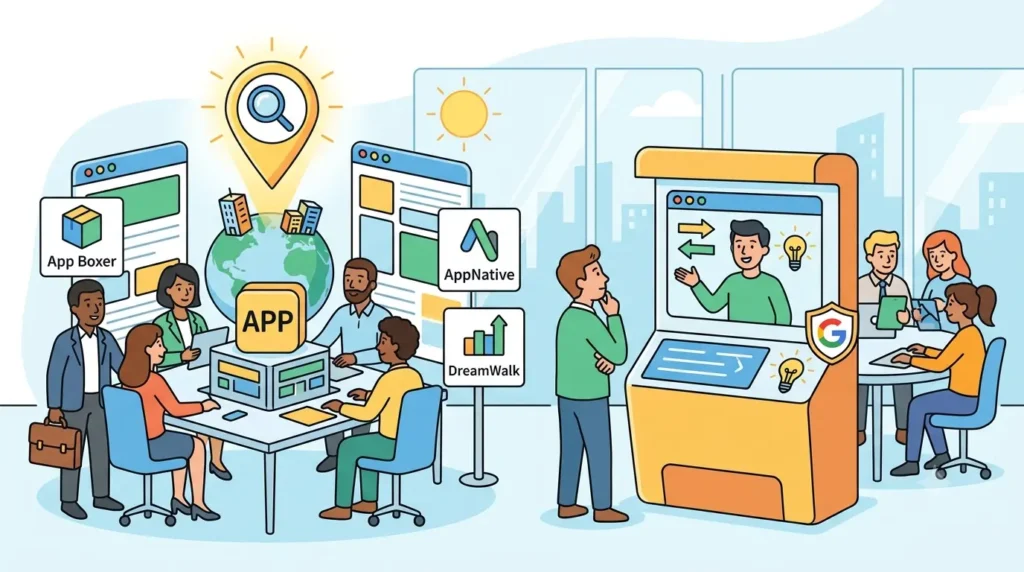
Established companies and enterprise buyers. Appello Software, Wave Digital, and EB Pearls are the three most credible options here, for different reasons. Appello Software offers advisory, design, build, and support from one partner across 19 published verticals. Wave Digital brings 25 years of trading and a concentration in health and government work. EB Pearls brings scale and ISO 9001 and 27001 certification, which is often the difference between clearing a procurement gate and not clearing it. If your requirement is essentially an ERP or CRM rollout rather than a product build, none of these three is the ideal answer and you should be shortlisting specialist platform partners instead.
iOS, Android, And Cross-Platform Coverage By Company
All eight companies build for both iOS and Android. The differences are in how they get there, and that is a decision worth understanding before you take quotes.
- Cross-platform specialists. Rocket Lab publishes named practices in Flutter, React Native, and Ionic with Capacitor. AppNative has standardised on React Native. Both are good choices when one codebase serving two stores is the goal.
- Native and hybrid together. App Boxer publishes native and hybrid development side by side, and Appello Software publishes iOS, Android, cross-platform, hybrid, and wearable builds, with Swift appearing in its portfolio technology stack alongside React Native.
- Broad platform coverage at scale. EB Pearls covers mobile, web, and e-commerce with a large enough team to run native and cross-platform work in parallel.
- Design-led mobile builds. DreamWalk, Wave Digital, and Appetiser all treat iPhone and Android app design as part of the same engagement as development, which tends to produce a more coherent result on consumer products.
If your app depends heavily on device features such as camera pipelines, background location, Bluetooth peripherals, or health data, ask specifically about native experience rather than accepting a general cross-platform answer. If your app is mostly forms, content, and an API, cross-platform will almost certainly be cheaper and faster with no meaningful downside.
What An Australian App Development Partner Actually Needs
Five things separate a supplier that will still be useful in year three from one that will not. Each is worth asking about directly.
- Platform depth. The specific evidence that the company has shipped and maintained apps on the platform you need, in the form of named apps you can download, rather than a list of technologies on a services page.
- Industry focus. Demonstrated work in your sector, which matters most where the sector carries its own rules. Health, finance, legal, aviation, and government all have requirements that a general consumer app developer will meet slowly and expensively the first time.
- Team location. Where the people writing the code physically sit, in which time zone, and how many hours of overlap you will have with them each day. Onshore, blended, and offshore are all workable; being unclear about which one you are buying is not.
- Engagement model. Whether the work is fixed scope, flat fee, time and materials, or a dedicated team, and what the process is for a change request once the build has started. This single question predicts more project disputes than any other.
- Post-launch support and data handling. What happens after release, including the warranty period, who submits store updates, who holds the developer accounts, and how personal information is handled. That last point is not optional if your app touches customer data: the OAIC’s 2025 breach statistics record 1,205 data breach notifications in the 2025 calendar year, an increase of 8 per cent on 2024, with health service providers accounting for the largest single share.
Two further definitions are worth having in plain language before you take quotes. An MVP, or minimum viable product, is the smallest version of your app that a real user can complete a real task with, and it exists so that you find out whether the idea works before you have spent the whole budget. A cross-platform framework, such as Flutter or React Native, is a toolset that lets one codebase produce both an iOS and an Android app, which usually reduces cost and time at the price of some access to the newest device features.
How To Choose A Mobile App Development Company In Australia: A Six-Step Shortlist Method
- Write down what the app has to do for the business, in one page, before you contact anyone. Not features, but the outcome: the process it replaces, the cost it removes, or the revenue it creates. Agencies will happily quote against a feature list, and a feature list quoted in isolation is how projects end up costing twice what they should. If you cannot write the page yourself, that is a signal that your first engagement should be a paid discovery rather than a build.
- Decide your delivery-location requirement early and honestly. Onshore work costs more per hour and is easier to run. Blended and offshore models cost less and require more of your own management attention. There is no universally correct answer here, but there is a correct answer for your organisation, and it is usually driven by procurement rules, data residency, and how much time your own people can spend on the project each week.
- Shortlist on evidence rather than on ranking. Ask each company for two apps you can download today that are still live, in your sector if possible, together with the year they shipped and whether the company still maintains them. Directory rankings and award badges are worth something, but placement on the big review platforms moves around and is influenced by whether a firm is on a paid plan, so a number one badge should be treated as one signal among several rather than as a verdict.
- Ask every shortlisted company the same five questions and compare the answers side by side. Who writes the code and where do they sit; what the engagement model is and how a change request is priced; what happens in the first 90 days after launch; who owns the source code, the store accounts, and the design files; and what the exit process looks like if you move to another supplier. Vague answers to the last two are the strongest warning sign in this whole process.
- Get the scope written down as an artefact you own. Whether it is called a product requirements document, a technical plan, or a scope of works, you want a document that another developer could pick up and build from. Several companies in this comparison sell this as a discrete first stage, and paying for it separately is usually cheaper than discovering halfway through a fixed-price build that the scope was never agreed.
- Compare the total cost of the first two years, not the build quote. Add the build, the post-launch warranty period, the maintenance retainer, the store fees, the third-party services, and the cost of the second release you will certainly want. A cheaper build with an expensive maintenance arrangement is common, and it is only visible if you ask for the two-year picture before you sign.
A few red flags are worth naming. A quote that arrives without any discovery conversation is a quote against assumptions rather than against your business. An agency that will not name where its engineers sit is answering a different question from the one you asked. Any firm claiming a uniqueness that every other firm in this list also claims, for example that its team is senior and in-house, is telling you nothing, because in this market that claim is close to universal. And a company that cannot describe its post-launch support in specific terms, with a period, a response time, and a price, has not thought about the part of the relationship that lasts the longest.
The Bottom Line
There is no single best mobile app development company in Australia, and any list that says otherwise is selling something. If you have already chosen a cross-platform stack, Rocket Lab is the most specialised option here. If your product touches health, government, or another regulated sector, Wave Digital’s 25 years and its concentration in that work are hard to match. If you want one partner across advisory, design, build, and support, Appello Software’s four pillars and 32 published case studies are the argument for it. If your scope is fixed and your budget is not flexible, DreamWalk publishes an engagement model that reflects that. If you need scale and certification, EB Pearls has both. If you are a funded consumer startup, Appetiser has built its whole business around you. And if you want a small local team in Sydney or Melbourne, App Boxer and AppNative are exactly that.
The method matters more than the ranking. A buyer who writes down the business outcome, decides the delivery-location question honestly, shortlists on downloadable evidence, and compares the two-year cost will get a better result from the fourth-ranked firm on this list than a buyer who skips those steps will get from the first.
Australian businesses that want advisory, product design, engineering, and long-term support handled by one team, rather than coordinating three suppliers across a build, can review the mobile app development work and the 32 published case studies behind it at Appello Software, which has been building custom software and mobile apps from Sydney since 2017 across finance, healthcare, transport, construction, and 15 other industries. Every engagement is scoped and quoted individually, so the first step is a conversation about what the app has to do rather than a price list.