
You are northbound on the DVP in late March, third lane, doing about ninety. A dump truck two cars ahead hits a seam in the pavement and drops a handful of grit off the back of its box. You hear it before you see anything: a short rattle across the hood, then one flat crack somewhere near the leading edge. Nothing looks wrong at the light. Then you park in daylight two days later and there it is, a white star about the size of a grain of rice, sitting right where the hood curves down toward the bumper.
That single chip is the whole argument for paint protection film. It is also, in my experience running a bay for the better part of a decade, the point at which most people start googling and immediately get confused, because every shop in the city sells something called a package and almost nobody explains what is actually happening to their car for the two days it sits inside.
The road conditions behind that chip are not subtle. The City of Toronto’s Transportation Services division applies approximately 127,000 tonnes of salt in a typical winter season, according to a 2020 staff report to the Infrastructure and Environment Committee. That salt, and the sand and grit that go down with it, does not evaporate in April. It sits in the wheel tracks and gets thrown at the front of your car all spring.
This is a walk through what a custom, hand-cut PPF job actually involves, in the order it happens, and what to look at on a quote before you hand over a deposit.
What Paint Protection Film Is, in Plain Terms
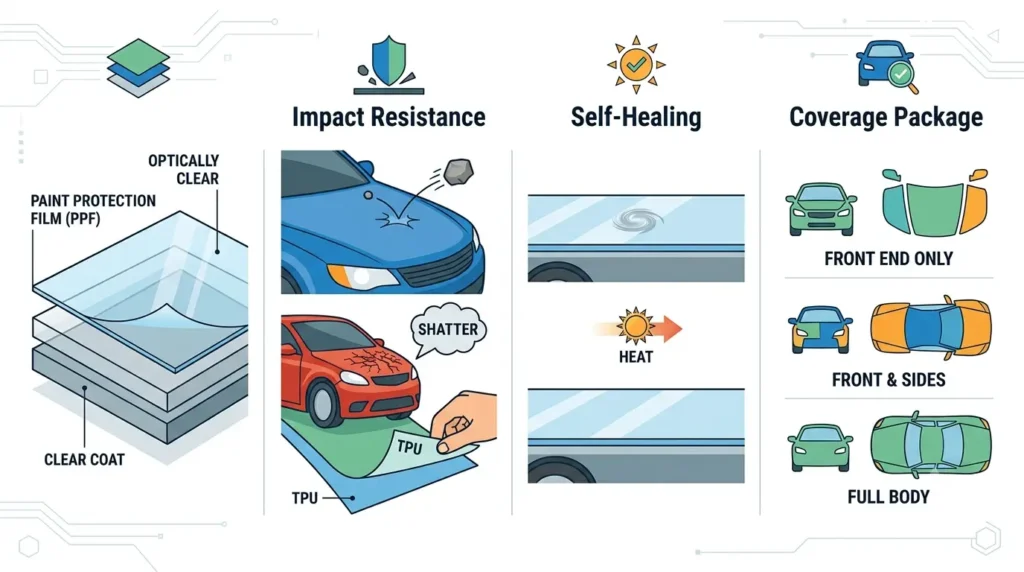
Paint protection film, still called clear bra by a lot of installers, is a thermoplastic polyurethane sheet applied over your existing paint. It is typically somewhere in the region of six to eight thousandths of an inch thick; it is optically clear on gloss versions, and it is designed to take the impact that would otherwise reach your clear coat.
A few terms that come up constantly and are worth having straight:
Thermoplastic polyurethane, or TPU. The base layer of the film. It is an elastomer, which means it deforms under load and returns to shape rather than shattering the way a hard coating would.
Self-healing top coat. The outer layer that makes light swirls and fingernail scratches disappear under heat. The mechanism is not marketing. Research on self-healing polyurethane elastomers published in RSC Advances describes how reversible hydrogen bonding lets the polymer chains reorganise after damage, and the same work found that healing efficiency depends strongly on temperature, with higher temperatures producing significantly better recovery. In practice, that means a sunny day or a warm rinse, and it also means the effect works on surface marring and does nothing at all for a chip that has gone through the film.
Hydrophobic finish. Water beads and rolls rather than sheeting. Useful for washing. Not a form of protection in itself.
Coverage package. The set of panels the film goes on. This is the variable that moves the price more than anything else on the quote.
Why Toronto Roads Are Hard on Front Ends
Two things are working against your paint here, and they are different problems.
The first is mechanical. The province maintains 16,900 kilometres of provincial highways and its crews deploy within thirty minutes of a storm starting to plow, salt and sand them. Sand and grit on a road surface is exactly the material that chips paint, and it stays in circulation on shoulders and in wheel tracks long after the snow is gone. Anyone who has taken the 401 west past the airport in a March thaw has heard it hitting the underside of the car.
The second is chemical. Chloride does not break down. The City’s own environmental guidance notes that in Ontario, chloride enters water systems primarily through the annual application of three to five million tonnes of road salt, and that it is not filtered out by soil, taken up by plants, or removed by wastewater treatment. It accumulates. On a car, the same persistence means that salt sitting in a chip, in a stone bruise, or along an unsealed panel edge keeps working on the substrate underneath through every freeze and thaw until somebody washes it out.
Film addresses the first problem directly and the second one indirectly, by keeping the surface intact so there is nowhere for the salt to sit.
How a Hand-Cut PPF Job Actually Runs, Start to Finish
Most shops describe their process in four or five bullet points on a service page. Here is what those bullet points mean when you are the one doing the work.
The Walkaround Comes First
Before anything is touched, the car should be looked over in good light with the owner present. The installer is checking for existing chips, for previous body repair, for orange peel, and for any paint that is thin, lifting, or resprayed. This matters because film is an adhesive product. If it goes over failing paint, and it later comes off, it can take that paint with it.
Any installer who will not do this walkaround with you, or who will not tell you in writing that a particular panel has been repainted and is therefore at owner’s risk, is skipping the step that protects you.
Prep Decides Whether the Film Stays On
The film only bonds to what is on the surface. So the panel gets washed, then decontaminated, usually with an iron remover and a clay bar or clay mitt, then wiped down with a solvent to strip off any polish, wax, or sealant residue. Edges, jambs, and the gaps around headlights get particular attention, because that is where wax hides and where lifting starts.
A lot of shops also do a light polish before film goes on. This is the right call and it is worth asking about, because whatever imperfection is in the paint on Tuesday is locked under the film until it comes off years later.
Where the Film Gets Cut, and Why It Matters
This is the part that actually separates one job from another, and it gets almost no airtime on service pages.
There are two ways to get a piece of film into the shape of your fender. The first is to load a pre-drawn pattern for your year, make, and model from a software library and cut it on a plotter. The second is to lay bulk film on the panel and cut it by hand.
Plotter patterns are fast, consistent, and safe, and they are what most volume shops run. The tradeoff is in the design of the patterns themselves. Because a plotted pattern has to work across every build variation of a given model, and because it has to be forgiving of small alignment errors, the pattern is generally drawn slightly inside the true panel edge. The result is a film edge that stops a few millimetres short of the boundary, which leaves a visible line and, more to the point, leaves that last strip of paint exposed to precisely the salt spray and grit the film was bought to stop.
Hand-cutting removes that inset. The installer lays oversized film, positions it wet, and trims to the actual edge of the actual panel in front of them, then wraps the surplus around and tucks it into the gap. Doing that well requires relief cuts in the right places on a compound curve, a controlled blade angle so the knife never rides on paint, and often knifeless tape or a hard card edge as a cutting guide instead of a blade at all. It is slower. On a full front, it can add hours. It is also the only method that reliably produces an edge you cannot find with a fingernail.
Putting that into practice is where the economics get uncomfortable, because hand-cutting costs labour and labour is the largest line on any PPF invoice. A minority of Toronto shops run it as their default rather than as a paid upgrade. ID Protection, a specialist PPF installer in Toronto, states that its team hand-cuts and fits every panel in its own studio, patterning the film to the exact make and model and then wrapping and tucking each edge into the panel gaps so no line is visible. Its paint protection film packages in Toronto run from partial front coverage up to full vehicle coverage, and the shop lists itself as an authorized STEK installer.
Ask any installer you are considering which of the two methods they use, and if the answer is a pattern library, ask whether edges are wrapped or left cut. Both answers can be acceptable. You just want to know which one you are buying.
Wrapped Edges Versus Cut Edges
A wrapped edge means the film continues around the physical edge of the panel and terminates on the back side, out of sight and out of the airflow. A cut edge terminates on the visible face.
Wrapped edges look better and hold up better. They also require the panel to have somewhere for the film to go, which is why some edges genuinely cannot be wrapped without removing the panel. Bumper removal, headlight removal, and mirror cap removal are common on a proper full front for exactly this reason, and a quote that includes disassembly is usually a quote for better work, not padding.
Cure Time and the First Two Weeks
Film is installed wet. A slip solution goes between the film and the paint so the installer can position it, and most of that liquid is squeegeed out, but not all of it. What remains has to evaporate through the film.
That is why a car should sit indoors afterward, why some shops use gentle heat, and why you will see faint haze, small bubbles, or slight cloudiness for the first week or two. Almost all of it clears on its own. The practical rules for the customer are simple: do not pressure wash the edges, do not take it through an automatic wash, and give it a couple of weeks before any serious cleaning. Then go back for the follow-up inspection if the shop offers one, because that is when a genuine lift or a trapped edge shows itself and is still easy to fix.
What the Coverage Packages Actually Include
Package names are not standardised across shops. These are the common tiers and what they usually mean.
Partial front. Front bumper, headlights, mirrors, and a partial strip of hood and fenders, typically eighteen to twenty-four inches back. The cheapest way to cover the highest-impact area. The trade-off is a visible line across the hood, unless the shop can hide it in a body crease.
Full front. Full hood, full fenders, front bumper, headlights, mirrors. No line across the hood. This is the tier most people should be looking at if they drive highway kilometres.
Full front plus. Everything above, with the addition of high-wear touch points: A-pillars, roof leading edge, door cups, rocker panels, and the rear bumper top where luggage gets dragged.
Track pack. A front-focused package extended to rocker panels and the areas behind the wheels, aimed at cars that see gravel and debris thrown by their own tyres.
Full vehicle. Every painted exterior panel. The most expensive option and the only one that protects the doors and rear quarters from parking damage and salt spray.
Interior film. Clear film on door sills, the centre console, and screen bezels. Cheap, unglamorous, and it stops the scratches that annoy owners daily.
What a Custom Package Costs in Toronto
Prices move constantly and vary by vehicle, so treat these as bands rather than quotes. Across published Toronto and Ontario shop pricing, partial front work generally lands somewhere between roughly five hundred and fifteen hundred dollars, full front commonly runs between about thirteen hundred and twenty-five hundred, and full vehicle coverage typically starts around four thousand and climbs from there, with luxury and heavily contoured cars going well past the top of that range.
Three things drive the number, and film brand is the smallest of them.
Panel count and panel shape. A flat sedan hood is one piece of film and one set of relief cuts. A hood with a power bulge, a scoop, or an aggressive crown may need multiple pieces and considerably more time.
Disassembly. Removing a bumper to wrap the edges is real labour. It is also the difference between an edge that lasts and one that lifts in year three.
Cutting method. As above. Hand-cutting is hours, and hours are money.
If one quote is dramatically cheaper than the others for the same coverage, the saving is almost always in one of those three, and usually not in the film.
Questions Worth Asking Before You Book
Do you plot the patterns or hand-cut on the car, and are edges wrapped or cut?
Which panels come off for this job, and is that included in the price?
What exactly does the warranty cover, and is it the film manufacturer’s warranty, your workmanship warranty, or both?
Where does the car sit while it cures, and for how long?
Can I see a car you finished at least two years ago, specifically the edges?
That last question is the useful one. Any shop can produce a car that looks perfect on delivery day. Edges at the twenty-four-month mark tell you what the work was really worth.
Where the Real Difference Shows Up
The film brands sold in Toronto are, at the top of the market, broadly comparable. They are made from similar polymers, they carry similar warranties, and in blind conditions most owners could not tell one gloss film from another on the hood.
What is not comparable is the fit. Whether the edge is wrapped or left short, whether the bumper came off, whether the panel was properly decontaminated, whether someone took the extra three hours to cut the film to the car in front of them rather than to a drawing of a car. Those decisions are invisible on the day you collect the vehicle and completely visible three winters later. Spend your evaluation time there.
Key Takeaways
- Hand-cutting trims the film to the actual panel edge, while plotted patterns are usually drawn slightly inside it, which leaves a visible line and a strip of exposed paint at the edge.
- Wrapped edges terminate out of sight and out of the airflow, and getting them usually requires the bumper, headlights, or mirror caps to come off, so a quote that includes disassembly generally reflects better work.
- Preparation carries the job. Wash, iron decontamination, clay, and a solvent wipe are what the adhesive actually bonds to, and any paint defect left in place is locked under the film for years.
- Self-healing works on light marring and is temperature-dependent, per published research on self-healing polyurethane elastomers. It does nothing for a chip that has penetrated the film.
- Coverage level, disassembly, and cutting method drive the price far more than the film brand does, so compare quotes on those three things.
- Toronto conditions justify front-end coverage specifically. The city applies roughly 127,000 tonnes of salt per season, and provincial crews sand and salt nearly seventeen thousand kilometres of highway, which is what puts grit in the wheel tracks every spring.
- Ask to see an installer’s work at the two-year mark, and look at the edges rather than the panels.