
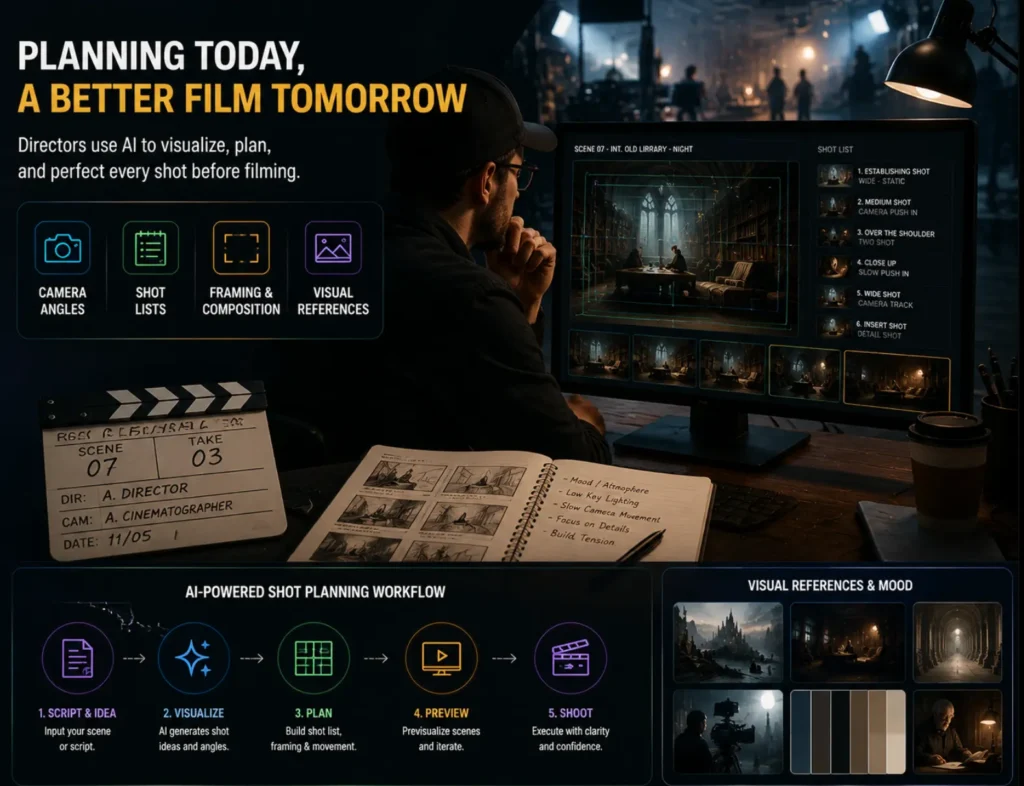
Every great film begins with careful planning. Before cameras start rolling, directors spend significant time deciding how each scene should look, feel, and move. Camera angles, framing choices, lighting, character positions, and shot transitions all play a role in shaping the final visual experience.
Traditionally, directors and cinematographers relied on storyboards, shot lists, location scouting, and previsualization techniques to plan these decisions. These tools helped teams understand how a scene would be captured before production began.
AI is now changing this process by giving filmmakers new ways to visualize and organize cinematic ideas before filming. Instead of waiting until production begins to explore different possibilities, directors can use AI-assisted workflows to test camera approaches, develop visual references, and create more detailed shot plans.
From independent filmmakers to large production teams, AI is becoming a valuable creative assistant for planning shots with greater speed and precision.
Why Shot Planning Matters Before Filming
A well-planned shot does more than capture an image. It controls how audiences experience a story.
A close-up shot can highlight emotion, a wide shot can establish scale, and a moving camera can create tension or excitement. Every framing decision influences how viewers connect with characters and understand the world of the story.
Without proper planning, filmmakers may face challenges during production, such as unclear camera direction, inefficient setups, or missed creative opportunities.
Shot planning helps directors answer important questions before filming:
- What should the audience see?
- Where should the camera be positioned?
- How should characters move within the frame?
- What visual style supports the story?
AI tools are helping directors explore these decisions earlier in the filmmaking process.
How AI Helps Directors Visualize Shots Before Production
One of the biggest advantages of AI in pre-production is the ability to quickly visualize ideas.
A director can describe a scene, provide references, or define a visual style and explore different possibilities before moving into filming. This allows creative teams to test concepts and make adjustments before production resources are involved.
For example, a director planning a dramatic dialogue scene can experiment with different camera angles, lighting styles, and compositions to understand which approach best supports the emotion of the scene.
This process works like a digital version of previsualization, helping filmmakers make stronger creative decisions before stepping onto set.
Creating Better Shot Lists With AI Assistance
Shot lists are an essential part of filmmaking because they organize the sequence of shots required for a scene.
A detailed shot list helps production teams understand camera requirements, movement, framing, and coverage needed during filming.
AI can support this process by helping directors transform scripts or ideas into structured shot plans. Instead of manually breaking down every scene from scratch, filmmakers can use AI assistance to explore possible shot variations.
A well-developed AI-assisted shot list can help identify:
- Establishing shots
- Close-ups
- Character interactions
- Camera movements
- Transition shots
This allows directors to focus more on storytelling choices while reducing repetitive planning tasks.
Using Visual References to Define Cinematic Style
Visual references have always been important in filmmaking. Directors often create mood boards and reference collections to communicate their vision to cinematographers, production designers, and creative teams.
AI is expanding this process by making visual exploration faster.
A filmmaker can experiment with different references for:
- Lighting styles
- Camera compositions
- Color palettes
- Environments
- Character positioning
For example, a director creating a futuristic film may explore different visual approaches for city landscapes, camera movements, and lighting before finalizing the production design.
These references help maintain consistency between the initial creative idea and the final filmed result.
AI-Assisted Shot Planning Workflows
AI-assisted shot planning is becoming an important part of modern filmmaking workflows because it connects creative ideas with practical production decisions.
Invideo Agent helps filmmakers approach shot planning as part of a connected creative workflow. Working with ideas, scripts, and references, it helps creators structure video projects while keeping visual direction connected across scenes.
For directors, this can be useful during previsualization when planning camera angles, scene compositions, and visual styles before production begins. Instead of treating every shot as an isolated task, creators can develop a more complete understanding of how scenes work together.
With invideo Agent Two, larger projects can benefit from improved coordination across areas such as cinematography planning, storyboarding, and visual development. This helps creative teams maintain consistency when managing complex productions with multiple scenes and detailed visual requirements.
Planning Camera Angles and Movement With AI
Camera movement and positioning are key parts of cinematic storytelling. A director needs to decide whether a scene requires a static frame, a tracking shot, a close-up, or a larger movement that reveals the environment.
AI tools are helping filmmakers explore these choices before filming.
A director can test different approaches, such as:
- A slow push-in for emotional moments
- A wide shot to establish a location
- A tracking movement during action scenes
- A changing perspective to reveal information
By experimenting before production, filmmakers can better understand which camera choices support the story.
AI and Previsualization for Complex Scenes
Complex scenes often require extensive planning. Action sequences, large environments, and multi-character scenes involve many moving parts that need to work together.
Previsualization helps directors understand how these elements will come together before filming.
AI is making previsualization more accessible by helping filmmakers create early versions of scenes, explore camera positions, and test visual ideas.
For example, a director planning a large-scale battle scene can explore environment layouts, character placement, and camera movement before building the final sequence.
This allows teams to identify creative challenges earlier and make better production decisions.
Maintaining Visual Consistency Across Multiple Shots
A major challenge in filmmaking is ensuring that every shot feels like part of the same story.
Camera style, lighting, composition, and visual direction need to remain consistent throughout a project.
AI-assisted planning helps filmmakers maintain these connections by allowing them to establish references and creative guidelines before production.
For example, a commercial campaign may require multiple product shots across different locations. Planning these visuals early helps ensure that every shot matches the same brand style and cinematic direction.
The Role of AI Models in Cinematic Shot Planning
Different AI models are improving different parts of the filmmaking process. Some focus on realistic video generation, while others help with image references, motion, or creative exploration.
For example, Google Veo 3.1 helps creators generate cinematic video sequences with improved motion and scene understanding. This can support filmmakers exploring camera movements, visual styles, and scene concepts during early production planning.
Using multiple AI capabilities allows directors to choose the right tools for different stages of the creative process, from initial ideas to final visual development.
How AI Is Changing the Director’s Workflow
AI is not replacing the creative role of directors. Instead, it is changing how they approach planning and experimentation.
Directors can now explore more ideas, compare different visual approaches, and communicate their vision more clearly with production teams.
The traditional filmmaking process often required committing to creative decisions early. AI gives filmmakers more flexibility by allowing them to test possibilities before production begins.
This creates a more efficient workflow where technology supports creative exploration rather than limiting it.
The Future of AI-Assisted Cinematic Planning
As AI filmmaking tools continue to improve, shot planning will become more interactive and detailed.
Future workflows may allow directors to move from a simple script description to complete visual plans with camera movements, framing decisions, and scene references.
This will make pre-production more accessible while giving experienced filmmakers new ways to experiment with cinematic ideas.
AI will not replace the vision behind filmmaking. Instead, it will provide directors with more tools to visualize, refine, and communicate that vision before the first camera starts recording.
Frequently Asked Questions
1. How is AI used in shot planning for films?
AI helps directors visualize scenes, test camera angles, and build shot lists before filming starts. Instead of relying only on storyboards and location scouting, filmmakers can quickly explore different framing, lighting, and movement options to see what best supports the story.
2. Does AI replace traditional previsualization methods like storyboards?
No. AI adds to these methods rather than replacing them. Storyboards, shot lists, and location scouting are still valuable, but AI tools make it faster to test ideas and compare options before committing resources to production.
3. Can AI help create a shot list from a script?
Yes. AI can help break a script down into a structured shot list, identifying elements like establishing shots, close-ups, character interactions, and camera movements. This reduces manual planning time and lets directors focus more on storytelling decisions.
4. How does AI support visual consistency across a project?
By helping filmmakers set references and creative guidelines early, AI makes it easier to keep lighting, composition, and camera style consistent across multiple shots, scenes, or even locations in a single production.
5. Is AI shot planning useful for independent filmmakers?
Yes. Independent filmmakers often have fewer resources for extensive previsualization. AI tools give them an accessible way to explore camera angles, visual references, and shot ideas without the cost of traditional previsualization processes.
6. Will AI change the director’s creative role?
AI is meant to support the director’s vision, not replace it. It gives directors more ways to experiment with ideas and communicate visual plans to their teams, while creative decisions still rest with the filmmaker.
Conclusion
Planning cinematic shots before filming is one of the most important parts of the filmmaking process. Camera angles, framing, movement, and visual references determine how audiences experience a story.
AI is transforming this stage by helping directors explore ideas faster, create stronger shot plans, and visualize complex scenes before production begins.
By combining traditional filmmaking knowledge with AI-assisted workflows, directors can make more informed creative decisions and bring their cinematic vision to life with greater control.