
If you’ve been searching for a python course in chennai, you’ve probably noticed something. Most pages read like advertisements. They tell you the institute is “the best,” list a few features, and ask you to fill a form.
That’s not what you need right now. You need a clear picture of what Python actually is, why it’s worth learning, what a good course should teach you, and how to tell a genuinely useful program from a marketing pitch. This guide is written for that purpose, as a decision-making tool, not a sales page.
By the end, you’ll know how to evaluate any python course in Chennai on its actual merits: curriculum depth, trainer quality, project work, and real placement outcomes.
Why Learn Python?
Benefits of Learning Python
Python reads almost like plain English, which shortens the learning curve for beginners. It also has a massive ecosystem of libraries, so you rarely build things from scratch, someone has usually already solved the hard part.
It’s also genuinely versatile. The same language that powers a simple automation script can also train a machine learning model or run a production web server.
Industries That Use Python
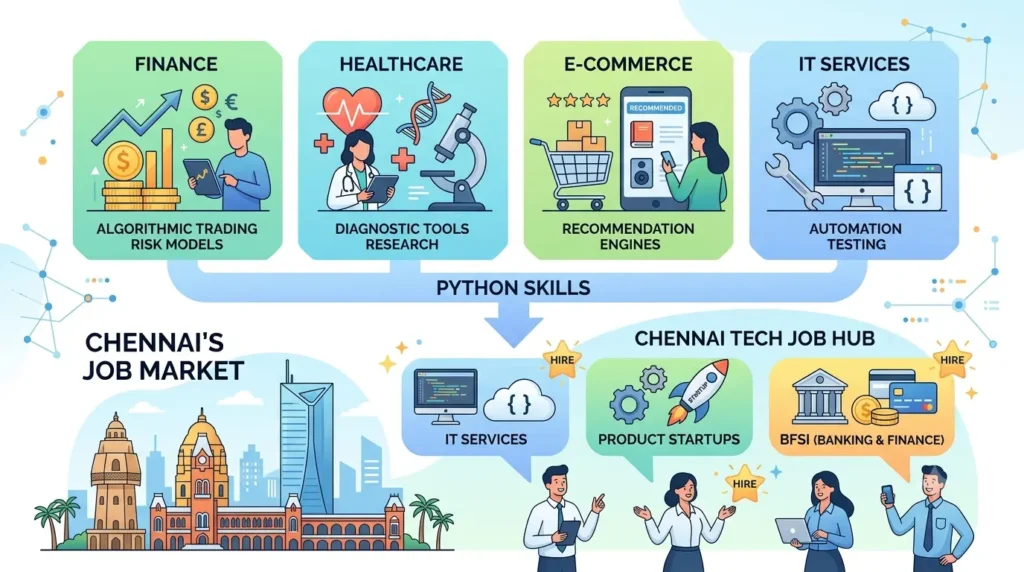
Python shows up in finance (algorithmic trading, risk models), healthcare (diagnostic tools, research), e-commerce (recommendation engines), and IT services (automation, testing). Chennai’s job market, heavy on IT services, product startups, and BFSI (banking, financial services, insurance), hires for all of these.
Why Python Is Ideal for Beginners
Unlike languages such as Java or C++, Python doesn’t force you to understand memory management or complex syntax before writing your first working program. You can build something functional, a calculator, a to-do list, a simple game, within your first week of learning.
Who Should Enroll in a Python Course?
A good python course in Chennai should serve more than one type of learner. Here’s how the fit usually breaks down.
1. Students
College students, especially in their second or third year, use Python to strengthen their core CS fundamentals and build projects for their resume before placements begin.
2. Freshers
Recent graduates without a strong coding background often start with Python because it gets them writing real code quickly, which matters when campus placements or off-campus interviews are just months away.
3. Working Professionals
Professionals from non-tech backgrounds, finance, operations, even non-IT engineering, pick up Python to move into data analysis or automation roles without starting a four-year degree over again.
4. Data Analysts
Analysts who currently work in Excel or SQL often add Python to handle larger datasets and build repeatable analysis pipelines instead of manual spreadsheet work.
5. Software Developers
Developers from other languages (Java, PHP) add Python for scripting, backend work with frameworks like Django or Flask, or to move into ML-adjacent roles.
6. Automation Engineers
QA and testing professionals use Python with tools like Selenium to automate testing, which is one of the more in-demand niche skills right now.
What Will You Learn in a Python Course?
A structured course usually moves through these building blocks in order. Skipping ahead often creates gaps that show up later in interviews.
1. Python Fundamentals
Syntax, how the interpreter runs your code, and basic input/output.
2. Variables and Data Types
Storing and working with numbers, text, lists, and other data structures.
3. Operators
Arithmetic, comparison, and logical operators used to build expressions.
4. Conditional Statements
if, elif, else logic that lets a program make decisions.
5. Loops
for and while loops for repeating tasks, the backbone of most automation scripts.
6. Functions
Reusable blocks of code, which is where most beginners start writing “real” programs instead of one-off scripts.
7. Object-Oriented Programming (OOP)
Classes and objects, a concept that trips up many beginners but is essential for interviews and larger projects. Wikipedia’s overview of OOP is a solid free reference if you want a primer before your course covers it.
8. Exception Handling
Writing code that doesn’t crash the moment something unexpected happens.
9. File Handling
Reading and writing to files, a small but frequently-tested interview topic.
10. Modules and Packages
Organizing code and using pip to install external libraries.
11. APIs
Understanding how programs talk to each other, especially REST APIs, which show up in almost every modern application.
12. Database Integration
Connecting Python to databases like MySQL or PostgreSQL to store and retrieve data.
13. Web Development
Building applications with Flask, Django, or the increasingly popular FastAPI.
14. Automation
Scripting repetitive tasks, file renaming, web scraping with BeautifulSoup, browser automation with Selenium.
15. Data Analysis
Using NumPy and Pandas to clean, transform, and analyze datasets.
16. Machine Learning Basics
An introduction to Scikit-learn and, in more advanced tracks, TensorFlow or PyTorch.
17. Final Capstone Projects
A larger project that combines several of the above skills — this is what you’ll actually show in interviews.
Python Learning Roadmap
Think of this as a rough map, not a rigid schedule. Everyone moves at a different pace.
Beginner Level
Syntax, data types, loops, functions, basic OOP. Goal: write small standalone scripts.
Intermediate Level
File handling, exception handling, modules, working with APIs, basic database connections. Goal: build a mini project end to end.
Advanced Level
Framework of choice (Flask/Django for web, Pandas/NumPy for data), version control with Git, and testing. Goal: build a portfolio-worthy project.
Job-Ready Stage
Mock interviews, data structures and algorithms practice, resume and GitHub portfolio polish, and applying what you know to real datasets or business problems.
Popular Python Libraries Every Learner Should Know
You don’t need to master all of these on day one, but you should know what each one is for.
1. NumPy
Handles numerical computation and array operations — the foundation for most data science libraries.
2. Pandas
The go-to tool for working with tabular data (think spreadsheets, but programmable).
3. Matplotlib
Basic data visualization, charts, graphs, plots.
4. Seaborn
Built on Matplotlib, but designed for more polished statistical visualizations with less code.
5. Flask
A lightweight framework for building web applications and APIs quickly.
6. Django
A more full-featured web framework, good for larger applications that need built-in admin panels, authentication, and more.
7. FastAPI
A newer framework focused on speed and modern API development, increasingly requested in job postings.
8. Scikit-learn
The standard entry point for classical machine learning (regression, classification, clustering).
9. TensorFlow
Google’s deep learning framework, used for more advanced neural network work.
Types of Python Courses Available in Chennai
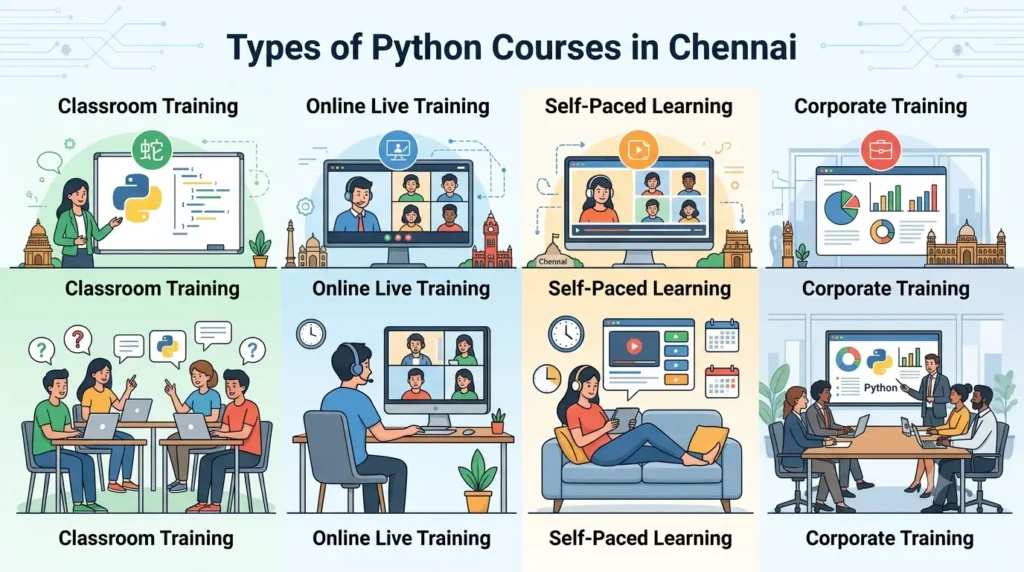
1. Classroom Training
In-person sessions, often preferred by students who want structured hours and direct access to a trainer for doubt-clearing.
2. Online Live Training
Live instructor-led sessions over video call, good middle ground between structure and flexibility.
3. Self-Paced Learning
Pre-recorded content you work through on your own schedule. Cheapest option, but requires strong self-discipline.
4. Corporate Training
Customized batches for companies upskilling their existing employees, usually focused on a specific use case (automation, data analysis, etc.).
How to Choose the Best Python Course in Chennai
This is the section most competitor blogs skip, and it’s arguably the most useful one for you.
Curriculum
Ask for the actual syllabus document, not a marketing brochure. Check whether it covers OOP, file handling, at least one framework, and a real capstone project.
Trainers
Ask about the trainer’s actual industry background. A trainer who has shipped real Python projects will explain concepts differently than one reading from slides.
Projects
Ask specifically: “What projects will I build, and can I keep the code afterward?” If the answer is vague, that’s a signal.
Placement Support
Ask for the actual placement process, is it a dedicated team, a tie-up with specific companies, or just “resume building help”? These are very different levels of support.
Certifications
Ask whether the certificate is recognized by employers or is just an internal completion certificate (more on this below).
Reviews
Check Google reviews and, importantly, look for discussions on platforms like Reddit’s r/developersIndia or Quora, where past students often give more candid feedback than on the institute’s own website.
Fees
Compare fees against what’s actually included — see the next section.
Python Course Fees in Chennai
Fees for a python course in Chennai typically range from a few thousand rupees for short self-paced programs to significantly more for comprehensive classroom or live-online programs with placement support. Exact pricing varies a lot by institute, duration, and whether specialization tracks (like ML or automation) are bundled in.
Factors Affecting Course Fees
Course duration, whether it’s classroom or online, trainer experience, batch size, and whether placement assistance is included all affect the price.
What’s Usually Included
Most reputable courses include study material, hands-on lab access, and some form of certificate. Fewer include genuine one-on-one mentorship or guaranteed interview referrals, always confirm this directly rather than assuming.
Python Course Duration
Beginner Courses
Typically a few weeks to two months for fundamentals, depending on class frequency.
Advanced Courses
Comprehensive programs covering a specialization (like data science or web development) often run three to six months.
Weekend vs Weekday Batches
Weekend batches suit working professionals and students with weekday commitments, though they naturally take longer to complete the same syllabus.
Python Certifications
Why Certification Matters
A certificate alone won’t get you a job, but it does two things: it signals commitment, and it gives recruiters a talking point in your resume screening.
Popular Python Certifications
Well-known options include the Python Institute’s PCEP and PCAP certifications, and certifications tied to broader platforms like Microsoft or Google Cloud if your course includes a cloud component. Employer-recognized, third-party certifications generally carry more weight than an institute’s internal certificate.
Career Opportunities After Learning Python
Python Developer
General-purpose development role — writing, testing, and maintaining Python applications.
Backend Developer
Building the server-side logic of web applications, often using Django or Flask.
Data Analyst
Analyzing data to support business decisions, usually combining Python with SQL and visualization tools.
Data Scientist
A more advanced role involving statistics, machine learning, and often a postgraduate-level understanding of the underlying math.
Machine Learning Engineer
Building and deploying ML models into production systems — a step beyond data science in terms of engineering depth.
Automation Engineer
Writing scripts to automate repetitive business or IT processes.
QA Automation Engineer
Using Python (often with Selenium) to automate software testing.
DevOps Engineer
Using Python for scripting within CI/CD pipelines and infrastructure automation.
Python Developer Salary in Chennai
Salary figures vary by company size, role, and specific skill stack, so treat these as general ranges rather than guarantees. For up-to-date figures, cross-check platforms like LinkedIn Salary insights or Glassdoor for Chennai-specific listings before making decisions based on any single number.
Freshers
Entry-level Python roles in Chennai generally start in the range typical of fresher IT roles in the city, with variation based on the hiring company and whether the role is a service-based or product-based company.
Mid-Level Professionals
With two to five years of experience, especially with a specialization like data science or backend development, compensation rises noticeably above fresher levels.
Experienced Developers
Senior developers, ML engineers, and architects with strong Python expertise typically command the highest packages, especially in product companies and MNCs with Chennai offices.
Factors Affecting Salary
Specialization (ML/AI pays more than general scripting), company type (product vs service), certifications, and portfolio strength all move the number meaningfully.
Real-World Python Projects for Beginners
Recruiters care more about what you’ve built than what certificate you hold. Here are project categories worth attempting.
Web Applications
A simple blog, to-do app, or portfolio site built with Flask or Django.
Automation Scripts
A script that renames files in bulk, sends automated emails, or scrapes a website for data (BeautifulSoup is great for this).
Data Analysis Dashboards
Analyze a public dataset (Kaggle has plenty) and visualize insights with Pandas and Matplotlib.
APIs
Build a small REST API using FastAPI or Flask that performs basic CRUD operations.
AI Mini Projects
A basic sentiment analyzer or image classifier using Scikit-learn — nothing too advanced, just enough to show you understand the workflow.
Common Mistakes Beginners Make While Learning Python
Watching tutorials without writing code is probably the single biggest mistake — it creates a false sense of understanding. Jumping straight into machine learning before mastering fundamentals is another common trap; you end up copying code you don’t actually understand.
Skipping practice with data structures and algorithms is a mistake that shows up later, in interviews, not during the course itself. And not using version control (Git) from the start means losing track of your own project history, a habit that’s much easier to build early than to retrofit later.
Online vs Classroom Python Course Comparison
| Factor | Online Course | Classroom Course |
|---|---|---|
| Flexibility | High — learn at your own pace/time | Fixed schedule |
| Doubt clearing | Depends on live vs recorded format | Usually immediate, in-person |
| Networking | Limited | Easier to build peer connections |
| Cost | Generally lower | Generally higher |
| Discipline required | High | Lower (structure is external) |
| Best for | Self-motivated learners, working professionals | Students who benefit from in-person accountability |
Python vs Java vs JavaScript
| Factor | Python | Java | JavaScript |
|---|---|---|---|
| Learning curve | Easiest for beginners | Steeper (more boilerplate) | Moderate |
| Primary use | Data science, automation, backend, ML | Enterprise backend, Android | Web front-end, full-stack (Node.js) |
| Typical first project | Script or data analysis | Console/enterprise app | Interactive webpage |
| Job demand in Chennai | Strong, especially data-related roles | Strong in enterprise/service companies | Strong in web development roles |
None of these languages is objectively “better” — the right choice depends on the career path you’re aiming for. If you’re unsure, Python’s gentler learning curve makes it a reasonable starting point regardless of where you end up specializing.
Best Free Resources to Practice Python
Documentation
The official Python documentation is free, thorough, and a habit worth building early — reading docs is a core developer skill.
Coding Platforms
Sites like HackerRank, LeetCode, and Codewars offer free problem sets to build coding fluency.
GitHub
Beyond hosting your code, browsing GitHub repositories of real projects teaches you a lot about how experienced developers structure their work.
YouTube Channels
Free tutorial content can supplement (not replace) structured learning, especially for revisiting a specific concept you didn’t fully grasp in class.
Tips to Become Job-Ready Faster
Build Projects
Aim for at least three solid projects that demonstrate different skills — one web app, one automation script, one data analysis project.
Create a GitHub Portfolio
Push your project code to GitHub with clear README files. Recruiters and interviewers do check this, especially at product companies.
Practice Coding Daily
Even 30 minutes a day on a coding platform keeps your problem-solving skills sharp, which matters more than most beginners expect during interviews.
Prepare for Interviews
Review core Python concepts, practice explaining your projects clearly, and be ready for basic data structures and algorithms questions — these come up even in roles that aren’t purely “developer” titles.
Frequently Asked Questions
Which is the best python course in Chennai?
There’s no single “best” course for everyone, it depends on your current skill level, career goal, and preferred learning format. Use the evaluation checklist above (curriculum, trainers, projects, placement process) rather than relying on marketing claims.
Is Python easy for beginners?n Python?
Basic fundamentals can be learned in four to eight weeks with consistent practice. Becoming job-ready with a specialization typically takes three to six months.
What is the average python course fee in Chennai?
Fees vary widely based on format and depth, from budget self-paced options to more comprehensive live or classroom programs. Always ask for an itemized breakdown of what’s included before comparing prices across institutes.
Does a python course include placement support?
Many institutes advertise this, but the actual level of support varies a lot. Ask specifically how many students got placed in the last batch and through what process, rather than accepting a general claim.
Can I learn Python without coding experience?
Yes. Python is commonly recommended as a first programming language for exactly this reason.
Which Python certification is best?
Third-party certifications (like those from the Python Institute) or platform-specific ones (AWS, Google Cloud) generally carry more recognition than an institute’s own internal certificate.
What jobs can I get after learning Python?
Roles range from Python developer and backend developer to data analyst, data scientist, ML engineer, and automation/QA engineer, depending on your specialization.
Is Python better than Java for beginners?
For most beginners, yes, mainly due to simpler syntax. Java remains valuable for enterprise and Android-specific career paths.
What projects should beginners build in Python?
Start with a simple script or to-do app, then move to a small web app, an automation script, and a basic data analysis project.
Can I learn Python online instead of attending classroom training?
Yes, and many professionals do. Online learning requires more self-discipline but offers more flexibility.
Is Python enough to get a software job?
Python alone can get you into certain roles (automation, scripting, data analysis), but broader software developer roles often expect data structures, algorithms, and at least one framework as well.
What salary can a Python developer earn in Chennai?
This varies significantly by experience level, specialization, and company type, check current listings on LinkedIn or Glassdoor for Chennai-specific, up-to-date figures rather than relying on generic averages.
Which industries hire Python developers?
IT services, product startups, BFSI, healthcare tech, e-commerce, and increasingly, traditional industries adopting data-driven decision-making.
Final Thoughts
Choosing a python course in Chennai isn’t really about finding the institute with the flashiest website. It’s about matching a curriculum and teaching style to where you actually want to end up, whether that’s web development, data science, automation, or something you haven’t decided on yet.
Before you enroll anywhere, ask for the real syllabus, talk to a few past students if you can, and get a straight answer on projects and placement support. A course that’s honest about what it offers, even if it sounds less impressive on paper, will usually serve you better than one that promises everything.
Take your time comparing options. The right python course in Chennai for you is the one that fits your starting point, your goals, and your schedule, not necessarily the one at the top of a search results page.