
Are you a student standing at the crossroads after Class 12, wondering which technology course will set you up for a rewarding career? If computers, software, and the digital world excite you, BCA: Bachelor of Computer Applications, could be the perfect stepping stone. This complete guide answers every question you have about the BCA course: what it is, who can do it, how long it takes, what subjects you study, and much more.
1. What Is BCA Course?
BCA stands for Bachelor of Computer Applications. It is a three-year undergraduate degree programme designed to provide students with a strong foundation in computer science, software development, and information technology. The course blends theoretical concepts with practical application, preparing graduates to work in the fast-growing IT industry.
BCA is equivalent in standing to a B.Sc. in Computer Science and is recognised by universities and employers across India and abroad. It bridges the gap between a pure science degree and an engineering degree, making it accessible to students from all academic backgrounds.
2. Is BCA a Good Course? Is BCA a Professional Course?
Short answer: Yes, BCA is one of the most career-oriented undergraduate programmes in the technology domain.
BCA is considered a professional course by most Indian universities and regulatory bodies. Here is why it stands out:
- Industry-relevant curriculum updated to match current IT trends
- Direct entry into the IT sector after graduation
- Gateway to top postgraduate programmes like MCA and MBA (IT)
- Globally applicable skills in programming, database management, and networking
- Shorter and more affordable path to a tech career compared to B.Tech
Whether BCA is classified as a “professional” course depends on the university awarding the degree, but its curriculum and career outcomes are firmly professional in nature.
3. BCA Course After 12th, Eligibility
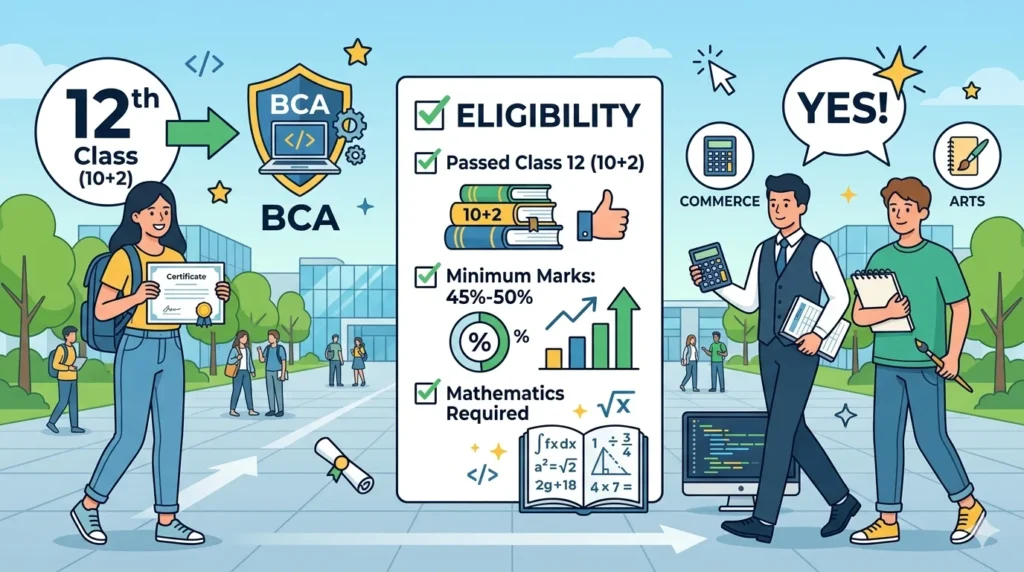
BCA is a popular choice immediately after Class 12. Here is who is eligible:
Basic Eligibility
- Passed Class 12 (10+2) from any recognised board
- Minimum aggregate marks: 45%–50% (varies by university)
- Mathematics as a subject in Class 12 is mandatory in many universities
Can Commerce Students Do BCA?
Yes! Many universities allow commerce students to apply for BCA, provided they have Mathematics or Business Mathematics in Class 12. Some universities also accept students from arts streams if they have basic computer knowledge. Always check the specific eligibility of the university you are targeting.
4. How Many Years Is BCA Course?
BCA is a three-year undergraduate programme, divided into 6 semesters (2 semesters per year). Each semester typically lasts 6 months and includes coursework, practicals, and internal assessments.
| Year | Semesters | Focus Area |
| Year 1 | Sem 1 & 2 | Fundamentals of computers, mathematics, C programming |
| Year 2 | Sem 3 & 4 | Data structures, OOP, web development, DBMS |
| Year 3 | Sem 5 & 6 | Advanced topics, electives, project work |
5. BCA Course Subjects, Complete Syllabus
The BCA syllabus covers a wide range of subjects spanning programming, mathematics, management, and emerging technologies. While the exact syllabus varies between universities, the core subjects remain largely consistent.
BCA Course Subjects: 1st Year (Semester 1 & 2)
- Introduction to Computer Applications
- C Programming Language
- Mathematics I (Calculus, Discrete Mathematics)
- Digital Electronics and Computer Organisation
- Communication Skills / English
- Principles of Management
- Visual Basic / Fundamentals of IT
Here is a complete semester-wise overview of common BCA subjects:
| Semester | Subjects |
| Sem 1 | Computer Fundamentals, C Programming, Mathematics I, Digital Electronics, English Communication |
| Sem 2 | Data Structures, OOP with C++, Mathematics II, Operating Systems, Visual Programming |
| Sem 3 | Database Management Systems, Java Programming, Computer Networks, Software Engineering, Web Technology |
| Sem 4 | Advanced Java, Computer Graphics, System Analysis & Design, Elective I, Mini Project |
| Sem 5 | Python Programming, Cloud Computing, Mobile Application Development, Elective II, Internship |
| Sem 6 | Artificial Intelligence, Cyber Security Fundamentals, Project Work, Elective III, Viva Voce |
6. BCA Course Books
Students across most BCA programmes use the following standard textbooks:
- C Programming: Let Us C by Yashavant Kanetkar
- Data Structures: Data Structures Using C by Reema Thareja
- DBMS: Database System Concepts by Silberschatz, Korth & Sudarshan
- Java: Head First Java by Kathy Sierra & Bert Bates
- Computer Networks: Computer Networks by Andrew S. Tanenbaum
- Operating Systems: Operating System Concepts by Silberschatz (“Dinosaur Book”)
- Mathematics: Discrete Mathematics by Kenneth Rosen
In addition to these, your university will recommend institution-specific study material for each semester.
7. Types of BCA Courses
BCA is offered in several formats to suit different learner needs:
Regular BCA
The standard 3-year full-time degree offered by most colleges and universities. Ideal for students who want classroom learning, lab access, and campus placements.
BCA with Specialisations
Many universities now offer BCA with focus areas such as:
- BCA in Computer Science
- BCA in Information Technology
- BCA in Data Science and Analytics
- BCA in Artificial Intelligence and Machine Learning
- BCA in Cloud Computing
- BCA Cyber Security, See Section 8 below
Online BCA
Offered by universities such as IGNOU, Manipal Online, and Amity Online, an online BCA allows working professionals and distance learners to earn the same degree at their own pace.
BCA–MCA Integrated Course
Several universities offer a 5-year BCA + MCA integrated programme, combining both undergraduate and postgraduate study in one continuous course. This saves one year compared to doing BCA and MCA separately, and provides a seamless academic journey.
- Total duration: 5 years (10 semesters)
- Eligibility: Class 12 pass with Mathematics
- On completion: Equivalent to BCA + MCA
- Offered by: SRM, Amity, Jain University, and others
8. BCA Cyber Security : Specialisation Details

With cybercrime on the rise globally, BCA with a Cyber Security specialisation has emerged as one of the most in-demand programmes. It prepares students for roles in ethical hacking, digital forensics, network security, and information security management.
Key Subjects in BCA Cyber Security
- Network Security and Cryptography
- Ethical Hacking and Penetration Testing
- Digital Forensics
- Information Security Management
- Malware Analysis
- Cloud Security
Career Scope After BCA Cyber Security
- Ethical Hacker / Penetration Tester
- Security Operations Centre (SOC) Analyst
- Information Security Analyst
- Cyber Forensic Investigator
- Network Security Engineer
Top recruiters for cyber security graduates include TCS, Infosys, IBM, KPMG, and government organisations like CERT-In and the National Informatics Centre (NIC).
9. BCA Benefits – Why Choose BCA?
Choosing BCA over other courses offers several tangible advantages:
- : BCA is significantly more affordable than B.Tech or B.E. programmes.Affordable fees
- : Science, Commerce, and Arts students with Mathematics can apply.Open eligibility
- : Programming, database, web, and network skills are taught from Year 1.Industry-ready skills
- : IT sector hires BCA graduates in software development, QA, support, and analytics.Wide job market
- : BCA is the natural precursor to MCA and MBA (IT/Systems).MCA / MBA pathway
- : Equips you to build apps, websites, or start your own tech venture.Entrepreneurship
10. BCA vs B.Tech
| Factor | BCA | B.Tech (CSE) |
| Duration | 3 years | 4 years |
| Eligibility | Any stream with Maths | Science with PCM |
| Avg. Fees | ₹50,000 – ₹2,00,000 | ₹3,00,000 – ₹12,00,000 |
| Focus | Applications & Software | Engineering & Core CS |
| PG Option | MCA / MBA | M.Tech / MBA |
| Job Roles | Developer, Analyst, Support | Engineer, Architect, DevOps |
11. Frequently Asked Questions About BCA
Can a commerce student do BCA after 12th?
Yes, provided the student has Mathematics or Business Mathematics in Class 12. Many universities across India actively welcome commerce students into BCA programmes.
Is BCA equivalent to B.Tech?
BCA and B.Tech are different degrees. BCA is a 3-year programme focused on computer applications, while B.Tech is a 4-year engineering degree. However, after completing MCA post-BCA, graduates are considered equivalent to B.Tech graduates by many employers, including the government.
Is BCA a professional course or not?
BCA is widely regarded as a professional undergraduate course in the technology domain. It equips students with job-ready skills in software development, IT, and computer applications. Some autonomous universities officially classify it as a professional degree.
What is the BCA–MCA integrated course?
It is a 5-year combined programme that covers both BCA and MCA content without the need to separately apply for MCA admission. Students save time and gain a master’s-level qualification in 5 years instead of the usual 6.
Who can do BCA?
Any student who has passed Class 12 from a recognised board with at least 45–50% aggregate marks is eligible. Mathematics in Class 12 is required by most universities. Students from Science, Commerce, and some Arts streams (with Mathematics) can apply.
Conclusion
BCA is a versatile, industry-aligned, and affordable undergraduate programme that opens the doors to a thriving career in the IT sector. Whether you are a science student passionate about coding, a commerce student looking to pivot into technology, or someone interested in specialised domains like cyber security or data science, BCA has a pathway for you.
From its comprehensive syllabus covering programming, databases, networks, and emerging technologies to its multiple formats including full-time, online, and the convenient BCA–MCA integrated course, BCA remains one of the best choices for technology education after Class 12.