
Information is moving at lightening speed in this digital age. News comes and goes in seconds, social media trends come and go in minutes and global conversations happen in real time. It is essential for businesses, investors, and analysts to stay up to date on this stream of information. This is where media monitoring software comes in handy. Media Monitoring software Is Built for High-Speed Data Intelligence provides insight into the design of modern systems that can capture, process, and analyze vast amounts of data in near real-time.
Media monitoring software can be used to monitor mentions, headlines, articles and conversations across various digital channels. It converts unstructured content into structured insights that can be utilized for decision-making by organizations. The main difficulty is speed. These systems need to handle thousands of data points per second without compromising accuracy or relevance.
The need for high-speed data intelligence.
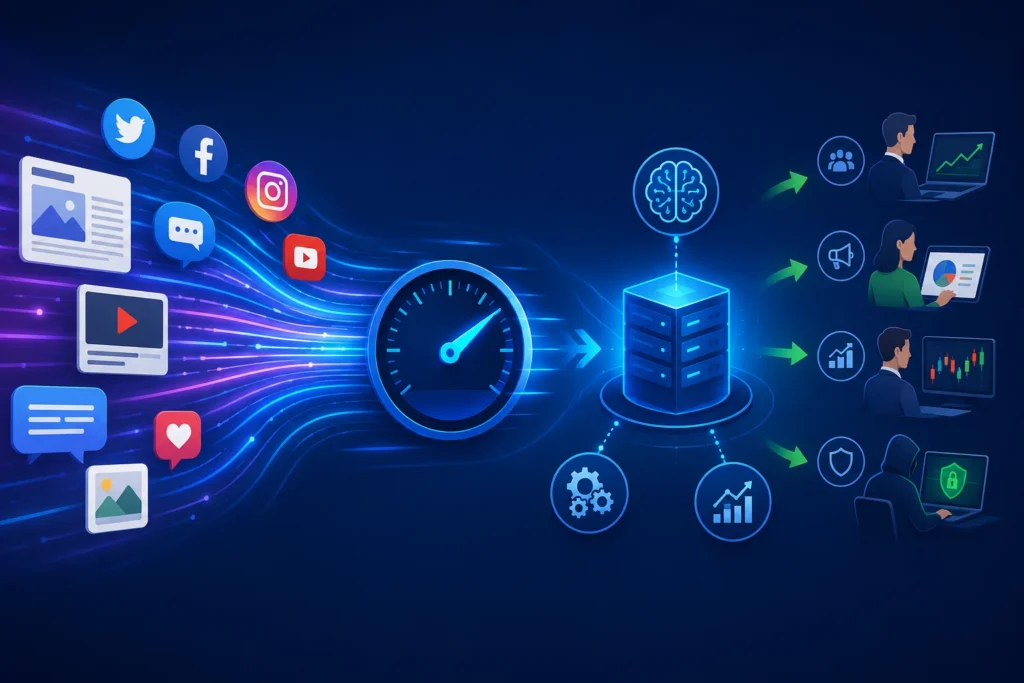
The world of digital communication has revolutionized the way information is disseminated. One news headline or social media post can go viral in seconds, impacting public opinion, financial markets, and brand reputation.
The traditional monitoring methods are not fast enough for this environment. The information could be outdated by the time manual analysis is done.
High-speed data intelligence addresses this issue by allowing for the real-time collection and processing of data. Media monitoring software will make sure that users are updated as soon as an event happens, so they can react quickly.
This is particularly crucial for sectors like finance, marketing, public relations, and cybersecurity.
The development of Media Monitoring Software for high-speed data intelligence.The construction of Media Monitoring Software for high-speed data intelligence.
Media monitoring software is created with a blend of advanced technologies that collaborate to process data effectively. The system is built on data ingestion engines, real-time processing frameworks, and intelligent analysis models.
Media Monitoring Software Is Built for High-Speed Data Intelligence
Data ingestion systems are designed to pull data from news sites, blogs, forums, social media, and other online sources. These systems are designed to handle large volumes of incoming data simultaneously.
The data is then fed into real-time data processing pipelines. These pipelines clean, structure and organize information for rapid analysis.
Last but not least, AI models analyze the content to derive meaning, gauge sentiment, and identify trends.
The multi-layered structure guarantees a seamless data flow from collection to insights, eliminating delays.
Real-Time Data Collection Systems
The backbone of media monitoring software is the real-time data collection feature. This is done by using web crawlers, APIs, and streaming data connections.
Web crawlers are used to regularly check for new content on websites, and APIs offer direct access to structured data feeds. Social media streaming systems record posts and updates as they are created.
These technologies are designed to complement each other to guarantee that no significant information is overlooked. The system runs around the clock and continually adds new data to its pool.
The speed at which this is done is essential, as any delay could affect the accuracy of real-time insights.
Stream Processing for Instant Analysis
After collecting data, it needs to be processed right away. Media monitoring systems can use stream processing technology to process data as it comes in, without the need to store it for later analysis.
This helps to minimize latency and allows for immediate generation of insights. As soon as a news article or social media post is detected, it is processed through algorithms that extract key information.
Stream processing frameworks are optimized to process large volumes of data efficiently, making them suitable for high-speed environments.
This feature allows users to get alerts and updates as soon as an event happens.
Artificial Intelligence and Natural Language Processing.
AI is a key element in converting raw data into valuable intelligence. Natural language processing enables systems to comprehend human language, such as news articles, headlines, and social media posts.
AI models can be used to extract information from text, including identifying entities like companies, people, products, and locations. They also analyse sentiment, whether positive, negative or neutral.
For instance, if the news is about strong earnings, it can be considered positive, and if it’s about financial losses, it can be considered negative.
This automated interpretation enables media monitoring software to grasp context at scale, which would be difficult to do manually in real time.
Scalability and Distributed Architecture
The emphasis is on distributed architecture and scalability.
For high-speed data intelligence, systems must be scalable. Media monitoring software is frequently developed with distributed architectures, which enable multiple servers to work on data at the same time.
This guarantees the stability and responsiveness of the system even during heavy traffic. Data is split up into smaller streams and processed in parallel, which greatly enhances speed and efficiency.
The amount of digital content in the world is growing rapidly, so scalability is crucial. Real-time processing would not be possible without distributed systems.
Alarms and notifications in real-time.
Real-time alerts are one of the most crucial aspects of media monitoring software. If important events are identified, the system alerts users immediately.
These alerts can be set up for sudden increases in mentions, breaking news stories or sentiment changes. The aim is to keep users informed of significant developments at all times.
Real-time notifications enable businesses to react swiftly to crises, marketing opportunities, or market changes.
Data Filtering and Noise Reduction.
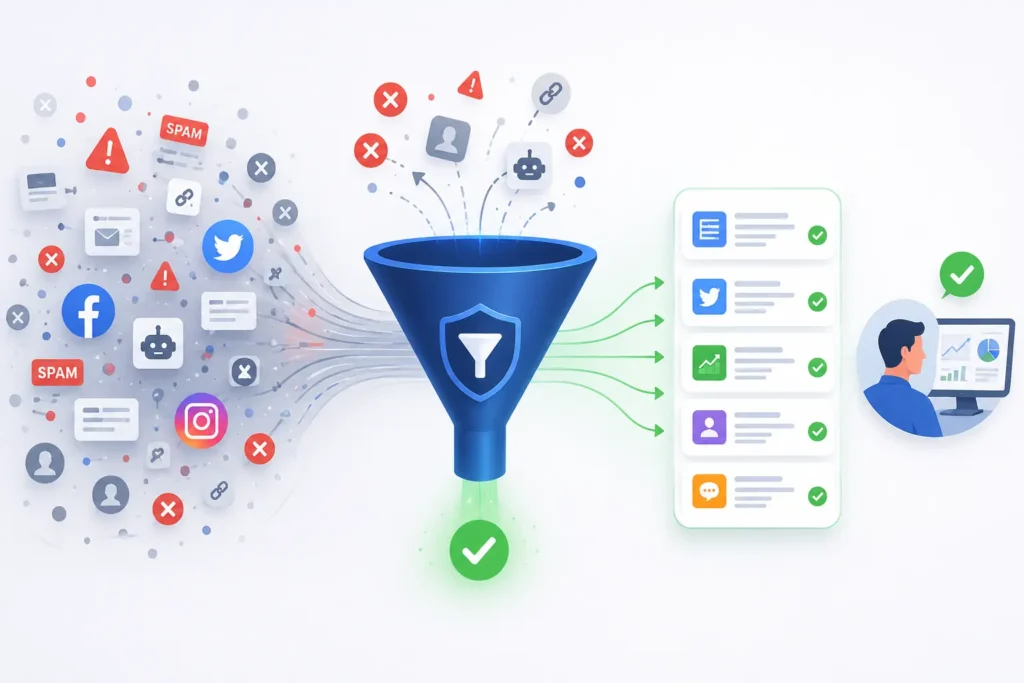
Not everything is of equal importance. Filtering out irrelevant or low quality data is one of the biggest challenges in media monitoring.
Spam, duplicate content and irrelevant mentions are eliminated using advanced algorithms. This means that only relevant information is transmitted through the system.
Noise reduction is critical to accuracy and to not overwhelming the information. Otherwise, users may be inundated with irrelevant information.
The problems of High-Speed Media Monitoring.
Building high speed media monitoring software with advanced technology is not without its challenges. There is one big problem with data accuracy. Information provided in real-time may at times be incomplete or incorrect at the time of publication.
The other difficulty is system overload. In times of large-scale events, the amount of data can increase significantly, straining processing systems.
Consistency, speed and accuracy are all important and must be maintained at the same time, which means continuous optimization and strong infrastructure.
The Future of High-Speed Media Intelligence
As AI and automation technologies evolve, the future of media monitoring software looks promising. Systems will be even faster, more predictive, and more context-aware.
Future platforms will not just report what is happening, but also make predictions about what is likely to occur next, based on data patterns. The integration with the wider AI ecosystems will enable even more insights across industries.
With the continuous advancement of technology, businesses in the digital age will increasingly demand high-speed data intelligence.
Conclusion
Media monitoring software is designed to manage one of the most difficult tasks in the digital age: the processing of a huge amount of information in real time. These platforms integrate data ingestion, stream processing, AI, and scalable architecture to provide high-speed data intelligence for faster and smarter decision-making.
From real-time alerts and sentiment analysis to distributed processing and noise reduction, every component is designed for speed and accuracy. Media monitoring software will become even more vital for organizations to keep informed and responsive in an always-on world as digital information continues to expand.